
By Savvas Bout, Founder of Prefixx. Last updated 2 October 2026.
The advertised price per IP address for an IP address block is typically only one component of the total price, with additional variables including the size of the IP address block being purchased. The RIR that manages the IP address space, the buyer’s reputation, and whether the addresses are being purchased outright or leased. The jurisdiction in which the buyer intends to operate can also influence pricing, as different regions impose varying compliance and documentation requirements.
Importantly, the price to purchase a /24 from ARIN may not be the same as the price to purchase an identical block of IP addresses from RIPE NCC. Neither ARIN nor RIPE NCC publicly discloses the prices at which IP addresses are sold. Organizations that operate within multiple RIR jurisdictions must navigate these pricing differences when planning their address acquisitions across regions.
For network engineers and for the infrastructure leads of companies, buying IPv4 addresses in the secondary market is opaque. To pay too much for a 'polluted' block (or /8) can lead to it being listed on blacklists almost immediately.
Conversely, buying a block for far less than its true worth and then having that lease pulled could be disastrous for any in-flight development. Understanding the true market value protects customers from overpaying for assets that may require expensive remediation or from entering agreements that lack long-term stability.
We cover issues such as demand, transfer fees, rent vs buy, and lastly quality control to ensure one pays full price for poor quality IP addresses. Buyers who understand these factors can better evaluate whether the pricing they encounter reflects genuine market conditions or simply attempts to exploit less-informed customers.
What determines the cost of an IP address block
There are four variables which will influence the cost of an IP block in the secondary market. These need to be understood before any deal is opened.
Block size and how to buy IP addresses for your pool
All 4.3 billion IPv4 addresses have been allocated. The five Regional Internet Registries (RIRs) have exhausted their free pools of IPv4 addresses between 2011 and 2020. All subsequent transactions of IPv4 address space take place on the secondary market and are traded in blocks.
The price of a block of IP addresses is directly proportional to the size of the block. So a /24 with 256 addresses will cost less than a /20 with (4,096 addresses) but you get a lower price per IP address as the block size increases. A /16 block will command a significant premium over smaller blocks of IP addresses. For community perspectives, see Lifetime Static IP? : r/Windscribe.
RIR region, IPv4 address space value, and purchase agreement
The price for a /24 under ARIN can be vastly different from the same size block listed under RIPE NCC for trade in the same month. The demand, transfer rules and local scarcity all vary greatly. These numbers are never published in any official reports.
Address history, IP reputation, and lease vs. Buy
A block’s past history matters greatly. A clean address history commands a higher premium as buyers seek to avoid costs of future remediation. Buyers who understand this dynamic can negotiate more effectively, while sellers with pristine records can justify premium pricing to prospective customers.
Whether you buy or lease IP addresses changes more than just cost structure.
We run Tixx quality checks on every subnet our consultants list on behalf of sellers, covering key aspects of the block such as size, region, expected growth potential, seller reputation and deal terms. The same variables are weighed differently in a block on a different registry, explaining price divergence between similar blocks. Buyers should carefully review commercial terms to ensure alignment with their operational requirements and budget constraints.
How block size and registry region move market prices
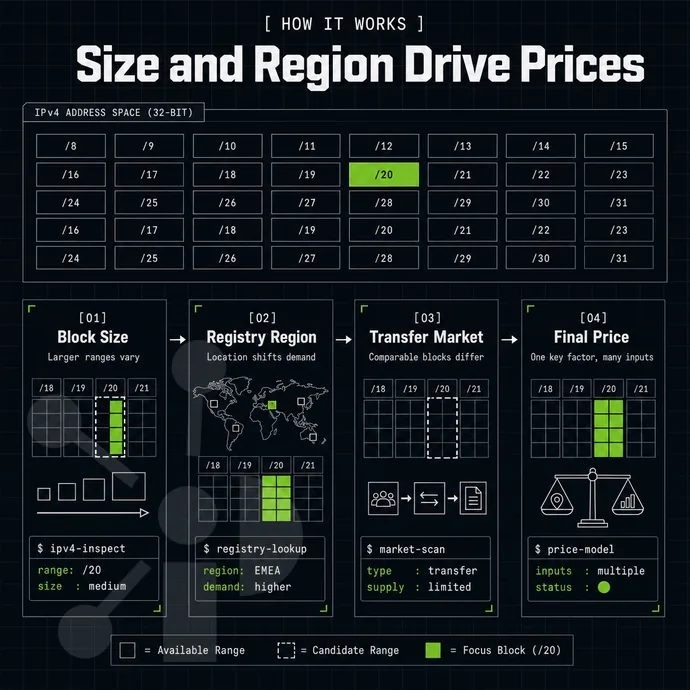
Two identical sized blocks can have completely different price tags depending on where they are in the world.
Block size and per-ip rate
For instance, a /24 is worth more than minimum routable network size (MNRS), the price that a buyer or service provider pays for IP addresses in addition to address space, to a routable block of a /20 size, where the premium of the /24 is spread over more IP addresses thus lowering the per-IP price. Economies of scale mean that larger blocks typically offer better per-address pricing than smaller allocations of the same quality.
Registry status region and price divergence
A /24 subnet assigned by ARIN will generally trade at a different price than an identically sized block of IP numbers assigned by RIPE NCC, even though neither organization discloses any data on IP trades. Organizations that lease IPv4 space often find that pricing varies by registry due to differences in transfer policies and documentation requirements.
In North America, the price of IP will be influenced by the resource relationship between demand for IP there, the volume of IP trades in Europe, and the amount of IP held by each of the RIRs in Asia, Latin America, and Africa (i.e. APNIC, LACNIC, and AFRINIC). Organizations that operate across multiple regions must account for these regional pricing dynamics when planning their IP acquisition strategy.
| Registry | Transfer procedures | Typical timeline | Key pricing factor |
|---|---|---|---|
| ARIN | RSA or LRSA required; 8.3 or 8.4 policy | 2-4 weeks | High demand, limited supply |
| RIPE NCC | Member agreement; LIR sponsorship if needed | 1-2 weeks | Liquid market, active secondary trading |
| APNIC | Membership required; needs accurate records | 2-3 weeks | Growing demand across Asia-Pacific |
| LACNIC | Facilitated; registry state must be clean | Variable | Smaller pool, emerging demand |
| AFRINIC | Applicable registry framework under review | Variable | Limited secondary market activity |
What network services mean for buyers
Whether a domain is registered in.com,.net,.org,.info or.pro space, every resource holder needs to check which registry is responsible for the respective block of domain names before entering into negotiations. Registry staff review documentation from prospective buyers to verify that customers meet policy requirements before approving any transfer request.
The respective registry framework determines whether a transfer is eligible and when it will take place. Registry policies also govern which parties have the right to request or approve access to transfer documentation during the approval workflow.
Hidden costs beyond the per-ip price
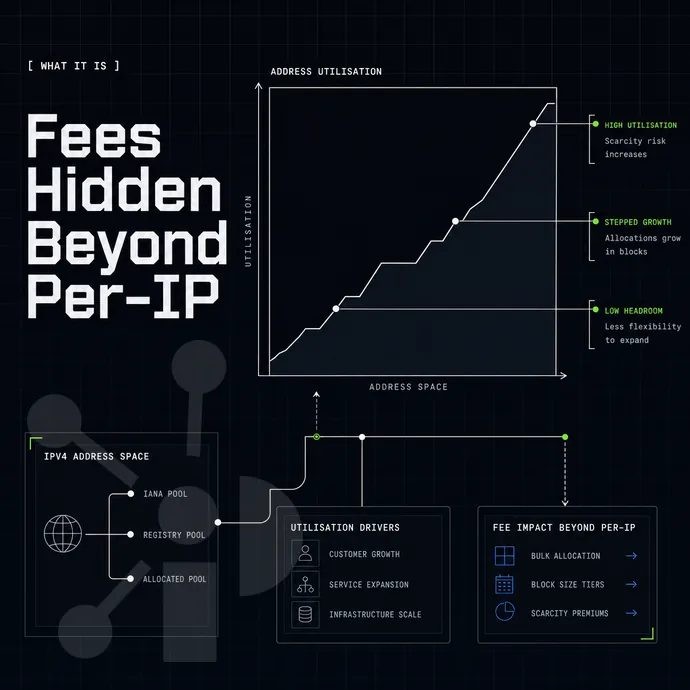
The operational costs associated with a commercial transaction that a buyer or lessee failed to factor in can greatly affect the bottom line of a transaction. Each service provider involved in the transaction may impose separate handling or administrative charges that compound quickly across multiple parties.
Reverse DNS transfer and administrative fees
RIR transfer fees vary per registry and per block size, broker commission rates vary per seller and are listed as a separate line item. Prefixx charges a 3-8% commission on seller transactions, with smaller block sizes charged at the higher end of the rate range. Buyers should clarify all fee structures upfront to avoid surprises, as transparency in pricing helps customers budget accurately for their acquisition.
LOA preparation, RPKI ROA signing, and IRR route object maintenance are typically undetectable until something breaks. We handle these as part of our white-glove service, so you won’t be surprised by any additional paperwork costs.
Routing and underlying resource relationship reputation remediation
The history of a block can be crucial to an operator. They may inherit old BGP announcements, IRR objects and even open abuse reports from previous operators that need to be cleaned up. A mail system’s address history can be particularly sensitive, with a single listing on the Spamhaus ZEN list for example able to block the outbound email of thousands of users. Organizations running mail systems must verify that acquired addresses have no prior spam or abuse associations that could impair deliverability.
Prefixx runs Tixx quality control on every Prefixx block before sale or lease. The check includes blacklists, basic routing sanity and RIR sanity. Modern network operations and security systems depend on accurate blacklist and routing data to maintain service reliability.
Operational responsibility: DNS, geolocation, and cloud comparison
Reverse DNS often is forgotten. As long as no valid PTR records exist for a hostname, incoming firewall rules might silently drop packets and in case of abuse it becomes hard to handle as there is no valid contact anymore. Prefixx manages reverse DNS delegation as well as PTR records for single hosts on the client area of the Prefixx Portal. Organizations often maintain customer allowlists based on reverse DNS validation, making proper PTR configuration essential for service delivery.
Prefixx provides a daily geofeed according to RFC 8805 to help correct geolocation information quickly. Working with a trusted provider ensures that geolocation data remains accurate and that any discrepancies are resolved promptly through proper registry channels.
For comparison, under a similar operating model, cloud public IPv4 addresses are charged like Elastic IPs by AWS (i.e., per IP when unattached), static external IPs by GCP that are not in use (i.e., charged for in $/hr), and idle public IPs by Azure (i.e., charged for in $/hr). Organizations evaluating these cloud pricing models often compare them against the economics of acquiring their own IPv4 addresses through the secondary market.
Owned/leased space for steady-state workloads is likely to be more cost-effective than paid public IP space even after the initial transfer. But the cost of the transfer itself, and the timeline and fees of the transfer process, is also an important factor to consider.
Organizations must also evaluate whether their cloud provider offers sufficient flexibility to accommodate owned IP space or whether leased addresses remain the only viable option. Deciding whether to lease IPv4 addresses or purchase them outright depends on how long the organization expects to require the resources and whether future scalability is anticipated.
Leasing IPv4 addresses: when it makes more sense than buying
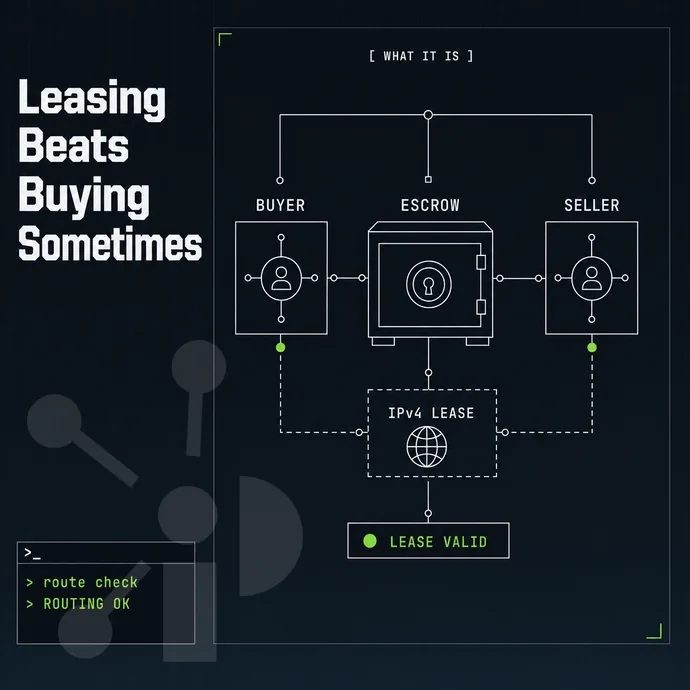
Buying a block is best suited for long-term and stable network requirements. Leasing is suitable for short-term projects, test environments and companies whose operational requirements, including IP reputation management, are still evolving and want to avoid a large upfront investment while growth is still unknown.
Organizations must carefully evaluate their infrastructure roadmap and growth projections to decide which acquisition model aligns with their operational and financial constraints. Companies that lease IPv4 space retain the flexibility to scale their address footprint up or down as demand shifts without committing capital to permanent ownership.
What a lease ends guarantee operationally
A full LOA, complete RPKI ROA (Route Origin Authorization) and all corresponding IRR route objects are provided for every lease by our team. Reverse DNS, IP Rep and Blacklist monitoring services are also included in our white-glove service. Our system relies on your IP addresses being routed for the full term of the lease. Your Prefixx lease is provisioned within 24 hours of ordering. Clients can select a lease term that aligns with their project timeline and infrastructure planning needs.
Lease vs. Buy IP addresses: decision dimensions
| Factor | Lease | Buy |
|---|---|---|
| Capital outlay | None; predictable monthly cost | Full market price upfront |
| Intended use | Short-term, testing, uncertain scale | Permanent, stable infrastructure |
| Exit plan | Let the lease end; notice period applies | Sell on the secondary market |
| Registry relationship | Operational arrangement only | Full RIR registration in your name |
| Acceptable use requirements | Governed by lease agreement | Governed by RIR policy |
When to choose each operating arrangement
Lease for speed, flexibility or to run operations on a short-term basis. Buy for a full registry relationship as a long-term asset. Tixx vets every block of domains before they are made available to lease or buy and escrow is used to secure all domain purchases. Working with an experienced provider ensures that both lease and purchase transactions are structured to meet the specific operational and compliance requirements of the acquiring organization.
Why choose Prefixx for buying, selling or leasing an IPv4 block
Whether you want to buy IP addresses, lease IPv4 space, or sell a block you no longer need, the cost of an IP range and the quality of the transition workflow matter equally. Prefixx is a registered broker with ARIN, RIPE NCC and APNIC. Our team handles every commercial transaction end to end, from registry record verification through successful transfer.
- Zero buyer fees. Sellers pay a 3 to 8% commission on a no-win, no-fee basis. Buyers pay nothing extra.
- Tixx quality control on every block. OwnershIP, address reputation, routing history and registry state are checked before any block reaches a buyer.
- White-glove service included with every lease. Our team manages reverse DNS, monitors abuse reports, corrects geolocation and handles abuse handling on your behalf.
- Non-revocation lease guarantee. Provisioning within 24 hours. Accurate records and LOA, RPKI ROA and IRR objects prepared by our consultants.
- Escrow-secured transactions. Funds are held in escrow until transfer procedures are confirmed complete, reducing operational risk for both sides.
For pricing guidance or to compare lease and purchase options, visit Prefixx.net/IPv4-pricing or Prefixx.net/lease-IPv4-addresses. Reach out to our consultants to discuss your network requirements and get a personalized offer.
Frequently asked questions about operational responsibility
What do mail providers pay for an IPv4 block used as an exit plan?
A /24 under ARIN and an identically sized block under RIPE NCC can trade at noticeably different rates in the same month, and neither number appears in any official registry. Block size, RIR region, routing record, and reputation all move the figure. Organizations that operate infrastructure across multiple RIR regions must account for these regional pricing variations when planning their IP address acquisitions.
How do IP address blocks work in mail systems?
An IP address range is a contiguous range of IPv4 addresses allocated in powers of two and expressed in CIDR notation, such as /24 (256 addresses) or /16 (65,536 addresses). The five Regional Internet Registries (ARIN, RIPE NCC, APNIC, LACNIC, AFRINIC) track ownership and maintain the authoritative records. These registries operate independently but follow coordinated policies to ensure global IP address uniqueness and proper allocation.
When a block changes hands, the receiving party registers the transfer with the relevant RIR and updates routing records (RPKI ROA, IRR route objects) so the addresses are reachable on the public internet. Proper registration ensures that the addresses will announce correctly when the receiving party configures them on their new network.
Is it worth paying for a static IP?
For most production workloads, yes. A static IP lets you anchor DNS records, SSL certificates, RPKI ROAs, and packet filter rules to a fixed address that never changes without notice. Dynamic addresses create operational risk: a reassignment can break services, invalidate reputation history, or strand mail delivery. If your workload runs anything customer-facing or requires consistent routing, the cost of a static IP is almost always justified.
How much does a static IP cost through a cloud provider?
Cloud providers charge per Elastic IP or equivalent reserved address, and the fee structure for intended use typically penalizes addresses that are allocated but not actively attached to a running instance. AWS, GCP, Azure, and OCI all publish their current per-address rates on their pricing pages. Those per-IP costs accumulate quickly at scale, which is one reason organizations with large address needs often bring their own IP space (BYOIP) rather than renting addresses from the cloud platform.
IPv4 leasing vs buying an IPv4 block: what is the difference?
Buying transfers full RIR ownership to you: the block appears in your name in the registry, you control it indefinitely, and you can resell it later. Leasing gives you routing rights for a defined term without an ownership transfer, which means lower upfront cost but no asset on your balance sheet and no resale value. Organizations that purchase addresses gain the ability to announce them through their own network infrastructure and maintain full routing autonomy.
Leases suit short-term capacity needs or budget-constrained growth; buying suits organizations that want a permanent, appreciating network asset. Prefixx offers both, with white-glove routing paperwork and a non-revocation guarantee on every lease. Organizations that require immediate connectivity can secure leased addresses and gain network access within days rather than waiting weeks for a completed transfer.
What hidden fees should I expect when buying an IPv4 block?
The main cost categories beyond the block price are RIR transfer fees (each registry publishes its own schedule), escrow service fees, and any post-transfer work such as RPKI ROA setup, IRR updates, or geolocation correction. Prefixx charges zero buyer fees and handles the LOA, RPKI ROA, and IRR route objects as part of the deal, so the transfer paperwork is not an add-on.
How long does an IPv4 block transfer take?
Timeline varies by RIR and deal complexity. ARIN, RIPE NCC, and APNIC each have their own review and approval windows, and inter-RIR transfers add coordination steps between registries. Having clean documentation ready before submission, including a finalized transfer agreement and accurate WHOIS data, is the single biggest factor in avoiding delays. A broker with registered status at the relevant RIRs can prepare and submit paperwork correctly the first time, which reduces back-and-forth with the registry.
Factors that influence pricing per IP greatly include the size of the IP block, the IP registry’s location (i.e. within the ARIN, RIPE NCC, APNIC etc. regions), the buyer’s reputation, and whether the party is purchasing IP addresses for sale outright or leasing them.
The same sized clean /24 can be quoted at very different pricing per IPv4 addresses block over any defined period, with identical blocks registered under ARIN and identically sized blocks registered under the RIPE NCC serving as a clear example.
Note that the sticker price quoted is only a part of the true cost of acquiring the domain. Transfer fees, RIR process ing time, routing domain name paperwork, as well as costs of any reputation remediation needed to acquire the domain all need to be factored into the cost to the buyer. And skipping due diligence on these layers will cost the buyer twice.
If you are ready to move from research to numbers, Prefixx works on a zero buyer-fee model. Every block goes through Tixx quality control before it reaches you, and the team handles the LOA, RPKI ROA, and IRR objects end to end. Contact Prefixx to get a personalized offer on the block size and registry region you need.
Contact us to discuss your IPv4 needs today
No hidden fees, free consult. A broker replies within one business day.