

By Savvas Bout, Founder of Prefixx. Last updated 4 September 2026.
Every time you need to buy a static IP address, you hit a brick wall: unclear pricing, unknown history and tons of red tape for transferring IP addresses. If you are a network engineer responsible for BGP routing, a reputation-sensitive mail server that relies on a dedicated IP add on, or even a BYOIP setup on a cloud platform. Then a clean block of IP addresses with a good history and clear ownership is not enough, it is the minimum required.
The secondary market is the only option to acquire IPv4 addresses these days. Due to the closure of the free pools of the five regional registries between 2011 and 2020, every dedicated IPs acquisition today comes with a history attached, and thus must be scrutinized. There are blacklists, hijacked prefixes and disputed ownership of dedicated IPs that differ from a private IP address setup, so it is a real operational risk if due diligence is not conducted.
This article explains what to verify before committing to a block of IP addresses, how IP address transfers work for ARIN, RIPE NCC, APNIC, and LACNIC, what the lease-versus-buy decision for dedicated IPs actually turns on, and where quality control separates a smooth deployment from a months-long remediation project.
First, we start with the basics: what is a static IP address and how does it differ from the typical dynamic IP address that most connections receive by default.
What is a static IP address and how it differs from a dynamic IP
A static IP address is given to a single device or account and is set up to not change for any given sessions, unlike the majority of set up internet connections that are left to default.
How dynamic IP addresses work with dynamic DNS
A dynamic address is handed out from a shared pool, and it can change whenever the lease expires or the connection drops.
Mailing servers, VPN gateways, and payment processing servers that frequently change their public IP addresses create unnecessary friction, allow lists break, and rules for remote access need constant updates.
What a fixed IP address gives you
A fixed IP address means your endpoint will always come up on the same IP for a given session. A static IP address means that a given endpoint will always come up on the same IP even after reboots, etc. and despite of any maintenance that a carrier may do from time to time. When the device connects to the network after a power cycle or ISP maintenance window, the static assignment ensures it retains the same address without requiring manual reconfiguration.
The distinction matters because a fixed address guarantees session consistency, while a static address provides long-term persistence across infrastructure changes. Requesting a new IP address from your ISP typically results in a dynamic assignment that changes with each connection, whereas static provisioning locks the address permanently to your account.
A business running a dedicated mail server benefits from having a static IP address. This means that the same IP address will always appear in the SPF records for your domain, as well as in the DKIM lookup. Your email reputation is thus built on a single address, rather than being scattered over a pool of dynamic IP addresses.
Where a static IP remains constant in your network
- Remote access and VPN allowlisting.
- Hosted services requiring consistent DNS resolution.
- Payment gateways with IP-based fraud controls.
- BYOIP deployments where your block must announce from a known origin ASN.
Organizations that require a static IP at scale can acquire a dedicated block of IP addresses from a registered broker, such as Prefixx. This allows organizations to acquire and manage their own address space, set their own routing policy, and build their own reputation history, once they understand what a static IP is for. Verifying the dedicated IP location metadata before deployment ensures that geolocation databases correctly reflect your intended region, preventing access policy conflicts downstream.
Dedicated IP option vs shared IP address: core differences
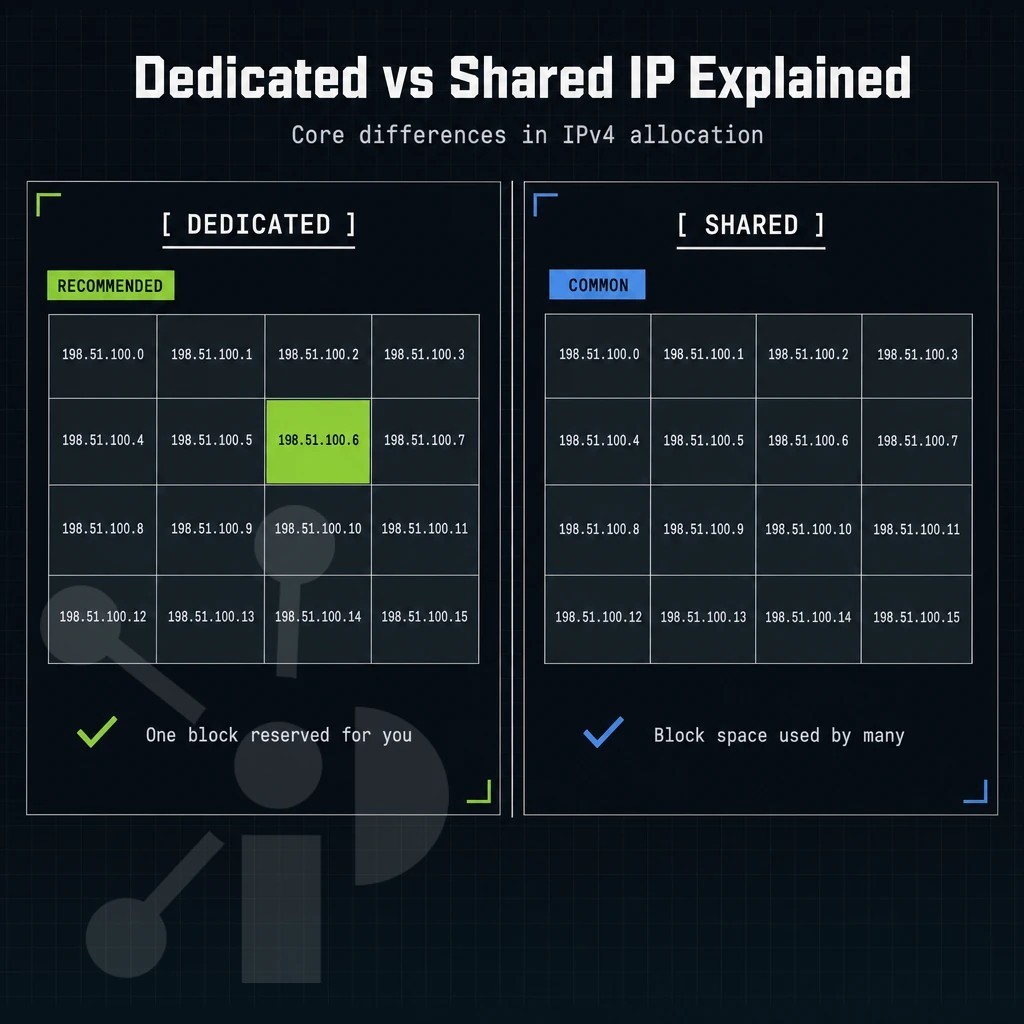
Note that not all IP addresses are created equal. In the list above, I tried to point out some of the key differences between using a dedicated IP address and a shared IP address. How your mail is perceived through dedicated IPs, how well it is delivered, and how quickly your site comes up are all issues that matter a great deal at times of crisis.
What dedicated ips actually means for your connection
A Dedicated IP is a single IP Address that is assigned to 1 user or business. No one else will send traffic through your Dedicated IP Address. You have full control of your public Dedicated IP Address and its associated reputation. Organizations deploying dedicated IP addresses for multiple users typically assign each user or department a distinct address to maintain individual reputation tracking and access control.
When provisioning resources, assigning one static IP per user ensures that reputation metrics and access logs remain cleanly separated across departments. This isolation is particularly valuable when only one user needs to maintain a clean sender reputation for compliance-sensitive communications or financial transactions.
A shared IP address is used by multiple users at once.
Shared reputation risk with dedicated ips
A shared VPN IP can hurt your online experience. For example, a dedicated IP VPN means that only you will be sending traffic from a given IP address. A shared pool of VPN IP addresses means that other VPN users can be sending spam or triggering off of a fraud alert that will drag down the IP reputation for everyone using that IP address.
When only you control the IP address through a dedicated assignment, reputation management becomes straightforward because every action traces back to your organization's policies.
In terms of affecting your online experience, email servers, login systems, online banking systems, etc. can flag or block an IP address based on the collective behavior of all users sending traffic from that IP address. These automated security measures can disrupt everyday browsing when shared IP addresses trigger false positives, forcing legitimate users to complete additional verification steps.
Dedicated IP addresses help organizations avoid login challenges that arise when shared pools trigger security flags across multiple user sessions. Organizations managing multiple devices under a single account face compounded risk when shared IP pools trigger blanket blocks that affect all connected endpoints simultaneously.
Dedicated ips vs shared ips: at a glance
| Factor | Dedicated IPs | Shared IPs |
|---|---|---|
| Users per address | One | Many |
| Reputation control | Full | None |
| Consistent IP address | Yes | No |
| Dedicated IP VPN use case | Supported | Not applicable |
If reputation, deliverability, or access consistency is critical to your business, then only dedicated IPs can deliver the required results. As we explored above when you buy a static IP address you instantly own the corresponding reputation. What’s next is choosing the correct path to acquire the ownership of said IP address. Evaluating whether a dedicated IP worth the investment depends on your traffic volume, compliance requirements, and how much control you need over sender reputation.
The three ways to buy a static IP address
When searching for a static IP address to buy, you can get three completely different results, and only one ends with you holding the account as the owner.
Path 1: dedicated ips add-on from a VPN service
- For existing VPN customers, add a Dedicated IP add-on. Choose a location for your Dedicated IP and all of your web traffic is sent out over the Internet from that one fixed Dedicated IP server.
- Remember that what you are renting is a proxy IP (i.e. it belongs to the VPN provider). It can’t be transferred, BGP announced, or used from outside the VPN server.
Note: This path suits individuals who need a consistent address for allowlisting. It does not suit network operators or businesses that need portable, owned address space. Some VPN providers offer a dedicated IP option as an add-on to their standard subscription, giving users a middle ground between full ownership and shared pools.
Path 2: static IP upgrade from an internet service provider
- To set up a static IP address, you first need to contact your internet service provider and ask them to upgrade your internet connection to a static IP address for a fee. Normally this would cost more than a shared IP address, but it would be available as a paid service from your ISP.
- The address is assigned to your account and not to you as a person. It will revert to the ISP’s control when you cancel your account.
Path 3: acquiring owned IPv4 space through the secondary market
- Block size (e.g. /24 and larger) and appropriate RIR region to support desired routing.
- We work with a registered IPv4 broker. He sources the needed IP addresses for you. We do quality control together with Tixx. We set up an escrow account. Finally, we handle the complete transfer of the RIR prefix via ARIN, RIPE NCC, APNIC and LACNIC.
- The RIR transfer is complete. The recorded address space is now yours to announce, lease or sell.
Note: Paths 1 and 2 are usage rights, not ownership. Only Path 3 gives you a transferable asset recorded at a regional internet registry. Understanding which path fits your needs also means understanding what each one costs.
Why your dedicated IP location affects performance
When you buy a static IP address. The geographic registration of the block of IP addresses in RIR databases and geolocation databases will list the geographic location where the internet would first determine the IP address to be from. This registered location can affect more than just a map pin.
Why dedicated ips and their location matter
Many services, including streaming, online banking and government sites, gate access by country or region of the IP address. Services that check the server location in geolocation databases for example, actually check that for access. A block of dedicated IPs registered under ARIN for example will route differently than the same block of IP addresses registered under the RIPE NCC even if they are sitting on the same server.
Remote access tools and corporate firewalls use IP-to-country lookups for their access policies. This can happen after a transfer of IP space, when the dedicated IP location database has not yet been updated and thus still shows the old RIR assignment. Enterprises relying on corporate networks for secure remote workforce access are particularly vulnerable to these geolocation mismatches, as authentication systems may reject legitimate connection attempts from misclassified IP ranges.
When geolocation data lags behind actual deployment, access control lists may inadvertently block the entire network segment until each provider's database reflects the correct regional assignment. Organizations that depend on consistent connectivity for mission-critical applications must ensure their IP assignments provide reliable access across all authentication checkpoints and regional verification systems.
How geolocation databases fall out of sync
Each provider (MaxMind, IP2Location, DB-IP, ipinfo.io) maintains a separate dataset for geolocation, including dedicated IPs, and each will update on a separate schedule. If you have a VPN plan that targets a single country (e.g. USA), or online services that require a local network presence, they can break for weeks if the geolocation isn’t being actively corrected.
Accurate geolocation tied to each public IP address is as important to deliver Residential IPs and access to region-locked content as the correct routing. Providers specializing in residential IPs must maintain current geolocation records across all major databases to ensure clients can reliably access region-specific services without authentication failures.
How Prefixx corrects it with dedicated ips
I've made a daily RFC 8805 geofeed for each IP address assigned exclusively to my dedicated IPs available at Prefixx.net/geofeed.csv, which the following providers consume directly in their updates.
Dynamic DNS is occasionally proposed as an alternative to owning a static IP.
Dedicated ips: who needs one and who does not
Whether or not an operator needs a dedicated IP address will depend on their specific use case and how critical a consistent, non-shared IP address is to their workflows.
Who finds a dedicated IP worth it with a VPN
- Email server operators. IP reputation is everything in mail delivery. By using a single static IP for your domain, mail box providers can start to build a trust history for your sending address. Using a shared IP on the other hand means your deliverability will increase and decrease with other unknown senders on the same IP.
- Teams that need to access systems in a secure fashion. For firewalls and VPNs that are set up to whitelist by IP address, a fixed IP source for all devices is ideal. Remote access to corporate systems, databases, and sensitive portals for example, works very well when your IP address never changes.
- BYOIP operators. Bringing your own block to cloud or bare metal requires a routable, owned address. Dedicated IP offers full control over routing, RPKI, and LOA paperwork. Prefixx handles that end to end.
Who can skip it
- Casual VPN users. General privacy browsing with the occasional need to mask traffic usually can get by with using a shared IP on a commercial VPN service. Since masking traffic occurs so infrequently, the overhead of dedicating a block for this user is generally not justified.
- This also only applies to streaming only use cases. Geo-unblocking for streaming purposes does not require a fixed IP. Here a rotating IP or a shared IP pool is usually fine enough.
One check before you decide
These pain points occur when your workflows break because your IP changes.
Note: Do not assume a dedicated IP is automatically clean.
Why Prefixx for buying or leasing a static IP block
Prefixx enables you to easily obtain static IP address blocks to use as needed (as opposed to as an add-on to a VPN service).
- Tixx quality control on every block. We check for ownership, blacklists, routing hygiene and RIR standing before delivering dedicated IP addresses to you.
- Escrow-secured transactions. In such cases, funds are released from the escrow account, thus no counterparty risk is carried by either party.
- White-glove lease service: LOA preparation, RPKI ROA setup, IRR route objects creation, geolocation fixes, IP reputation monitoring during the lease.
- Guarantee non-revocation and provisioning within 24 hours. Your static IP is guaranteed for the term of the lease.
- BYOIP deployment support. Netrouting can deploy private IPs on bare metal servers without any per-IP charges, and also supports cloud BYOIP programs on AWS, GCP, Azure and other cloud providers.
Registered with ARIN, RIPE NCC and APNIC, we also facilitate inter-RIR transfers across all five registries. If you are ready to buy a static IP address block or explore lease options, compare your options with our team.
Frequently asked questions about dedicated ips
Can I purchase a dedicated IP address for my account?
Yes, you can purchase a static IP address outright through the secondary market. All five regional registries (ARIN, RIPE NCC, APNIC, LACNIC and AFRINIC) exhausted their free pools between 2011 and 2020, so buying from another organization is now the standard route. A broker handles the RIR transfer paperwork, escrow and routing setup on your behalf. Prefixx, for example, manages the full process of acquiring multiple dedicated IPs from a vetted block through to LOA, RPKI ROA and IRR registration.
What is the cost to purchase a dedicated IP address for my network?
A /24 of dedicated IPs under ARIN and an identically sized block under RIPE NCC can trade at noticeably different rates in the same month, and no registry publishes an official price list.
Contact a broker for a current personalized offer rather than relying on any figure you find online.
Are dedicated ips available for free?
Some ISPs assign a static IP as part of a business plan, but that address belongs to the ISP and cannot be transferred or used independently.
Is it worth paying for dedicated ips instead of a shared address?
Dedicated IPs give you a static, provider-independent address so you can maintain consistent DNS records, SSL certificates and firewall rules without disruption if you change hosting providers. It also enables BYOIP deployment with a dedicated IP address per server, so you can bring your own block to bare-metal servers or cloud platforms like AWS, GCP and Azure and keep the same addresses across environments.
For anything production-grade, the operational stability of owning or leasing a static block outweighs the cost.
A static IP address means you have control over your IP addresses as opposed to with dynamic IP addresses. This means that with static IP addresses you can set up your routers to always send traffic to the same place, you can geolocate your servers with certainty.
The cost to acquire a static IP address, and the process to get them assigned, can vary greatly depending on whether you acquire them from your ISP, a cloud provider, or the secondary transfer market. The number and the cost of static IP addresses are impacted by the RIR region in which they are assigned as well as the block size of the assignment.
Geography actually matters for IP more than most buyers expect. A block of ARIN-assigned IP registered as a single address (e.g. 12.34.56.78) is quite different from the same number of IP addresses registered as identically-sized RIPE NCC blocks (e.g. 12.34.56.78, 12.34.56.79. 12.34.56.80 etc.), and where that single dedicated IPs address sits on the geolocation map can significantly affect several aspects of its use: latency, issues with regulatory compliance, and ad targeting.
If you are ready to source a vetted block with clean routing history and full transfer paperwork handled end to end, talk to the team at Prefixx and get a personalized offer within 72 hours.
Contact us to discuss your IPv4 needs today
No hidden fees, free consult. A broker replies within one business day.