
By Savvas Bout, Founder of Prefixx. Last updated 13 October 2026.
However, expert advice consistently confirms that most such space has already been consumed by companies engaged in spamming, or is wrapped in poor routing and non-compliance with RIR rules.
In particular, factors like the quality of the space (i.e. the likelihood that it is not already listed on a spam blacklist), transferability of the space, the space’s prior ownership history, and the space’s status at the relevant IP registry all affect the ultimate cost to the buyer of that space. Buyers must evaluate these assets carefully to ensure they meet both technical requirements and compliance standards before committing to a purchase.
In this guide, we explain the price of IPv4 addresses in detail and reveal the large differences in price between bulk inventories and more or less valueless remaining stock. We then explain which options (buying, leasing or transferring IP addresses between RIRs) are best for you depending on your time frame and financial resources. Understanding these pricing tiers becomes especially important for organizations that need to scale their infrastructure rapidly without compromising on address quality or compliance.
Finally, we explain what checks are needed before paying for IP addresses and where additional quality control beyond a simple WHOIS lookup by a service like Tixx can add value. We start with an explanation of what we mean by "cheap" in a world where all available IPv4 addresses have already been sold. Selecting a reputable provider ensures that the addresses you acquire come with clean routing history and proper documentation for registry approval.
What 'cheap IPv4' actually means in the secondary market
All IP addresses are already allocated, the free pools ran out between 2011 and 2020.
Three buyers, one support team keyword
Routable IP address space attracts a variety of different users. Companies like network operators require large blocks of IP addresses that can be announced via BGP. Businesses need static IP addresses for outward facing traffic. Organizations interested in acquiring address space should first determine whether their use case requires full ownership or whether leasing might suffice.
These could be for security reasons such as email address reputation, to use a VPN exit or to use a payment gateway online. Proxy users want stable sessions for prolonged periods of time for scraping or automation. In this article we are concentrating on routable IP address space only. Some services also require static IPs for authentication purposes when connecting to restricted APIs or internal systems.
How much does an IPv4 or e mail address cost in 2025?
Market rates for new IP addresses vary significantly by RIR region, by block size, and by reputation history. Larger organizations seeking to scale their infrastructure will find that pricing structures become more favorable as block sizes increase.
Leasing IPs may cost less upfront than buying, but note that leasing IPs temporarily transfers IP addresses to your company's name space before they become yours permanently.
How long does an IPv4 network transfer take?
The timeframes indicated are based on the respective RIRs and the time it takes for transfer requests on a block to clear the Tixx quality control across many networks. Brokerage of ARIN, RIPE NCC and APNIC number resources for transfer. Clean IP space with no blacklists tends to move more quickly than others. Tixx works to facilitate smooth transfers by coordinating documentation and registry approvals across multiple jurisdictions.
Note that claims of “unlimited traffic” by proxy resellers have no relevance to a transfer of a routable number block.
How much do IPv4 addresses cost today
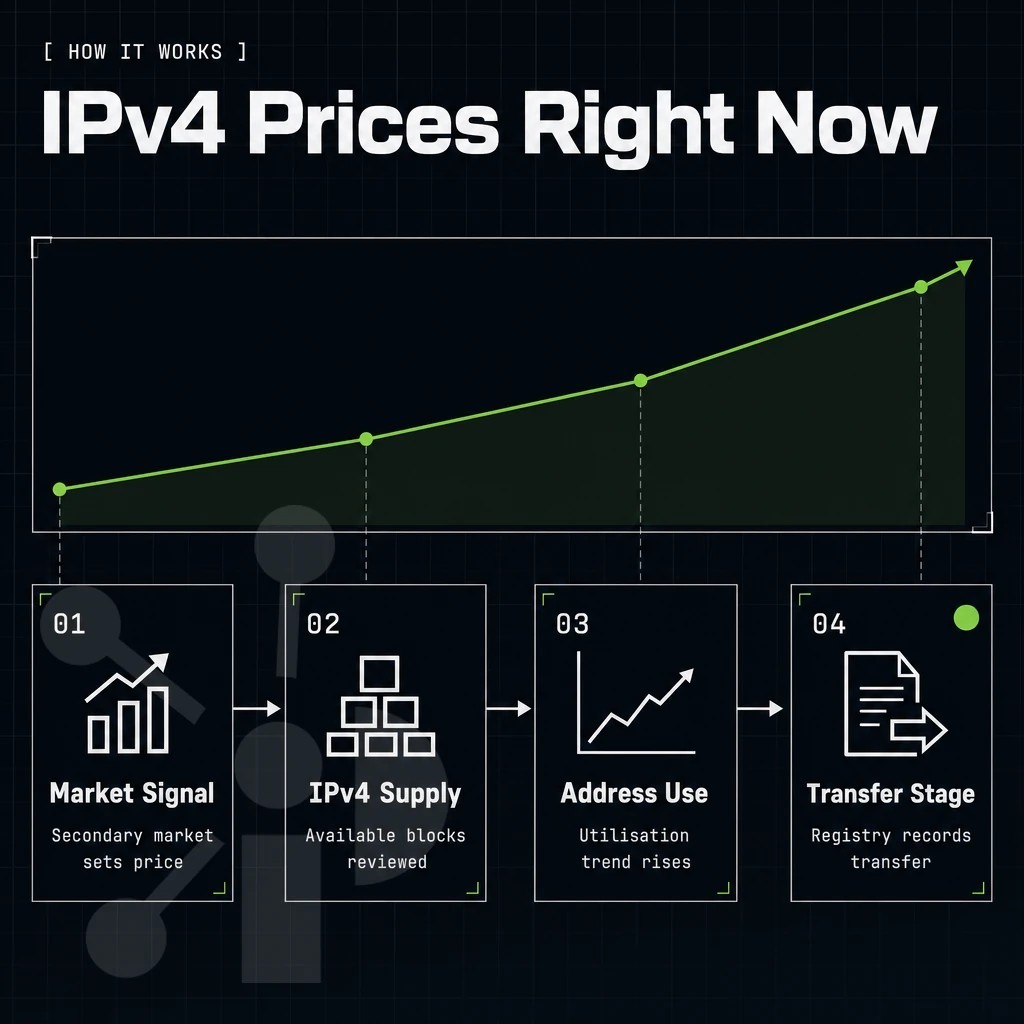
Note: The price for IPv4 addresses is set by the secondary market and NOT by the registries. Current price s for buying IPv4 addresses on the secondary market are in the $20-$35 per IP range while current prices for leasing IPv4 addresses on the secondary market are around $0.30 per IP per month. Leasing IP addresses is very common because it avoids the initial capital outlay to buy IP addresses upfront.
How block size and network region move the price
Larger blocks of IP space generally trade at a lower per IP price than smaller blocks of space. Due to the large premium that buyers place on having a /24 or /23 in a single clean lease of contiguous space. Additionally, the same network space in the ARIN registry can trade at vastly different prices than similar space in the RIPE NCC registry.
Even when of identical size and scope, the purchase price for internet address blocks can vary due to differences in demand, RIR approval timelines from country to country, and regional scarcity. The pricing structure reflects how buyers value contiguous address space, whether organized as subnets within a larger allocation or as standalone blocks.
Cloud costs as a support and comparison anchor
AWS charges for idle Elastic IPs. As a result, cloud-heavy teams find that leasing or even buying a portable block to use as needed across services and between providers saves money in the long run. This leased space can then be announced via BGP. Teams running distributed infrastructure across multiple cloud providers particularly benefit from this portability and control.
Can I buy an IPv4 address outright?
We can sell an IP address block outright in full. This is a simple process where the buyer pays the market rate plus that of any RIR transfer fees. Once paid the new block is assigned to the buyer under their organization. The transfer occurs as a direct assignment from seller to buyer through the relevant RIR's official process.
We manage the whole RIR paperwork process end to end (LOA, RPKI ROA, IRR objects etc). Contact us to receive a personalized buying offer valid for 72 hours. This will enable you to compare buying to leasing IP address space.
Buying vs leasing IPv4 addresses: which costs less
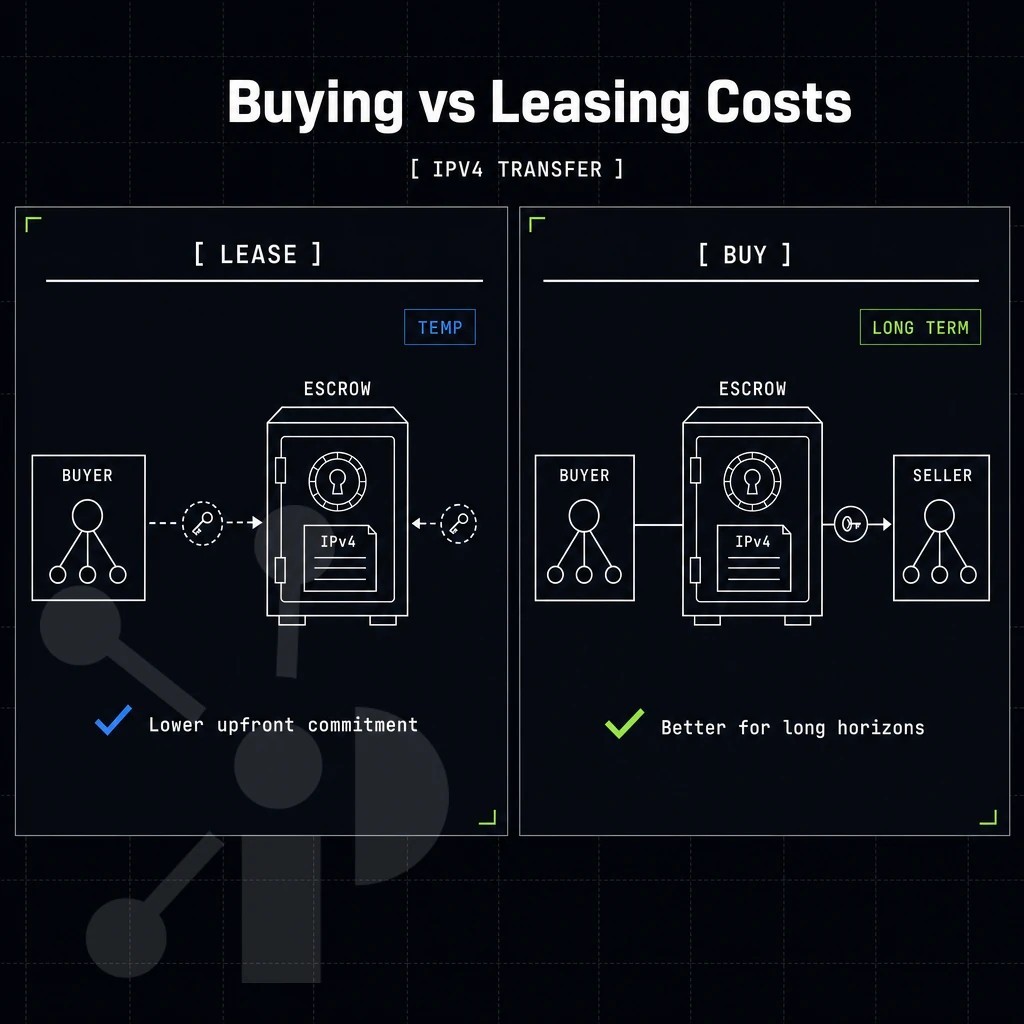
When it comes to IPv4 addresses, whether you should buy them or lease them depends on your budget and how long you need the IP space for and how much you want to spend upfront. Organizations with limited capital often prefer leasing to preserve liquidity while still securing the address resources they require.
When leasing costs less with the right support
- Determine your time horizon. A lease converts your capital into fixed and predictable ongoing expenses. For addresses needed less than 2 years, leasing will likely result in less total spend over the short term.
- Speed is also a factor. Approval time for new RIRs is not required when leasing IP addresses. We provision new leased IP address space within 24 hours. All required LOA, RPKI ROA and IRR objects are provided by Prefixx for our clients.
The RIPE NCC waiting list and why buyers use the secondary market
- Free IPv4 addresses have disappeared. RIPE NCC is accepting requests for a single /24 on the waiting list, but they will be assigned as returned space becomes available. Most organizations need more space than that and cannot wait.
- Go to the secondary market and buy it directly. Your one-time payment plus RIR transfer fees to change the registered contact usually end up paying less over several years than you would spend leasing the same amount of internet-routable space.
Is leasing IPv4 addresses cheaper than buying?
The break-even point is variable based on the block size and region of the buyer/seller. Prefixx allows the parties to expand their understanding of both scenarios before deciding to proceed with a purchase. Buyers can discover which approach aligns best with their operational requirements by reviewing the financial implications of each option.
Note: RIR transfer fees and registry paperwork add to the purchase total. Factor those in before comparing against lease costs. Even after you settle on the right acquisition process across different countries, a low headline price can still hide setup and other costs that only surface after the deal closes. Understanding the full lifecycle expense of acquiring and maintaining these assets helps organizations budget accurately for their networking infrastructure.
Hidden fees that make 'cheap' IPv4 expensive
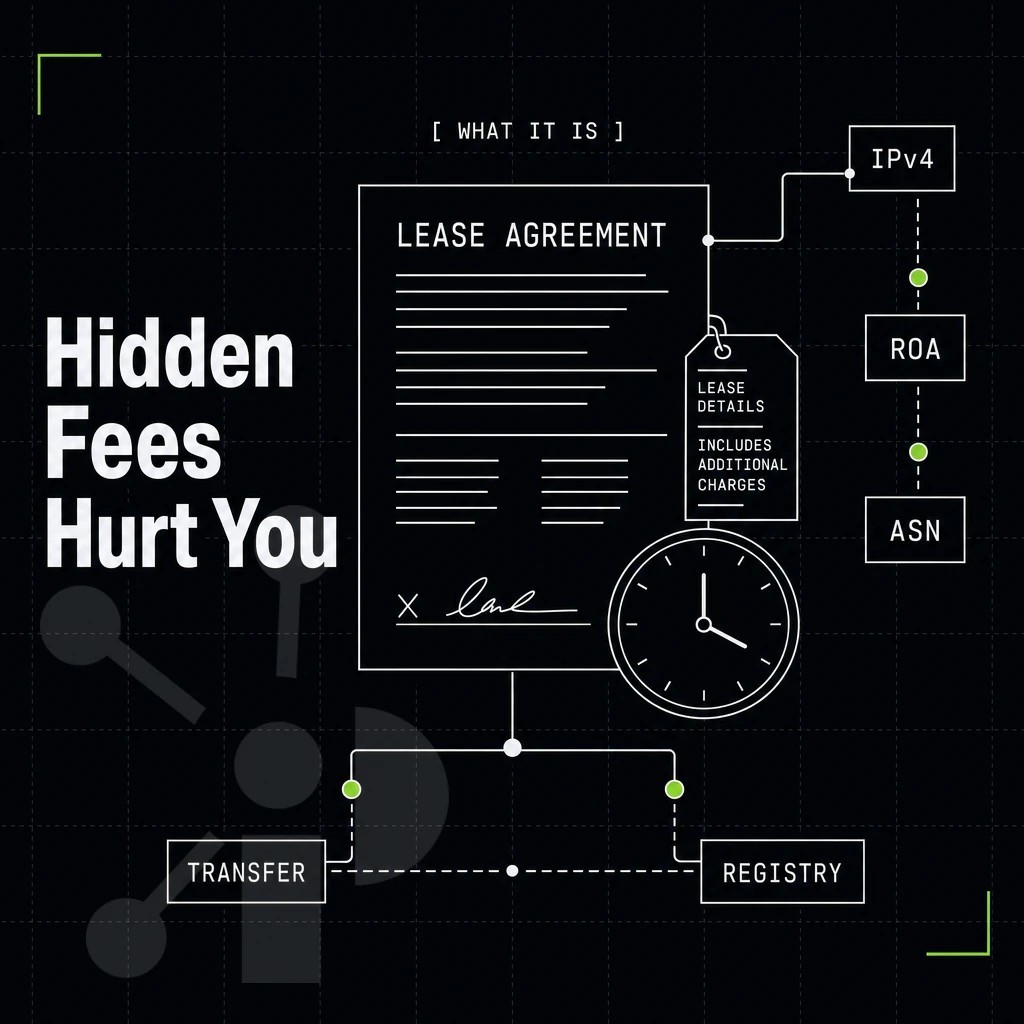
The apparent savings of a low headline price for a dirty block can routinely cost more than a clean block sold at a higher price. The buyers are unaware of these hidden fees until after the transaction has taken place. For community perspectives, see IPv4 block prices still going down? Best place to buy?.
RIR costs during the entire transfer process
Each registry Internet Representative (RIR) charges an administrative fee to complete a transfer. The Escrow layer also incurs a cost.
While these costs are typically not shown in a broker’s listing price for domain name sales, the potential loss of any savings by a buyer who completes a purchase without Escrow to try to save money on these fees can be tremendous and far exceed any savings in completing the transaction without Escrow. Buyers should request a complete breakdown of all registry and escrow fees before signing any agreement.
IP addresses resources for reputation and remediation
Blocks on Spamhaus ZEN and the Barracuda network list require manual intervention to become usable (delisting is not guaranteed). The setup work, processing of abuse complaints, and monitoring of time all cost money.
By contrast, Tixx by Prefixx verifies IP address ownership, blacklists, and other aspects of routing health and security before any block is offered for purchase, so the cost of all that work ends up on the seller, not you. Organizations that lack in-house expertise to manage delisting workflows often find that outsourcing verification to a trusted broker reduces both risk and administrative overhead.
Ptr records and network geolocation correction
Errors in PTR records can speed up the process of mail being rejected by spam filters and also getting classified as ad-fraud. New geolocation databases can also get newly transferred IP blocks wrong for months, and even affect account status with other online services and platforms that use geolocation data for geo-targeted services.
This all takes time and access to the database that most buyers don’t have in-house. Mail servers and content delivery networks may also flag traffic from an ISP with inconsistent reverse DNS, complicating delivery further.
Where to find cheap static IP resources for your business
Pricing is not a good indicator of a good deal when it comes to IP. A static IP arriving blacklisted or even mis-routed can end up costing much more to resolve than the initial cost savings. Prefixx offers a lease on a vetted selection of clean, verifiable Prefixx IP, with white-glove service included. Blacklisted addresses can prevent email delivery and block access to websites until the reputation issues are fully resolved.
Provisioning of new IP completed within 24 hours. By knowing exactly what to check before you sign any deal for IPv4 blocks, you can avoid hidden costs of poor IP service. Understanding the routing history and registry compliance status of IPv4 blocks before acquisition protects against delays in deployment and unexpected remediation work.
What to check before you buy or lease an IPv4 block
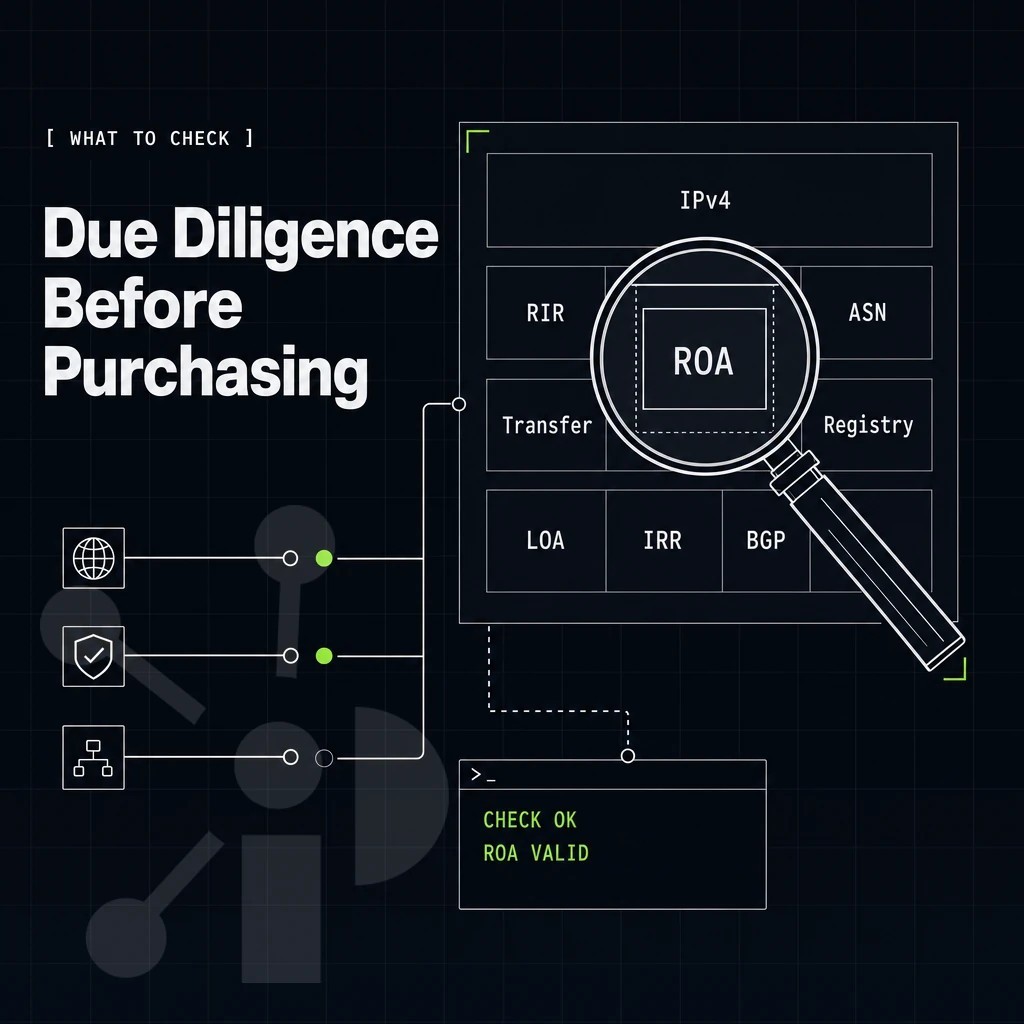
Very low-price IPv4 addresses blocks are offered for a reason: The seller may be unclear on who actually owns these, or there may be some problem with transferability that can take months of services and effort to clear up. Alternatively, the addresses may have a 'reputation' history that can expand over months before it fully clears up.
Doing your 'due diligence' with a proper support team may expense you a few hundred dollars upfront, but skipping it will expenditure you tens of thousands of dollars to 'remediate' later. Addressing these concerns through proper verification helps buyers avoid the costly remediation work that follows a hasty purchase.
The core IP reputation and assets checklist
- RIR WHOIS ownership: Confirm the registrant matches the seller and the block is not under dispute or administrative hold.
- Transfer eligibility: Some blocks are frozen by policy or pending another transfer. Verify status before the process goes further.
- Blacklist and DNSBL standing: Check Spamhaus ZEN and comparable lists. A single listing can block outbound mail and damage security posture across your infrastructure.
- RPKI ROA validity: An invalid or missing ROA means routing can be rejected by downstream peers.
- IRR route objects: Inconsistent IRR records cause filtering at major transit providers.
- PTR records and geolocation: Mismatched PTR records and stale geolocation data affect ad targeting, fraud scoring, and access controls. Contact the relevant geolocation providers to correct this after transfer.
- Abuse history: Review ARIN, RIPE NCC, or APNIC abuse logs. Inherited complaints follow the IP blocks, not the previous owner.
How tixx by Prefixx covers these checks
All blocks that we broker through to clients are run through our pre-sale quality control process, Tixx. It checks for ownership, transfer eligibility, blacklists on 12+ DNSBLs, routing and other health indicators as well as RIR standing. A full health report on the IPv4 blocks with a transfer readiness score is provided to the buyer before the sale is closed.
Post transfer the client can also monitor the block through the client area. Clients who acquire blocks through this process can continue to monitor and maintain their address space health through the same platform after the transfer completes.
Are IPv4 blocks becoming obsolete?
Although IPv6 adoption is growing, most companies still rely on IPv4 as by far the most important IP addressing layer in commercial networks. The secondary market for IPv4 is very active just now, because there is still plenty of demand for IPv4 addresses. The future of IPv4 will be characterized by managed scarcity, not by obsolescence. Organizations continue to prioritize IPv4 because their existing infrastructure, applications, and usage patterns remain optimized for this protocol.
Why choose Prefixx for affordable IPv4 addresses
Prefixx is a boutique IPv4 brokerage, not a self-serve platform. We broker the purchase, sale, and lease of IPv4 addresses with no hidden fees for buyers and a seller-only commission. Every deal comes with a human consultant, escrow-secured payment, and Tixx quality control on every block before it reaches you.
- Zero buyer fees. Sellers pay a 3-8% commission. Buyers pay nothing extra to acquire IP addresses.
- Tixx QC on every block. Ownership, IP reputation, routing hygiene, and transfer eligibility checked before any block changes hands.
- White-glove routing paperwork. Our team prepares the LOA, RPKI ROA, and IRR objects. You don't manage the process alone.
- Non-revocation lease guarantee. Leased IPv4 addresses provision within 24 hours, with PTR records and reputation monitoring included.
- Registered across ARIN, RIPE NCC, and APNIC. We facilitate inter-RIR transfers and support BYOIP deployment onto Netrouting bare metal with no per-IP surcharge.
If you want to buy, sell, or lease IPv4 blocks without surprises, see how our process works or explore pricing and contact our team for a personalized quote.
It means understanding what drives price and taking into account block size, RIR region, reputation history, and whether you need ownership or just routing rights. A block with blacklist baggage or a clouded transfer history will fee far more to remediate than the discount was worth.
The second thing that matters is total charge of ownership. Broker fees, escrow, LOA preparation, RPKI ROA filing, IRR updates, and ongoing reputation monitoring all add up. A deal that looks lean on the surface can get expensive fast if any of those steps lack proper support or end up billed separately.
If you want a vetted block with no buyer fees, Tixx quality control on every listing, and white-glove routing paperwork included, Prefixx is the right starting point. Submit an inquiry and get a personalized offer within 72 hours.
Contact us to discuss your IPv4 needs today
No hidden fees, free consult. A broker replies within one business day.