
By Savvas Bout, Founder of Prefixx. Last updated 12 October 2026.
The location in the IPv4 address space where an address originates (i.e. the address’s regional internet registry) determines the rules that apply to a particular address space or “block” of IP addresses. Understanding these regional distinctions is essential because global policies governing address allocation and transfer vary significantly across registries.
What information a company will need to provide to complete such a transfer, and whether that company can announce the newly assigned names and IP addresses in the global routing table. These policy mistakes can lead to a host of other problems including an unacceptable price for IP addresses. Understanding these regional variations in global policies is essential to avoid compliance issues that could delay or invalidate a transfer.
The five regional internet registries, ARIN, RIPE NCC, APNIC, LACNIC and AFRINIC, serve different geographic regions and have different transfer policies , pricing, waiting lists etc. Thus organizations that hold IP addresses under ARIN might find a different global internet market price for a /24 than those holding an identical block under RIPE NCC in the same month. The policy framework each RIR holds shapes not only transfer mechanics but also the documentation requirements organizations must satisfy.
This is operational due diligence when contemplating an acquisition, a lease, or a cross-registry transfer of IP address space.
This article defines what a regional Internet registry is and then maps out the geographic area covered by each registry. It then outlines the different policies for transfers and leasing of IP address space for each registry and explains what the differences mean to you for your next IP address space purchase.
What is a regional internet registry RIR for internet service providers
A regional internet registry (RIR) is anarchy-neutral non-profit organization which allocates and assigns IP addresses and other unique internet numbers (autonomous system numbers, etc.) within a particular geographic region. The RIRs form the second tier of the internet number resources registries globally, receiving large blocks of numbers from IANA (the top tier) and assigning them to lower level registries, such as IP address registries. For community perspectives, see Who controls the Internet and How it works - IP addresses.
Regional internet registry structure for internet service providers
The Internet Assigned Numbers Authority (IANA) is at the top of the hierarchy and distributes Internet number resources to the five RIRs. The RIRs in turn distribute the number space to Internet service providers, enterprises and other organizations within their region. The hierarchy enables consistent management of IP addresses all over the world. This coordinated hierarchy ensures that the global network operates with a unified addressing framework across all regions.
The five regional internet registries and local registry tier
Under each RIR there are local internet registries, typically operated by Internet service providers and large companies. They are allocated space by the RIRs and then in turn allocate smaller parts of this to their own customers. Most end users never deal directly with the RIRs that manage their IP addresses. This layered allocation model ensures that end-user customers receive appropriately sized address blocks suited to their operational needs.
Autonomous system numbers and the internet number registry system
RIRs do not just allocate IP addresses, AS numbers (Autonomous System numbers) are also part of the Internet number resources managed by each RIR. It is the three-tier structure of IANA -> RIRs, > end users that allows the Internet to run with unique and traceable addresses. The internet corporation for assigned names and numbers, IANA, coordinates this global allocation framework to ensure consistency across all regional registries.
How the RIR system works
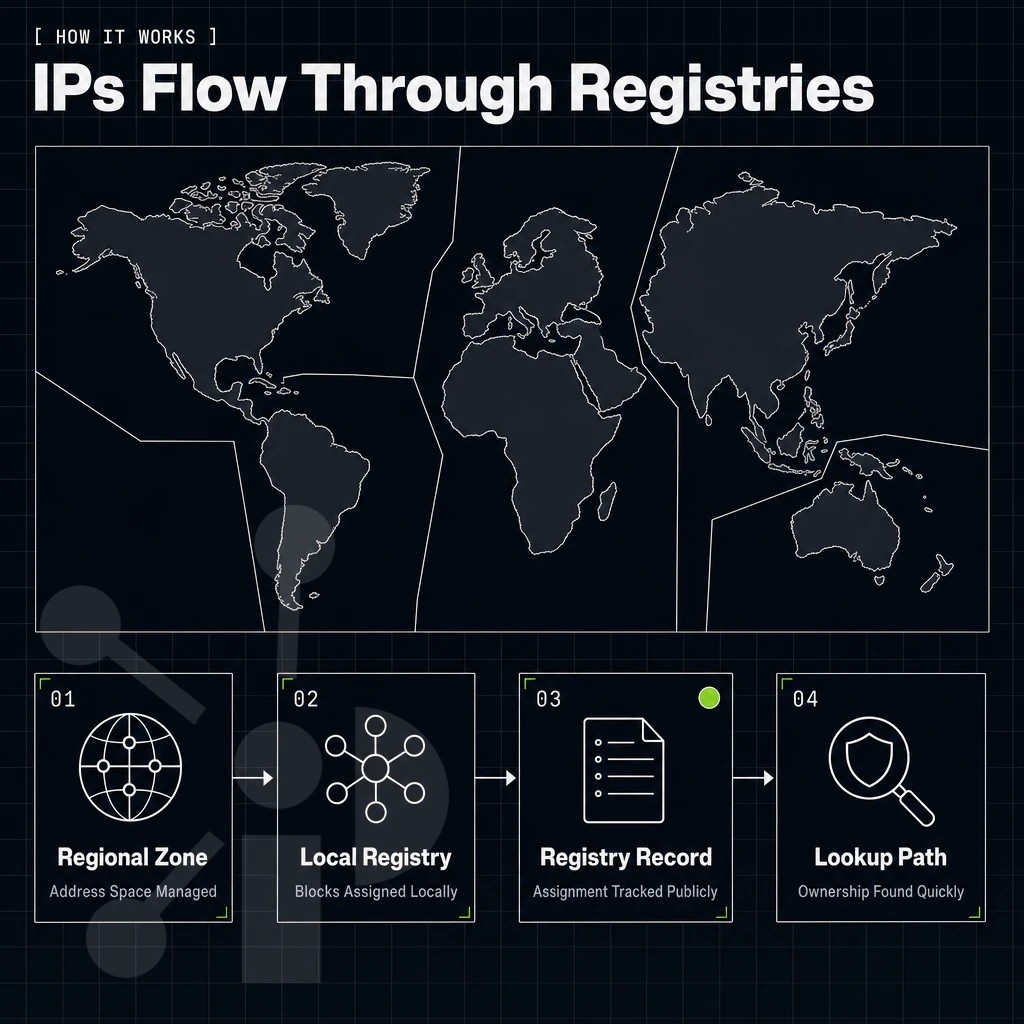
The Internet runs on a hierarchical system through which organizations receive IP addresses, tracking every assignment so anyone can find who is using each one.
Tier structure: from IANA to end users
IANA sits at the top, distributing large blocks to the five regional internet registries. Each RIR then allocates IP address ranges to ISPs, a national internet registry where one exists, and large enterprises. Those ISPs assign smaller prefixes to end user organizations and individual customers. Understanding this hierarchical RIR system is essential for organizations seeking to acquire or transfer address blocks across different regions.
Internet number resources and registration data
The RIRs manage the number resources for IPv4, IPv6 and ASNs.
What this means for buyers and sellers
Clean Whois and correct routing objects are basic requirements for a transfer of address space within any service region. Prefixx’s Tixx process already checks these issues before a buyer can purchase a block of IP addresses. The next critical piece of information needed to transfer an address block is to determine which of the five regional internet registry organizations governs the desired address space. Understanding which registry holds authority ensures compliance with the policies and procedures specific to their respective regions.
Why RIR free pools are exhausted and what that means
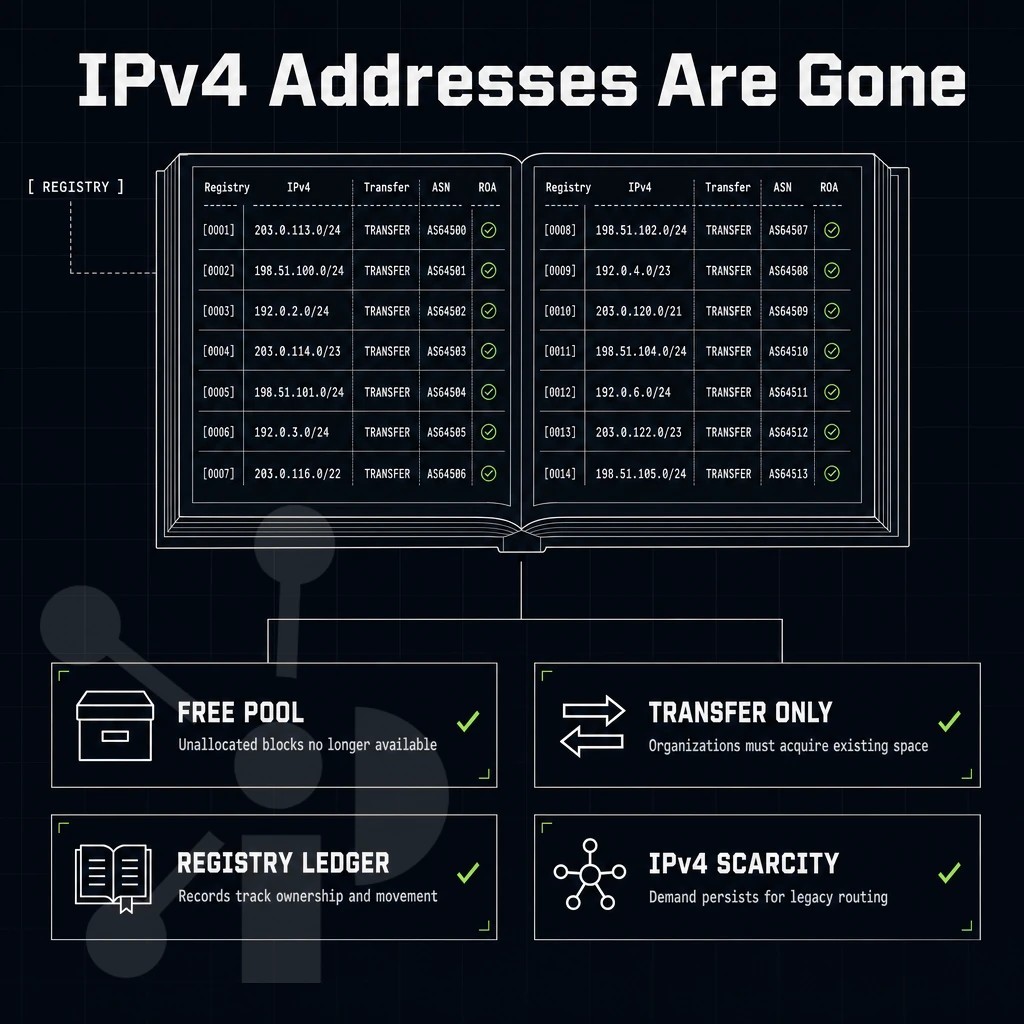
Each connected device on the internet requires an IP address, or unique identifier. In the case of Internet Protocol version 4 (IPV4), it uses a 32-bit number to represent each IP address, totaling 4.3 billion addresses. And yes, that was always a finite number, the global internet has now reached that limit.
How each regional internet registry exhausted its internet number resources
five RIRs (RIRs) manage the allocation of IP addresses and other Internet resources in their respective geographic areas. IANA, managed by the Internet Corporation for Assigned Names and Numbers (ICANN), distributed the last big blocks of IP addresses to the RIRs. These RIRs operate as independent entities but coordinate on policy matters affecting their collective interests in maintaining a stable global routing system.
While APNIC, the Asia Pacific network information centre, ran out of IP addresses as early as 2011, every local internet registry under ARIN, the American Registry for Internet Numbers, felt the impact by 2015.
The other three RIRs, RIPE NCC (Europe), LACNIC (Latin America and the Caribbean), and AFRINIC (Africa) each ran out of IP addresses by 2020. There is no more free pool of IP addresses anywhere. ARIN's service region includes the United States and Canada, meaning organizations in both countries faced the same depletion timeline.
A registry can run out of an allocated IP block. Today, when an organization joins the Internet, they can no longer simply approach an ISP and demand an allocation of IP addresses. All additional IP addresses are now sourced from the secondary transfer market.
IP addresses and the secondary market
Although IPv6 adoption has started to gain momentum, huge parts of the Internet's service region are still running on IPv4. All carriers, cloud providers and enterprises with online services need IP addresses to be able to operate online.
The enormous and persistent demand for IP addresses in contrast to a limited supply of numbers creates the transfer market for used IP space, which is now regulated by the regional internet registry policies. Organizations must understand which service region governs their address holdings to ensure compliance with the applicable transfer policies and routing requirements.
All existing IPv4 addresses are already allocated. When acquiring network addresses today, these are mostly bought or even rented from a holder (organization) and subject to the transfer rules of the respective RIR.
Global importance for buyers and sellers
Understanding exhaustion is crucial to the nature of a brokerage transaction. We operate on a global scale, listing space for sale across ARIN, RIPE NCC, APNIC and LACNIC spaces, and detailing transfer rules for each. Quality controlled for ownership, eligibility for transfer and fundamental routing health in line with number resource organization standards, we list every internet registry block of space for sale on Tixx. We detail the various internet numbers transfer rules in place across these RIR system registries in the following section.
RIR transfers, inter-rir transfers, and the secondary market
Regional Internet Registries govern the transfer of address space within their respective service regions. In conclusion regional internet registries maintain distinct policy frameworks that organizations must navigate when managing number resources across different service regions.
Within-rir transfers of internet number resources
The five RIRs (ARIN, RIPE NCC, APNIC, LACNIC, and AFRINIC) have their own transfer policies, covering specific IP address spaces, eligibility for IPv4 block allocation, and requirements for IP range registration. These policies are geared to the specific geographical region that each of the five RIRs serves, from North America to the Middle East.
Inter-rir transfers of internet number resources
A cross-registry transfer in the asia pacific region requires approval by both registries involved, and is done according to their respective policies. Inter-RIR transfers are supported by ARIN, RIPE NCC, and APNIC, which also covers central asia, whereas LACNIC transfers have specific conditions. The approval process ensures that one party cannot unilaterally move resources without meeting the policy requirements of both the source and destination registry.
The price per /24 for the same size of IP space allocated by ARIN and by RIPE NCC can differ by a substantial margin in the same month. Market conditions and demand levels in their respective regions drive these pricing variations between registries.
Where Prefixx fits with internet number resources
Our team handles the paperwork with the registries for these joint projects using public technical identifiers like ASNs and address space blocks. As registered brokers with ARIN, RIPE NCC and APNIC, our consultants guide IP address transfers for educational and commercial organizations across regions from central Asia to the Americas and beyond. Educational institutions often require specialized guidance through the transfer process due to their unique organizational structures and compliance requirements.
For related reading on how we handle cross-registry deals, see our IPv4 transfers page.
Where Prefixx fits into the RIR ecosystem
Prefixx is a registered broker with ARIN, RIPE NCC and APNIC for number resources, and can perform transfers to LACNIC registries. We deal with the individual transfer policies of every regional internet registry RIR on your behalf, saving you the trouble of having to work out each one's individual rules. Organizations operating across Latin America benefit from our experience navigating LACNIC's specific transfer requirements and documentation standards.
- Zero buyer fees are charged. The seller pays a commission of 3% to 8% and the buyer nothing.
- Tixx quality control for every single block of IP to verify the following: the IP is yours to own. The IP is not blacklisted, all routing is correct, the RIR representation for that IP block is accurate.
- We do white-glove paperwork for you. We prepare LOA, RPKI ROA and IRR route objects for you end to end.
- Inter-RIR transfers handled. We can do cross-registry transfer s (between ARIN, RIPE NCC, and APNIC) and have LACNIC help with such transfers.
If you are buying, selling, or leasing internet number resources, contact our consultants to compare options.
Frequently asked questions about internet number resources
Is ARIN a government number resource organization managing internet resources?
ARIN is a nonprofit membership organization, not a government body. It operates under a community-driven policy process, meaning the network operators and companies that use its services collectively shape the rules. Governments have no direct authority over ARIN's decisions as a regional internet registry RIR, though ARIN does coordinate with regulatory bodies where required by law. The rules governing transfers and allocations represent policies developed through open consultation with member organizations and stakeholders in that community-driven process.
Who owns internet resources like a specific IP address range?
The RIR that allocated the block holds the registration record, and the organization that received the allocation is the registered holder. Holding a registration for internet number resources is not the same as legal title in the traditional property sense, but in practice the registered holder controls the block and can transfer, sell, or lease it. The registered holder can manage routing announcements, delegate reverse DNS, and update contact records through the RIR's member portal.
When these number resources change hands through a broker or direct transfer, the RIR updates the registry record to reflect the new holder. The registry record is maintained by the number resource organization that originally allocated the block and continues to govern its use.
How do RIRs manage internet resources like IP addresses and number allocations?
An RIR IP address is a block of IPv4 or IPv6 space that was allocated or assigned by one of the five regional registries: ARIN, RIPE NCC, APNIC, LACNIC, or AFRINIC . ARIN governs address space in the United States and Canada, while RIPE NCC serves Europe, the Middle East, and parts of Central Asia.
Each RIR serves a specific geographic region of the global internet, enforces its own regional policies, and maintains the authoritative Whois record for every block under its administration. Because the free pools at all five RIRs emptied between 2011 and 2020, any new IPv4 allocation today must come through the secondary transfer market rather than directly from an internet coordinating body or registry.
The five IP address registries are the primary mechanism for the allocation and number management of routable addresses on a global scale. The free pools of IPv4 addresses that the five RIRs manage have all been allocated. Additionally, Thus the way in which a network operator manages internet addresses (i.e. buying/selling/leasing addresses from other entities) is very different from that in which address blocks are allocated (i.e. by requesting space from a registry).
It's very important to know which RIR governs your internet number resources block, since the transfer rules, time frame and costs all differ between ARIN, RIPE NCC, APNIC, LACNIC and AFRINIC. A seemingly identical block of IP allocations can therefore have completely different transfer requirements, depending on which regional internet registry RIR it is registered under.
If you need to acquire address space, exit a holding, or move a block across an internet registry, Prefixx handles the paperwork, vetting, and routing setup end to end. Talk to the Prefixx team to get a vetted block or a transfer quote.
Contact us to discuss your IPv4 needs today
No hidden fees, free consult. A broker replies within one business day.