
By Savvas Bout, Founder of Prefixx. Last updated 25 August 2026.
When your network's routing domain announces prefixes to the global Internet, it does so under the authority of an Autonomous System Number (ASN).
Will help you ensure that your traffic is identified correctly, your announced IP ranges validate correctly against. If they’re not, your announced prefixes will go dark. For more context, see buying process.
If your team is acquiring or leasing IPv4 address space, you’ll soon discover how quickly the ASN (Autonomous System Number) situation can get out of hand.
This article covers the process of ASN registration at ARIN, RIPE NCC, APNIC, LACNIC, and AFRINIC, the key differences between a public and private ASN, and how they work within BGP (Border Gateway Protocol).
For a complete overview, explore our what is an ASN guide.
What is an ASN used by network operators?
An ASN (Autonomous System Number) is a number assigned to an autonomous system. An autonomous system is a group of IP addresses, i.e. IP prefixes, managed by a single entity, operating under a single routing policy, a single operator, or a group of operators. In order to exchange routing information on the public Internet, every network requires an ASN. For more context, see Autonomous system (Internet).
Why the internet assigned numbers authority manages asns
Routers that connect separate networks (across the whole internet) use BGP protocol. Without a stable identifier (e.g. a hostname), BGP cannot tell the networks of separate operators apart. Each autonomous system may encompass one or more network segments that share a unified administrative policy and exchange reachability information through standardized protocols. Modern data centers deploy both core and edge switches to segment broadcast domains and enforce policy boundaries within each autonomous system.
How the internet assigned numbers authority issues asns
A global pool of numbers is held by IANA. Additionally, The 5 Regional Internet Registries (RIRs) are given blocks of numbers, which are in turn assigned to organizations in their regions, according to a clearly defined traffic forwarding policy.
For example, a university running its own unique packet forwarding policy would qualify for its own Autonomous System Number (ASN) from its regional RIR. But how does BGP, the Internet’s path selection tables, use this to move traffic around the Internet? These policies establish the rules under which each registry evaluates applications, ensuring fair allocation and preventing number exhaustion.
How to obtain an autonomous system number ASN
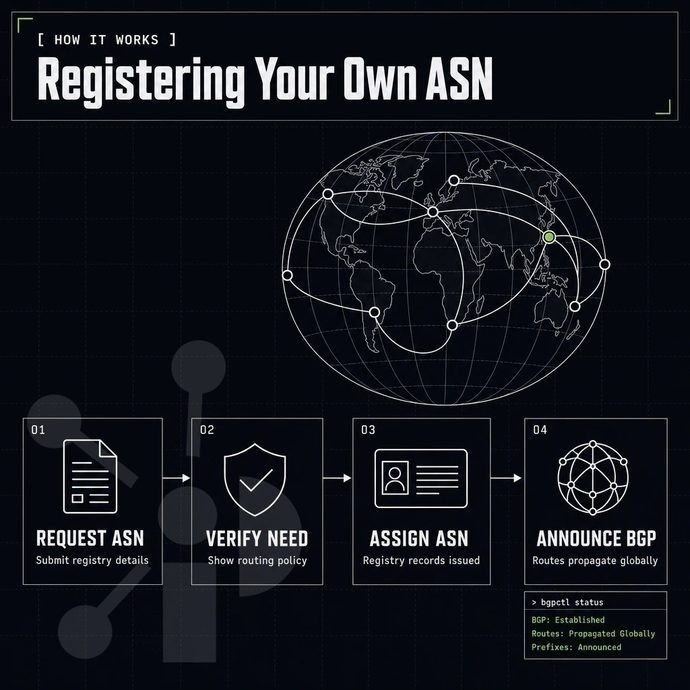
To get an ASN, you start with the Internet Assigned Numbers Authority (IANA), which assigns number resources to the five regional registries. First find out which RIR is responsible for your part of the world, then apply for your unique number directly through their web site. Each regional registry operates under policies set by its community, though some applicants such as educational institutions or a government agency may qualify for fee waivers or expedited review.
IANA delegates authority to ARIN (North America), RIPE NCC (Europe/Middle East), APNIC (Asia-Pacific), LACNIC (Latin America), and AFRINIC (Africa), each managing allocations within their service region. Most RIRs handle online applications and respond to requests within two to four weeks, though timelines vary by region and completeness of documentation.
Eligibility and application for internet service providers
Evidence of the IP network traffic direction policy and payment of the appropriate registry fee is required.
RIPE NCC sponsorship with a clearly defined routing policy
The sponsor LIR holds the registration for the applicant, who does not have his own LIR membership. The sponsor LIR is responsible for the compliance of the applicant. Prefixx offers RIPE LIR sponsorship for PI and ASN holders.
Working with a broker to compare internet service providers
Need an ASN to go with your IPv4 range? We can source both for you. The acquisition of an ASN is handled as part of our broader prefix deals, thus keeping your transit paths and related paperwork in order. Contact us to discuss your needs in conjunction with our address space purchase offerings.
Your packets only flow correctly if your ASN and prefix(es) are registered consistently across all the relevant RIR records, IRR databases, and RPKI validation servers.
Frequently asked questions
How do network operators use asns and border gateway protocol BGP to manage routing policy?
An ASN (Autonomous System Number) identifies a network under a single administrative control so it can exchange route control information with other networks on the public web.
Does every organisation, like a government agency, need its own ASN?
Most organisations connect to the net through a single ISP and never need their own ASN. You need one when you multihome (connect to two or more upstream providers), run your own inter-domain routing protocol routing protocol routing protocol prefix data flow steering policy, or announce your own IP address space independently. Smaller organisations typically rely on their upstream provider's ASN and let the provider handle all route handling announcements on their behalf. Many small to mid-sized businesses find that relying on their ISP's infrastructure is more cost-effective than managing their own autonomous system. Organizations with dedicated IT staff can choose to have their autonomous system fully managed by a third-party provider who handles all announcements, peering sessions, and policy updates.
What is the difference between an ASN and an IP address?
An IP address identifies a specific device or interface on a network. An ASN identifies the autonomous system, meaning the entire network or organisation, that controls a group of IP prefixes. Think of IP addresses as street addresses and the ASN as the name of the city district that contains them. exterior gateway protocol uses ASNs to route packet flow between networks; IP addresses are used to deliver that routing packets to its final destination within a network. When a router receives packets destined for a remote network, it consults its BGP table to determine which autonomous system should handle the next hop.
Can you transfer or sell an autonomous system number ASN
Yes, ASNs can be transferred between organisations, subject to the policies of the relevant RIR. ARIN, RIPE NCC and APNIC all support ASN transfers, including legacy resources. Prefixx handles ASN acquisition alongside block deals where needed, and can facilitate the transfer paperwork across all participating registries.
What does ASN stand for in networking?
ASN stands for Autonomous System Number. An autonomous system is a collection of IP networks and routers under the control of a single organisation that presents a common network handling policy to the global network. The number is the unique identifier assigned to that system by a Regional Internet Registry such as ARIN, RIPE NCC or APNIC. This definition clarifies the relationship between the numeric identifier and the collection of resources it represents.
What is the difference between a public and a private ASN?
A public ASN is globally unique, registered with an RIR, and visible in the worldwide web's path forwarding table. It is required whenever you need to exchange route processing information with other networks outside your own organisation. This global presence ensures that routers worldwide can identify your network and correctly forward packets destined for your IP ranges.
A non-public ASN is chosen from a reserved range (64512 to 65534 for 16-bit, or 4200000000 to 4294967294 for 32-bit) and is only valid within a single organisation's internal network. In border gateway protocol BGP, local ASNs must be stripped before routes are advertised to the public interconnected network, just as RFC 1918 addresses are not routed globally.
When configuring internal BGP sessions, administrators must ensure that private ASNs never pass beyond the organization's edge routers into the public internet. Private connections between data centers or branch offices often rely on these non-public ASNs to maintain logical separation from the public internet while still enabling dynamic path selection.
Do I need an ASN to use BYOIP on cloud platforms?
AWS, Google Cloud and Azure each have their own BYOIP onboarding process that connects your prefix to their network, and most require you to prove ownership through a signed Letter of Authorization rather than requiring your own ASN. Each cloud provider maintains a verification portal where you upload proof of ownership, establishing the link between your registered resources and their platform. Customers can initiate the onboarding workflow from a web browser on any desktop or phone, making it convenient to submit documentation from anywhere.
However, if you are bringing IP space to a bare metal environment and announcing it via BGP routing protocol path selection peering protocol, you will need an ASN to originate the prefix. Prefixx supports both paths for multi homed deployments: cloud BYOIP programs (AWS, GCP, Azure, OCI, Cloudflare) and BYOIP deployment onto Netrouting bare metal, with LOA, RPKI ROAs and IRR route objects, along with all associated data, prepared by the Prefixx team.
An ASN, or Autonomous System Number, is the identifier for your network “on the global routing fabric” and thus required to run exterior gateway protocol path selection, to announce your own address space and to enforce your own routed data processing policy. Public ASNs are for organizations that peer with external networks, while restricted ASNs are only used within the organization’s own infrastructure.
If you have reached the point where a public ASN makes sense for your physical infrastructure, the next practical question is sourcing one alongside the address space it will announce. Prefixx handles ASN acquisition as part of the same deal, across ARIN, RIPE NCC, APNIC, and LACNIC. The team also prepares the LOA, RPKI ROAs, and IRR route objects so your subnet is routable from day one. Contact Prefixx to discuss your network navigation requirements.
Contact us to discuss your IPv4 needs today
No hidden fees, free consult. A broker replies within one business day.