
By Savvas Bout, Founder of Prefixx. Last updated 2 November 2026.
I can only recall IPv4 addresses on the financial statement being considered as a “utility” such as a rack of servers and written off as an expense. The day that the free pools of IPv4 addresses were depleted and a true secondary transfer market emerged with real price discovery, was the day that IPv4 addresses became a material asset.
Today a /16 under ARIN or a portfolio of IPv4 addresses held under the RIPE NCC can become a significant asset for a company and lead to a number of questions from the finance team to the network engineering team that would have never been considered before.
How do I value this? Does it depreciate? How does the accounting treatment change if I were to lease the IPv4 addresses as opposed to purchasing them? Understanding how these assets fit into the broader business model helps finance and engineering teams align on acquisition and utilization strategies.
The answers depend on how the address blocks were acquired, which registry holds the record, and whether your organization controls the resource outright or holds usage rights under a lease agreement. Each path carries different implications for capitalization, amortization, and the way auditors view the asset. Blocks that were originally assigned directly by a registry decades ago may carry different documentation requirements than those acquired through recent inter-company transfers.
This piece works through the accounting considerations, the practical differences between owning and leasing more addresses as IPv4 space, and what both options mean when the numbers land on your books. Understanding these distinctions helps any business make informed decisions about how to structure IPv4 transactions and report them accurately.
For a complete overview, explore our ipv4 addresses on the balance sheet guide.
What it means to carry IPv4 addresses as an asset
The IPv4 address has transitioned from being a purely technical commodity to a financial asset. The five RIRs all exhausted their pools of free IPv4 address space between 2011 and 2020.
As a result, all blocks of addresses bought on the secondary market today have a fixed cost to acquire and also a current market value, making them suitable for inclusion in a company’s balance-sheet. Blocks acquired in the past when addresses were freely distributed now carry minimal or zero book values despite their substantial current worth.
Legacy versus purchased IP address options
Many organizations still hold addresses that were originally allocated for free before the pools of addresses closed. These legacy addresses are held off asset ledger at zero cost basis. In contrast, addresses purchased for market rates have their acquisition cost recorded and then treated accordingly by the organization’s accounting. When addresses are assigned directly by a registry before exhaustion, they carry no purchase price and remain unrecorded until a transfer occurs.
Growing demand and the depreciating asset question
The IPv4 address space is finite, with approximately 4.3 billion addresses.
How use shapes the accounting
There is a big difference between a block held for internal use and a block leased to customers for revenue. Transfer of IP addresses held by ARIN are governed by ARIN’s rules while IP addresses held by RIPE NCC and APNIC are governed by the rules of each of those registries. The registry under which an IP address block is registered determines the procedural requirements for documentation and the timeline for completing transfers or lease arrangements.
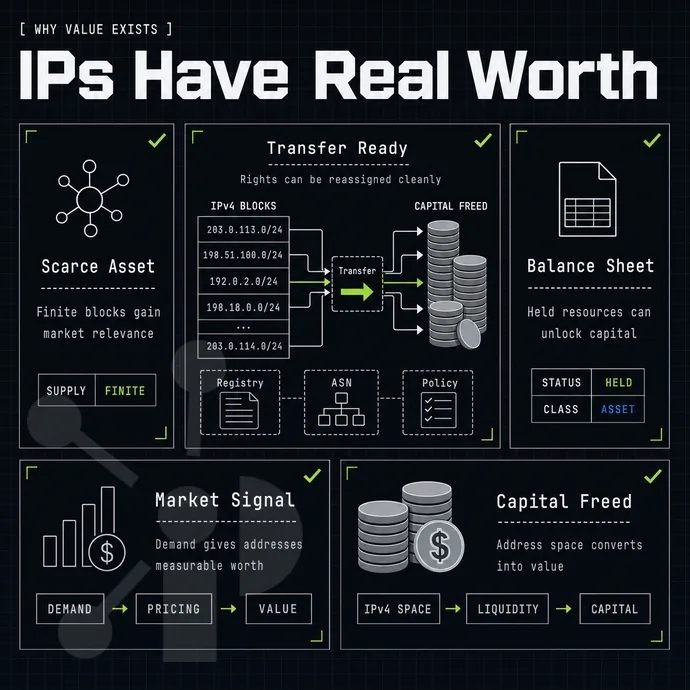
Our Prefixx consultants help customers properly document their cost of acquisition and use of newly acquired IP addresses from the start.
Why IPv4 address space has measurable financial value
Like other scarce resources, space, commodities, etc.
The free pool of IP addresses is gone
There are approximately 4.3 billion IPv4 addresses in existence.
Sustained demand keeps prices moving
There are many entities that require routable IP addresses: cloud providers, mobile operators and enterprises.
Over time secondary market prices for IP addresses in the secondary market have gone up, and this is particularly the case since the IP address pools were closed. In some regional areas, where there is scarcity of IP addresses available in the secondary market (e.g. ARIN), pressure on prices in the secondary market has increased. Regional differences in available supply directly influence how quickly prices rise in each registry's jurisdiction.
Block size and region both move the number
Note that a /24 of addresses purchased under ARIN may trade at a very different price per IP than an identical /24 block of IP numbers traded under the RIPE NCC.
Large blocks of IP numbers carry different per-IP economics than smaller blocks, and these figures never appear on registries' official price lists, which is why actual transaction data across the network is so valuable to companies carrying these assets on their balance sheets.
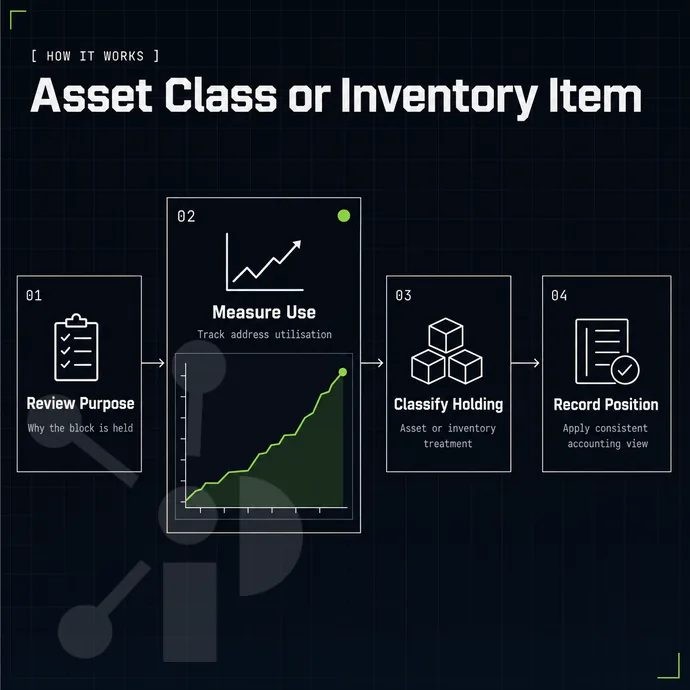
How accountants classify IPv4 addresses: intangible asset or inventory
Accounting for IPv4 blocks from RIRs and other registries is a grey area; treatment should be based on why an organization holds them, not on the RIRs' statements.
Intangible asset treatment (operational use)
- Intangibles, IAS 38 vs ASC 350. IP held for a company’s own network operations (i.e. for their Internet connectivity) is an intangible asset. Useful life is generally indefinite, therefore amortization is abandoned and the asset is subjected to impairment testing.
- Test for impairment on an annual basis and compare carrying amount to recoverable amount. There is no official price published by the American Registry for Internet Numbers or other RIRs; thus, one must rely on secondary, observable market data.
Note: Legacy blocks obtained at zero cost carry a low or nil book value even when market value is substantial. This creates a hidden-asset situation that can distort acquisition due diligence. This discrepancy becomes particularly relevant during corporate acquisitions when target companies hold legacy resources that do not reflect their true economic worth.
Intellectual property held for resale
- Classify as inventory. Brokers and traders holding mining blocks for resale treat them as current assets in accordance with IAS 2 or ASC 330, measured at the lower of cost and net realisable value.
- Careful record-keeping of costs. Cost basis of new IP cost equals acquisition cost + transfer costs. Zero-cost legacy IP assets still require a cost memo to be able to prove costs for audit purposes.
Choosing the right treatment for your IP address
- Determine the intent at the time of acquisition. If used for operational purposes then it will be an intangible asset. If sold then it will be inventory. Mixed product portfolios may require both classifications.
- Document the accounting policy for internet addresses. Written accounting policies are expected by auditors. Create the policy in advance and align it with your GAAP or IFRS framework before the first block of internet addresses appears in the financial ledger.
Note that the classification of a property is only half the story. The value at which the property is recorded on the books thereafter will depend on a number of factors.
Factors that affect the economic value of an IPv4 address block
The value of an IPv4 block on paper versus the sale price for a transfer or rental fee for a lease can vary widely for many factors. Understanding these variables helps in setting a defensible carrying value and flagging blocks that may require remediation to generate cash from them. Blocks may diverge from their nominal valuation for several reasons, including technical reputation and the administrative complexity of completing a clean transfer.
Block size, liquidity and per-ip address premiums
The price per IP and the liquidity of a block of IP addresses changes with the size of the block in opposite directions. Large blocks of IP addresses are of interest to big institutional customers and can be sold for higher prices per IP in RIRs. Institutional buyers often prefer acquiring IPv4 address blocks in larger contiguous allocations because they simplify routing table management and reduce administrative overhead.
Smaller blocks of IP addresses are more liquid as there are more buyers for smaller blocks of IP addresses. However the price per IP in dollars can be lower than for larger blocks of IP addresses. Organizations that sell smaller allocations often complete transactions more quickly due to the broader pool of interested parties.
RIR region, routing history and reputation
In the RIR region of IP address transfer, policy, timeline and demand all intersect. While ARIN blocks of addresses command a premium over equivalent RIPE NCC held space, the historical routing of a block to itself serves as an equally important variable to price. Hijack, non-announcement, or origin ASN variance all decrease value. Blacklist status, negative for net realizable value, can command significant delisting effort prior to consideration for transfer or lease.
RPKI ROA coverage has become the new normal. A block without a valid ROA will get filtered by most networks and thus is of limited use and value.
Market conditions and remediation costs
In addition to these factors, market conditions are currently at a high. Thus, potential problems with a domain such as routing issues in the fourth version of the internet protocol or even a domain being on a blacklist can significantly decrease the offer price by a potential buyer. Additionally, The cost to remedy issues with a domain also needs to be subtracted from the gross price to arrive at the domain’s net realizable value.
Tixx is the name of the quality control process that Prefixx performs prior to the sale of a domain name to verify a domain name's ownership and transfer eligibility, as well as to check a domain name's routing and confirm it is not on a blacklist that would prevent internet users from accessing it. Each domain undergoes this verification protocol, and the resulting report serves as an example of the due diligence standard expected in professional IPv4 transactions.
All of this is documented for both the buyer and the seller. After a domain name has been determined to have a certain value within a network, the decision remains as to what should be done with the domain name. For example, a domain classified as held-for-sale may require different disclosure than one classified as an operational intangible.
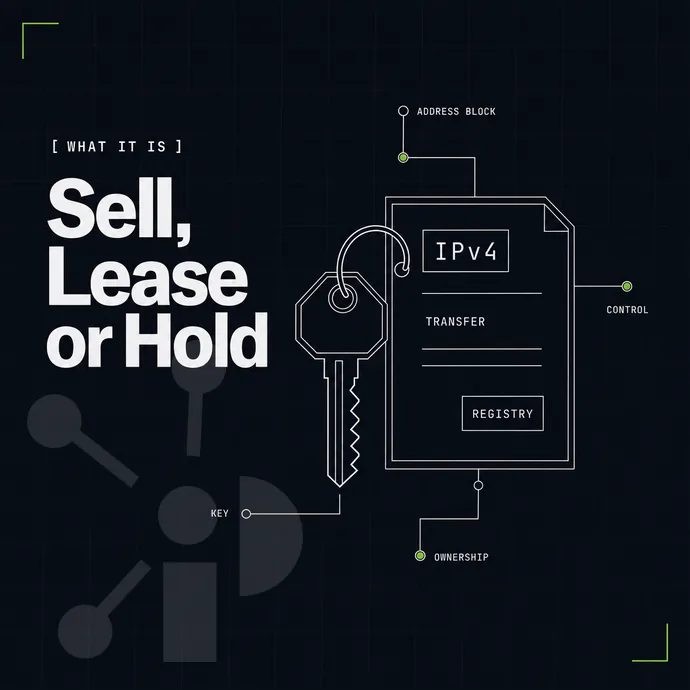
Selling, leasing or holding IPv4 addresses: strategic options
Decision-making around owning IPv4 address space is a real strategic issue for organizations. Deciding whether to sell, lease or hold onto a block of IPv4 address pool has different financial implications and operational consequences. The choice between these options only makes sense when leadership weighs both the immediate liquidity needs and the long-term operational requirements of the network.
Sell outright and realise the gain
Secondary transfer market sales of dormant assets can now instantly turn them into liquid capital. There are numerous reasons a company may be moving to IPv6, or merging & consolidating their existing infrastructure. The transfer eligibility to sell in the market is typically determined by the RIR region where the block is currently registered.
Companies evaluating these options often weigh the proceeds from outright sales against the recurring revenue potential of lease arrangements or the operational continuity provided by retaining the addresses for internal use, particularly when planning mergers or acquisitions.
Prefixx brokers the transaction end to end: Tixx quality control, escrow-secured settlement, and full RIR transfer paperwork. See sell IPv4 addresses for details.
Lease and generate recurring revenue
Leasing retains ownership while monetising spare capacity. It meets market demand for routable addresses without a permanent transfer. Our team prepares the LOA, RPKI ROA, and IRR objects, and provisioning completes within 24 hours. See lease IPv4 addresses. The brokerage coordinates all technical and administrative services required to establish the lease arrangement between lessor and lessee.
IP address space you still need operationally
Holding makes sense when the block supports live infrastructure. The strategic value here is operational continuity, not yield. Monitor the current market periodically: if the cost of alternative addressing falls, the calculus shifts. The decision to hold rather than monetize reflects a long-term view of the asset's role in the network architecture and its potential appreciation as an investment.
- Sell: best when migrating away or reducing footprint.
- Lease: It’s best when there is spare capacity but you need to own it.
- Hold: best when the block is actively routed.
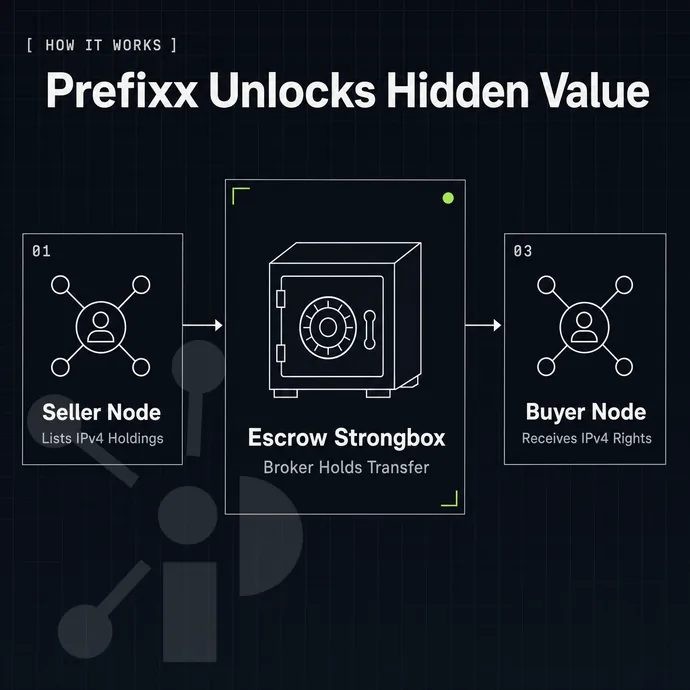
Regardless of which method is best for you when acquiring address blocks, you will need a broker who has good relationships with the registry and has the quality control processes in place to safeguard your interests throughout the transaction. A qualified broker can also advise on the optimal timing to sell blocks based on current pricing trends and liquidity needs.
How Prefixx helps organisations unlock the value of their IPv4 holdings
Prefixx is a boutique IPv4 brokerage founded in 2018 by a team based in Miami. The company acts as brokerage for both parties to the market: helping sellers get worth out of their idle IP space and helping buyers find good. Verified IP blocks for purchase with solid routing reputation and legitimate ownership. The firm's advisory services include technical due diligence, transfer documentation, and coordination with regional internet registries throughout the transaction lifecycle.
- No fees for buyers. Sellers pay a 3-8% commission on the close of a property.
- As part of our quality control Tixx checks all the blocks in any proposed deal for ownership, transferability, blacklisting and routing issues before completing the deal.
- In an escrow-secured transaction both parties are protected throughout the transfer process.
- White-glove paperwork for you, we create LOA, RPKI ROA and IRR route objects as needed.
- Inter-RIR transfers to ARIN, RIPE NCC, APNIC and LACNIC regions facilitated.
Whether you are looking to sell IPv4 addresses, acquire address blocks, explore current market conditions, or navigate an inter-RIR transfer, our consultants are available to walk through your options. Our brokerage handles the full transaction lifecycle when you decide to sell, from valuation and documentation through registry approval and fund settlement.
Frequently asked questions about IP address
Are IPv4 address blocks allocated by RIRs considered an intangible asset?
Yes, under most accounting frameworks IPv4 addresses are classified as intangible assets. They are identifiable, separable, and can be sold or transferred independently of the business. IFRS treats them under IAS 38, and US GAAP handles them as indefinite-lived intangibles when there is no foreseeable limit, such as regional scarcity, to the long term trend of the period over which they generate monetary worth. Because the secondary market is active and prices are observable, the asset is also considered to have a reliably measurable fair market worth.
How do legacy IPv4 addresses affect the book value of allocations?
Legacy allocations were issued before the RIR system existed, typically at no cost, so they often sit on the asset register at zero or near-zero carrying financial worth. That creates a significant hidden asset: the market worth of those addresses can be substantial, yet the book monetary worth does not reflect it until a transaction occurs. In the past, these allocations were simply recorded as operational infrastructure rather than recognized as assets with potential resale worth.
When a company sells or formally registers a legacy block, the gain recognized can be disproportionately large relative to the recorded cost basis. Auditors increasingly flag this gap as a source of reputational risks, and some companies choose to revalue legacy holdings to fair market worth under IFRS to present a more accurate picture.
Can a company depreciate IP address space?
No, not under standard treatment. IPv4 addresses are classified as indefinite-lived intangibles because there is no statutory expiration date and the secondary market shows persistent demand. If market prices across the network fall materially below carrying financial worth, an impairment charge is recorded, but routine depreciation does not apply.
How selling IPv4 addresses on the balance sheet works
The intangible asset is derecognized at its carrying worth, and the disposal addresses the proceeds by flowing them through the income statement as a gain or loss. Because many blocks were acquired cheaply or received for free, the gain is often significant and taxable.
Cash or receivables increase by the sale proceeds, improving the liquidity position.
How does leasing IPv4 addresses affect financial statements compared with buying?
Leasing keeps the addresses off the accounting record entirely: no intangible asset is recognized, and no capital is tied up in the block. Lease payments are expensed as an operating cost, which smooths cash flow and avoids the large upfront outlay that a purchase requires.
Buying, by contrast, records a long-term intangible asset and may require financing, affecting leverage ratios. For companies that need address space temporarily, or that want to preserve capital for core infrastructure, leasing produces a cleaner asset inventory at the cost of building no equity in the resource.
Treating IPv4 address inventory as an afterthought on the financial inventory can end up costing a fortune. How one classifies a block (e.g. as intangible assets vs. inventory) determines the depreciation schedule and tax treatment, as well as how the acquired company will look across its network of potential future acquirers.
Deciding between selling, leasing, and holding out to cash in an internet protocol asset has significantly different implications for liquidity, revenue, and reputational risk that need to be carefully modeled by accountants and finance people.
If your organization holds unused or underutilized IPv4 space, the next step is a straightforward one. Get a current market valuation, confirm the block's transfer eligibility and routing hygiene, then decide whether to monetize now or structure a lease. Prefixx handles all three: Tixx quality control covers the hygiene check, and the brokerage team can walk you through sale and lease options for specified recipients with no buyer-side fees and no obligation. Start the conversation at Prefixx.net.
Contact us to discuss your IPv4 needs today
No hidden fees, free consult. A broker replies within one business day.