
By Savvas Bout, Founder of Prefixx. Last updated 6 October 2026.
For most organizations with Provider Independent (PI) space (e.g. an IP address range) or an Autonomous System Number (ASN). The biggest hurdle to using these resources on the internet is that of RIPE NCC sponsorship by a LIR (Local Internet Registry) which can often cost a lot of money and sometimes even more for processing fees that can vary greatly. Finding a cost effective sponsorship arrangement that avoids excessive processing fees remains a priority for organizations seeking to maintain their resources without unnecessary financial burden.
With the sponsored LIR model, PI holders can rest assured their space is up to date and routed correctly without setting up a full Local Internet Registry to manage their resources.
As most guides on the subject fail to explain in sufficient detail, the mechanics of LIR sponsor arrangement are of critical importance. The LIR that sponsors your objects at the RIPE NCC will be responsible under contract for said objects. Thus, the quality of the relationship with the sponsoring Local Internet Registry is of critical importance to the continuous operation of your routing. The sponsor becomes directly involved in maintaining the accuracy of your resource records and ensuring they remain consistent with RIPE policy.
This article describes the registry sponsorship model in detail, outlines the RIPE NCC policy requirements for both the sponsor LIR and the sponsored LIR, and contrasts sponsorship with establishing a LIR of your own.
What is a local internet registry LIR and why sponsorship exists
A Local Internet Registry (LIR) is a RIPE NCC member which has been allocated parts of the Internet number space and can distribute them to end users as well as to its own infrastructure. Not every organization needs or even can become a full member of RIPE NCC. However, within RIPE NCC policy there is room for an existing LIR to act as sponsor for an organization. For community perspectives, see RIPE LIR recommendations : r/networking.
Local internet registry LIR: the sponsorship model
The end user obtains resources (as described above) through his/her supporting LIR who has a contractual relationship with the relevant regional Internet registry. The LIR deals with all resource requests from the end user and is held accountable by RIPE NCC with respect to such requests.
Internet resources: IPv6 pi versus pa space
Space allocated as Provider Independent (PI) follows the customer to the end of the life cycle, on whatever upstream providers they run. Provider Aggregatable (PA) space is held by the LIR until the provider relationship with the LIR is cancelled and the space is released back to the LIR. Sponsorship exists for PI space only. The same distinction applies when an organization holds an autonomous system number under sponsorship, as the ASN remains with the holder regardless of transit provider changes.
Autonomous system number and existing resources under ripe policy
An autonomous system number (ASN) assigned as an independent resource also requires a affiliated LIR. Resources already held as PI can be transferred to a new designated LIR should the original LIR change. Prefixx can assist with both new PI assignments and ASN sourcing. Once you have a grasp on the above model, it remains to be seen who within the sponsoring service's legal entity will actually be doing what within such an arrangement.
How a sponsoring LIR manages internet resources on your behalf
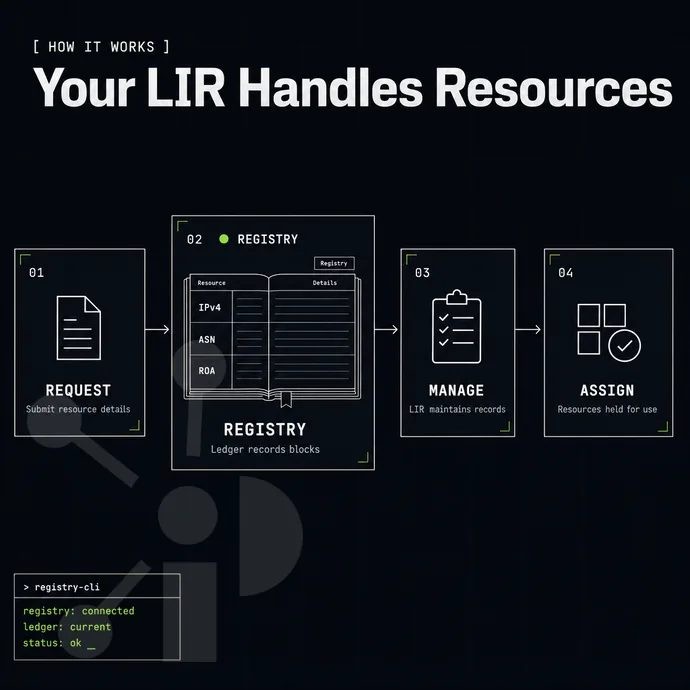
A registered LIR functions as a contractual interface between an end user and the RIPE NCC. The LIR in question is a member of the RIPE NCC and submits requests with respect to resources required by end users. The end user relies on this registered entity to act as their operational sponsor for all registry interactions and policy compliance matters.
The LIR is also responsible for the RIPE database objects pertaining to end users and for compliance with RIPE policies on an ongoing basis. End users are, however, fully responsible for the use of the address space and the ASN assigned to them. Proper configuration and maintenance of the autonomous system ensures that routing policies are enforced correctly across the network.
Who controls the IP address space
Although the contracted LIR holds the contractual relationship with the RIPE NCC, the end user maintains full control over the operational use of his IP resources including routing and the assignment records.
What the LIR handles for your RIPE NCC service region organisation
The LIR will create and update all RIPE objects required for the assignment. Handle policy changes and update the annual agreement to sponsor the respective holder of the PI address space, the AS numbers and any other related routes or persons. These updates must align with current ripe policy to ensure compliance and maintain the validity of all database entries.
What happens if the relationship ends
Internet number resources assigned under the auspices of a sponsoring organization are not 'lost' when the sponsoring relationship ends. End users can move to a new RIPE NCC LIR and sign an independent assignment agreement for those resources which are then allocated to the new sponsor without reassignment being required. The continuity of existing resources is preserved through the transfer process, allowing organizations to maintain their addressing without operational disruption.
Prefixx’s IP sponsorship model service manages this transition and ensures your routing continues uninterrupted. It is only when you understand the fundamental difference between PI and PA address space that this makes operational sense. The process requires careful coordination to ensure all parties involved understand their responsibilities throughout the transition period.
Provider independent pi space vs provider aggregatable pa space
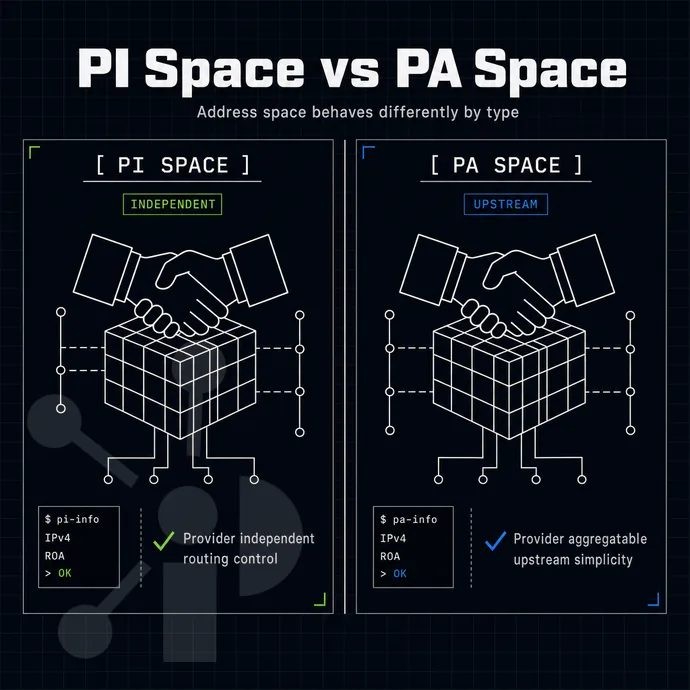
IP address space announced by a company does not all behave the same.
Understanding IP address types in the ripe region
PI address block is assigned directly to your organization by the RIR, regardless of the upstream providers you use.
IPv6 PI numbers are similarly portable, assigned by the RIRs, announced by you from your own network with your own ASN once you run BGP.
When ASN sponsorship applies to your own network
There are two classes of PI holders: those who are members of an LIR, and those who are not. For the latter, a partnered LIR must hold the contractual relationship with the RIR; for PA holders there is no such requirement. This is the practical trigger for LIR sponsorship.
Prefixx provides RIPE LIR-sponsored model to PI and ASN holders who wish to maintain their resources without forming a LIR under the RIPE NCC. Allocations made under PA space do not require such sponsorship and are non-portable. Organizations seeking ASN sponsorship benefit from the same streamlined administrative model that applies to their address resources.
Note: Choosing PA space to avoid sponsorship fees is a false economy if you ever plan to multihome or change providers. Migrating to PI later costs more in time and transfer fees than sponsorship would have. The formal document that governs all of this is the backing LIR Agreement, and its terms are worth understanding before you sign.Why choose Prefixx for LIR sponsorship
Prefixx is a boutique IPv4 brokerage registered with ARIN, RIPE NCC and APNIC. Our team handles regional registry sponsorship for PI address space and ASNs, so the end user has one point of contact from block acquisition through RIPE database compliance and renewals.
- Integrated service. The same consultants who broker the block also prepare LOA, RPKI ROA and IRR route objects on your behalf.
- ASN sponsorship included. We sponsor both PI address space and autonomous system numbers under a single responsible LIR agreement.
- White-glove compliance. Senior consultants manage RIPE database objects, reverse DNS and annual renewals, no self-serve required.
- Published fees. $300/year per object, plus a $300 one-time start fee.
Reach out to our team at Prefixx.net to discuss sponsorship alongside your next block or ASN deal.
Frequently asked questions about autonomous system number
How does a local internet registry follow RIPE policy for ASN allocation?
A Local Internet Registry (LIR) is an organization that has been allocated a block of IP address space from a Regional Internet Registry and distributes that space to its customers or members. ISPs, hosting providers, and large enterprises typically hold LIR status. Becoming an LIR requires paying membership fees to the relevant RIR and accepting an agreement defines ongoing administrative obligations. Most smaller organizations or natural person applicants find it more practical to use an assigned LIR rather than maintain their own membership. The RIR manages IP address allocations according to published policies that ensure fair distribution and efficient use of the available address pool.
How does ripe policy shape the five RIRs and internet exchange point roles?
The five RIRs are ARIN (North America), RIPE NCC (Europe, Middle East, and Central Asia), APNIC (Asia-Pacific), LACNIC (Latin America), and AFRINIC (Africa). Each registry manages the allocation and registration of IP space within its region. All five support transfers of IPv4 space and ASNs, including legacy resources.
What is a regional internet registry (RIR)?
A internet address registry is an organization responsible for managing the allocation and registration of address space and ASNs within a defined geographic region. RIRs operate as non-profit membership organizations, setting policy for how internet number resources like addresses are distributed and transferred in their region. The five RIRs collectively exhausted their free IPv4 pools between 2011 and 2020, which is why all new IPv4 address space now comes from the secondary transfer market.
What happens to my sponsored resources if my sponsoring LIR closes?
If your nominated LIR closes or loses its membership, RIPE NCC will contact you directly and give you a defined window to find a new appointed LIR. Your resources are not immediately revoked, but you must secure a replacement sponsor within that window or the registration will be deregistered. This is why choosing a stable, established delegating LIR matters: a broker or provider with a long track record reduces the risk of disruption to your routing. In practice, most LIRs maintain stable memberships for many years, making sudden closures relatively uncommon in the registry ecosystem.
Can I switch to a different sponsoring LIR?
Yes. You can transfer your sponsorship to a different LIR at any time by submitting the appropriate request to RIPE NCC. Both the outgoing and incoming LIR must agree to the transfer, and the process is straightforward when both parties cooperate. Your IP resources and ASN remain yours throughout; only the administrative sponsoring relationship changes. The transfer follows the ripe policy process and typically completes within a few business days once documentation is submitted.
Do I need to become a RIPE NCC member to hold provider independent IP space?
No. Provider Independent (PI) space can be held by an end-user organization without LIR membership, provided a primary LIR takes on the administrative relationship with RIPE NCC on your behalf. The host LIR registers and maintains your resources in the RIPE database and is accountable to RIPE NCC for their correct use. Prefixx offers RIPE IP address sponsorship for PI IP space and ASN holders who want that coverage without the cost and overhead of running their own LIR membership. The same sponsorship arrangement applies when an organization holds an autonomous system number but does not wish to maintain direct registry membership.
What is the difference between pi and pa address space?
Provider Aggregatable (PA) space is allocated to an LIR, which then assigns portions of it to its customers. If you leave that provider, you lose the addresses because they belong to the LIR, not to you.
Provider Independent (PI) space is assigned directly to your organization and is portable: you can announce it through any upstream provider or ASN without losing the registration. For organizations that need stable, long-term control over their IP range, PI is the correct choice, and a parent LIR arrangement is what makes holding provider-independent IP space possible without full LIR membership.
RIPE sponsorship model is the most practical way to hold Provider Independent (PI) IP block without joining the registry as a full member. As the sponsoring registry is the administrative contact to the RIPE NCC for the space held under the PI address holder’s prefix/ASN, the holder always remains in full control of that space, regardless of the upstream used for the space’s transmission.
A LIR sponsoring agreement is not a mere formality. It outlines who is responsible for compliance with terms and conditions of use, what happens when a party cancels and what you have to pay each year.
Prefixx offers RIPE NCC LIR registration for independent address allocation and ASN holders who need a registered sponsor without the overhead of running their own LIR. If you need sponsorship alongside a block acquisition or lease, speak with the Prefixx team to get the details for your specific situation.
Contact us to discuss your IPv4 needs today
No hidden fees, free consult. A broker replies within one business day.