
By Savvas Bout, Founder of Prefixx. Last updated 23 October 2026.
Many organizations hold large numbers of unused IPv4 addresses and underestimate what they're sitting on.
The decision to sell IP address blocks is straightforward, but the execution is not as it involves RIR transfer rules, escrow, buyer verification, routing hygiene checks etc. that can impede a seller that is trying to sell IP address blocks on their own. Navigating the technical infrastructure requirements and registry protocols demands expertise that many first-time sellers lack.
In this guide, we walk through every stage of the process to transfer IP address space, for any block, regardless of transfer eligibility. This guide details the Tixx quality control checks undertaken prior to a deal closing, the role of the escrow account in holding money securely, and how it protects both the seller and buyer.
Additionally, The various structures of commission that are available for the transfer of IP address space of different block sizes. Tixx works to facilitate each transaction by coordinating documentation between parties and ensuring registry compliance throughout the transfer timeline.
We explain how to check transfer eligibility for IP addresses held in ARIN, RIPE NCC, APNIC, and LACNIC regions and outline the steps required for each.
Prefixx can handle every stage of the process on a no-win, no-fee basis, from listing the block through to settlement.
What it means to sell a block of IP addresses
When you sell an IP address block , you are transferring the registered stewardship of a specific range of contiguous Internet Protocol Version 4 (IPv4) addresses to a new holder.
Importantly, IPv4 addresses are not physical properties that can be bought and sold like houses or cars, for example. Instead, they are allocated resources that are registered with regional internet registries (RIRs). The process of transferring an IP address block thus involves reassigning the registration of the relevant allocated resources. Each RIR maintains records that identify which entity holds the registration rights to a given block at any point in time.
Why the IPv4 addresses secondary market exists
There are approximately 4.3 billion IPv4 addresses in total, and every single one of them is already allocated. The five RIRs have long since used up their supply of free IPv4 internet address space, with the last of the pools being exhausted between 2011 and 2020. Since then, the only way to get more address space has been to buy it from someone who already holds it, and transfer it to them.
How much does buying or selling IP addresses cost?
The price of IP addresses can vary depending on the registry, the size of the block, and the reputation history of the seller. For example, a /24 block of addresses would cost the same amount under ARIN as it would under RIPE NCC, but would trade at different prices in the same month. Pricing dynamics also shift with market demand, as buyers seeking to scale their infrastructure may drive up valuations during periods of IPv4 scarcity.
By selling your IP addresses through a broker, you can find the right buyers for your space, and have confidence that your sale is being conducted in a professional and secure manner. Prefixx does not charge any fees to buyers, and all of our sales are conducted through escrow. Working with an experienced broker gives sellers the ability to navigate complex registry requirements while maintaining focus on their core business operations.
Can I sell part of my IPv4 addresses and keep the rest?
Yes, as long as you're selling a portion of your IP space that is greater than or equal to the minimum transfer size for your RIR. Additionally, You have enough left over to be above the minimum transfer size threshold, then yes, we can sell you a portion of an already existing block of IP space.
Etc. and our consultants can verify if a specific block would be eligible for sale prior to it being listed. However, before we can list a block for sale or lease, it must first go through a number of checks against various registries and for routing issues.
Which IPv4 addresses and blocks are eligible to sell IPv4
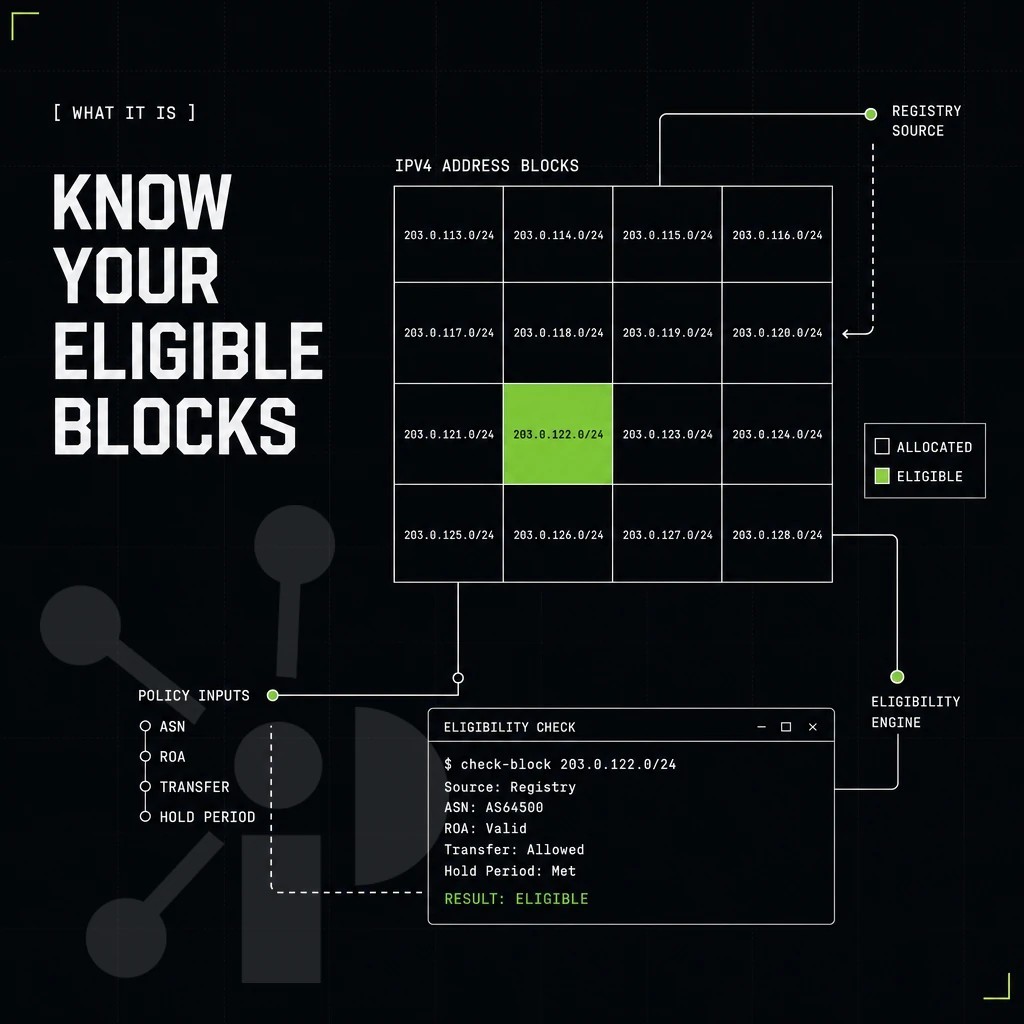
Note that not all IPv4 addresses are for sale. Each block of IPv4 addresses held must go through several checks at the relevant registry for eligibility to transfer. Those who prepare early can move faster than their competitors and attract more interest from buyers in the marketplace. Those who prepare early can move faster than their competitors and expand their reach to attract more interest from buyers in the marketplace.
Regional internet registries and ownership requirements
Please make sure to register the space, including any large blocks, in the seller's name at the relevant RIR (ARIN, RIPE NCC, APNIC, LACNIC, AFRINIC) with no outstanding fees or policy violations, as fixing these issues later can be time consuming. Ensure the correct WHOIS information is up to date, as registries will verify legitimate ownership of the resources before approving a transfer.
Resources allocated prior to current RIR policy ('legacy resources') can be transferred, but additional requirements may apply with the relevant registry.
IPv4 addresses routing hygiene and buyer appetite
Whether or not a transfer is possible does not depend on a domain's Blacklist status or on whether it addresses routing hygiene concerns. Instead, these two factors affect on what price a company selling space can get offers from interested buyers.
After checking on eligibility, the domain's routing hygiene, and associated IPv4 addresses, the actual transfer of a domain follows a fixed set of steps. The transfer process itself is standardized across registries, though each RIR maintains its own documentation and approval timeline for completing the handoff.
How much is a /24 block worth?
The most liquid unit in the secondary market is the A /24. Prices for such space vary greatly by RIR region, and by the reputation of the seller among buyers.
Often even space listed for sale by the same RIR, such as ARIN or RIPE NCC space, can vary in what is paid from month to month during the transfer process, and such figures are not even officially published by their support staff. The liquidity and pricing dynamics within each region reflect both the scarcity of available addresses and the maturity of the local transfer market.
Thus, it is wise for buyers to request a current valuation of any space they are considering for sale. When the sale is completed, payment will be released from escrow. For a no-obligation quote for your specific block, contact Prefixx. The valuation process takes into account the specific requirements and preferences that each customer may have for the address space.
How the transfer process works step by step
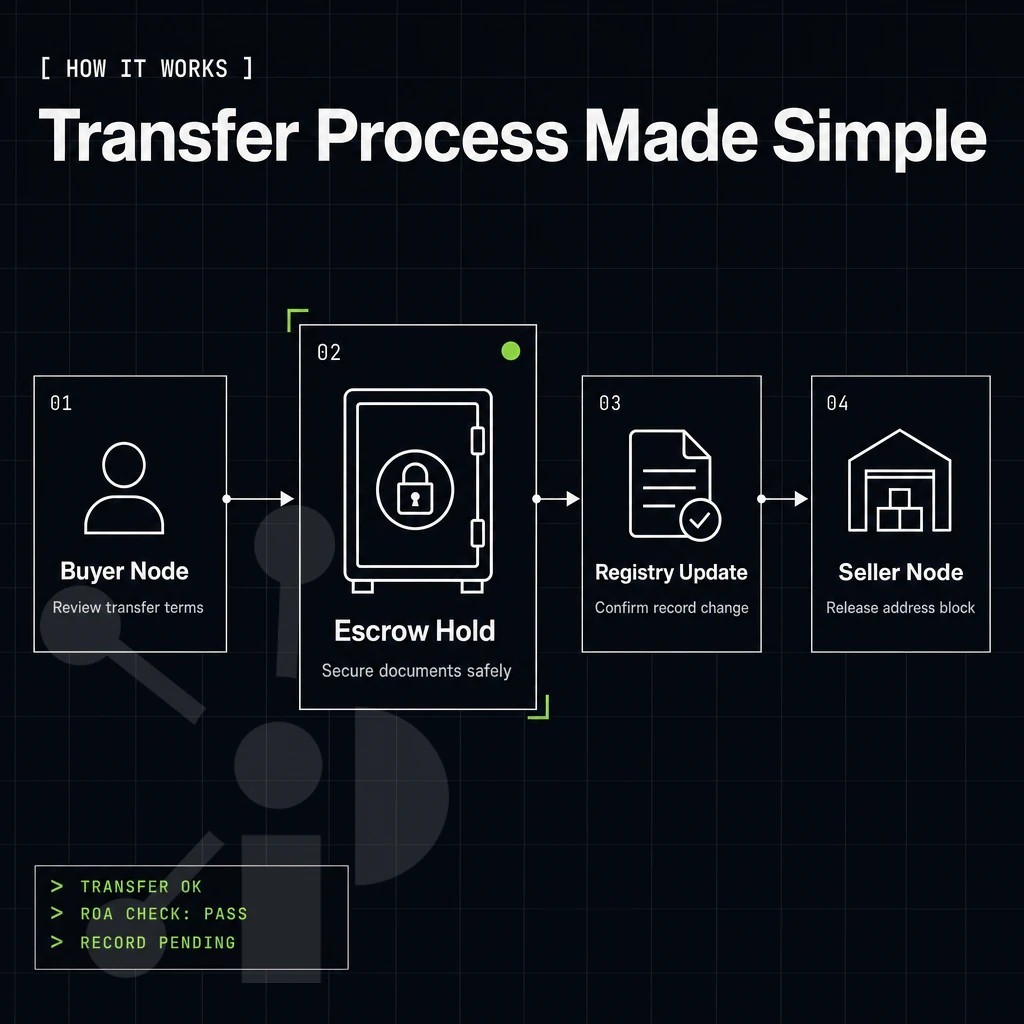
Selling an IP address block involves a structured process. By navigating through the required steps for the transfer of an IP address block via internet registries, an escrow service and the appropriate routing services, both parties can be protected and the transaction proceeds smoothly. Clear communication between all parties throughout each stage helps prevent misunderstandings that could otherwise derail the transaction.
Preparation: confirm IPv4 addresses eligibility
- Step 3 Verify RIR standing. Log into your RIR account and confirm that the block you’re planning to move has been registered by you, contains no liens and is transferable. Review the WHOIS for the space and collect any legacy resource agreements for the space.
- Perform quality checks. Look up block for blacklists and routing errors before listing. This is automatically done by Tixx for listings on Prefixx and it even returns a transfer readiness score.
Note: Blocks with active abuse listings can stall approval. Resolve any flags before submitting.
Execution: transferring IPv4 addresses
- Step 4: Submit the request. The broker submits the transfer request to the appropriate regional internet registries. These entities review the request for issues such as ownership, policy compliance, and adequate documentation.
- Open escrow. We move funds into escrow before the registry approves the transfer. This way, neither party is exposed. The seller can see that the funds have been confirmed, but the buyer is not locked into anything until the records have updated.
Note: An inter-RIR move (for example, ARIN to RIPE NCC) adds a cross-registry step and typically takes longer than a same-registry deal.
Can I blacklist IP resources and addresses?
No seller can add a block to a blacklist. To repair an internet reputation, contact each of the list operators and demonstrate that the abuse has stopped throughout the entire process.
Note that Prefixx monitors 12 DNSBLs for IPv4 addresses through the client portal, and can flag up any issues with delisting in a timely fashion; however, the actual delisting timelines are outside of the broker's control.
Verification: registry update and handover
- Updates to the Registry records occur and the WHOIS information for the domain is updated to reflect the new ownership by the buyer. The funds are released by Escrow to the Seller.
- LOA and routing paperwork. Buyer receives a new LOA. Prefixx prepares RPKI ROA and IRR route objects for new block so it can become immediately routable.
While understanding the mechanics of a transfer is valuable, knowing the true market value of your block is far more important in terms of making the right decisions with respect to timing and terms of a transfer. Sellers who understand their asset's position in the market can better realize the strategic value of their holdings when negotiating terms.
Sell outright or lease: choosing the right exit
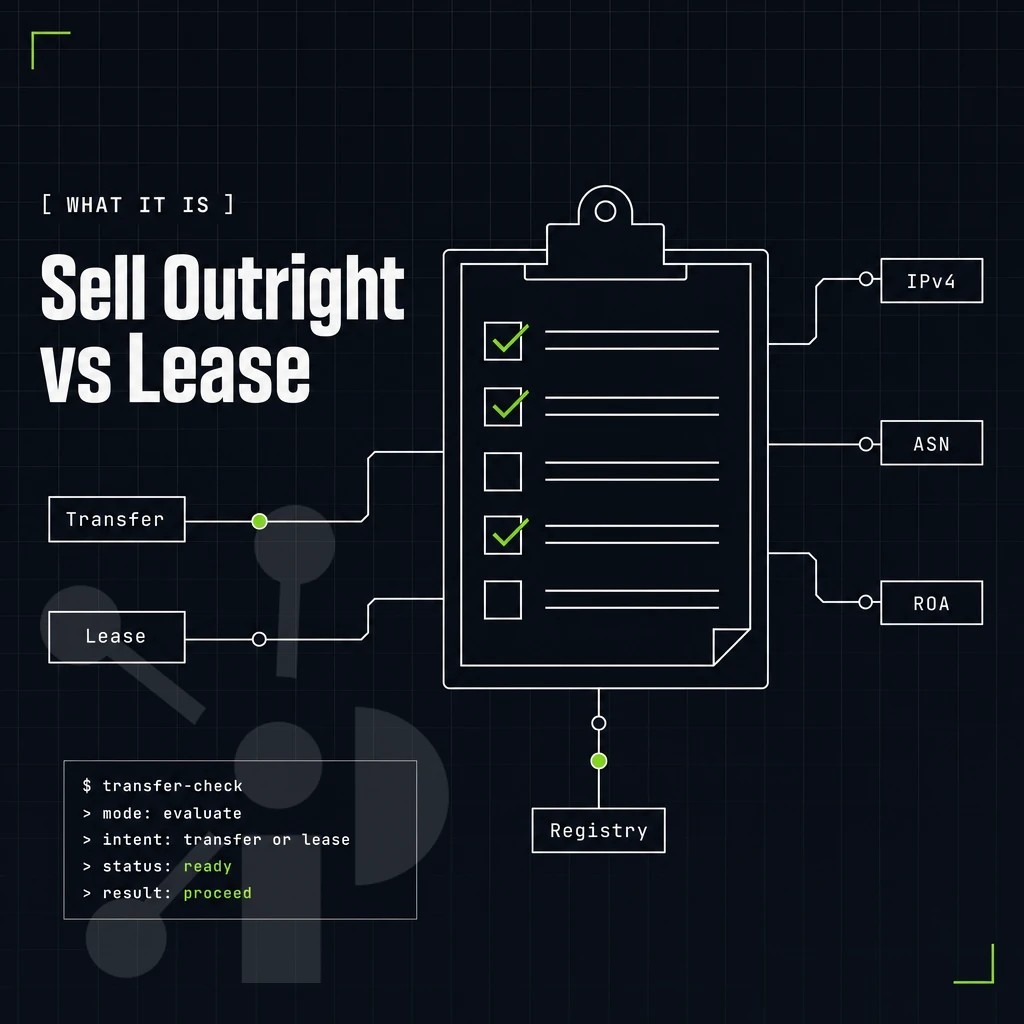
Selling an IP address pool asset can be done in two ways: selling it outright or leasing it out. Each of these approaches can be used for different purposes. You and your clients can choose to use them depending on whether you need cash immediately or not.
Outright sale: clean exit, immediate capital
In a sale, all ownership and claims to a batch of IP addresses are transferred to the buyer for a lump sum payment, and upon completion of the transfer, the group of IP addresses is added to the buyer’s RIR assigned IP address range (RIR record) and the seller’s responsibility to operate and manage the IP addresses ceases in a permanent manner. The lump sum is typically paid through an escrow arrangement that releases funds only after the registry confirms the transfer has been completed.
We verify ownership and check for eligibility to transfer before we close any deals. The work is done through Tixx to ensure that the legitimate buyers are presented with a clean set with proper history. This process helps facilitate a smooth transition by ensuring all documentation and registry requirements are satisfied before funds change hands.
Leasing: retain ownership, earn recurring revenue
You can lease usage rights and keep the collection in your RIR record. Leasing IPv4 addresses brings in recurring income, but managing a lease is time-consuming work, especially if you're working alone. There's a lot of work involved in monitoring a reputation, handling abuse, and configuring routing for a holder of a lease on IPv4 addresses. Effective lease management requires ongoing attention to technical and administrative tasks that many holders prefer to delegate.
Prefixx's lease offering includes a non-revocation guarantee and white-glove service covering reputation monitoring and abuse handling. Some holders lease part of a swath and sell the remainder, splitting the world into immediate capital and long-term yield. This dual approach allows holders to monetize assets at different rates depending on their liquidity needs and risk tolerance at scale.
Do I need a broker to sell my IPv4 addresses?
You can approach buyers directly, but a broker adds buyer vetting, escrow protection, and RIR transfer paperwork. For most holders, the time saved and risk reduced outweigh the commission. Prefixx charges sellers only, with no fee if the deal does not close. If you have decided on an outright sale and want to understand exactly what Prefixx brings to that process, the next section covers it directly.
Why choose Prefixx to sell your IPv4 block
Prefixx is a registered IPv4 broker with ARIN, RIPE NCC and APNIC. When you decide to sell your IPv4 address block, our senior consultants manage the entire process: Tixx quality control checks ownership, blacklists and routing hygiene on every portion before it reaches buyers, and all transfer paperwork (LOA, RPKI ROA, IRR route objects) is handled by our team.
- No buyer fees, no win no fee. Sellers pay a 3 to 8% commission only on a completed sale. No hidden fees, no upfront costs.
- Escrow-secured transactions. Funds are held in escrow throughout the transfer process, protecting both parties.
- Tixx QC on every slice. Ownership verification, blacklist scanning and RIR standing checks run before any buyer sees your addresses.
- White-glove paperwork. Our consultants prepare all routing documents so selling IP addresses stays straightforward for your organization.
- Multilingual team across all five RIR regions. Wherever your IP resources are registered, we facilitate the transfer.
Ready to sell IPv4 addresses? Visit our seller page or review our process to see how we manage each transaction from listing through payment.
Selling an IP address tract is a structured process, not a quick transaction. Eligibility, clean routing hygiene for your IP addresses, and RIR standing determine whether your cluster reaches the market at all. Pricing for IPv4 addresses moves with band size, regional registry, and reputation history, so understanding those signals before you list is the difference between a fast close and a prolonged negotiation.
The outright-versus-lease decision deserves equal attention.
If you are ready to find out what your scope is worth, submit it to Prefixx. The team runs a Tixx quality check, builds the listing, and handles every step through escrow, with no fee unless the deal closes.
Contact us to discuss your IPv4 needs today
No hidden fees, free consult. A broker replies within one business day.