
By Savvas Bout, Founder of Prefixx. Last updated 23 October 2026.
RIPE NCC or APNIC account has a market value and by applying IPv4 monetizationit can be transformed into a tangible and predictable amount of cash without having to give up your allocation permanently.
With all regional free pools having been depleted of technical resources like address space, the only place businesses can get hold of more is the secondary market, where demand from would-be buyers and lessees is structurally high. Organizations with allocations that exceed their current operational requirements can unlock substantial liquidity by participating in this active secondary marketplace. For more context, see Internet protocol suite.
Selling your resource can take the form of an outright sale or a lease, to generate recurring cash flow while still being able to use the resource yourself. Choosing the best option will depend on several criteria, including: do you need the space back within a certain timeframe?
What is the block’s reputation like? Which registry will be involved in the transfer or the lease agreement? Each option takes a different contractual form, with leases typically structured as service agreements and sales executed through registry-approved documentation.
This post covers each option, quality checks for your block, required routing documents that companies need to keep leased prefixes running, and how to evaluate a broker on criteria that matter for big money and long term RIR standing.
What IPv4 monetization actually means
Monetizing unused IPv4 address space, or surplus held in reserved IPv4 address space, can generate one-off or recurring income, from sales or rental. Those holding large blocks of addresses which they no longer use for routing can realize the full asset value held in such resources. Organizations that monetize these allocations can redirect the proceeds toward infrastructure upgrades or other strategic priorities.
Why unused space has value now
By 2011 all five RIRs had used up their free pools of IPv4 addresses. Today all new IP address space is distributed via the secondary market for transfers of existing IPv4 addresses. The scarcity of public IP addresses makes every IP address a tradable asset rather than simply a free allocation of addresses.
Two ways to generate revenue from IP space
Holders of surplus blocks have two clear paths: organizations can monetize their holdings through either route, depending on whether they prioritize liquidity or flexibility.
- Sell: a one-time transfer converts the block into immediate capital.
- Lease: the block stays in your name and generates recurring income while you retain ownership.
Qualifying your IP addresses and IP blocks
Ownership of the block must be clear, routing history verifiable, and blacklist standing acceptable to potential buyers or lessees.
The two core paths: selling vs leasing your IPv4 blocks
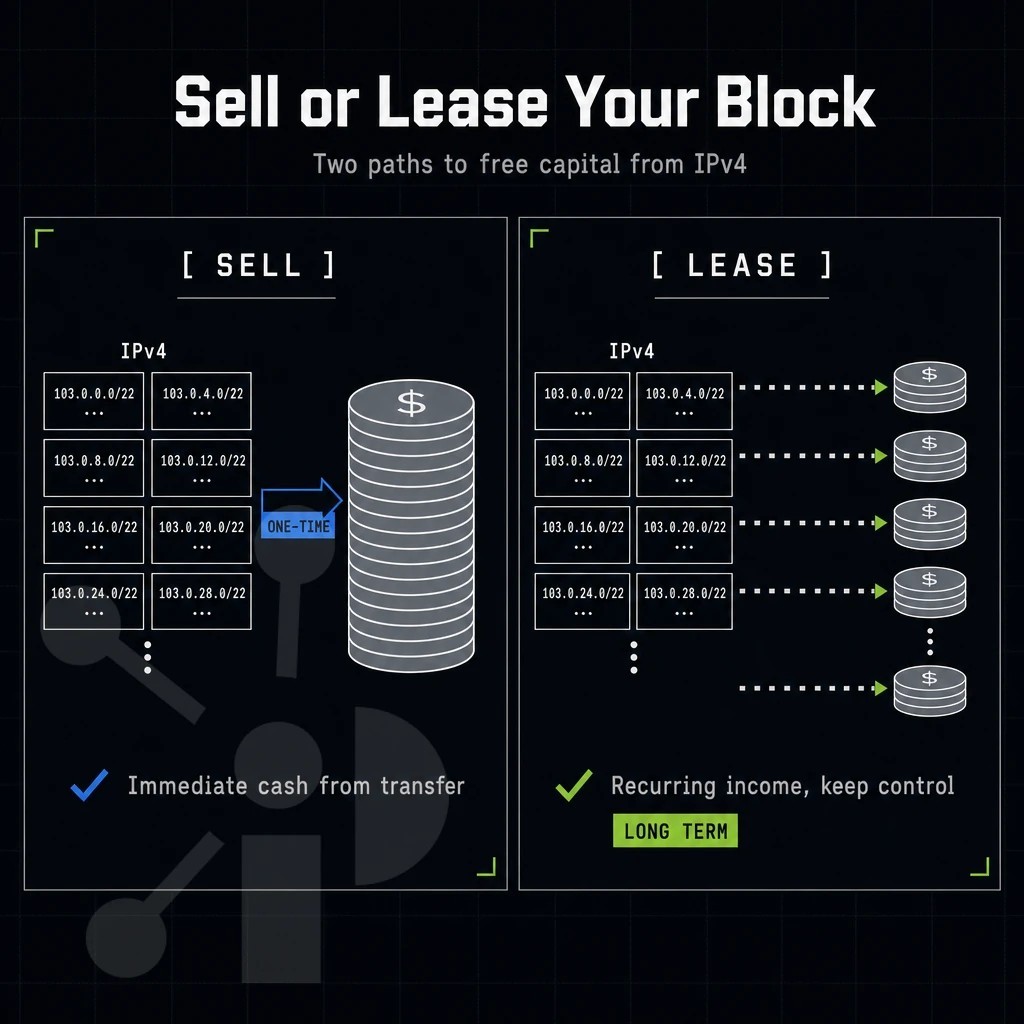
To monetize IPv4 address space, there are essentially two paths: sell it for immediate cash, or lease it to a tenant, preserving long term strategic flexibility by keeping control of the allocation. The best option for you depends on your needs regarding capital, time and degree of control over the address space in question.
Selling: immediate capital, clean exit
When a block is sold, it instantly becomes capital for the owner. A sale includes the transfer of a block’s ownership and it will be immediately removed from your portfolio. The sales price of identical blocks can vary greatly due to the size of the block and the RIR region it is in. For example, a /24 under ARIN can trade at vastly different prices than an identical sized block in the RIPE NCC region in the same month.
Leasing: recurring revenue and retaining ownership
Prefixx offers Leases which generate recurring revenue whilst the owner retains full control of the Space.
Block size and which path fits
| Dimension | Selling | Leasing |
|---|---|---|
| Capital timing | Lump sum at close | Monthly income stream |
| Ownership | Transferred permanently | Stays with you |
| Smaller blocks | Viable; higher per-IP rate | Strong demand from tenants |
| Larger blocks | Higher total proceeds | Broader tenant pool |
Need liquidity now with no future routing plans?
What determines the revenue potential of a block
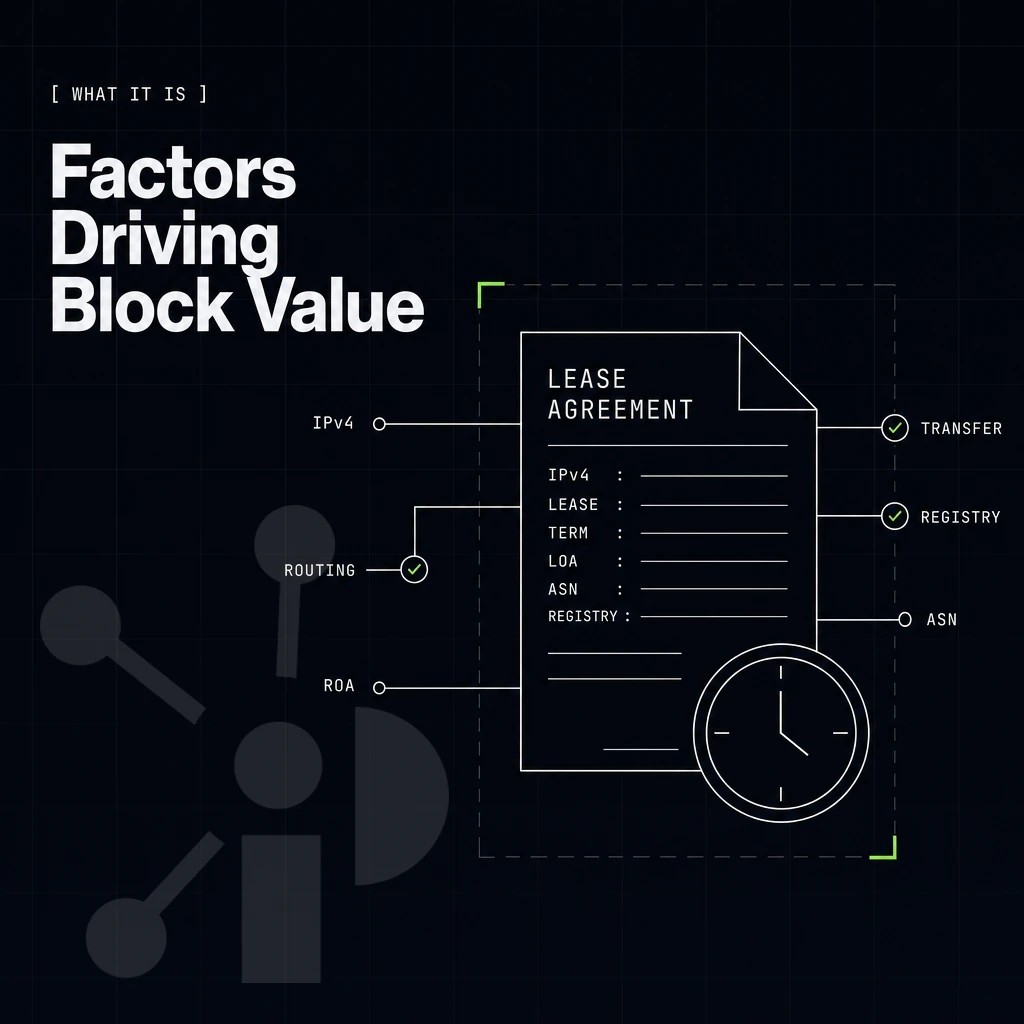
Not all IPv4 blocks have equal value.
Block reputation and data centers routing hygiene
A Blacklist status is the fastest way to reduce the Lease Value of a Block of IP address space.
Leases and Acquisitions of Blocks of IP address block, used to generate revenue or expand operations, are far easier to effect when the buying party can announce the Block(s) without first having to engage in remediation work. Organizations that maintain clean routing records and documented ownership can more readily monetize their holdings when the time comes to divest or lease.
Prefixx uses Tixx to check for domain ownership and transfer eligibility. As well as scan 12 DNSBLs for mail sending and check routing hygiene before any block of IP IPv4 allocation is sold to a buyer or leased as part of a lease agreement. The platform automates these checks to ensure every allocation meets quality standards before listing.
Revenue potential for businesses by region and size
ARIN allocated blocks typically command a premium to comparable size RIPE NCC and APNIC allocated space given strong demand from North American networks and organizations. Blocks of larger size (e.g. /20, /16) can command lower per IP prices than comparable size /24 space given the reduced number of potential buyers as block size increases.
Lease rates follow a similar logic. Smaller blocks of space in high demand locations command a premium on a per address basis. Larger blocks of space are best suited for carriers and cloud operators who can efficiently use large amounts of space. Organizations that monetize their holdings through leasing can adjust pricing based on block size and regional demand to maximize returns.
Transfer eligibility and market timing blocks
The value of a block of IP addresses is largely diminished if it cannot be transferred in a clean process. In addition to reputation, a block's eligibility within transfer processes, a hurdle many organizations encounter, is affected by the policies of the RIRs to which it will be assigned, legacy technical resource status, and outstanding fees.
Market demand for IPv4 addresses varies greatly, however, as the total amount available for sale decreases and as buying in the market goes in and out of season. Organizations that understand these dynamics can position their blocks more effectively when entering the secondary marketplace.
Negotiating prices for blocks is done in good faith. If your block is ready, your reputation is clean, and your ownership has been documented and is transfer-ready, ideally tracked from one dashboard, you are in a strong position to negotiate the best price. Knowing the value of your block(s) is important, but executing the monetization of your block(s) is equally important.
How the monetization process works step by step
We outline the straightforward process of IPv4 monetization in detail. As broker for IPv4 addresses, we accompany our clients through all stages of the process from audit to compliance. Our platform streamlines documentation, buyer matching, and compliance tracking so that clients can focus on strategic decisions rather than administrative overhead.
Audit, eligibility, and reputation check
Start with an inventory of your currently used and unused IP blocks. Verify ownership and check for transfer eligibility at the RIR where the IP space is registered (e.g. ARIN, RIPE NCC, etc.). A reputation and routing hygiene assessment is conducted prior to listing any IP addresses on affected services. Organizations should also review their network architecture to confirm which addresses serve external-facing services versus internal infrastructure that may be candidates for renumbering.
Sale vs. Lease IP addresses: long term value
Forecasts of utilization and the organization’s capital requirements determine whether a sale (permanent) or a lease (generating recurring revenue and preserving future ownership options) is in the organization’s best interest. Organizations with diversified digital infrastructure portfolios often find that a mixed approach allows them to optimize returns across different classes of resources.
Execution and ongoing monitoring of monthly income
Our team prepares the LOA, RPKI ROA and IRR route objects for your network. We manage the RIR transfer or lease agreement execution, keeping the operational processes running without any disruptions. Our team handles all documentation and coordinates with the relevant registry to ensure contracts are executed smoothly and in full compliance with applicable policies.
- Tixx quality control checks every block before it reaches a buyer or lessee.
- Non-revocation guarantees and provisioning within 24 hours for Lease agreements.
- Active leases are continuously monitored for BGP and reputation issues via the Prefixx portal.
The effectiveness of this process depends greatly on the effectiveness of the broker running the process. Experienced brokers understand how to structure transactions that maximize value and help sellers monetize their assets efficiently.
Why work with a registered IPv4 addresses broker
Selling IP address block directly to RIRs and on public markets can be very time-consuming and involve all aspects of buyer and seller vetting. IP addresses holding in escrow, routing and other paper work as well as complying with respective local regulations. Managing these administrative and legal requirements demands significant internal resources and expertise that most organizations lack in-house.
This is all taken care of by registered brokers that help businesses, such as Prefixx that is registered with ARIN, RIPE and APNIC (with LACNIC having been facilitated). They charge a seller-only commission of 3% to 8% (no win no fee), and there are no fees of any kind charged to buyers.
- Tixx QC on every block. We confirm ownership, blacklists, routing, and transfer eligibility before closing any deal.
- Escrow-secured transactions. Funds and addresses move only when both sides are confirmed.
- We handle all the necessary white-glove routing paperwork. LOA, RPKI ROA, and IRR route objects are all set up for you by our team, thus avoiding any transfer process involvement on your part.
- Lease with non-revocation guarantee. Provisioning within 24 hours. Reputation monitoring, reverse DNS, and blacklist scanning are included.
- Boutique human-in-the-loop M&A. Senior consultants on every deal, not M&A software.
Whether you want to sell IPv4 addresses, lease IP blocks for recurring revenue, or explore long-term monetization options while retaining ownership, our consultants can walk you through the options. Visit Prefixx.net/sell-IPv4-addresses or reach out to compare approaches.
Frequently asked questions about data centers
How can companies generate ongoing income from unused IPv4 addresses?
IPv4 address monetization means converting unused or underutilized IPv4 IP range into revenue. You can do that by selling blocks outright on the secondary transfer market, or leasing them to organizations that need routable addresses while you retain long term control, or pursuing both strategies over time. Because the five RIR free pools emptied between 2011 and 2020, every address in circulation has real market worth, and sitting on idle space is a missed opportunity.
How can companies generate revenue from their IPv4 addresses?
The two main routes are a sale through a registered broker or a lease to a vetted tenant. A sale transfers ownership permanently and delivers a lump sum; a lease keeps you on title while generating recurring income. Organizations that sell IPv4 addresses through this route benefit from broker expertise in navigating registry requirements and closing transactions efficiently.
Either way, and preserving flexibility to choose the best path, the block needs to pass quality checks covering control records, RIR standing, blacklist status, and routing hygiene before any transfer can close. Prefixx handles all of that through Tixx quality control, manages the escrow or lease agreement, and prepares the routing paperwork (LOA, RPKI ROA, IRR) on your behalf. Prefixx employs proprietary technology to automate compliance verification and streamline the entire workflow from initial audit through final registry update.
Should companies lease IPv4 addresses instead of selling them?
It depends on your cash-flow needs and your long-term view of the market. Selling delivers immediate capital and eliminates ongoing management, which suits organizations that have permanently downsized their infrastructure. Leasing preserves title, so you benefit from any further price appreciation and keep the option to sell later at a higher market worth.
If your addresses are sitting idle for an extended period, leasing first and selling later is often the higher-return path. Prefixx offers both, with white-glove service included on every lease, so the operational burden on you is minimal either way. Organizations that choose to monetize through leasing can test tenant relationships and address-block performance before committing to a permanent sale.
Is IPv4 becoming obsolete, and does that affect its value?
IPv6 adoption is growing, but IPv4 is nowhere near obsolete. The global internet still routes the vast majority of traffic over IPv4, and most companies running enterprise, cloud, or carrier infrastructure require it for compatibility. Demand for routable IPv4 space continues to outpace supply on the secondary market, which has kept prices elevated since the free pools closed. For the foreseeable future, owning a clean, routable IPv4 block remains a tangible asset worth monetizing. Enterprise and carrier infrastructure depends on IPv4 to maintain connectivity across the global network and ensure interoperability with legacy systems.
With IP address monetization, there are only two ways to go about it: a clean exit or a recurring revenue stream. Selling locks in monetary worth today versus leasing idle space to create a steady income stream of predictable asset worth.
In both scenarios, the financial market worth of a particular block of IP addresses is determined by factors including reputation, RIR standing, and routing hygiene. Therefore, it is critical to have an accurate sense of what you are selling prior to entering the market.
Additional complexity and more paper work than most holders expect is also part of the process. LOAs, RPKI ROAs, IRR route objects and RIR transfer filings all have their own timelines and need to be filled out correctly. Failure in this process can delay the finalization of the transfer and thus reduce its market price.
If you own IPv4 space and want to know what it is actually worth today, submit your block details to Prefixx. The team will assess the block, run Tixx quality control, and come back with a clear long term picture of your options, no commitment required.
Contact us to discuss your IPv4 needs today
No hidden fees, free consult. A broker replies within one business day.