
By Savvas Bout, Founder of Prefixx. Last updated 3 November 2026.
Many organizations incorrectly assume that listing their idle IPv4 address space with a broker is the fastest way to sell their excess space.
To ensure a smooth transaction, it is critical to understand the role of the broker at each step in the process: validating the IPv4 address space you intend to list, establishing fair market prices based on current market offers, evaluating potential buyers and handling all of the necessary paperwork with the RIR. Working with experienced IPv4 brokers ensures that both technical validation and regulatory compliance requirements are met before any transfer is initiated.
This guide will run through all of the steps one by one.
The real variables here are the size of the block of IP you own, the RIR’s policies for said IP and the quality of broker you choose to work with.
For a complete overview, explore our how to list ipv4 with a broker guide.
What it means to list IPv4 address space with an IPv4 broker
Selling an IPv4 address block through a broker means you have hired a specialist to represent your interests and help sell your IP. This would include finding suitable buyers and concluding a sale via an escrow service.
This is different to listing your IP address on a self-serve style sales site or even conducting a direct transfer of your IP from your registry account. When you choose to buy sell through a broker, you benefit from their expertise in navigating registry requirements and matching parties efficiently.
What an IP broker actually does
Your IPv4 broker acts as your agent. He evaluates the IPv4 address space you wish to sell, approaches potential buyers, deals with the relevant RIR, and organizes the escrow payment. The seller never has to negotiate with unknown potential buyers. Working with an experienced IPv4 brokerage ensures that both technical validation and commercial negotiation are handled by professionals who understand registry requirements.
How it differs from self-serve options
Typical self-serve platforms will list your address space for fixed prices for all to see.
We are a seller-only broker, paid only a commission on completed sales. We have no upfront listing fees. Inquire to sell IPv4 address space.
How to buy IPv4 through brokerage vs registry transfer
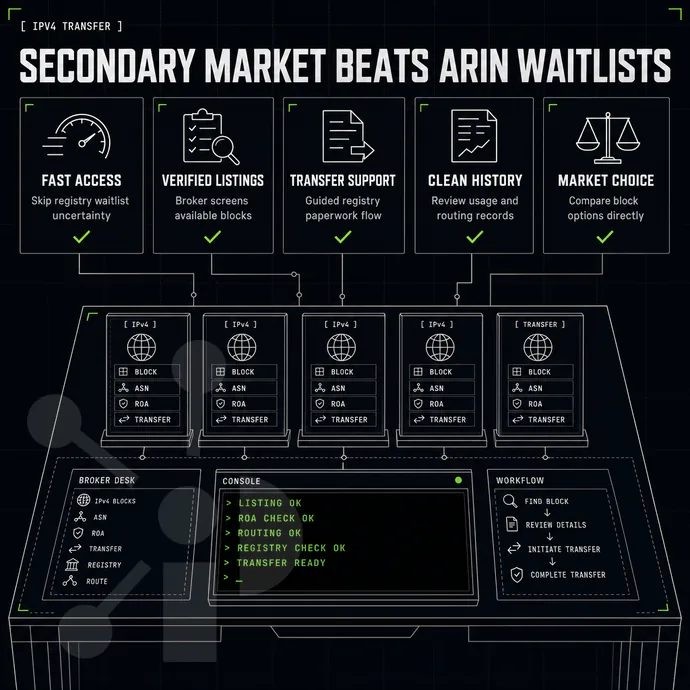
A registry transfer is the transfer of an IPv4 address from one company to another.
Why you should buy IPv4 on the secondary market
All 5 regional internet registries closed their free pools of IPv4 addresses between 2011 and 2020.
Why address blocks make price discovery hard
For now, no registry publishes prices for past transactions. A /24 under ARIN might trade at a very different price than an identical /24 under RIPE NCC in the same month. There is no broker, so buyers have no idea what to pay, and sellers have no way to know if an offer is fair.
Why IPv4 address blocks vary in quality
Some IPv4 address blocks are cleaner than others. While a clean block might look fine on the surface, anyone looking to lease IPv4 space should know that even one IP on a blacklist or a block with unresolved abuse reports or old/stale IRR records can negatively impact a buyer's email deliverability and/or Internet routing before they even send their first packet of email.
Tixx, Prefixx’s pre-sale quality control process, checks for ownership, transfer eligibility. Additionally, Routing health on every block of IPv4 address space that the Prefixx team is considering for sale well before a sale is actually closed.
Where a broker adds value
A brokered listing of your unused IPv4 address space helps to solve both problems. Prefixx supply is vetted and the listing is handled by the escrow service. All paperwork required for RIR transfer is managed by Prefixx on your behalf.
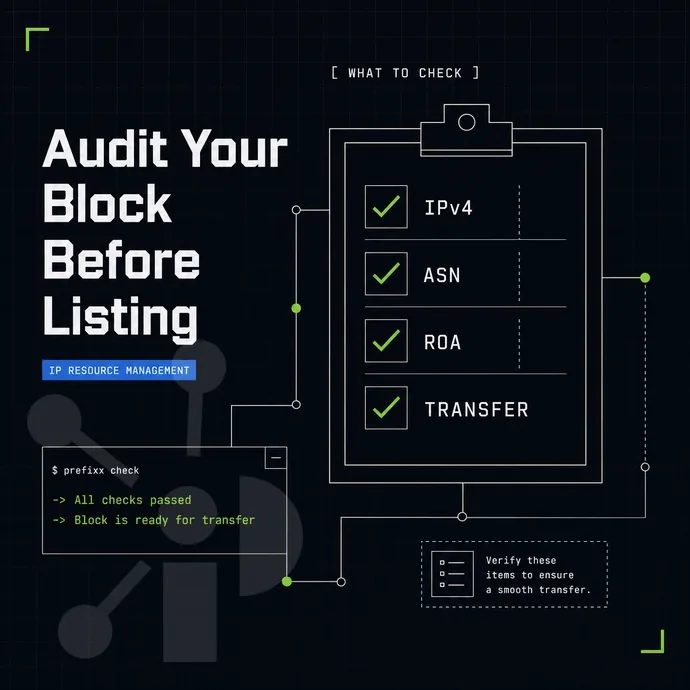
Sellers get a correct market price and are exposed to a pool of qualified buyers. Buyers get to purchase verified IP addresses free of hidden problems in them. However, before all of this can happen, your block of addresses has to pass a set of eligibility checks.
What to check before you list: block eligibility and quality
Checking a few simple things before you list an IPv4 block with a broker is crucial: can you sell the block and what will it get you on the open market. One false step and the whole deal falls over. Understanding whether your address block meets transfer eligibility criteria prevents wasted time and ensures you can move forward with confidence.
Ownership and transfer eligibility via IPv4 brokers
- Verify RIR registration for the IPv4 block. Check the RDAP or WHOIS record for the registered IPv4. It must list the organization that is currently the resource holder for that block. Any discrepancy here will prevent any transfer via the RIRs.
- Check if the IP address can be transferred. Each RIR has its own policy. ARIN needs an RSA or LRSA for example. RIPE NCC checks if the member account allows transfers. APNIC and LACNIC have their own waiting-periods for transfers. In addition to the above steps, legacy IP addresses need special treatment as well.
IPv4 addresses routing and reputation health
- Verify if an IP address is blacklisted. Test if an IP address is listed on the major DNSBLs. Being blacklisted reduces buyer interest and makes removal more difficult.
- Review routing hygiene and RPKI state for the given block. Does it have a valid ROA or is it unannounced? Check for orphaned route objects and for an invalid RPKI state flag. This poses risks to buyers.
For every listing Prefixx processes, it runs them through Tixx, our pre-listing quality control check list.
Note: Tixx identifies issues and scores readiness. It does not guarantee delisting outcomes or RIR approval timelines.
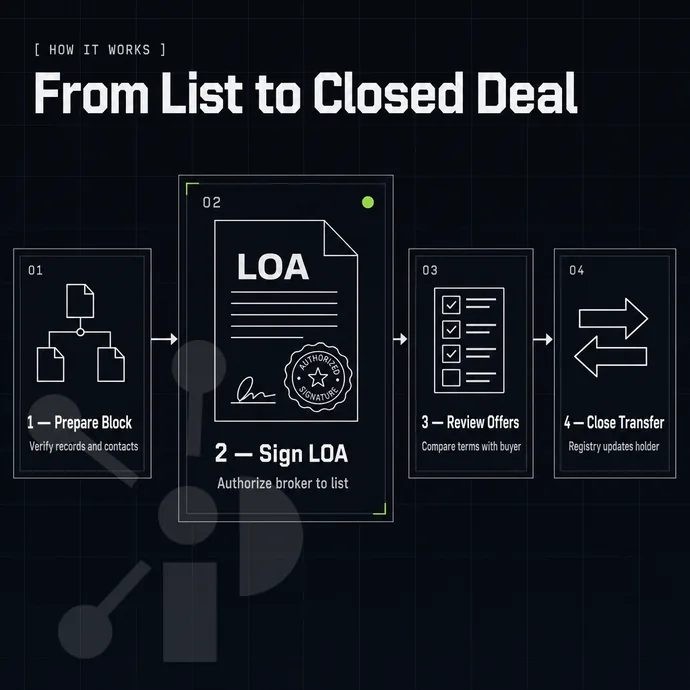
After your block passes all relevant checks, the process moves to the actual sale, from submission to RIR transfer.
How the listing and sale process works step by step
Selling IPv4 through a broker follows a particular sequence. Each stage has a particular objective and, by knowing the process better, you will be able to sell faster and avoid some of the common pitfalls. Understanding when to buy sell through a broker versus handling the transaction independently depends on your organization's familiarity with registry requirements and market conditions.
IPv4 market submission and quality control
Sellers provide Tixx with information on the blocks they wish to sell including proof of ownership. We then run a Tixx quality check on the blocks including verification of ownership, RIR check, blacklisting across 12 DNSBLs and up-to-date routing information. We provide the seller with a health report and a transfer readiness score.
We then offer a price based on our assessment of the buying/selling dynamics of the specific RIR region.
Buyer matching and price agreement
We promote the block to our pre-verified buyers. There is no public advertisement of the block for sale and therefore no unwanted inquiries from non-pre-verified parties.
Escrow close and RIR transfer
The transaction will close via an escrow for the funds. They will not be released until the transfer at the RIR has completed. We handle the full transfer for you and prepare all of the necessary objects (LOA, RPKI ROA, IRR route objects etc) as part of the service.
We charge a seller-only commission of 3% to 8% (the smaller blocks at higher end %), No win, no fee.
Ready to list your block? Contact us at Prefixx.net to start the process.
Understanding the process of assessing a property is not the same as understanding the real value of your block of land in the current market. That will depend on the location of your block and the size of the block.
Why choose Prefixx to list your IPv4 block
Prefixx is a boutique IPv4 brokerage founded in 2018. We work with sellers across all five RIR regions to move IPv4 address blocks cleanly, quickly, and at full market value.
- Seller-only commission, no win no fee. We charge 3 to 8% only on a completed sale. Zero buyer fees means more competitive bids on your block.
- Tixx QC on every block. Ownership, blacklists, and routing hygiene checked before any buyer sees your listing.
- Registered with ARIN, Europe's RIR and APNIC. We handle sell IPv4 transactions across all major registries, including inter-RIR transfers.
- White-glove paperwork included. Our team prepares the LOA, RPKI ROA, and IRR route objects on your behalf.
- Escrow-secured transactions. Funds are held in escrow until the RIR transfer completes.
Ready to list?
Frequently asked questions about address blocks
How long does buying selling IPv4 address blocks take with a broker?
Timeline varies by block size, RIR region, and current buyer demand.
What documents do I need to list my block on a buying selling platform?
At minimum, you need proof of registration with the relevant RIR, showing the block is held in your organization's name and is in good standing.
Prefixx runs Tixx quality control on every IPv4 blocks listing before it goes up for buying or selling, which checks ownership, transfer eligibility, routing hygiene, and RIR standing, so any documentation gaps are caught early rather than at closing.
Can I list a block for lease IPv4 rather than buy or sell?
Yes.
What is the minimum block size a broker will list?
A /24 (256 addresses) is the practical floor for most brokers, because it is the smallest block that can be announced independently in the global routing table.
How does escrow protect the seller?
Escrow holds the buyer's funds in a neutral account before the RIR transfer is initiated. The seller does not release the block until payment is confirmed and secured.
This structure eliminates the risk of delivering IPv4 block to a buyer who has not paid, and it protects the buyer equally by ensuring they do not pay before the transfer is verified. Prefixx has used escrow-secured transactions since day one.
What happens if my block is on a blacklist?
A blacklisted block will not sell at full market value and may be rejected outright by buyers who screen for reputation.
If a listing is affected, Prefixx works through the remediation process, including abuse complaint processing and delisting requests, as part of the white-glove service.
Do I pay anything if my block does not sell?
No.
Listing IPv4 blocks successfully comes down to three things: confirming your IP range is clean and transfer-eligible before you approach anyone, understanding how registry region and block size shape what buyers will actually pay.
While a reputation score gives a first impression of the quality of a registered IPv4 block, other factors such as clear ownership, RIR standing and optimal routing also play a major role in the buying selling process and how fast a block can be sold for the best price. A good broker analyzes these details for you already in the initial consultation, saving you weeks of negotiating later on.
If you are ready to find out what your block is worth, submit it to Prefixx for a no-obligation assessment. Tixx checks every block before it reaches a buyer, and there are no seller fees unless the deal closes.
Contact us to discuss your IPv4 needs today
No hidden fees, free consult. A broker replies within one business day.