
By Savvas Bout, Founder of Prefixx. Last updated 17 November 2026.
The LOA (Letter of Authorization) accepted by upstreams is what differentiates a routable block from one that doesn't route, even when held by an authorized organization with a valid RIR allocation that was just transferred to them.
In many cases even though a customer holds a valid RIR allocation with a proper registry record and the transfer has been completed, all of his or her prefixes will be refused by border carriers' NOCs because the carriers' NOCs have not received any documentation from an authorized representative that they consider to be acceptable.
Upstream providers use the letter of authorization LOA to check whether a customer has authorization to announce a prefix, and the LOA acceptance criteria at upstreams vary greatly from customer to buyer.
Mistakes cost time. LOAs are rejected due to missing AS numbers, wrong CIDR notation, expired dates or because they were signed with the wrong organizational contact. Other providers check the LOA against their RPKI ROA data or against their IRR route objects. Some carriers will also reject an LOA if the prefix is written in a format other than the exact prefix they expect to see in their routing tables.
This article describes what upstreams actually check for. These mistakes are most common during IP deployment and here is how to properly document a prefix in the relevant registry in order to get it announced to the routing table without any back-and-forth with the abuse or routing departments of the carriers. Proper documentation also ensures that queries from network operations or abuse handling teams can be resolved quickly without service interruption.
What a letter of authorization is and why upstreams demand it
A letter of authorization is a signed document by your upstream provider that they will accept a BGP announcement of a prefix that you do not fully own or have verified that you own. The upstream will then configure its border gateway protocol session to accept routes for that prefix from your autonomous system.
What the document contains for authorized organization network operators
An LOA includes the name of the registered holder of an IP address space. The authorized party who may advertise the space, the specific prefix in CIDR notation, the Autonomous System number from which announcements will originate. Additionally, Contact information including a telephone number which may be used to verify information on the LOA. The document must clearly identify the specified ASN that is authorized to originate routes for the prefix.
The document described here is not a registry record. It fills the gap between the data in the RIRs and the provisioning process of an upstream provider. The network operations department can then use this document as human readable artifact to map the request to the provisioning process. This human-readable artifact enables the network action required to provision the route and validate the announcement against the holder's authorization.
Who must sign it as the receiving provider
The LOA must be signed by the resource holder or his/her representative. The representative must be listed as an authorized organization contact in the RIR's database to ensure the signature is recognized by upstream providers.
Why transit providers enforce it
The intent of a hosting provider or a transit carrier cannot be established from the IP routing information alone. When two customers try to advertise the same prefix, the LOA decides who is allowed to originate that specific block of IP addresses. Routing policy enforcement relies on the LOA to validate which entity may legitimately originate BGP announcements for a given block.
How an IP announcement travels from resource holder to transit providers
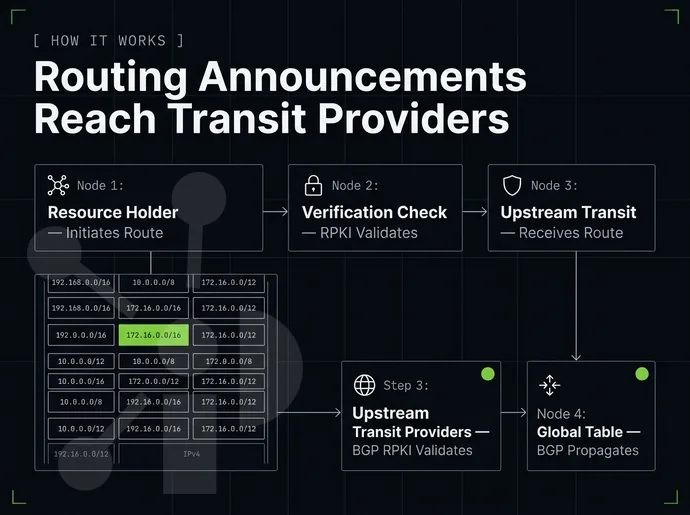
As a resource holder announces an IP prefix, the route goes through several verification steps on the way to being accepted by rest of the Internet. Each of these steps, or “hops”, helps to explain why simple letter of authorization is not sufficient.
From RIR database to intended origin ASN in BGP announcements
A resource holder's block is maintained in the RIR database under their organization's name.
IRR route object, RPKI, and autonomous system number
Typically, LOA are not read by transit providers and network operators on a large scale. They rely on two objects: the route origin authorization (RPKI ROA) which allows routers to verify by means of digital signatures if the correct ASN is announcing a certain block of IP addresses. The IRR route object allows filtering systems to verify if a route is announced in line with the announced LOA authorization or not.
Where Prefixx fits for network operators
For every lease and BYOIP deployment Tixx prepares LOA, ROA and IRR records.
| Layer | Object | Verified by |
|---|---|---|
| Legal | LOA | Upstream ops teams manually |
| Cryptographic | RPKI ROA | Router origin validation |
| Policy | IRR record | Automated prefix filters |
Each of the three layers has its own set of requirements.
IP leasing and the LOA: what changes when you announce IP space you do not own
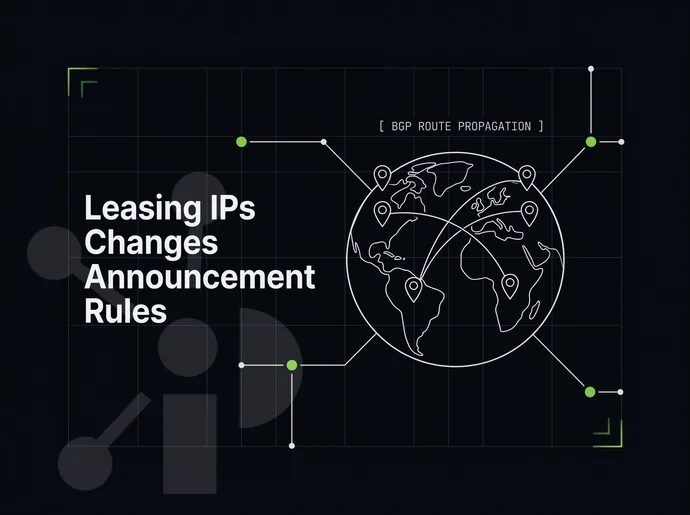
Leasing IPv4 addresses rather than purchasing them results in the registered holder being recorded in the relevant RIR database. The documentation challenge here is that every upstream needs to verify that the announcing party has been delegated to originate the route.
Who issues the LOA for leased IP addresses
LOA must be issued by the resource holder, listing the lessee’s ASN as the authorized origin for the announcement. The document must clearly identify the customer's ASN so that the upstream can verify the authorization matches the announcement.
IRR and ROA must reflect the lessee's IP space
The IRR route object and the RPKI ROA must list the ASN of the lessee as origin, not that of the holder. Routes with an origin ASN not listed in the published objects will be dropped by upstreams running ROV or IRR-based filters. Upstreams validate BGP announcements against these published objects before accepting routes into their tables.
Non-revocation language and the IP address continuity question
The LOA is usually written in such a way that it contains a non-revocation clause for the duration of the agreed-upon lease term. In order to add the specific route to their address space policy, some network operators require a copy of the related service contract as additional proof of and for the leasing agreement in question. Some operators may request additional evidence to confirm the authenticity of the arrangement before updating their routing policies.
Building all of this out correctly (LOA, ROA, IRR objects, non-revocation terms and all) is what Prefixx does for you as part of a BYOIP deployment. The service also includes guidance on how to structure a withdrawal plan should the client later need to decommission the deployment or return the resources.
How Prefixx prepares your LOA, ROA and IRR object for BYOIP
Senior consultants at Prefixx create the necessary documentation for BYOIP for you. This includes the letter of authorization, the RPKI route origin authorization and the IRR routing object. The files are created individually and the necessary data (origin ASN, IP prefix, prefix length) is coordinated with your upstream provider to enable correct BGP announcements by the receiving provider. The documentation ensures that all specified prefixes are correctly identified and authorized for announcement by the designated autonomous system.
- LOAs are created to match the upstream providers’ templates. Authorizations list the authorized party, the ASN of the origin, and the exact prefix in CIDR notation.
- RPKI ROA has been submitted to the related registry to associate the IP prefix with the intended origin ASN.
- New IRR route entry created and maintained to keep registry data in sync with latest BGP updates.
- BYOIP to Netrouting bare metal (AS6206) servers includes LOA, ROA and IRR updates. All done for NO extra charge per IP.
- White-glove service for rented IP addresses includes reverse DNS, geolocation correction and IP reputation monitoring.
No automated engine, no self-serve forms.
Frequently asked questions about your receiving provider
Why is an LOA accepted by upstreams before announcing BGP prefixes?
An LOA is a official written document from the registered holder of an IP block authorizing a specific network or customer to announce that prefix via BGP. Upstream providers require it as proof that the entity requesting the announcement has permission from the rightful owner. Without it, the upstream has no way to distinguish a legitimate announcement from a hijack attempt. Most carriers will not activate a new prefix session until a valid LOA is on file.
Does an LOA expire for each internet service provider upstream?
Many LOAs for your own ASN include an explicit expiry date and prefix length details, typically covering 30 to 365 days, after which the upstream may require a refreshed copy before continuing to carry the route. You do need a separate LOA for each upstream provider, because each carrier needs its own named authorization on file. Some carriers also impose a maximum length constraint, refusing to accept announcements for prefixes longer than /24 in IPv4 or /48 in IPv6.
What is the difference between an LOA, an IRR route object, and a route origin authorization (ROA)?
An LOA is a human-readable authorization letter, signed by the prefix holder and submitted directly to an upstream's NOC or provisioning team. Some carriers maintain their own format requirements, while others will accept a universal LOA template that includes all standard fields.
A ROA is a cryptographically signed record in the RPKI system that lets any router validate whether a given ASN is authorized to originate a prefix. All three serve overlapping but distinct purposes: the LOA satisfies the upstream's legal and operational process including provider acceptance requirements, the IRR object feeds automated filter generation, and the ROA enables RPKI-based origin validation. The ROA identifies which autonomous system numbers are permitted to originate a given block, creating a cryptographic trust anchor that routers can verify independently.
Can I announce leased IP addresses with an LOA, or do I need to be the registered holder?
You can announce leased addresses with an LOA. The registered holder (the lessor) issues the LOA authorizing your ASN to originate the prefix, which satisfies most upstream requirements. The LOA authorizes the lessee to announce the space under their own autonomous system, establishing the legal and operational permission that upstream networks require.
Prefixx includes all of this as part of its white-glove lease service: the LOA documents permission to use the space, alongside the ROA, IRR objects, and reverse DNS, all prepared by the Prefixx team on the client's behalf, so the lessee arrives at the upstream with a complete documentation package. The documentation package ensures that the client can announce from leased space without encountering the common upstream rejection scenarios that arise from incomplete or inconsistent authorization records.
What happens if my upstream rejects my LOA?
Rejection usually means one of three things: the LOA is missing required fields (prefix in CIDR notation, authorized ASN, contact details, or a wet or digital signature from the registered holder), the prefix details do not match the RIR registration record, or the upstream's NOC cannot verify the signer's authority against the WHOIS or RDAP data. Some NOCs require a verification contact step before accepting the LOA, asking the signer to confirm the request by phone or email.
Request the carrier's LOA template if they have one, then cross-check every field against the current RIR record before resubmitting. Some carriers publish a specific template on their NOC portal, while others expect you to draft the letter using standard fields and have it signed by the resource holder.
Do I need a separate LOA for each IP prefix I want to announce?
Generally yes, one LOA per prefix per upstream is the safest approach. Combining unrelated prefixes on one document creates ambiguity that NOC teams will push back on. When a single authorization must cover multiple blocks, clearly delineate one or more prefixes in separate lines to avoid confusion during NOC review.
How does Prefixx help with LOA preparation for BYOIP deployments?
Prefixx prepares the full routing documentation package for every BYOIP deployment under delegated authority: the LOA, RPKI ROA, and IRR route objects are all handled by the Prefixx team, not left to the client to figure out.
This applies across any provider filter you might use, from BYOIP onto Netrouting bare metal, where the service is natively included with no per-IP surcharge, to cloud BYOIP programs on AWS, GCP, Azure, OCI, and Cloudflare, as long as you meet each receiving provider's requirements.
The LOA only contains the information that you provide. The upstreams' route servers will reject the announcement as soon as prefix, ASN and authorized party do not match the IRR route record and the corresponding RPKI ROA.
The chain of LOAs gets longer when leasing rather than buying space. The resource holder signs the LOA, the lessee announces the LOA, and every upstream participant in the chain, including the regional internet registry, must verify that the documentation for the object announced in each LOA looks consistent throughout the chain.
If you are sourcing a block to announce, or prepARIN g to lease space you need routed quickly, Prefixx handles the full paperwork stack. The team prepares the LOA, RPKI ROA, and IRR route objects on your behalf, so your upstream accepts the announcement the first time. Contact Prefixx to get started.
Contact us to discuss your IPv4 needs today
No hidden fees, free consult. A broker replies within one business day.