
By Savvas Bout, Founder of Prefixx. Last updated 27 October 2026.
Purchasing IPv4 addresses is legal. Every year thousands of IPv4 addresses are sold through the IPv4 transfer market via major registries. Secondary markets for IPv4 addresses are complex. Organizations considering buying IP addresses must understand that the transfer process involves registry approval, technical due diligence, and compliance with regional policies that govern these transactions.
Owners of IPv4 addresses are listed with the regional Internet registries (RIRs) and follow strict policies for transfer. So even seemingly simple blocks of IP addresses can contain problems such as blacklisting, incorrect history or even problems with IP addressing (routing) that can take months to fix. These technical and administrative complications can disrupt normal network operations if not properly addressed during the transfer process. Organizations buying IPs should verify routing stability and blacklist status before finalizing any acquisition to avoid inheriting operational problems.
Yes, the RIRs (ARIN, RIPE NCC, APNIC, LACNIC and AFRINIC) have formal transfer policies and thus address resale market acquisition of IP address space is legal and can be traced. Organizations seeking IPv4 addresses through these channels benefit from transparent registry oversight that ensures legitimacy and proper documentation of ownership changes.
It also looks at the structure of an acquisition (i.e. buying IP address space plus associated network or just leasing IP address space for example) and how that affects the amount of protection that can be purchased. The lease cost structure differs fundamentally from an outright acquisition because the lessee never becomes the registered holder and thus cannot obtain the same contractual protections from the registry.
We will also explore the formal regulatory framework, the key due-diligence areas to investigate, and the key difference between a 'clean' transfer of IP address space and a 'dirty' transfer of IP address space, which can lead to significant liability for the acquiring party. These considerations suit organizations of all sizes seeking to acquire IPv4 space through legitimate transfer channels.
Is buying IPv4 addresses legal? The short answer is yes
Buying IPv4 addresses is legal. The sale and transfer of IPv4 addresses is a process managed by the Regional Internet Registries (RIRs) and follows a defined transfer process that has been in place for over a decade. Today’s need for IPv4 address space can most readily be met by the IP address trading market for IPv4 addresses. For more context, see How does buying IP addresses work? (RIPE) : r/networking.
What buying a unique IP address actually means
An IP address is not “property” in the traditional sense of something that can be owned. Each IP address is an allocation of numbers that is held by a party under a contractual relationship with a registry for that block of IP addresses.
Therefore when you “buy” IP addresses you are acquiring the right to use them and to hold that block of IP addresses as the new registered holder after a transfer has been approved by a registry. This contractual arrangement represents a long term commitment to maintain compliance with registry policies and operational requirements.
The RIR records the change, your organization’s name is listed in the WHOIS database and you can control routing to those newly acquired IP addresses. Once the registry update is complete, you can begin using the addresses in your network operations immediately.
Why buying IP addresses on the secondary market exists
The five RIRs depleted their free pool of IPv4 addresses between 2011 and 2020. In total this means that there are zero IP addresses left for new allocations. All blocks of IPv4 addresses are now being moved from holder to holder. This means that all new IPv4 addresses are sourced by cloud providers, enterprises and communication providers. Organizations that delay acquiring address space may find themselves forced to spend millions when their immediate operational needs become urgent and supply tightens further.
Note: This is not a grey market. Such transfers are published in the transfer policies of ARIN, RIPE NCC and APNIC and are logged in public databases for all approved transactions. Organizations pursuing IPv4 leasing arrangements follow the same transparent approval and logging procedures as outright acquisitions.
Buying or acquiring leased addresses safely through IP brokers
The work of an IP broker includes preparation of the transfer documents, checking the history of a block of IP addresses. Payment of the purchase price in escrow until the IP addresses have been registered in the name of the buyer at the relevant IP registry. This structured approach ensures that buying organizations receive clean, transferable address space without hidden liabilities.
At Prefixx our IP consultants go through every step of the transfer process, checking Tixx quality data and preparing LOA and RPKI ROA documents as required by the various IP registries. The following section describes the structure of such an IP address transfer and what is required by each IP registry. This thorough vetting process helps ensure that customers receive clean, transferable address space without hidden routing or reputation issues.
How the IPv4 transfer market actually works
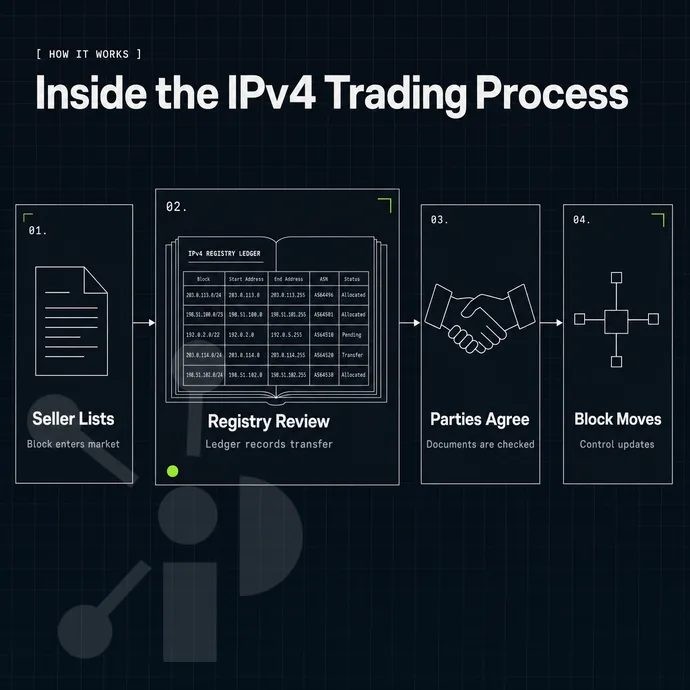
All IPv4 addresses traded today on the secondary market as all five RIRs used up their free pool of IPv4 addresses between 2011 and 2020. For the foreseeable future, IPv4 will be a commodity traded on the market that can be purchased. First one has to understand how the trading and transfer of such IP addresses really works. Then one can buy or sell them in a legal way and with due care.
RIR policies and what a transfer means
A transfer is the recording of a change of registration with a relevant RIR. All five of the regionally-based IP address spaces (including IPv4 address space and AS numbers) can be transferred, including legacy spaces.
Space and numbers, key infrastructure requirements, are registered with ARIN for North America, with RIPE NCC for Europe, the Middle East and Central Asia, with APNIC for Asia-Pacific, with LACNIC for Latin America, and with AFRINIC for Africa. Organizations expanding into new regions must ensure they meet the specific registration and policy requirements of the corresponding RIR before initiating any transfer.
The procedures for the transfer of IP number resources between registries are published by each registry. Transfer of whole block sizes also differs considerably between the registries and usually a /24 is transferred faster than a /16. Also, for inter-RIR transfers a second approval by the registry of the source RIR is required. The block size determines not only the transfer timeline but also the technical complexity of routing announcements and registry documentation required for approval.
Cloud platform pricing, escrow and settlement
A single block of same size IP addresses can trade at significantly different prices per IP when trading under the ARIN namespace versus the RIPE NCC namespace in the same trading month. Large hosting providers and cloud operators with millions of IP addresses in huge blocks negotiate these in private deals with ARIN and RIPE NCC.
Smaller buyers of IP addresses get custom quotes from brokers for their needed IP addresses. Pricing fluctuates based on the current market dynamics within each registry's jurisdiction and the specific technical characteristics of the address block.
Typically, RIRs use an escrow model to settle transactions. Funds are held by a 3rd party neutral until the RIR acknowledges the change in a WHOIS database. This escrow arrangement protects both parties during the transfer of IPv4 addresses and ensures that ownership records are updated only after payment clears.
IPv4 IP leasing as an alternative path
IPv4 leasing allows your company to use un-used address space to route as if it were your own with a non-revocation guarantee. This IPv4 leasing option is typically best for companies that need to go online in a hurry or wish to test out a /24's routing history before purchasing it.
Prefixx can create LOA, RPKI ROA and IRR route objects for leasing IPv4 address space and will provision a lease within 24 hours. Organizations with idle resources can monetize their unused allocations through such arrangements while buyers gain immediate access to address space.
| Path | Ownership | Typical use case | RIR involvement |
|---|---|---|---|
| Buy via transfer | Full | Long-term infrastructure | Transfer approval required |
| Lease | Usage rights only | Short-term or test capacity | LOA and routing paperwork |
| Direct from RIR | Full | No longer available | Pools exhausted |
Each of these paths is affected by the policy rules in place at the relevant registry. Here are the policy rules for each registry. Organizations evaluating IPv4 leasing should review how each registry's transfer and assignment policies govern temporary address arrangements under their jurisdiction.
What the RIR policies say about inter RIR transfers
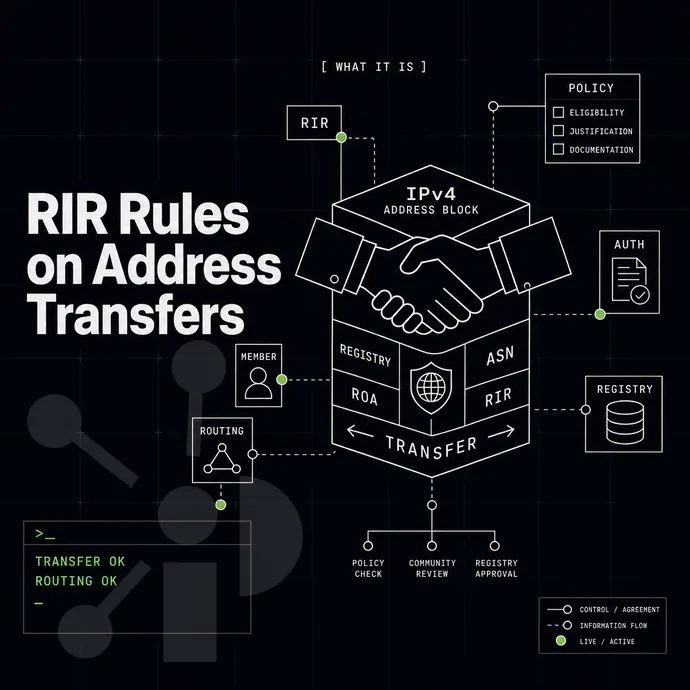
All the RIRs have their own policies, but all the policies have one thing in common. The only thing that matters for a legitimate transfer of IPv4 addresses is that the new holder is registered at the relevant registry for the transferred IPv4 space after the transfer has taken place. While the specific procedural requirements vary across ARIN, APNIC, LACNIC, AFRINIC and other RIRs, the fundamental principle of registered holder verification remains consistent.
Understanding the policy frameworks and registry relationship
- ARIN and APNIC: requires justification and a needs test for the recipient’s ability to use addresses within a certain time frame. ARIN typically requires a 24-month utilization plan to be developed by the recipient. APNIC applies a similar needs-based test to resource transfers between registries. The key to distinguishing a legitimate transfer from a simple sale is the resource relationship between the recipient and the registry.
- RIPE NCC: first-come, first-served. The RIPE NCC’s way of operating the registry for IP addresses for its members is first-come, first-served. Members or their sponsors need to be a current active member of the RIPE NCC to receive IP addresses, not based on usage.
- Inter-RIR transfers: cross-registry eligibility of inter-RIR IP number transfers between ARIN, RIPE NCC and APNIC (according to the respective bilateral agreements) whereas each side applies its local rules and LACNIC IP number transfers are brokered.
What registration actually means for your continuity plan
- Update WHOIS, RDAP and routing registries after transfer procedures completed. New IP holder is shown in WHOIS and RDAP. Update IRR route objects for recipient to announce routes from correct origin ASN. Note: Registry fees are charged by receiving registry.
- Note that failure to comply with a registry’s policies can have serious consequences. However, a registry is not a government and thus cannot impose criminal penalties for non-compliance. Transfers outside of stated RIR policy can result in the addresses in question being revoked, and once a resource has been revoked it is gone, forever.
Knowing the policy framework for buying or leasing is only half the story. You then have to decide whether buying outright or leasing is best for you. The decision often hinges on your organization's financial strategy and whether keeping capital liquid for other investments outweighs the long-term cost savings of ownership. Organizations buying IPs must weigh immediate operational needs against long-term budget constraints when choosing between these two approaches.
Due diligence: what to check before any purchase
Many buyers of IPv4 blocks fail to complete due diligence and end up buying addresses that are blacklisted, under dispute, or cannot be transferred. This oversight affects many organizations that underestimate the complexity of verifying address block history and registry compliance before completing a transaction. Organizations buying IPs without proper technical vetting risk inheriting reputation problems that can take months to resolve and disrupt critical network services.
Verifying ownership and long term commitment before transfer
Start by checking the RDAP or WHOIS data for the seller, to verify that they are listed as the registered contact for the relevant RIR for the block of IP address space in question. Verify with the relevant abuse contacts that the space is not legacy only, under transfer lock, or otherwise prohibited from transfer within a specified time frame.
In any IPv4 leasing arrangement, a discrepancy between the seller's identity and the corresponding registry data for the space constitutes a deal killer. Organizations pursuing short term projects may find leasing more suitable than outright acquisition, though the same verification steps apply to ensure the space is clean and transferable.
Verify transfer eligibility with the RIR where the block is currently held (e.g. ARIN, RIPE NCC, APNIC). Even if a block is legitimately held by an organization, outstanding fees or other policy violations can render it ineligible for transfer.
Organizations buying IP addresses must confirm that the seller holds clear title and that no encumbrances exist that would prevent the registry from approving the transfer. Organizations buying IPs should also verify that the seller has completed any required justification documentation and that the block size aligns with the buyer's demonstrated need under the target registry's utilization requirements.
Inspecting address blocks for routing history and reputation health
Verify if BGP advertisements match the origin ASN of the respective routing table entries. Unexpected hijacks or missing advertisements on a block that got misused or abandoned can be detected by means of reputation monitoring across the major DNSBLs to detect abuse reports and past blacklists not disclosed by the seller. This verification process is essential because IPv4 addresses that have been previously misused can carry reputational baggage that affects deliverability and network trust.
Please verify that the listed contact addresses for potential abuse in the registry are up to date. An active case of abuse can prevent a transfer entirely and also delay it. Organizations exploring IPv4 leasing arrangements should similarly ensure contact records remain current to avoid administrative friction during registry approval processes.
What a purchase agreement must cover
The purchase agreement should contain representations regarding conveyance of clear title, block size, RIR status, and existence of any liens. Such agreement must describe the remedy available for long term control over any defect discovered after closing and specify how the purchase money will be held until the RIR confirms the transfer of title.
In the meantime, the escrow addresses the funds of both parties by holding them and granting long-term control thereof to neither party. The agreement should also clarify the buyer's responsibilities for completing due diligence before buying and outline the timeline for registry approval.
For every block we transfer at Prefixx, it goes through Tixx, our quality assurance layer. It checks for valid WHOIS, blacklists, correct routing, correct RIR for IP space, and generates a health report as well as a transfer readiness score for every closed deal. There are some obvious risks here even with good due diligence and some of them are worth a quick word before we go on.
Why work with a registered IPv4 addresses broker
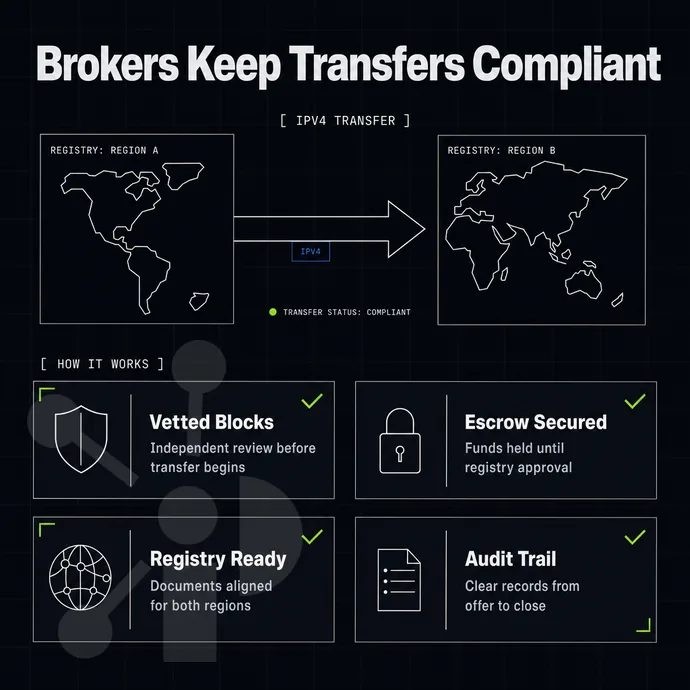
P2P transactions of IPv4 IP assets have several critical gaps in them: no independent vetting of the blocks offered for sale, no escrow to protect payment, no assistance with required routing updates. Additionally, No registry with which to follow up in case of a transaction failure. Brokers bridge these gaps by guiding customers through registry procedures, coordinating escrow arrangements, and verifying that blocks are clean before funds change hands.
Prefixx is a registered holder of IP address block with ARIN, RIPE NCC, APNIC and LACNIC, and can facilitate transfers into LACNIC space. We have fully documented processes for the purchase and transfer of address block from sourcing through to RIR settlement. Our consultants conduct all necessary due diligence on your behalf, to ensure that the purchase of IPv4 block does not become a compliance project for you and your team.
- No fees to buyers. We charge seller-only commission of 3-8% with no win no fee. What you agree is the purchase price is what you pay.
- We run Tixx QC on every block. It checks for ownership, blacklists, routing trail and RIR standing before selling IPv4 allocations to buyers.
- We handle the white-glove routing paperwork for you. We create LOA, RPKI ROA and IRR route objects for you. You just announce the routes and we take care of the rest.
- All secured transactions are conducted as Escrow-secured transactions. All purchase agreements are settled by Escrow.
- Buy, sell, lease or transfer IP range, owned or leased. Also, inter-RIR transfers between registries can be done by one team for you end to end.
If you are weighing buying versus IP leasing, or need to understand what a block of IPv4 prefixes will cost on the current secondary market, our consultants are a good first call.
Why choose Prefixx
Buying IPv4 ranges is legal, straightforward and well-supported by registry policy, but the resale market rewards preparation. Working with experienced IP address brokers reduces financial risk, keeps due diligence on track and ensures every transfer procedure is handled correctly.
- Registered across ARIN, RIPE NCC and APNIC. We broker buying IPs and selling IPv4 holdings under all three registries, with LACNIC facilitated. Every purchase agreement is backed by a proper registry relationship, so ownership transfers cleanly and your allocation is defensible.
- Tixx quality control on every block. Before any IPv4 inventory reach a buyer, Tixx checks BGP history, BGP announcements, abuse reports and RIR standing. You know exactly what you are buying, including how many addresses carry clean reputations.
- White-glove transfer paperwork included. Our team prepares the LOA, RPKI ROA and IRR route objects on your behalf. Transfer procedures across registries are handled end to end, including inter-RIR transfers where your target RIR region differs from the seller's.
- Leasing available for organizations avoiding a large capital expense. IP leasing suits organizations that need IP allocation without a significant upfront investment. Leased addresses come with non-revocation guarantees, reputation monitoring and provisioning within 24 hours.
- BYOIP deployment support. If you plan to announce routes on cloud providers or bare metal, our consultants prepare every routing document and support BYOIP programs across major cloud platforms.
Whether you are buying IPs for the near term or exploring IPv4 leasing as a lower-commitment path, reach out to our team at Prefixx.net to discuss your IP resources and get a personalized offer.
Contact us to discuss your IPv4 needs today
No hidden fees, free consult. A broker replies within one business day.