
By Savvas Bout, Founder of Prefixx. Last updated 22 October 2026.
It’s smart to verify the registration of an IPv4 broker before you wire the funds for a lease agreement . There are many players operating in the secondary market of used IP addresses, and not all of them can verify that they possess the RIR credentials they claim to. Confirming that a facilitator holds legitimate credentials protects the digital assets you intend to acquire and reduces the risk of disputes after transfer.
One faulty transfer of IP addresses in the resale market can cause a lot of harm to the buyer of the IP addresses. They may not be able to announce the IP addresses on their routers . They may get into a dispute with the seller, and lose.
Most importantly, the IP addresses in question may be tied to legacy debt that the seller is not responsible for. The buyer may also face unexpected capital outlay to remediate routing issues or legal disputes arising from the flawed transaction.
To verify the registration of an IPv4 broker, you need to check the public databases of all five registries that issue IPv4 addresses: ARIN, Réseaux IP Européens Network Coordination Centre, APNIC, LACNIC and AFRINIC. Each of these five registries maintains a database of registered brokers who sell IPs, as well as of approved transfer facilitators.
Once you know where to look, the process of verifying a broker's registration takes only a few minutes. The public WHOIS databases also allow you to look up the current registration details of specific addresses to confirm ownership before a transaction proceeds.
This article explains how to verify the registration of IPv4 brokers in detail, including how to check the databases of the five RIRs. What to look for in a registration within your RIR region, what to watch out for in cases where a broker's credentials have expired or have been forged.
Additionally, Finally how the paperwork that a broker uses to negotiate the purchase and sale of IP addresses (lease agreements, LOAs, RPKI ROAs, IRR route objects, etc.) can be used to verify a broker’s credentials. Understanding how these credentials apply when evaluating offers for IPv4 address blocks ensures that buyers can assess whether the seller has legitimate authority over the resources being sold.
What it means for an IPv4 addresses broker to be registered
The registration of a broker is granted by a regional internet registry. ARIN, Europe's regional internet registry and APNIC each maintain a list of authorized transfer facilitators. The registered transfer facilitator is also held accountable by the relevant registry after registration. These registries oversee the allocation and transfer of IPv4 address blocks within their respective geographic regions, ensuring that all transactions comply with established policies.
How each internet registry handles IPv4 addresses
ARIN and APNIC verify brokers directly to publish a list of named facilitators. the European RIR’s broker process is done through the existing LIR membership. This verification process helps ensure that only qualified entities can facilitate transfers within each region's jurisdiction.
Registered IP broker versus unregistered reseller
Unregistered resellers typically list IP addresses on any online trade platform without any control from IP registries.
How to verify an IPv4 broker registration in practice
Registration of IP numbers does not necessarily include all services a broker is offering. Services like Reverse DNS, RPKI setup, IP reputation checks etc. are usually outside of the scope of the IPv4 address blocks registration at the different RIRs (Regional Internet Registries). We are brokering IP number sales across all five RIRs and those extras as services. Many organizations and companies rely on these additional services to ensure their newly acquired address space is fully operational and properly configured for production use.
ROA (Route Origin Authorisation) and IRR (Internet Routing Registry) objects are handled for you, so sellers and buyers of IP numbers don't need to worry about paperwork.
Red flags that signal an unregistered or risky broker
Not all listings on the secondary market are legitimate.
Vetting the IPv4 broker and address blocks
- Check if a RIR registers your broker. Lists of registered brokers are published by ARIN, the RIPE registry and APNIC. If a broker is not in the list, stop buying from this broker. No registration implies no accountability towards a registry.
- Verify block hygiene by obtaining a written report detailing the ownership of the specific blocks, blacklist status and full routing history prior to any offer being presented. Legitimate brokers conduct this verification prior to presenting an offer on a block of IP addresses that they sell. Tixx by Prefixx verifies all of the blocks that we sell prior to an offer being presented.
- Demand escrow. Any broker trying to tell you to refuse escrow is a scammer. Escrow holds both parties’ funds until RIR transfer is complete.
Reviewing IPv4 addresses purchase agreements and fees
- Read the fee schedule carefully in order to avoid hidden fees within paperwork that have killed deals in the past. A true broker only charges the seller and clearly states his or her commission in advance. The buyer should never pay a fee for his or her services.
- Verify the ownership documents. Large blocks of IP with vague or missing RIR records constitute a serious warning. Require RDAP output plus signed LOA prior to transfer initiation.
Doing your due diligence in the free pool transfer process
- Carry out a detailed comparison between the broker’s process as stated and the published RIR transfer policy and highlight any differences which could indicate a shortcut being taken that may invalidate the transfer.
Note: If a broker cannot produce a block hygiene report or refuses to name the escrow provider, walk away. No legitimate deal requires you to waive due diligence. Once you have ruled out the bad actors, it helps to understand what a registered broker who handles IP assets actually does step by step, so you know what to expect from the right one.
What a registered broker actually does during the transfer process
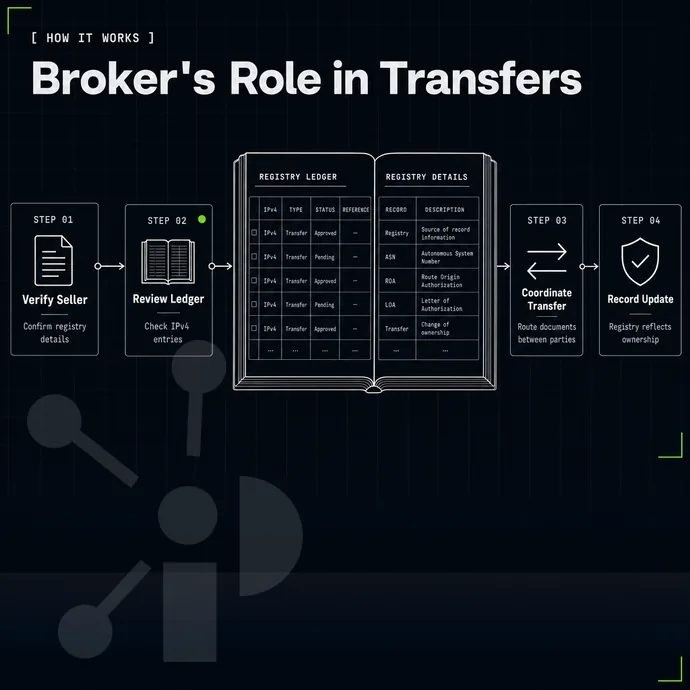
A registered broker acts as a neutral intermediary between a party looking to sell IP address space and a party interested in buying IP address space and co-ordinates the parties’ respective requirements and respective conduct with respect to the transaction that each party is not able to arrange themselves. The intermediary's role depends on clear communication to align both parties' expectations and ensure each step proceeds smoothly.
Vetting the IPv4 address blocks before purchase
Before we can complete a transaction, the broker performs a number of checks: verifying the owner of the IP address, verifying the RIR status, checking if the IP address is listed on any blacklists, and verifying the IP address’s routing health.
At Prefixx we call this Tixx and it generates a health report along with a transfer readiness score for every block of IP addresses we sell. The owner's org id is cross-referenced against the RIR's public WHOIS data to confirm that the listed resource holder matches the party requesting the transfer.
Preparing documentation and submitting the transfer process request
Once a block of IP addresses has cleared Quality Control by the broker, the broker will prepare the LOA, RPKI ROA and IRR route objects for submission with the formal transfer request to the appropriate RIR. The broker does not become a RIR and thus cannot allocate IP addresses. The broker's role is to submit the documents to the RIR and to follow up until the completed transfer is confirmed by the RIR.
The funds are held in escrow throughout the process. The funds are released from the escrow account only after the registry has confirmed the RIR transfer.
How block size and registry policy shape the full transfer process
Registry policies vary by region as well as by allocation size. A /24 typically moves through the process faster than a /16 for due-diligence reasons. The three main regional registries (ARIN, the European regional internet registry and APNIC) each manage their own online platform with needs-justification or waiting-period requirements.
A broker that is registered with all three can assist a buyer of IPv4 address blocks through the requirements of all three registries. Organizations that plan to expand their infrastructure across multiple regions benefit from working with a facilitator registered in all three.
The time frame from signed LOA to confirmation of routing for IPv4 addresses can vary greatly between registries and blocks but typically completes within days to weeks. A broker being registered with the various RIRs gives credibility to a submission and keeps a transfer on track. Routing confirmation signals that the transferred assets are now operationally under the buyer's control and ready for production use.
How Prefixx satisfies each registration check
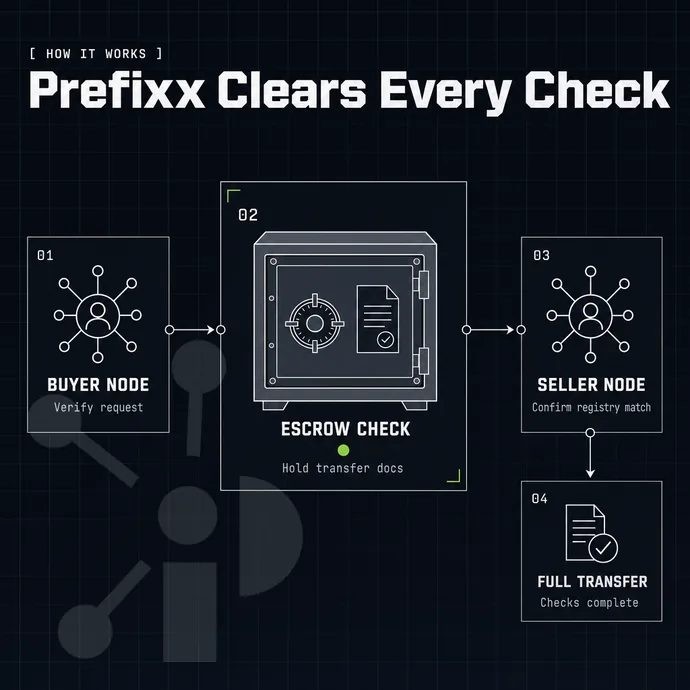
Prefixx is a registered IPv4 broker with ARIN, the RIPE coordination centre and APNIC, facilitating LACNIC transfers. All transfers are fully escrow-secured and include no buyer-only fees. Prior to a sale of an address block, Tixx by Prefixx runs pre-sale quality control checks on prospective buyers including verification of ownership or authorized transfer.
Eligibility to receive IP addresses, IP address blacklist checks and full IP address routing/infrastructure checks for proper connectivity and operational health. Buyers gain immediate access to technical support and routing assistance once the transfer is confirmed.
Lease IPv4 addresses and receive white-glove service including rDNS, geolocation corrections and IP address reputation monitoring and alerting. Prefixx handles all the steps of transfer fully for you. All you need to do is buy IP addresses and we handle the rest with no hidden fees or confusion over necessary documentation. Organizations that sell IPs through Prefixx benefit from the same comprehensive support and documentation handling throughout the transaction.
- Registered Broker for ARIN, the RIPE authority and APNIC; LACNIC facilitated registration.
- Escrow-secured transactions; zero buyer fees.
- Tixx QC on every IPv4 address block: ownership, blacklists, routing hygiene.
- White-glove leasing: PTR records, geolocation, reputation monitoring included.
- LOA, RPKI ROA and IRR objects created by our consultants.
We'd be happy to verify an IPv4 broker's registration before you commit capital to a purchase. The following are some of the questions we've encountered from potential buyers of IPv4 address space as they begin their inquiry with Prefixx.
Frequently asked questions about IPv4 addresses
Does a broker serve the same role as an RIR when purchasing an address block?
No. A Regional Internet Registry (RIR) is the official body that allocates and records IP address ownership for a geographic region. ARIN, the European IP registry, APNIC, LACNIC and AFRINIC are the five RIRs. A broker is a private intermediary that facilitates the buying, selling or leasing of address space between parties, and must apply to each RIR separately to be listed as an approved transfer agent. The RIR records the transfer; the broker manages the deal. The RIR also maintains the free pool of unallocated addresses in its region until that pool is exhausted.
Can a broker facilitate buying directly without RIR registration?
Technically, anyone can call themselves an IPv4 broker, because the title is not legally protected. However, only brokers listed on an RIR's approved facilitator or transfer agent roster can submit transfer requests directly through the registry's processes. Working with an unregistered intermediary means buying directly through informal channels that lack the oversight and protections that come with official facilitator status.
An unregistered broker must rely on the buyer or seller to file paperwork themselves, which increases the risk of errors, delays and fraud. If a broker cannot show you their listing on at least one RIR's facilitator page, treat that as a serious red flag. Seeking expert advice from a registered facilitator before signing any agreement helps buyers avoid these pitfalls and ensures proper due diligence.
What documents should a broker provide before transferring IPv4 addresses?
Before a transfer proceeds, a registered broker should supply a Letter of Authorization (LOA) confirming the seller's right to transfer the block, evidence of RIR registration for the specific registry involved, and a signed transfer agreement or purchase contract held in escrow. For routing continuity, the broker should also prepare or verify RPKI Route Origin Authorizations (ROAs) and IRR route objects. Receiving these documents before any funds move is the baseline check for a legitimate transaction. The seller must also initiate the transfer request through their RIR portal, ensuring that all authorization records match the LOA exactly.
How long does transferring IPv4 addresses through a broker take?
Timelines vary by registry and prefix size. ARIN transfers within the RIR region commonly complete within a few weeks once all paperwork is submitted and the registry review queue is clear. RIPE's network coordination centre transfers can move faster when both parties hold active LIR memberships and documentation is clean. Clean paperwork and responsive communication between parties facilitate smoother handoffs at each stage of the review process.
APNIC sits broadly in the same range. An experienced broker who prepares the LOA, verifies transfer eligibility and submits complete paperwork on day one will consistently reach the shorter end of those windows. Incomplete documentation is the single biggest cause of delays. Transfers involving smaller blocks often move through the queue more quickly than large prefix requests because they require less scrutiny during the eligibility review phase.
Does broker registration differ between ARIN, RIPE NCC and APNIC?
Yes, each RIR runs its own program with distinct requirements. ARIN maintains a list of approved IPv4 transfer facilitators, and brokers work with support staff to apply separately to be included. RIPE does not operate a formal broker registry in the same way, but brokers typically work through or alongside a sponsoring LIR.
APNIC similarly has its own transfer policies and eligibility criteria. A broker operating across all three regions must satisfy each registry's rules independently, which is why verifying registration region by region matters rather than assuming one listing covers all. Organizations and companies seeking addresses in multiple regions should confirm their facilitator holds the necessary standing with each applicable RIR.
What happens to my funds if a broker is not registered?
Without RIR registration, a broker has no standing to guarantee that the block will transfer cleanly, and there is no registry-backed accountability if the deal collapses. If funds were not held in a neutral escrow account, recovering them depends entirely on civil litigation, which is slow and uncertain across jurisdictions.
Even with escrow in place, an unregistered broker may be unable to complete the RIR paperwork, leaving you with money tied up and no address space. Registered brokers who use escrow from the start, as Prefixx does on every transaction, eliminate this exposure by design.
Verifying a broker’s registration is not a triviality. It is the quickest way to distinguish between authorized intermediaries and unaffiliated operators throughout the entire process, without standing at ARIN, Europe's RIR or APNIC. The easiest way to check for authorized brokers in Latin America is to refer to the respective registry's list of accredited brokers. Verification of an escrow function is also recommended.
A registered broker does more than facilitate a handshake. They manage transfer paperwork, quality-check the block with the relevant RIR before it reaches you, and ensure routing hygiene is in order from day one. Prefixx is registered with ARIN, RIPE, and APNIC, runs Tixx quality control on every block, and secures every transaction through escrow. If you are sourcing address space and want a broker you can verify before you sign anything, start with Prefixx.
Contact us to discuss your IPv4 needs today
No hidden fees, free consult. A broker replies within one business day.