
A successful closed IPv4 auction is a harsh reality check: the free pool has long been depleted, and everyone is now left to fight it out on the secondary market. Engineers and other infrastructure leads seeking supply of addresses today are forced to assess various auction platforms.
The transfer time, the respective policies of the registries as well as the quality of the blocks on offer. What on the surface appears to be a serviceable block of IPv4 addresses can in reality be affected by many factors including being on a black list. Having problematic routing and even having holds on transfer.
This guide covers auctions for IPv4 addresses held by ARIN, RIPE NCC, APNIC, and LACNIC, the factors that determine prices across registries, the quality of blocks up for auction and how to evaluate them before you bid. Additionally, where auctions stand in comparison to brokered transfers and leasing.
I start with the mechanics of the actual auctions.
What is an IPv4 auction and how do IPv4 address blocks work
An IPv4 auction is an online auction-style system where a seller lists IP address space (an IPv4 block) for sale, and then a buyer places a bid within a set time frame. The clearing price is determined by the live demand at the time the highest bid is removed, rather than some fixed rate per IP that has been established. Therefore, the final per IP value is what the market is willing to pay for that IP on that day.
How the mechanics work
A seller can list an IPv4 block and define an auction period, as well as a reserve price for the block. Then, during the set auction period, registered bidders can place incremental bids for the IPv4 block.
The highest bid above the reserve price wins the auction when the set auction period timer closes. The winner of the auction then pays the clearing price for the IPv4 block and can transfer and then escrow the block. For more context, see IPv4 address exhaustion .
Why prices vary by registry
The price for a /24 can differ between ARIN and RIPE-NCC (identical block size) even within the same month. Here the regional supply, the network policies as well as the pool of potential buyers are key factors. There is no fixed published price for a /24 in the whole market.
What auctions miss
- No quality check on the block before bidding closes.
- Routing hygiene, blacklist status, and transfer eligibility are rarely disclosed upfront.
- After the fact the buyer is responsible for the paperwork (LOA, RPKI ROA, IRR).
Brokered deals fill that gap. If you want a vetted block with escrow and white-glove transfer support, contact us before committing to an auction outcome. To understand exactly where the two models diverge, the next section breaks them down side by side.
What is a brokered IPv4 transaction and how does it differ
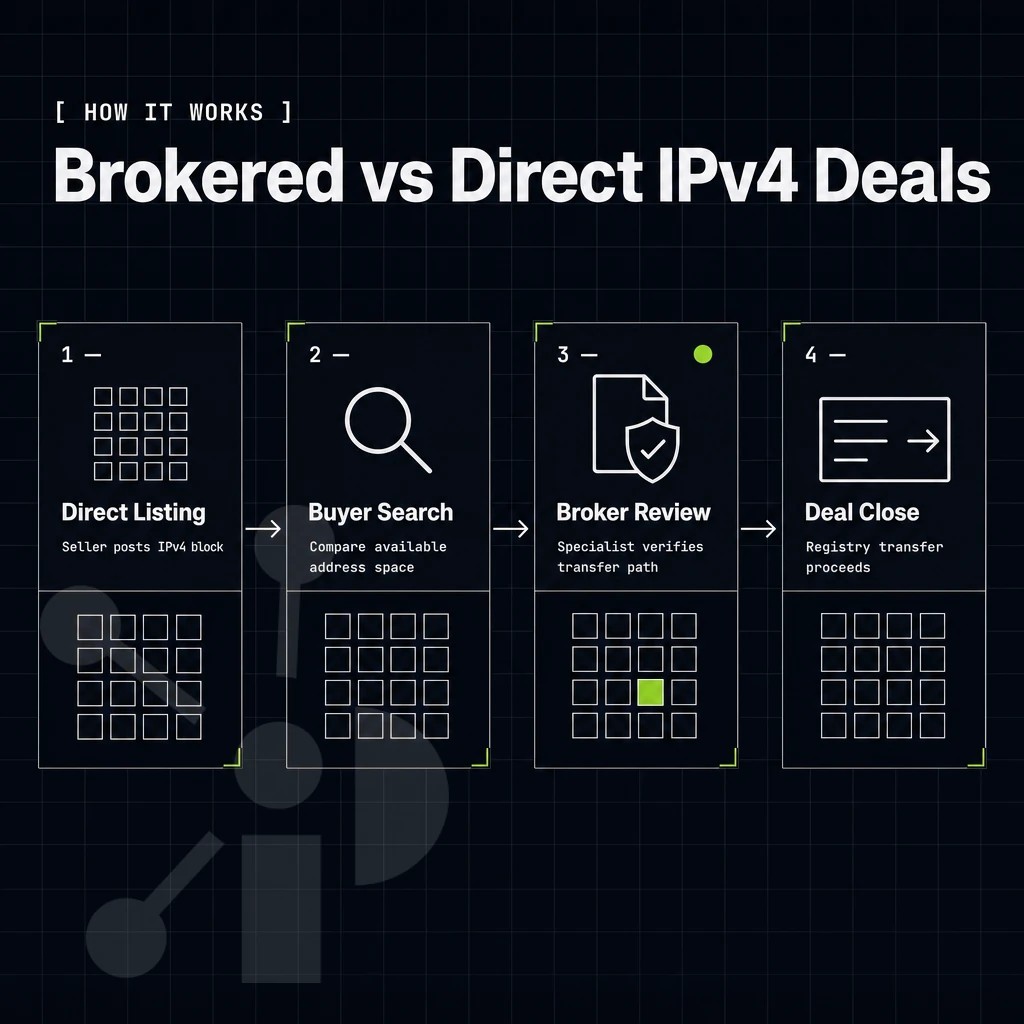
In an IPv4 auction, the highest bidder wins the allocated address space. A brokered transaction is conducted by a specialist intermediary who sources the required IPv4 address space (in the form of blocks) on a private basis. The intermediary then checks the addresses and negotiates a price before finally closing the transaction via an escrow service. There are three key aspects that differentiate these models for the buyer.
Price discovery
Auctions are bid-driven, with prices moving in real time.
Quality control
Due diligence in an auction for IPv4 addresses is with the buyer(s). In a negotiated sale of IP addresses, a broker typically checks the ownership, RIR status, black list status, and routing health of a proposed block of IP addresses before presenting the sale to potential buyers.
At Prefixx, for example. Tixx performs these checks prior to offering any block of IPv4 addresses for sale to potential buyers, with the block not being offered for sale until the buyer is advised that the transfer is ready (i.e. a clean transfer-readiness score).
Timeline and process
There are fixed times for auctions to close. There is no guarantee that a block will pass RIR review after the transfer process has started after the hammer has fallen. Brokered deals will only move when both parties are ready and the necessary paperwork has been prepared in advance.
| Dimension | Auction | Brokered (Prefixx) |
|---|---|---|
| Price discovery | Bid-driven, volatile | Negotiated, predictable |
| Quality control | Buyer-beware | Tixx vetting on every block |
| Buyer fees | Typically charged | Zero buyer fees |
In that case, brokered is the stronger option, but first, let's go through the pros and cons of each.
IPv4 address blocks: auctions versus brokered deals compared
Both routes allow buyers and sellers to trade IPv4 IP resources. Understanding the differences and trade-offs helps determine the best route for any block size and time frame.
Auction pros and cons
- Price transparency. Competitive bidding for real market prices. For liquid block sizes, like a /24, price discovery can happen much faster.
- Speed. Active auctions can close faster than a negotiated sale, provided there is sufficient demand at the time.
- Routing and reputation risk. Given that most auctions are sold prior to the sale without pre-sale quality checks, buyers can end up purchasing blacklisted IP addresses or faulty routing configurations. Transfer paperwork usually is left to the buyer to complete after the sale.
Note: Winning a bid does not mean the IPv4 block is clean. Blacklist status and IRR hygiene are your problem once the hammer falls.
Brokered deal pros and cons
- Verify quality of every block before selling to others by running through Tixx. Verify ownership, blacklists, routing, and RIRs before selling.
- All escrow and paperwork included. LOA, RPKI ROA and IRR route objects created by our team. Settlement protected for both parties by escrow.
- Less real-time price visibility. No live bid feed. If you want to sell your IPv4 addresses or buy a block of IP addresses, you will engage with a consultant who will offer you a quote on a personal basis.
- This process requires time for discussions with consultants. In the meantime, buyers interested in the sale of IPv4 addresses at a public price and in a fast manner, could consider an auction.
Note: The brokered model trades speed for certainty. For most enterprise buyers, inheriting a clean block with routing paperwork handled is worth the extra step. Those trade-offs become easier to evaluate once you understand what blocks actually cost in today's market.
IPv4 pricing: what blocks sell for when you sell IPv4
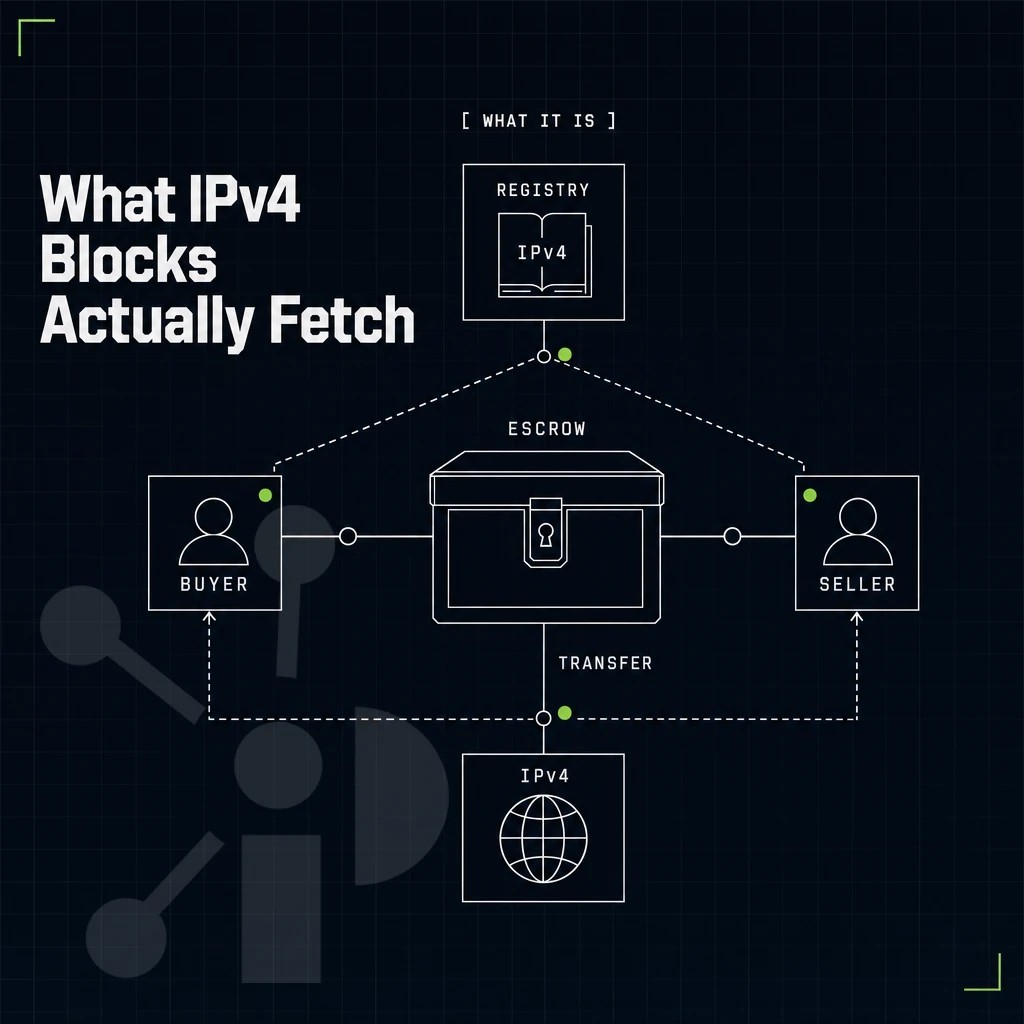
Pricing for IPv4 addresses can vary based on supply and demand, as well as the registry region. No official rate card exists, and what a block actually trades for can vary greatly based on where the block is from, how large it is, and the history of the block.
How per-ip prices have moved
Per-address prices on the transfer market have climbed steadily, and scarcity is the reason. The five RIRs exhausted their free pools between 2011 and 2020, so every block changing hands today comes from the secondary market. What any given block fetches depends on its registry, its size and its history, and it moves month to month.
Why block size and region shift the number
In addition to block size, larger blocks can also command higher per-IP prices depending on the RIR region in which they are located.
They are discovered by doing transactions.
How Prefixx prices deals
Prefixx does not list prices per block of IPv4 IP inventory. Prefixx issues personalized offers for a fixed period of 72 hours for the respective IPv4 block(s) and the respective market situation. In line with industry practice, there are no fees for buyers and sellers of IPv4 resources .
The commission, which is typically paid by the seller.
Why choose Prefixx for your IPv4 block transaction
Prefixx is a boutique IPv4 brokerage built around one principle: every IPv4 block transaction should be clean, documented, and fully protected. Whether you want to buy, sell, or lease IPv4 addresses, our consultants manage the process from sourcing through routing paperwork.
- Zero buyer fees. Sellers pay a 3 to 8% commission, no win no fee. Buyers pay nothing.
- Tixx quality control on every block. Ownership, blacklists, routing hygiene, and RIR standing are verified before any IPv4 address block reaches a buyer.
- Escrow-secured transactions. Every deal is settled through escrow. The transfer process is handled end to end across ARIN, RIPE NCC, APNIC, and LACNIC.
- White-glove routing support. Our team prepares the LOA, RPKI ROA, and IRR route objects on your behalf, including BYOIP deployment onto bare metal.
- Registered broker across three RIRs. We are registered with ARIN, RIPE NCC, and APNIC, with LACNIC transfers facilitated.
Ready to sell IPv4 space or source a vetted block? Browse our marketplace or contact us to discuss block size, region, and timeline.
Auctions move fast and can surface competitive pricing, but they trade control for speed.
Pricing varies by RIR, block size, and reputation. No public list exists. The only reliable way to know what a block is worth today is to talk to someone active in the market.
If you are buying, selling, or leasing IPv4 space and want a vetted block with zero buyer fees and Tixx quality control on every address, Prefixx is the next call to make. Submit an inquiry and receive a personalized offer within 72 hours.
Contact us to discuss your IPv4 needs today
No hidden fees, free consult. A broker replies within one business day.