
By Savvas Bout, Founder of Prefixx. Last updated 27 October 2026.
Deciding whether to work with an IPv4 broker or to use a self-serve platform to acquire IPv4 address space involves many factors. How many IPv4 addresses you need, the registry(ies) in which you are acquiring IPv4 address space.
The amount of routing information transfer required, and how quickly you need that IPv4 address space announced all affect trade-off decisions. You could wind up with a block of IPv4 address space that is blacklisted, RIR transfer that has stalled. Alternatively, Even worse, no one to call when the LOA does not match what your upstream expects.
The IPv4 broker model versus a self-serve platform for buying IPv4 addresses is a matter of several key trade-offs: control vs. expertise, speed to complete a transaction vs. due diligence. Additionally, Transaction cost vs. total cost of ownership. A self-serve marketplace for example will give you a nice dashboard and a checkout process to buy IPv4 addresses online .
A broker will give you a pre-vetted block of IPv4 numbers, an escrowed payment process, and someone who can complete the transfer for you (across ARIN, RIPE NCC, APNIC etc.). There are scenarios where both models are appropriate. First, understand the broker model in more detail.
What is an IPv4 broker and how does the process work
An IPv4 broker is the human equivalent of a deal broker on an IPv4 exchange platform. He or she sources, assesses, negotiates and closes IPv4 transactions on behalf of buyers and sellers for a fee. Brokerages take all the risks in IP dealing and possess the requisite knowledge of IP-related RIR policies and more. Clients of brokers don’t have to worry about IP-related issues such as RIR policies, escrow, IP routing and other hygiene factors.
What a broker actually does
We facilitate every step of the transaction. We qualify the block for potential buyers, negotiate against live market data to get the best possible price, and then file the RIR transfer in its entirety with all relevant parties.
Much more than paperwork. An IP broker studies transfer policies on ARIN, RIPE NCC and APNIC sites. He detects inadmissibility issues prior to them becoming problems and structures the deal to avoid them.
The end-to-end deal flow by phone number
A typical transaction moves through five stages:
- Block sourcing, we identify a block of IP addresses of the correct size for the buyer, on the correct RIR and for the correct use case.
- Quality control for IP address transfers: verify ownership, perform blacklist checks on 12 DNSBLs, check routing for issues, check RIR status. At Prefixx, we use Tixx to generate a health report and transfer readiness score.
- Escrow-secured settlement, Funds are held by a third-party escrow agent until both parties to a transaction have completed their respective obligations and confirm to the escrow agent that all have been completed.
- RIR transfer filing. We file a transfer of a RIR and track its approval.
- We prepare post-transfer documentation such as LOA, RPKI ROA and IRR route objects which can be immediately announced by the buyer on the block.
Why the broker model reduces risk
A release from escrow that has a Spamhaus ZEN listing is essentially valueless. Our consultants can identify this prior to your settlement for IPv4 address purchases greater than a /24. In the following section we describe how the broker model functions and the limitations of self-serve platforms for the same type of transactions.
What is a self-serve IPv4 platform and how does it work
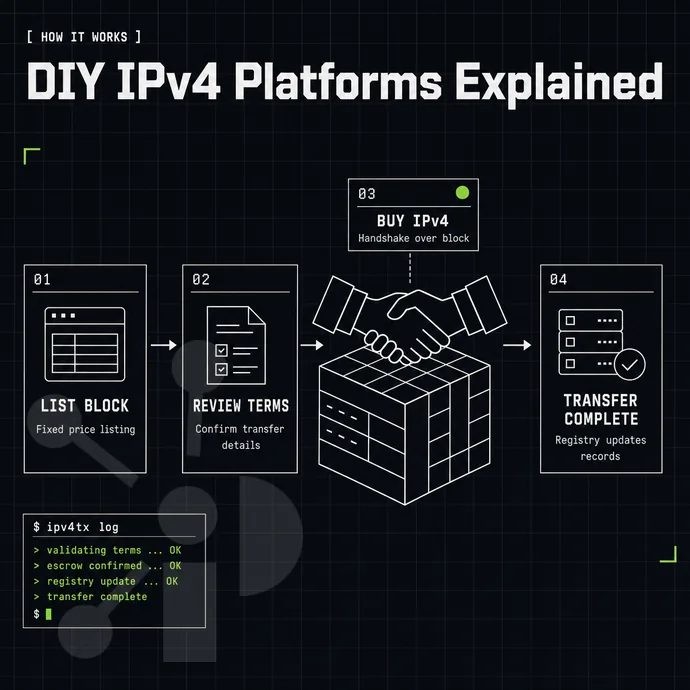
A self-serve IPv4 marketplace is an online platform where businesses list IP blocks for sale at fixed prices. Customers buy IP in this environment without the assistance of a specialist, the online platform handles matching, payment and even RIR transfer filing where required. Much of the normal due diligence required for an IP transaction is left to the buyer.
What buyers handle themselves
On self-serve platforms, buyers review and evaluate IP address reputation, verify if an IP address is on a blacklist, and review the IP address’s routing history. Typically, the responsibility of the RIR related paperwork (i.e. transfer application and LOA) rests with the buyer. Simple errors in the related paperwork can cause the transfer to stall for weeks.
How the models compare by phone number
| Dimension | Self-serve platform | Advisory broker (Prefixx) |
|---|---|---|
| Price discovery | Published list prices; limited negotiation | Personalized offer, valid 72 hours |
| Due diligence | Buyer-led; varies by platform | Tixx QC on every block before listing |
| RIR paperwork | Buyer files independently | LOA, RPKI ROA and IRR prepared by Prefixx team |
| Buyer fees | Platform-dependent | Zero buyer fees |
Which model fits which buyer
Experienced network engineers can manage self-serve IP addressing and RIR file processing without guidance.
Pros and cons: broker model vs self-serve platform
Should you choose an IPv4 broker or a self-serve platform? The decision to move IP addresses around will in most cases shift a lot of the risk and complexity to your own shoulders versus the broker’s.
The broker model from years ago
- Our broker handles the block vetting on your behalf, checking for ownership, RIR status, blacklists. Additionally, Routing issues before the block is handed over to you, preventing you from inheriting a reputation problem from someone else.
- Our negotiation and paperwork are included in our pricing. The pricing for our services is generally for us to work up an inquiry and work the market for you to find the best price for you. A broker can prepare LOA, RPKI ROA and IRR route objects for you as part of the Prefixx transaction. No fees to the buyer.
- The funds are held in escrow until the RIR transfer has taken place, thus both parties are protected.
Note: Inquiry-based pricing means no instant quote. Expect back-and-forth before a number is confirmed.
Self-serve platform for your phone number
- The biggest advantage of price visibility here, i.e. seeing the asking price for a listed block of IP addresses, is useful for straightforward /24s without any special cases.
- The buyer is responsible for due diligence on the listed blocks. Most platforms list the blocks without performing a mandatory quality check and thus it is up to you to check for e.g. blacklist status, routing quality and transfer eligibility.
- Most self-serve porting tools do not support Inter-RIR transfers and legacy resource transfers. These edge cases, including cross-registry transfers and other legacy resources, typically require specialized handling that is not provided by self-serve tools.
Note: If a block carries hidden reputation damage, a self-serve purchase gives you limited recourse after the transfer completes.
Which model fits your situation
For simple same-registry trades heavily dependent on price transparency, self-serve is a good model.
Common use cases: when each model fits best
No two IPv4 transactions are alike. We approach transactions based on a number of different variables including block size, registry complexity and buyer/seller resources.
When a broker fits
Block sizes of /20 and larger are worth enough to negotiate, go through due diligence and have the necessary protection via an escrow. Inter-RIR transfers (e.g. from ARIN to RIPE NCC or to APNIC) require proper coordination of filings at both registries. A broker can manage the sequence of these filings.
Similar problems exist for legacy resources. A large portion of the IPv4 space was registered prior to modern RIR policies and often lacks clean transfer eligibility records. Tixx by Prefixx checks ownership, routing health and blacklist status before listing a block for sale, thus preventing problems with self-serve listings that surface only after a sale has stalled.
Deals that include lease non-revocation guarantees, BYOIP deployment assistance. Additionally, Sellers looking for maximum price discovery but don’t want to create market listings all fall into the broker model, as they require human intervention at every step.
When self-serve fits
Small, standard-sized blocks of IP (a /24 in most cases) are well-suited to self-service by someone who is a member of an RIR and can complete the transfer form. Understands what is required and has checked the price on the market. Repeat customers who have completed many previous IP transfers will know the process inside out and can complete the transfer very quickly.
Timely spot purchases of single blocks are also included here, provided the purchasing party has already checked the block's reputation and routing integrity prior to the purchase. The purchasing party has to sacrifice some control to achieve faster processing.
Mapping transaction type to model
While total space may be the deciding factor for some, for others the deciding factor will be complexity. A single /24 with cross-registry components is a broker deal, but a /20 from a familiar seller within the RIR region in which you already operate would be a self-serve deal for an experienced operator.
A single block holder with no listing infrastructure will find the no-win-no-fee model of Prefixx very attractive as it only charge a 3% to 8% seller-only commission on the sale of the IP space. There is no charge to list or to have the IP space marketed. A comparison of the key features of all the services is provided in the side-by-side comparison in the following section.
Side-by-side comparison: IPv4 broker vs self-serve platform
The key differentiators between an IPv4 broker and a self-serve platform are the amount of risk, paperwork and post-transfer friction that you have to take on or manage. The table below outlines the main differentiators side by side.
Feature comparison from years ago to now
| Dimension | Prefixx (IPv4 broker) | Self-serve platform |
|---|---|---|
| Block vetting and quality control | Tixx QC on every block: ownership, blacklists, routing hygiene, RIR standing | Varies; buyer typically runs their own checks |
| Pricing model | Inquiry-based; personalized offer valid 72 hours | Listed prices, often public |
| Buyer fees | Zero | Platform fees common |
| Seller commission | 3 to 8%, seller-only, no win no fee | Varies by platform |
| RIR transfer handling | End-to-end across ARIN, RIPE NCC, APNIC; LACNIC facilitated | Buyer often manages paperwork independently |
| Escrow | Escrow-secured on every transaction | Not always included |
| Inter-RIR capability | ARIN, RIPE NCC, APNIC cross-registry; LACNIC facilitated | Limited or unsupported |
| BYOIP and routing paperwork | LOA, RPKI ROA and IRR route objects prepared by our team | Buyer self-serves; templates only |
| Post-transfer services | Geolocation correction, rDNS, reputation monitoring, blacklist scanning included with leases | Rarely included |
| Human advisory access | Senior consultants on every deal | Self-service; support tickets |
| Speed of execution | Lease provisioning within 24 hours; transfer timelines follow RIR policy | Depends on buyer readiness |
Where the difference matters most
For a simple purchase of a /24 within a single RIR, self-serve is fine. But for an inter-RIR move, a BYOIP, or a block with prior reputation, there’s a big gap until day one of service when we get LOA, ROA. Additionally, IRR objects updated to ensure proper routing from the get-go.
When to choose a broker
You would want to work with an IP broker for cross-registry transfers, for deals that require lease guarantees, or for blocks that require active reputation management. All of these scenarios are where Prefixx’s white-glove service adds the greatest amount of value. Below we detail out decision criteria for these types of scenarios and how they relate to a broker.
How to choose between a broker and a self-serve platform
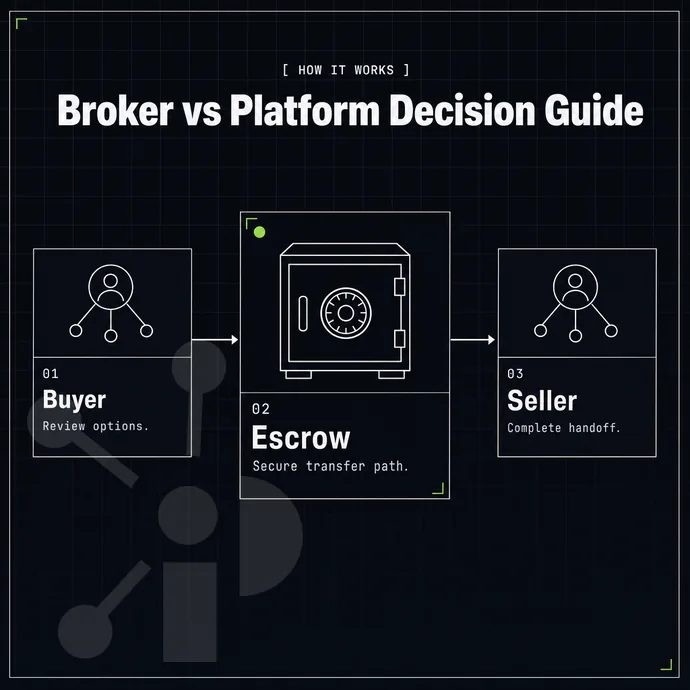
You have two choices when buying or selling IPv4 address space: full-service broker or self-serve marketplace. We describe the two options and provide guidance on which is best for you depending on a few variables including deal complexity, block size, and the buyer/seller’s in-house routing expertise.
Questions that point toward a broker
Market intelligence matters for block sizes /20 and larger as the secondary market for IPv4 addresses has no official published price. The best estimate of current ARIN versus RIPE NCC rates as reported by brokers will have a significant impact on a negotiation. The same also applies to inter-RIR transactions, legacy IP addresses as well as deals that require a BYOIP deployment after the transaction has settled.
There are many sellers on Prefixx who are trying to get the highest price per unit rather than just selling all of their inventory. By using a broker, Prefixx runs Tixx quality control on every block of inventory that the broker lists, highlighting any problems with the listing before the number closes.
Questions that point toward a self-serve platform
Smaller blocks, single-RIR transactions and customers with ARIN/RIPE NCC in-house expertise are best suited for the self-serve model as speed and low friction are more important than best-in-class support for such straightforward transactions.
Decision table from years ago
| Scenario | Broker | Self-serve |
|---|---|---|
| Block size /20 or larger | Yes | Possible |
| Inter-RIR transfer | Yes | Rarely |
| Legacy resource | Yes | No |
| BYOIP deployment needed | Yes | No |
| Single-RIR /24, clean block | Optional | Yes |
For more complex transactions it’s best to use a registered broker. For a simple clean /24 within a single registry, self-serve is generally most efficient. We handle all BYOIP, LOA, RPKI ROA, IRR paperwork etc. for our customers for these types of transactions end to end. The next section outlines scenarios where self-serve is not merely suboptimal but totally wrong.
When a self-serve platform is not the right choice
Self-serve platforms are best suited for simple, unencumbered block purchases. However, there are a number of scenarios where specialized policy knowledge, remediation efforts, and negotiation are required, all things that no automated marketplace can provide.
Recognizing the red flags
- Inter-RIR transfers: Transferring IP space between registries (e.g. ARIN to RIPE NCC or APNIC to LACNIC) requires meeting the policies of both registries at the same time. A self-serve platform is typically used to process single-registry transfers. The broker deals with policy mismatches by design and prevents rejections and delays.
- Blocks with blacklist history. If the address space carries DNSBL listings or abuse history, a platform will list it as-is. A broker identifies the problem before transfer, coordinates remediation, and confirms clean status before the deal closes. Note: skipping this step means inheriting reputation damage that can take months to clear.
- Legacy resources with unclear WHOIS lineage: Many legacy IPv4 address spaces have incomplete or even disputed WHOIS contact information. Verifying ownership or checking transfer eligibility of such resources typically requires direct contact with the respective registry instead of an online form.
When the deal structure itself demands a broker
- A buyer who needs an LOA, RPKI ROA and IRR route objects prepared for him to download as part of the transaction (as opposed to him having to commission a marketplace to prepare these documents for him) can have all of the routing objects for the block prepared for announcement on day one.
- Lease non-revocation and 24-hour provisioning. Unlike self-serve listings on marketplaces that typically offer no contractual guarantees, Prefixx leases include a guarantee not to cancel plus timely 24-hour provisioning and concierge-level support throughout the lease term.
- Large block price discovery. A /18 or larger holder needs to know market size not list their space. The price per address changes greatly with block size, with RIR and current market size. Active price discovery by a broker trying to find qualified buyers to offer space to is far more valuable than search traffic on a listing site.
These failure modes are real and are described in more detail in the following section about how their occurrence led to the adoption of a broker by various network teams.
Why businesses move from self-serve platforms to a broker
The secondary market has been the sole source of IPv4 numbers since the free RIR pools ran dry between 2011 and 2020. Therefore, a bad transaction can have real consequences for most network operators who are used to self-serve platforms until it goes wrong.
The blacklisted prefix problem
You buy a /24 through a self-serve marketplace, announce it, and immediately start seeing mail delivery fail. The block is carrying old Spamhaus ZEN or CBL history from its previous owner. Such history is typically not checked by self-serve platforms before a sale across multiple DNSBLs.
RIR paperwork and inter-rir transfers
ARIN, RIPE NCC and APNIC each have their own policies regarding IP number transfers, as well as specific templates for offers and approvals and different timeframes for approval. The processes for inter-RIR number transfers add a second set of requirements on top of those for a simple transfer.
Platforms that support self-serve number purchases typically are restricted to same-registry number transfers. Brokerage services that are registered under multiple RIRs can, however, complete the full set of paperwork (LOA, RPKI ROA, IRR route objects, etc.); submission to the relevant RIR then follows.
Sellers who switched after low offers
Historically, a block of land could be listed within a short period of time with interested buyers competing for the best price. While demand is strong, factors that affect price include the quality of the block, the seller’s online reputation and the location within the RIR regions.
A seller listing a property on a self-serve online platform may obtain a low first offer. A broker using Tixx-style due diligence can provide a more accurate positioning and negotiate a higher sale price than the seller could obtain themselves, with the broker’s commission being fully recovered.
For each block of IP addresses that we sell at Prefixx, all of them go through our Tixx quality control, which includes verification of the IP address owner, DNSBL blacklists check against 12 of them, IP address routing verification and RIR transfer eligibility verification. A report is generated for each block of IP addresses and this report travels with the block of IP addresses through all stages of the sale.
That combination of pre-sale diligence and active negotiation is what the Prefixx broker model is built around. Here is what that looks like in practice.
Why choose Prefixx for IPv4 brokerage
Prefixx is a boutique IPv4 broker that has been working in the address space market since 2018, with a team carrying industry experience stretching back to 2007. Every deal is handled by senior consultants, not a self-serve queue. When you need to buy, sell, or lease IPv4 addresses, here is what sets us apart.
- Zero buyer fees. We charge sellers only, at a 3 to 8% commission. No win, no fee.
- Tixx quality control on every block. Every IPv4 address we broker is checked for ownership, blacklist status, and routing hygiene before it reaches a buyer.
- Escrow-secured transactions. Funds and IP space transfer only after both sides confirm.
- Registered with ARIN, RIPE NCC and APNIC. We handle inter-RIR transfers across all five RIR regions, with LACNIC facilitated.
- White-glove service included with every lease. Our team prepares the LOA, RPKI ROA and IRR route objects, corrects geolocation, manages reverse DNS, and monitors reputation.
- BYOIP deployment support. We prepare routing paperwork for cloud BYOIP programs and bare-metal deployments on Netrouting infrastructure.
If you want to discuss your IPv4 space requirements with a real IP broker, contact our team directly. Share your block size, RIR region, and a phone number and we will come back with a personalized assessment, no obligation. The section below summarizes the core differences if you need a quick reference before reaching out.
The core differences between an IPv4 broker and a self-serve platform
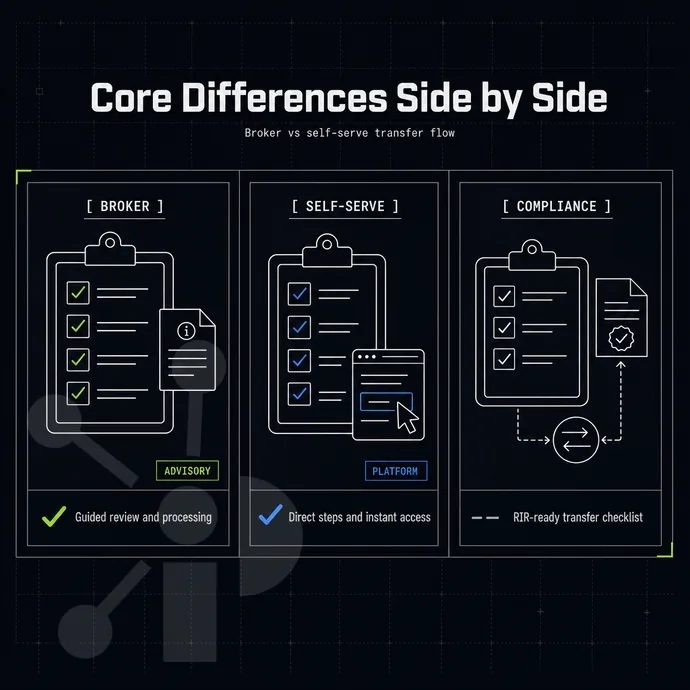
An IPv4 broker provides advisory services, qualified IP address stock, negotiable pricing upon inquiry, and full RIR compliant processing of all transfers. A self-serve platform lists available IPv4 addresses for sale at fixed prices and handles the registration for the buyer. The two models are used to sell different types of IPv4 address space.
In determining the best option, a few considerations need to be made. These include the size of the block, the complexity of the transfers, and the buyer’s in-house expertise. If a buyer can perform their necessary RIR processes for standard sized /24 blocks on a self-serve IPam platform, then they likely have no use for an IP broker. However, a buyer looking to purchase a large.
Multi-RIR block of IP addresses or someone that does not have IP routing experience in their organization will find much greater value in working with an IP broker that can source and route IPv4 addresses for them. The value an IP broker adds to purchase IP address block extends far beyond the actual transfer of address space to a buyer.
Key advantages of working with a specialist IPv4 broker
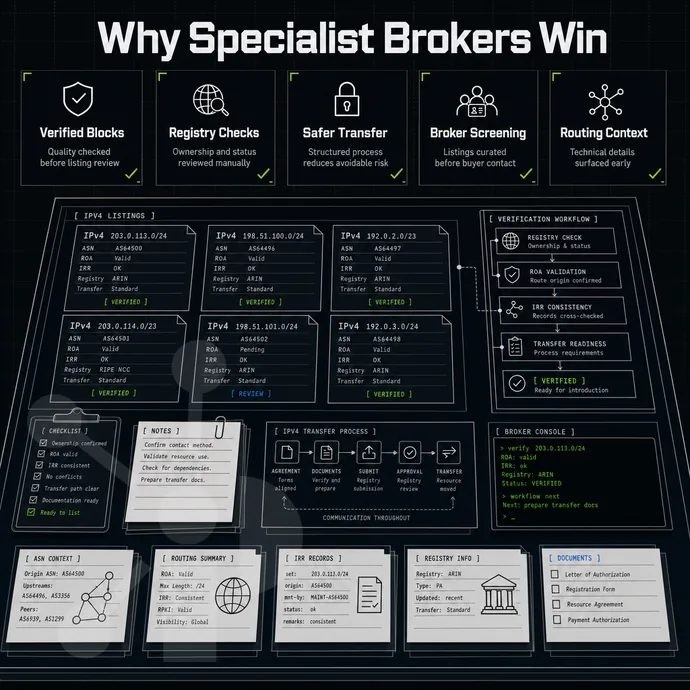
A specialist IPv4 broker can deliver many things that a self-service IPv4 broker cannot including verified IP address block quality prior to transfer, escrowed settlement to protect both parties. Additionally, All of the necessary routing documents (LOA, RPKI ROA, IRR) for on a daily basis. Additionally, a specialist IPv4 broker has Inter-RIR capability allowing for the transfer of IPv4 block held in ARIN, RIPE NCC and APNIC registries. He can close the deals that self-service platforms fail to complete.
Post-transfer support is where the gap widens further. An address broker stays engaged after the deal closes, covering geolocation correction, reputation monitoring, and abuse handling for the IPv4 addresses you just acquired. If that combination of protection, expertise, and continuity fits what you need, the Prefixx IPv4 broker page is the right next step.
Frequently asked questions
What does an IPv4 broker actually do that a self-serve platform does not?
A broker sources vetted blocks, negotiates pricing on your behalf, manages escrow, and prepares every routing document: the LOA, RPKI ROA, and IRR route objects. Self-serve platforms hand you a listing and a checkout flow, then leave the transfer paperwork and routing setup to you.
With a broker like Prefixx, a senior consultant is on the deal from sourcing through the moment the block is announcing in your ASN. That human-in-the-loop layer catches problems, such as a block with a hidden blacklist entry or a disputed ownership record, before they become your problem.
Are there buyer fees when using an IPv4 broker?
At Prefixx, buyers pay zero fees. The commission is seller-only, ranging from 3% to 8% of the sale price depending on block size, with smaller blocks at the higher end. Self-serve platforms often charge both sides, or fold a platform margin into the listed price. Always confirm the fee structure before you sign anything, because hidden buyer-side costs can meaningfully change the economics of a deal.
Can a broker handle inter-rir transfers that a self-serve platform cannot?
Yes.
How is block quality checked before a brokered IPv4 transaction closes?
Prefixx runs every block through Tixx, its pre-sale quality control process, before any offer reaches a buyer.
What is the difference between leasing and buying IPv4 addresses through a broker?
Buying transfers full ownership of the block to you via an RIR-recorded transaction.
How long does a brokered IPv4 transfer take compared to a self-serve purchase?
Registry timelines are set by the RIRs themselves, not by the broker or platform, so neither route bypasses the official process. What a broker changes is the time spent on either side of that window: sourcing a vetted block, preparing documentation, and submitting a clean transfer request from day one.
Errors in paperwork or eligibility issues are the most common cause of delays, and a broker's pre-submission checks eliminate most of them. Self-serve deals where buyers handle their own paperwork often stall at the registry stage because submissions arrive incomplete.
When should a seller use a broker instead of listing on a self-serve platform?
Use a broker when block size, cross-RIR complexity, or deal value makes a mistake costly.
Self-serve is generally best for simple, smaller acquisitions where speed is more important than advice. A broker’s value is in earning their fee when the block size is large, the routing/paperwork is unknown, and reputation becomes a liability after transferring to a new space.
Another consideration affecting deals is quality control. While many listings on self-serve marketplaces are quality, not every block has been reviewed for blacklists, for transfer eligibility, and for routing hygiene before it’s sold to a buyer. The gap between listings and deals is where things can go wrong.
If your next acquisition involves a /22 or larger, a cross-RIR transfer, or BYOIP deployment onto bare metal, talk to the team at Prefixx. Every block goes through Tixx QC before it reaches you, and there are no buyer-side fees.
Contact us to discuss your IPv4 needs today
No hidden fees, free consult. A broker replies within one business day.