
By Savvas Bout, Founder of Prefixx. Last updated 28 October 2026.
The number of parties that sign off on a transaction in the IPv4 transfer market exceeds two. All participants of the IPv4 market influence how IP address space is priced, how fast transactions are completed, and whether purchased IP addresses will arrive clean and routable or not.
Missing one of these participants in the process can cause one to overpay, have the transfer delayed for months. Alternatively, Even obtain a block of IP addresses with a bad history of being blacklisted, which would negatively affect deliverability from the very beginning. Navigating these complexities requires careful attention to registry policies and block reputation checks before finalizing any agreement.
The secondary market for used IP space is a complex ecosystem that includes regional registries that govern the transfer of space between holders.
While buyers and sellers are at opposite ends of the transaction, a host of intermediaries determine the ultimate terms and structure of any transaction.
In this space, an understanding of each of the players, what they can influence and where their interests lie can provide great insight to those looking to buy or sell used IPv4 blocks as well as those seeking to maximize return on space no longer required. In this article we review each of the key players with respect to the secondary market for used IP space in order.
Who shapes IPv4 address market dynamics?
In this document we describe IPv4 market participants. They buy, sell, lease or regulate IPv4 addresses in the secondary market for transfer. Their existence explains the regional differences in prices for IP addresses, why some stocks of IP addresses change hands very quickly while others do not move at all for years.
Who holds and sells IPv4 blocks
The market for IPv4 address space includes a few types of sellers. First, there are the legacy holders (i.e. companies and organizations that received large blocks of IPv4 addresses prior to the advent of IPv4 address scarcity). Universities and large enterprises often fall into this category, as they have consolidated their infrastructure and, reflecting broader market trends, have more IPv4 addresses than they know what to do with.
Additionally, space released by ISPs and telecoms during a network reconfiguration to use contiguous IP ranges is typically the cleanest space on the market. Well documented space that is consistently routed and easy to transfer.
Who drives IPv4 address market trends and demand
These buyers are typically cloud providers, web hosting providers, and other high-growth networks requiring large blocks of IP addresses to support their growing infrastructure.
A block held by an ARIN registrant cannot be transferred to an APNIC member without going through the cross-registry transfer process.
IPv4 address blocks, brokers, and the regulatory landscape
IP brokers act as intermediaries between IP buyers and sellers to facilitate the due diligence process, the management of an escrow and the corresponding paperwork. At Prefixx, we manage transfers on behalf of our customers to ARIN, RIPE NCC, APNIC and LACNIC. Each block is then verified by Tixx quality control before it is sold to a buyer.
The five RIRs form the regulatory layer that validates every transfer. To understand why that approval process exists at all, it helps to look at how scarcity created the secondary market in the first place. Registry approval remains crucial because it ensures that transferred addresses maintain their routing integrity and that the new holder meets policy requirements.
IPv4 market participants: who holds address blocks and why they sell
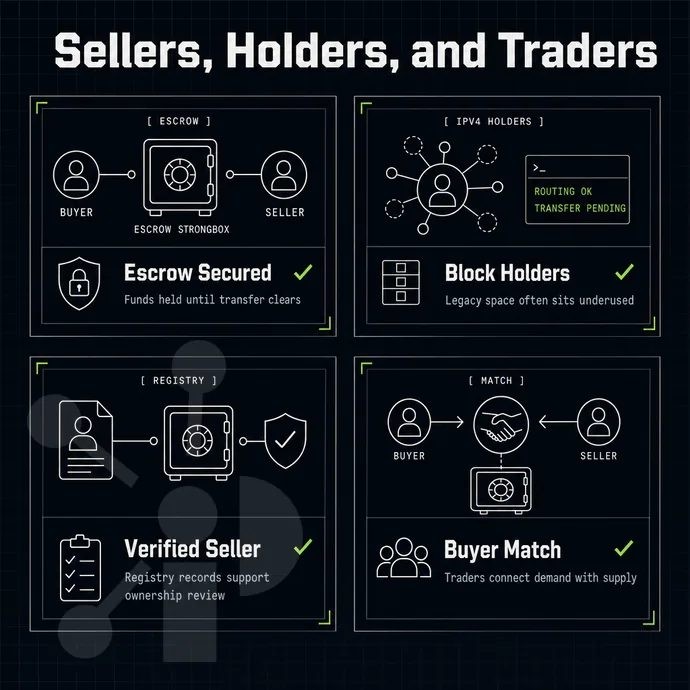
Not all organizations that hold a block of IPv4 addresses are using them all. Legacy space, reorganized networks, and relocated workloads all sit idle in vast amounts of unused IP addresses. Secondary markets for IPv4 exist to enable the transfer of such idle space.
Who typically sells with regional variations
Much of the initial large allocations of IP addresses to large corporations, and universities in the 1980s and 1990s were given out before IP address space became scarce. Many ISPs have downsized or merged and still hold large amounts of surplus IP space that they no longer actually route.
Organizations that have transitioned much of their application work load to cloud services or the use of Carrier Grade NAT (CGNAT) free up large blocks of IP address space originally allocated to support dedicated on-premise infrastructure. As organizations shift their operations online, the internet infrastructure requirements change, often leaving previously essential address allocations underutilized.
The motivation for sellers to list idle addresses onBit is to use the liquidity to fund upgrades, offset operating expenses, etc. Sellers simply want to monetize something that would otherwise be gathering dust. These idle allocations represent a resource that has become increasingly scarce and therefore valuable in today's exhausted IPv4 environment.
Preparation before listing
- Check if the block is listed correctly to confirm the ownership of the block. Check the WHOIS of the relevant RIR for the block. Disputed or outdated listings can cause problems with transfer of the block.
- Check if the transfer is eligible. Every RIR has its own rules (waiting period, etc.) and conditions that must be met. Make sure to verify the eligibility of the block before starting to contact buyers.
- Audit routing hygiene. Fix blacklisted numbers and inconsistent IRR records first. The rest of your work won’t get far until you’ve sorted these out.
Note: Block size and RIR region both affect demand. Large blocks attract a narrower pool of purchasers; regional pricing varies, so a /16 under ARIN and one under RIPE NCC will not command the same rate. Buyers must carefully evaluate these factors to determine which blocks align with their technical requirements and budget constraints.
Listing and closing your digital footprint
- Sell IP addresses through Prefixx by engaging a registered broker to list your IP address / prefixes for you, to pre-vet potential acquirers and close the sale via escrow. We operate a seller-only commission model, so you will never incur any upfront costs.
- Quality control by Tixx. Every block is verified by Tixx before it reaches a buyer. This includes verification of ownership, blacklisting and correct routing.
Every sale has a buyer with specific requirements, ones that often vary more than sellers realize.
Lessees and lessors: leasing as a cost-effective alternative
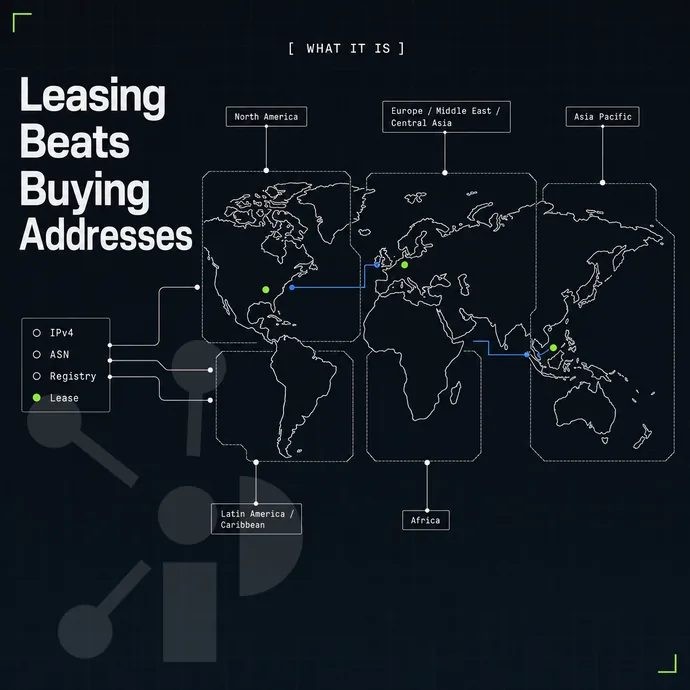
Not every organization needs to allocate permanent IP address space. IP leasing allows lessees to use a pre-vetted block of IP addresses for a set period of time and lessors can earn recurring income without the permanent transfer of IP address space. This can be a cost effective alternative to purchasing IP address space for short periods of time or where demand is uncertain.
What a lease arrangement involves
We build a complete routing package (LOA, RPKI ROA, IRR route objects) plus reverse DNS delegation and a reputation monitor.
Who benefits from pricing trends
Leased space can be used by businesses to run campaign or compliance infrastructure on a temporary basis, to test geographic expansion ideas in new locations and to utilize valuable address space held by lessors to generate income whilst retaining ownership and RIR rights. Leasing provides flexible access to routing capacity without the capital commitment of an outright purchase.
How Prefixx handles it
We act as brokers to both sides of the market.
In summary, all market participants, clients, sellers, lessees, share one common challenge: complexity.
Why Prefixx works across the full participant spectrum
Prefixx is a boutique IPv4 brokerage that is registered with the ARIN, RIPE NCC and APNIC (LACNIC facilitated) registries. Our boutique brokerage serves the needs of network operators, vendors and lessees of IPv4 addresses in all five RIR regions. Whether you are looking to buy IPv4 blocks, sell IP addresses, or look into leasing IP addresses as an alternative to buying and owning IPv4 addresses, Prefixx can manage the entire process for you.
- No fees to IP address acquirers. holders pay only 3-8% commission on closing of sale.
- We at Tixx inspect every IPv4 address block before we sell it to you.
- White-glove lease service with Geo-Locationing correction, rDNS, Reputation monitoring and Blacklist scanning.
- Escrow-secured transactions with LOA, RPKI ROA and IRR route objects prepared by our team.
- We support BYOIP on all our bare metal / cloud hosted servers. This includes hosting with Netrouting as well as with AWS, GCP, Azure, OCI and Cloudflare.
IP brokers play a crucial role in navigating transfer complexities and regional variations in the IPv4 market.
Frequently asked questions
Who drives billion-dollar IP leasing and IPv4 trades for companies seeking network expansion?
The market runs on five groups: Regional Internet Registries (ARIN, RIPE NCC, APNIC, LACNIC, AFRINIC), which authorize transfers; transferors, from enterprises shedding unused space to universities with legacy allocations; purchasers, typically cloud providers, ISPs, hosting companies, and fast-growing SaaS businesses; lessors and lessees trading usage rights without transferring registration; and brokers or marketplaces connecting the other parties, handling due diligence and paperwork.
Each group plays a distinct role, and a single deal often involves all five.
How do IPv4 address brokers differ from self-serve marketplaces?
A boutique broker like Prefixx, which many businesses turn to for hands-on support, assigns a senior consultant to every deal, vets each block before listing it (checking ownership, blacklist status, routing hygiene, and RIR standing), and prepares all routing paperwork, including the LOA, RPKI ROA, and IRR route objects, on the client's behalf. This approach has made the firm a leading choice for organizations that prioritize quality assurance and regulatory compliance throughout the acquisition process.
Self-serve marketplaces let IP consumers and divestors transact with minimal human involvement, which lowers friction and surfaces useful pricing trends but shifts due diligence responsibility onto the buyer. The broker model costs more in seller commission but addresses the risk of acquiring a block with hidden reputation or transfer problems. Self-serve marketplaces represent one category of platforms, while full-service brokerage firms represent another, each offering different trade-offs in cost, speed, and risk mitigation.
Why do IPv4 address prices vary between ARIN and RIPE NCC regions?
Supply, demand, and transfer policy all differ by registry. ARIN covers North America, where cloud and enterprise demand is intense and the waiting list for transferred space is long, which pushes prices higher. RIPE NCC covers Europe, the Middle East, and Central Asia, where a different pool of IP block owners and a distinct transfer policy create a separate price dynamic. Understanding these regional variations in supply and demand helps participants navigate market dynamics more effectively.
A /24 under ARIN and an identically sized block under RIPE NCC can trade at noticeably different rates in the same month due to each region's distinct regulatory landscape, and in a market that collectively moves billion dollars in value, neither number is published anywhere official.
Block size, the reputation history of the specific prefix, and whether the space carries legacy status also move the final figure independently of region. Understanding how these factors combine to determine final pricing helps organizations assess whether a given offer reflects fair market value.
Is leasing IPv4 addresses a better option than buying for most businesses?
Leasing is the better fit when capital preservation matters, when the requirement is temporary or uncertain in size, or when a business needs addresses quickly. Prefixx provisions leased blocks within 24 hours and includes a non-revocation guarantee, RPKI, LOA, and reverse DNS as standard. Organizations that lease rather than purchase retain flexibility to scale their address holdings up or down as network requirements evolve without committing capital to owned blocks.
Buying makes more sense when the need is permanent and the organization wants an asset on its balance sheet that can be sold later. The two models are not mutually exclusive: many operators lease while a purchase clears the RIR transfer process, then migrate to owned space once registration completes. Organizations considering purchasing should evaluate their long-term address requirements and budget constraints before committing to ownership.
What due diligence should a buyer perform before purchasing an IPv4 block?
At minimum, a buyer acquiring IPv4 blocks should verify that the seller holds current RIR registration for the addresses and that no liens or disputes are recorded against the resource. Routing tables should be checked to confirm that each IPv4 address in the block has been announced consistently and is not associated with spam or abuse databases.
Routing hygiene matters too: confirm the prefix has a clean BGP history, valid RPKI state, and consistent IRR objects. Prefixx handles all of this through Tixx, its pre-sale quality control process, which produces a health report and transfer readiness score before any block reaches a buyer. Verifying routing hygiene protects against inheriting reputation issues that could compromise the operational security of the acquired prefix.
Can legacy IPv4 holders sell, transfer, or use network address translation?
Yes. All five RIRs support transfers of legacy resources, and market dynamics consistently drive strong buyer interest in legacy space because it predates the classful allocation era and can carry clean routing histories. The process requires the legacy holder to enter a registration agreement with the relevant RIR before the transfer can proceed, which adds a step compared to transferring already-registered resources.
ARIN, RIPE NCC, and APNIC handle these transfers directly; LACNIC transfers are facilitated. A broker familiar with all five registries can navigate the legacy-to-registered conversion and the subsequent transfer in a single coordinated process.
What role do RIRs play in the IPv4 market transactions?
RIRs do not buy or sell addresses themselves, but they are the authoritative record-keepers: no transfer is legally complete until the receiving organization appears as the registered holder in the relevant RIR's WHOIS database. Each registry publishes its own transfer policy, sets eligibility criteria for purchasers, and charges a fee for processing the change.
ARIN, RIPE NCC, and APNIC each run their own transfer programs for IP addresses; LACNIC transfers are facilitated rather than directly registered through the same mechanism. Brokers registered with these bodies, as Prefixx is with ARIN, RIPE NCC, and APNIC, can submit transfer requests on behalf of their clients and track progress through each registry's internal workflow.
Buying and selling IPv4 addresses on the secondary marketplace has become a permanent solution to the problem of IPv4 address space allocation.
With all the free IPv4 IP space having been allocated from the regional IP IPv4 inventory pools by now, every company and entity, whether an enterprise making money off unused IPv4 addresses held in the past, or a cloud provider buying up IP address space for new data centers in geographic regions around the world, engages in the buying and selling, and even leasing of IP address space, all within the framework of transfer and quality of service provided by registries.
Two simple facts shape every transaction in the cryptocurrency space: potential buyers inherit the block reputation associated with an address, not the reputation of the previous owner. Additionally, the rules for transferring and the 'exchange price' for a particular cryptocurrency are strongly influenced by the geographic location of the relevant registry for that currency.
Whether you are sourcing a /24 for a new deployment, monetizing unused space, or evaluating the value of a lease against an outright purchase, Prefixx handles the vetting, paperwork, and routing setup from first inquiry through live announcement. Start with a conversation at Prefixx.net to get a personalized offer within 72 hours.
Contact us to discuss your IPv4 needs today
No hidden fees, free consult. A broker replies within one business day.