
By Savvas Bout, Founder of Prefixx. Last updated 30 October 2026.
Every IPv4 acquisition decision is a capex vs opex decision that can lock your budget in the wrong direction for years to come. The choice you make today will shape your network's financial flexibility and scalability well into the future.
You also have to pay the transfer fees for the IP addresses and all the associated routing configuration. IP address leasing allows you to spend the same lump sum of money and have it show up as a regular monthly expense on your bottom line instead. This approach preserves working capital and allows you to allocate funds to other infrastructure priorities without tying up liquidity in a single asset class.
However, with a one time purchase you will never build any equity in an address asset that has appreciated in value since the last of the free pools of IPv4 space closed. Your finance team’s preference for how to best allocate capital and how quickly you need to make the addresses live and routable. Organizations that need to quickly increase their routable address pool often prioritize speed of deployment over long-term asset ownership.
This piece breaks down the financial and technical details that go into each model, covering both capex and as a service offerings, along with the hidden obligations that most teams fail to account for in a one, three, and five-year financial model.
Block size, RIR region, and routing requirements all greatly affect the numbers, and this piece outlines a framework for you to better understand the costs of each model, whether for networking or data storage needs, to bring to your next budget conversation. We start with the basic accounting model for each. The framework also helps technical teams translate infrastructure requirements into financial terms that resonate in marketing and executive planning discussions.
For a complete overview, explore our IPv4 capex vs opex guide.
IPv4 capex vs opex: what the distinction actually means
Whether IPv4 addresses are purchased or acquired by some other means will affect where the cost associated with such assets is reported in financial statements. Such reporting has significant implications for issues including tax, capital expenditure and how such costs are viewed by a company’s CFO. These accounting considerations shape how leadership evaluates the trade-off between immediate liquidity and long-term asset ownership.
Capital and operational expenditures when buying a block
A block purchase is recorded as a fixed asset on the company ledger.
Operational vs capital expenditures when leasing address space
A lease will flow through the income statement as normal operating expenses. There is no need for large upfront payments and therefore improved operational efficiency. Lease payments are fully deductible in the year paid by companies with tight quarterly budgets. This treatment allows organizations to preserve capital for other business operations while maintaining the flexibility to scale address space up or down as requirements evolve.
Why the distinction matters for IPv4 operating expenses
An outright purchase of a /24 will likely be considered a capital asset which you can later sell.
How the capex model works for IPv4 purchases
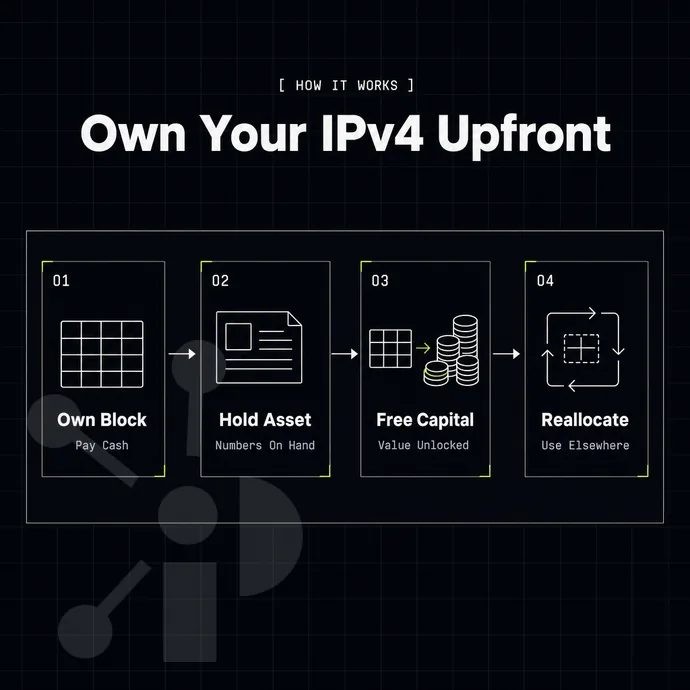
Paying cash for a stock of IPv4 addresses is a capex model decision. One pays cash and owns the block of numbers. That block of numbers would then be written off against income over the useful life of that stock of numbers, just as one would with one’s own servers and other long lived assets. The write-off allows the organization to deduct the cost incrementally rather than absorbing the full expenditure in a single reporting period.
What the one-time purchase covers
The price quoted for any free IP address space includes the cost of the address block plus the RIR transfer fee.
The price for any free space (of any size) is determined by the block size and the RIR region in which it was registered (e.g. ARIN /24s will trade at a different cost to RIPE NCC /24s which will trade at a different cost to APNIC /24s of the same size in the same month). Brokers typically quote prices that reflect recent market sales for comparable blocks in the same registry.
When this model makes sense
For a business with stable and long-term IP demand, owning is typically the best option. Businesses with multi-year running IT infrastructure on bare metal typically benefit from owning. Organizations across the industry have found that ownership provides greater flexibility when infrastructure needs remain consistent over multiple budget cycles.
How Prefixx handles operational expenditures in the transfer
Prefixx manages the RIR paperwork, Tixx quality control and the escrow settlement. There is cash locked in a purchase but the buyer has zero fees on top of the block price. Seller pays a commission of 3% to 8% whilst buyer pays nothing. The opex model has different trade-offs to keeping capital off corporate ledger.
How the opex model works for IPv4 leasing
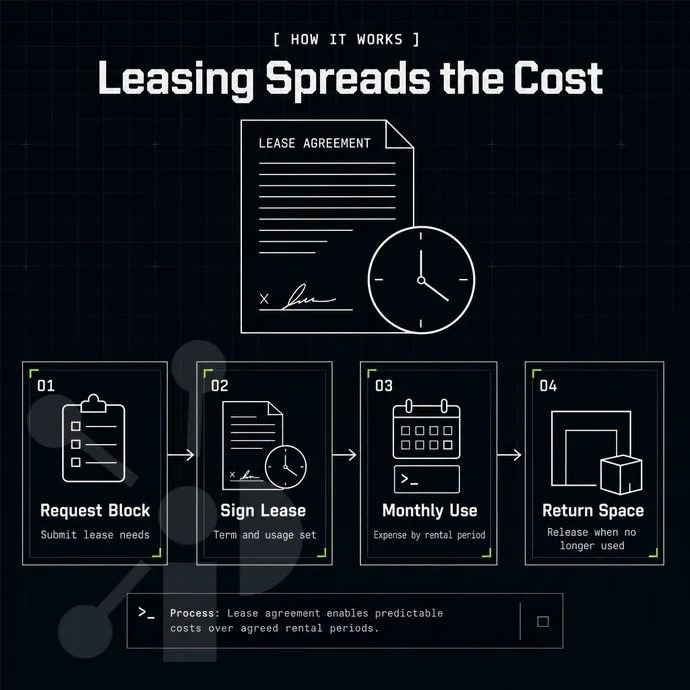
IPv4 address space is typically rented under an opex model for a monthly charge, expensed in the period rented, and returned when no longer required. This rental model offers greater flexibility for organizations whose address requirements may change as projects scale or wind down.
Setting up a lease in your own data center
- Block size to meet current requirements, choose prefix to cover immediate needs. Leasing allows companies to ‘right-size’ without getting locked into buying a fixed quantity long term.
- Confirming routing documentation. Prefixx prepares LOA, RPKI ROA and IRR route objects. All are provisioned within 24 hours of agreement.
Note: Skipping RPKI setup leaves your prefix vulnerable to route hijacks. Never announce a leased block without a valid ROA in place.
Managing ongoing costs and capital expenditures
- Treat lease payments (also known as the lease fee) as opex expenses. These will show up on your income statement as expenses for each period of time rather than as part of your capital expenditures. This will be especially important to track for companies that have very restricted capex approval processes.
- Grow or shrink your prefix at renewal. The opex model enables you to scale your prefix as your traffic grows and contract space that you no longer need. Add a second block of space without a new acquisition.
The ongoing costs of the two models are predictable and do not contain any hidden transfer fees, RIR filing timeframes or stranded assets as your requirements contract. It is only when you compare the two models side by side that the trade-offs become apparent. Organizations that choose the operating expense route preserve working capital and maintain flexibility to redirect funds toward infrastructure upgrades or other strategic initiatives as network requirements evolve.
When buying (capex) makes sense for your business
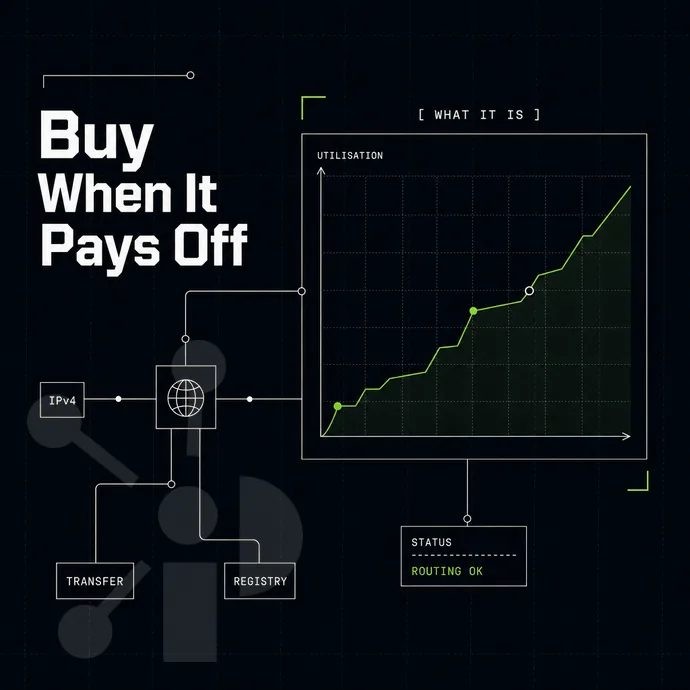
Buying a block outright is best suited for organizations with stable long term infrastructure plans and sufficient IT budget to support said plans. Ownership of IP allows for control of IP routing as well as preservation of your organization's reputation across cloud solutions, and by converting opex costs into a fixed asset, it allows for the creation of a fixed asset on your asset ledger.
Organizations must also evaluate whether their network capacity requirements will remain constant or fluctuate seasonally before committing capital to a fixed block size.
When capex fits over operational expenditures
If you own a data center and run your own BGP, an allocated /48 purchased as a one off integrates cleanly into your existing setup. There are no ongoing monthly charges or hidden cost for lease of the IP, and you have complete control and no risk of IP revocation as you own the block. This aligns with your business objectives around cost and operational control. The routing software you deploy will interact directly with the purchased block, requiring no additional licensing or subscription layers.
It investments that justify purchase
Buying address space makes sense if you can use it for long term investments in data storage (e.g. disk arrays), or for dedicated hosting. A /22 or larger block held for 5 years or more is typically less expensive than leasing the same space for that period of time. Organizations planning to scale their infrastructure should evaluate whether their projected capacity requirements justify the upfront investment in owned address space.
What Prefixx handles for capital expenditures
As part of the quality control of Tixx, on each block that we sell, we conduct all the necessary checks prior to closure of the deal, ensuring no hidden cost is overlooked. We prepare the LOA, RPKI ROA and IRR route objects. We manage the Escrow to ensure proper settlement. Clean routable space is handed over to the data center operator from day one. Whether you buy or lease space, Prefixx manages the process from start to end for you.
Why choose Prefixx for IPv4 capex and opex transactions
Whether IPv4 address space sits on your financial record as a fixed asset or flows through your income statement as an operating expense, Prefixx handles both paths. We broker vetted blocks for outright purchase (CapEx) and structured leases (OpEx), with every deal escrow-secured and every block cleared by Tixx quality control before it reaches you. Organizations evaluating whether to lease or buy typically weigh their capital availability and depreciation strategy before investing in address resources.
- CapEx buyers: zero buyer fees, RIR transfer handled end to end across ARIN, RIPE NCC, APNIC, LACNIC and AFRINIC, LOA/ROA/IRR prepared by our team.
- OpEx lessees: non-revocation guarantee, provisioning within 24 hours, white-glove service covering geo-location correction, reverse DNS and blacklist scanning.
- Sellers: 3 to 8% seller-only commission, no win no fee.
- BYOIP support: our consultants prepare routing paperwork for deployment onto bare metal or cloud platforms.
Reach out to compare options for your IT budgets and business goals.
Frequently asked questions about capital expenditures
How do IPv4 address costs affect data storage and your own data center operations?
Buying IPv4 addresses is capital expenditure: you acquire an asset, record it on the accounting record, and depreciate it over time. Leasing IPv4 addresses is operating expenditure: you pay a recurring fee for the right to use the space, and the cost flows through the profit and loss statement each period. The distinction matters for budgeting, tax treatment, and how the cost appears to investors or lenders reviewing your financials. The choice between these two models directly influences how efficiently capital is deployed and how the expense impacts your profit margin each reporting period.
Are IPv4 address leasing costs an operating expense for business operations?
Yes. A lease gives you usage rights, not ownership, so the periodic payment is treated as an operating expense in the same category as bandwidth or software subscriptions. There is no asset to capitalize, no depreciation schedule, and no financial books entry for the address block itself. That makes leasing attractive for companies that want predictable monthly costs without tying up capital. Organizations pay only for the duration they actually use the addresses, avoiding the upfront capital commitment that purchasing requires.
Does buying IPv4 addresses go on the balance sheet?
Yes. Purchased IPv4 addresses are an intangible asset and are recorded on the company books at acquisition cost. Most accounting frameworks treat them as indefinite-lived intangibles rather than favoring an opex approach, meaning they are not amortized on a fixed schedule but are tested for impairment. Your finance team should confirm the treatment under your applicable standard, whether GAAP or IFRS, since the classification affects how you allocate funds to report and review the asset. In some jurisdictions, businesses may be able to deduct impairment losses when the recoverable amount of the asset falls below its carrying value.
When does it make financial sense to buy IPv4 addresses instead of leasing?
Buying makes sense when your need is long-term and stable, typically three or more years of continuous use, because cumulative lease payments will eventually exceed the purchase price. It also is a good fit for it budgets where you want full routing autonomy, the ability to sell the block later, or when your lender or auditor values the asset on your accounting books. The purchase route also provides flexibility if your infrastructure plans may shift in the future.
Companies with strong cash reserves or access to cheap capital generally favor ownership; those preserving liquidity or operating under tight OpEx budgets lean toward leasing. Prefixx handles both paths as opex solutions or outright purchases, with escrow-secured transactions and guaranteed non-revocation leases, so the decision is purely financial rather than operational. Tax treatment and depreciation rules are additional considerations that vary by jurisdiction and should be reviewed with your accountant before committing to either model.
Can a company switch from leasing to owning IPv4 addresses later?
Yes, and it is a common progression. A company often leases first on a monthly basis to validate its routing setup and confirm the exact block size it needs, then purchases a block outright once demand is proven. This approach saves time by allowing the technical team to test routing configurations before committing capital to a permanent acquisition.
The leased block and the purchased block will typically differ in these opex solutions, since you do not buy the specific addresses you were leasing unless the lessor is also willing to sell. Prefixx can manage both the active lease and a parallel acquisition as fixed assets, handling the RIR transfer paperwork and Tixx quality checks on the incoming block so the cutover is clean.
Locking in an asset's today's price with a cost effective model that removes monthly expense from your books is great for short time horizons and large balance sheets. But such models typically require all-upfront capital to purchase 100% of the operational assets and you own them all.
Leasing converts your capital into fixed monthly payments, frees up your team from the daily task of creating and managing routes and scales without a transfer of assets. But, one model is not better than the other. It depends on how long you intend to occupy a space, how your company's finance group treats infrastructure expenses as intangible assets, and whether or not address management is at the core of what you do.
If you are still mapping out which path fits your situation, Prefixx works through both models. Every block, whether purchased or leased, goes through Tixx quality control before it reaches your cloud computing infrastructure, and white-glove routing support handles the LOA, RPKI ROA, and IRR objects either way. Reach out to the Prefixx team to get a personalized assessment and a 72-hour offer on the space you need.
Contact us to discuss your IPv4 needs today
No hidden fees, free consult. A broker replies within one business day.