
By Savvas Bout, Founder of Prefixx. Last updated 12 October 2026.
While there is often a substantial difference between two offers for the same block size, understanding the variables that determine IPv4 lease pricing makes it possible to compare offers on a more equal footing. Key variables include allocation size, regional registry, prefix reputation, lease duration and additional services. Lease duration determines whether the arrangement is temporary or long-term, with shorter commitments typically carrying higher per-address rates.
Alternatively, a lease may simply be a provision of a prefix for your team to complete as they see fit. This approach works well when your project requires only temporary use of the prefix without ongoing provider involvement.
Below, each of the variables that impact pricing for IP Feed Leases are explained in detail, including how past reputation as well as prefix size impact offered market rate feeds.
The factors to compare IPv4 lease pricing before you sign
The price for an IPv4 lease can vary based on a number of different variables and can be higher than you anticipate. With all 4.3 billion IPv4 addresses spoken for the secondary market has become the only source of IPv4 addresses on the market since the RIR free pools of IPv4 were exhausted between 2011 and 2020.
Several factors to compare IPv4 lease pricing
The two biggest levers for pricing IP address blocks are subnet size and RIR region. Thus a /22 can command a very different price under ARIN than it would under RIPE NCC, because market demand for IP address space varies by region as well as by industry. For community perspectives, see Newbie Question About IP Range Allocation : r/networking.
The contract term also affects price per address. A month-to-month agreement will generally cost more per address than an annual commitment. Further, an agreement with a longer contract term typically will have a lower price per address for the committed space than an agreement with a shorter contract term. Businesses planning for growth should weigh whether locking in a multi-year rate today protects them against market volatility in the future.
IPv4 leasing and what the quote actually covers
Some providers simply hand over a prefix and you handle the rest with your existing IPv4 infrastructure team. Other providers offer managed services where their technical team coordinates with network operators to complete announcements and maintain routing tables throughout the lease term.
IP reputation and address space quality
The history of a block influences its usability. IP addresses that in the past have appeared on spam or abuse lists need to be workingly remediated before they can be deployed to clients. For each block we at Tixx run a set of quality checks, covering items like blacklists and general routing health.
Knowing these basics, it is now also clear how an increase in address allocation size affects the per-IP rate for itself. This verification process ensures that each block meets baseline standards before deployment.
How block size moves the per-ip lease rate
Several considerations, including prefix size, affect the monthly price per IP address. In general, price per IP address for smaller blocks of IP addresses is higher than for larger blocks. For larger blocks, the price per IP address is lower, because the fixed costs of verification and negotiations are spread over more IP addresses. Organizations evaluating different blocks should recognize that buyers negotiating for enterprise-scale allocations typically secure better per-unit economics than those acquiring smaller ranges.
How IPv4 addresses scale with prefix size
A /24 holds 256 IP addresses, a /22 holds 1,024, a /16 holds 65,536.
| Prefix | Addresses | Per-IP rate tendency | Vetting complexity |
|---|---|---|---|
| /24 | 256 | Higher per IP | Low, fast to provision |
| /23 | 512 | Moderate | Moderate |
| /22 | 1,024 | Lower per IP | Higher, more negotiation |
| /16 | 65,536 | Lowest per IP | Significant due diligence |
Block size and routing overhead on demand
Minimum announcement size for most carriers is a /24. Most network operators enforce this minimum to maintain efficient routing tables and prevent excessive fragmentation of the global routing system.
How infrastructure teams size networks to actual routing requirements
Leasing too much under-provisioned space is common. Only lease space that you need for your current infrastructure. The smaller the space you lease, the easier it will be to fill, to keep clean, and to provision quickly. Regardless of size, Prefixx performs Tixx quality checks on all blocks before they are handed over to you. Only when you have determined the correct size for your needs, the registry region for the registered block of space becomes relevant.
RIR region and how geography shapes lease rates
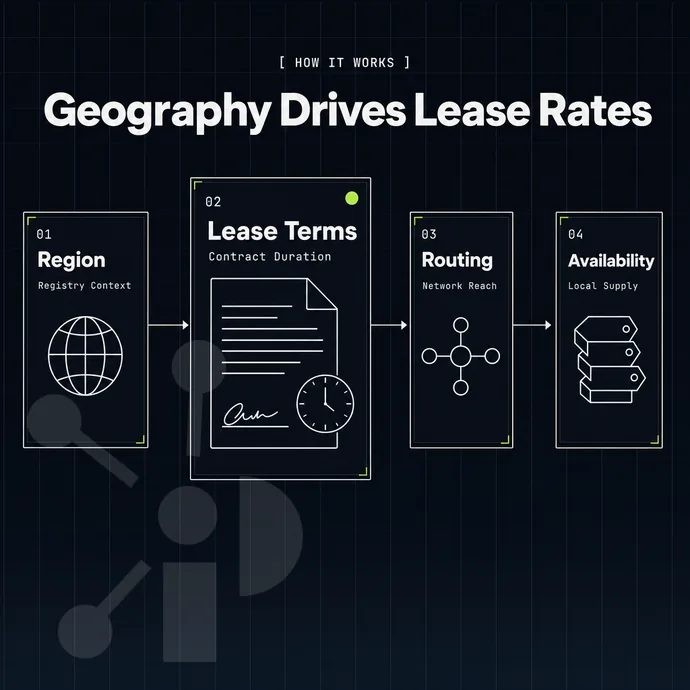
One of the key determinants for internet protocol address leases, the RIR region (regional internet registry) where addresses are leased out significantly affects supply. Demand as well as local regulatory requirements which are very different between the five RIRs and strongly affect the pricing. The APNIC region in particular has seen constrained availability due to early exhaustion of its free pool and strict transfer policies.
Understand regional supply and demand among hosting providers
- Match your traffic to the correct IP registry. For example, ARIN serves North America, RIPE NCC serves Europe, the Middle East and parts of Asia, APNIC serves Asia and the Pacific, LACNIC serves Latin America and AFRINIC serves Africa. A business serving a North American audience will need to get an IP address space from an ARIN-registered IP address. A business serving a European audience will need to get an IP address space from a RIPE NCC-block.
- Explain the regional price differences. The same /24 block of ARIN space can rent for a different lease rate than an identical /24 block of RIPE NCC space in the same month. This is due in part to the historically constrained supply of ARIN space as opposed to growing demand for APNIC space in the Asia-Pacific region as infrastructure development there accelerates. These figures are never published and must be requested as current quotes.
Match the block's registry to your deployment region
- Check where a block is registered, not just where it is routed. A block of network addresses registered under one RIR (e.g. ARIN) but announced from another region (e.g. Europe) leads to problems with geolocation accuracy. Geolocation services like MaxMind and ipinfo.io resolve internet addresses to locations based on the registration information for that IP address. So a mismatch here leads to wrong geolocation of your users.
- Business impact. The inaccurate geolocation affects front-end services that rely on location information. For example, content delivery, fraud scoring, and price per region. Services provided by customer services via geolocation targeting fail silently if the registered region does not match the actual region where the service is deployed.
Note: Prefixx publishes a daily RFC 8805 geofeed and manages geolocation corrections as part of the white-glove service included with every lease. If you lease a block through us, we handle the correction submissions to MaxMind, IP2Location, DB-IP and ipinfo.io on your behalf. Geography determines the rate, but the block's reputation history determines whether it's usable at all. Geolocation data also matters for services that route traffic through a proxy, where the perceived origin location affects access policies and content delivery.
IP reputation, abuse history and unclear ownership
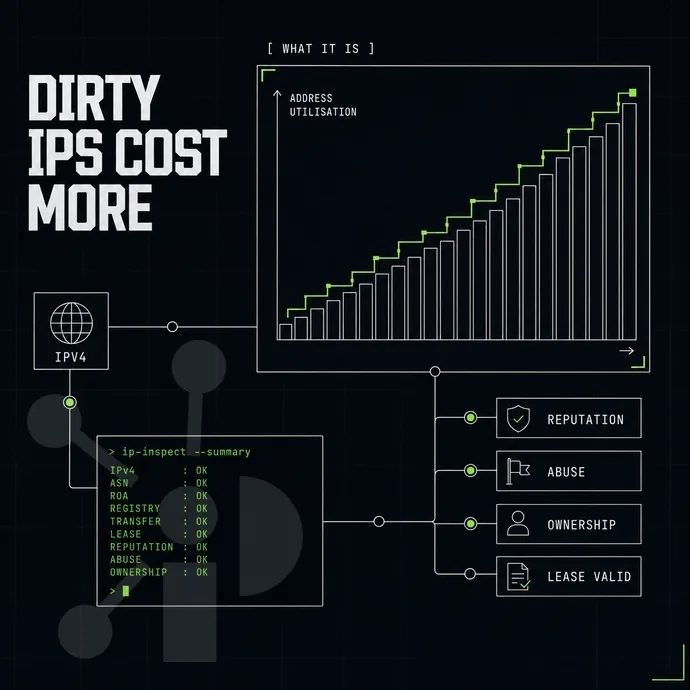
elements such as address reputation, abuse history and custodianship are often considered secondary when compARIN g lease options. But they are key determinants to consider when evaluating potential leased space. Each of these will impact your businesses space immediately upon moving in, and remediation of issues discovered after move-in is very time-consuming and expensive in terms of operational risk.
Poor IP reputation and its effect on services
Email blocks with poor IP standing are often pre-flagged by spam filters and land in users’ junk mail folders even before you send your first campaign message. Customer facing services such as support hotlines, account access and shopping carts may also be blocked by firewalls and content filters that reference commercial threat feeds. Organizations evaluating such blocks must conduct thorough due diligence, as buyers inheriting tainted ranges face immediate operational disruptions across multiple service channels.
The cost per email address does not reflect the true cost of Email Deliverability problems, as they also include the cost of remediation, re-IP planning and lost revenue. Organizations running proxy services or anonymization networks face particularly acute deliverability challenges because shared-use models concentrate sender behavior across many users onto a limited resource pool.
Any listing found is then flagged for the corresponding block before it is allocated to a lessee. Some lessors also verify that the block has not been used for proxy services that might have triggered automated filtering systems.
Abuse history and routing hygiene across hosting providers
Abuse history of routable addresses typically leaves traces in the RIR databases (route registries) and the upstream ASN's requirements for the blocks of address blocks that were previously used for spam, for scanning, for fraud etc. Routing hygiene checks ensure that all RPKI ROA s, all IRR route objects and the origin ASN (autonomous system number) information are up-to-date and correct. Any discrepancy here will result in route filtering by the transit providers.
Unclear ownership and cloud infrastructure RIR standing
A structural risk of unclear stewardship: If the lessor cannot show clean RIR registration for a given poor reputation block then it may be unroutable or subject to revocation. We at Tixx verify registration, transfer eligibility and RIR standing for any block we offer. Proper verification of registration and transfer eligibility ensures compliance with regional internet registry policies and reduces the risk of service disruption.
A poor reputation block with contested registration is not a cheaper option and thereby not a good lease for you. Only after a given poor reputation block has passed the above checks you can decide how long you need it and we can discuss the appropriate contract for lease protection for your operation. Businesses evaluating lease options should weigh whether their use case justifies a long term commitment or requires flexibility to scale and pivot as network needs evolve.
Contract term, renewal rights and operational flexibility

The way you structure the term of your lease will have implications for monthly cost and for issues like scaling, exit and renewal. Weighing the advantages of flexibility versus cost stability helps determine whether a short-term or multi-year commitment better suits your operational needs.
Short term versus long term structures
Short term leases are best suited for a product launch, a short term seasonal campaign or a proof-of-concept deployment. Although there is flexibility in short term leases, they do come with exposure to the provider not renewing, aggressive re-pricing or even the provider pulling the block with short notice. The primary advantages of this arrangement are speed to deployment and the ability to test market fit without long-term capital commitment.
For longer term commitments (twelve months plus), the cost per address can even decrease further. However, be aware that the longer the commitment the less flexible you will be should your routing needs change or the block in question deteriorate in some way mid-term. Organizations with stable infrastructure plans should carefully weigh whether a multi-year commitment aligns with their long term needs before locking in rates.
Renewal rights and non-revocation clauses
Without contractual extension rights your hard work warming a block of business can be terminated at the end of the term. Securing extension or renewal terms protects your operational continuity and ensures stable performance as your network scales into the future.
Non-revocation language is also crucial to understand and verify. A typical Prefixx lease includes a non-revocation guarantee. This simply means that we cannot remove a block of IP from service while it is covered under an active contract. This clearly sets the outer limits of potential risk to live traffic. For more context, see Dynamic Host Configuration Protocol.
How leasing helps preserve cash flow
By leasing rather than buying, you get to keep the capital in your pocket instead of throwing it at a rapidly depreciating asset. Leasing a large piece of equipment with fluctuating demand allows you to treat that huge upfront capital expenditure as a simple, ongoing operating expense. This approach allows organizations to deploy resources more strategically rather than tying up working capital in infrastructure assets.
- Leasing is suited for short-term requirements, testing by pilots, and phases of growth where long-term attribution is not yet required.
- Leasing for several years can have a cost profile similar to owning, while avoiding the transfer papers involved with buying and selling.
- Our consultants set up models for both scenarios. We recommend a structure based on the actual cash flow cycle of your business.
Only once the term structure has been defined does the last variable come into play: What exactly is covered by the lease rate that is quoted? Organizations evaluating whether to lease or purchase must understand that lease agreements typically bundle registry transfer support, ongoing compliance monitoring, and technical assistance into the recurring fee structure.
Lease vs. Buy: when each option makes financial sense
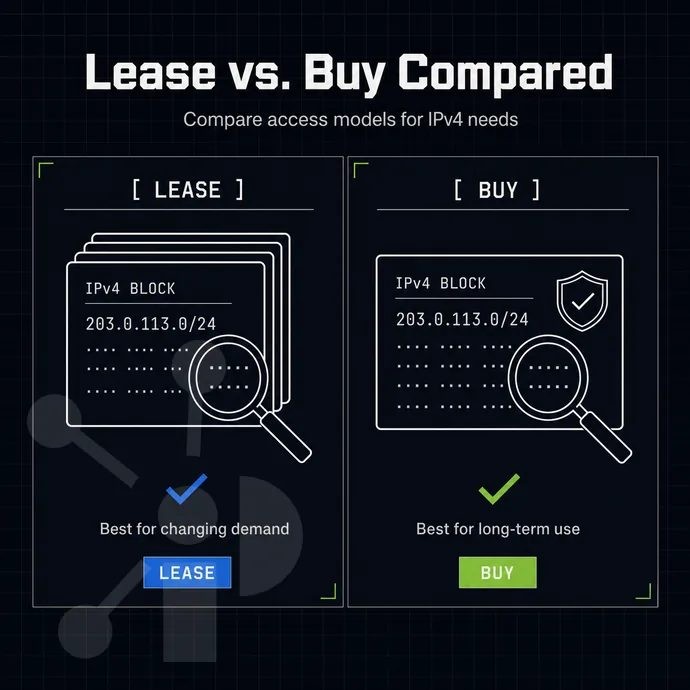
How long you need an IP address and how much money you're willing to put into it is what determines whether you buy an IP address or rent one. The decision depends on your deployment timeline and whether you prefer upfront capital expenditure or ongoing operational expense.
Leasing IPv4 blocks from hosting providers
- Determine your time horizon. If you need storage space for less than 3 years then leasing is more cost effective. You maintain capital, avoid large up front expenditure and can vary the number of blocks as required to accommodate fluctuating demand.
- The confirm routing paperwork is included. A quality lease will include an LOA, RPKI ROA and IRR route objects for you. Prefixx includes this as part of their white-glove service and they provision within 24 hours.
Note: Not every provider includes routing paperwork. Verify before signing, or you may announce addresses without valid RPKI coverage. Many operators discover this gap only after deployment, when upstream providers reject announcements lacking cryptographic validation.
Buying IPv4 addresses: full control
- Work out the long term cost to you of purchasing addresses. If you need to create addresses for a number of years then a purchase could be cost effective. You will own the block of addresses in full and be able to sell them at a later date to recoup your initial outlay.
- It’s also wise to include funds for any transfer fees and additional documentation required. These are in addition to any RIR transfer fees and broker commission. Importantly, we charge no buyer fees and handle the entire RIR transfer process on your behalf.
Choosing the right path across many networks
Short-term or uncertain demand favors leasing. Long-term, stable infrastructure favors buying. Visit Prefixx.net/lease-vs-buy for a detailed breakdown of both routes.
| Factor | Lease | Buy |
|---|---|---|
| Upfront capital | Low | High |
| Monthly cost | Ongoing | None after transfer |
| Ownership rights | No | Yes |
| Flexibility | High | Low |
| Routing paperwork burden | Handled by broker | Handled by broker |
Why choose Prefixx for IPv4 leasing
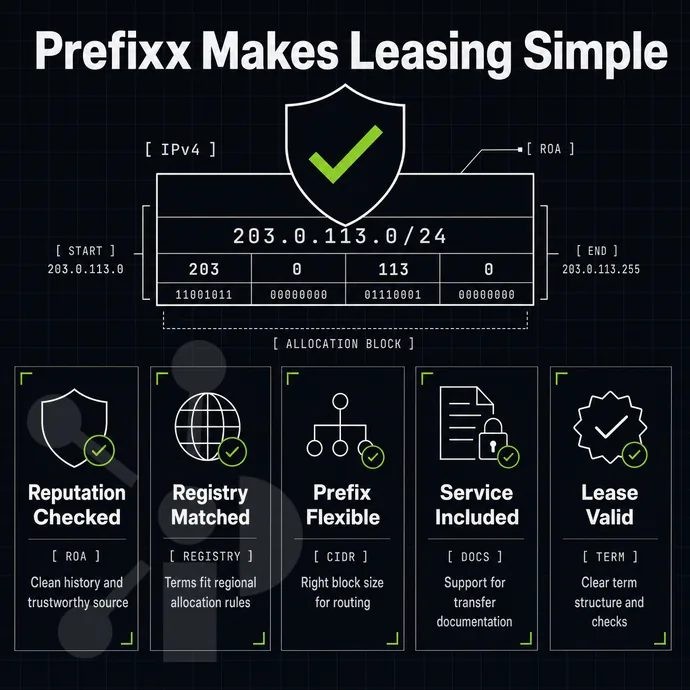
Every variable covered above, IP prefix size, registry region, reputation, term structure, and included services, comes down to one practical question: who is managing the deal on your behalf. When comparing factors to compare IPv4 lease pricing, the broker behind your address space matters as much as the price itself. Prefixx is a registered IPv4 broker with ARIN, RIPE NCC and APNIC, specializing in leasing IPv4 addresses to businesses and infrastructure teams that need clean, routable space fast.
- Tixx quality control on every block. Each block is screened for abuse record, poor address history and routing hygiene before it reaches you.
- White-glove included. Our team prepares the LOA, RPKI ROA and IRR objects. Geolocation correction, rDNS and reputation monitoring are handled for you.
- Non-revocation guarantee, provisioned within 24 hours. Leased space stays routable for the full term.
- BYOIP on Netrouting bare metal. No per-IP surcharge. Operators running dedicated servers get native BYOIP support with no routing setup surprises.
- Client portal included. BGP monitoring, 12-DNSBL reputation scanning, geolocation tools and rDNS management in one place.
Zero buyer fees apply to purchases; leasing is quoted per deal. If your customer-facing services rely on clean IPv4 addresses and you want compliance handled end to end, explore IPv4 leasing with Prefixx or contact our consultants to compare options. Organizations evaluating whether to purchase or lease should weigh the upfront capital commitment against their projected utilization timeline and budget flexibility.
Frequently asked questions about demand
What is the average IPv4 lease price for businesses needing a larger block of addresses?
Pricing varies by prefix length, RIR region, address reputation, and lease duration. ARIN-region addresses and RIPE NCC-region addresses can trade at noticeably different rates in the same month. Market dynamics in recent years have reinforced these regional pricing differences as demand patterns have shifted across registries.
How can I lease a larger block of IPv4 subnet addresses?
Start by identifying the subnet allocation you need and the RIR region that fits your network routing demands. A broker like Prefixx sources a vetted block, runs quality checks through Tixx, and prepares the LOA, RPKI ROA, and IRR route objects on your behalf. The broker will also support you through the announcement process to ensure routing is configured correctly.
What factors limit the number of available IPv4 addresses?
The total IPv4 pool is fixed at roughly 4.3 billion addresses, and every one is spoken for. New addresses can only come from the secondary transfer and lease market, where existing holders sell or lease space they no longer need. That structural scarcity is the primary reason lease rates have risen over time. Organizations that need to expand their network footprint must therefore turn to the secondary market rather than requesting fresh allocations from registries.
Does IP reputation affect my lease rate?
A block with a clean reputation, no blacklist entries, and a history of legitimate routing commands a higher rate than one with abuse complaints or DNSBL listings. Lessors price in the remediation risk. Prefixx runs every block through Tixx quality control before it reaches a lessee, checking assignment, blacklist status, and routing hygiene, so businesses are not paying a premium for a block that arrives with hidden problems. This quality assurance process ensures that buyers receive blocks meeting their operational requirements without unexpected remediation costs.
What is the difference between leasing and buying IPv4 addresses?
Buying transfers full allocation of the block to you through an RIR-recorded transaction. Leasing gives you routing rights for a defined term without an provenance transfer. Buying requires a larger upfront cost and involves RIR transfer paperwork, while leasing offers a predictable monthly cost and faster deployment. Leasing allows organizations to expand their available address pool without the capital commitment required for outright purchase.
What does white-glove IPv4 leasing service include?
Prefixx's white-glove service covers the full operational setup and ongoing management of your leased block. That includes geolocation correction across major providers, reverse DNS configuration meeting ASN requirements, reputation monitoring across 12 DNSBLs, blacklist scanning, and abuse complaint processing. The team also prepares the LOA, RPKI ROA, and IRR route objects so your block is ready to announce without additional legwork on your end. This comprehensive service model ensures lessees receive continuous technical support throughout the lease term without needing to coordinate with multiple vendors.
How long does it take to provision a leased IPv4 block?
The speed is possible because Tixx quality checks run before a block is listed, not after a deal is signed. This pre-qualification approach means buyers receive clean, ready-to-route resources without delays caused by post-contract discovery of listing or validation issues.
The three biggest variables affecting the price of lease rates for address resources are: address range size (how many IPs you’re buying), RIR region (where the address inventory are from). Additionally, IP trustworthiness (i.e. are the IPs on any blacklists? Are they in a region that presents problems for routing?). Organizations running web scraping operations or anonymization services often evaluate whether a proxy configuration will function reliably with the leased resources before committing to a contract.
And a cheap per-IP rate for a big block of IPs means nothing if the IPs in question have a bad reputation, or are located in a RIR region that presents problems. Also, an initial term that’s very short and no rights to renew at that time can leave you hanging when you need your IP infrastructure the most.
Running the numbers across all five dimensions (block size, location, reputation, flexibility and support) before signing a lease is far more important than just focusing on the low headline rate with no LOA, no RPKI, and no abuse handling.
Prefixx leases include Tixx quality control on every block, non-revocation guarantees, and white-glove routing paperwork from day one.
Contact us to discuss your IPv4 needs today
No hidden fees, free consult. A broker replies within one business day.