
By Savvas Bout, Founder of Prefixx. Last updated 19 October 2026.
As networks shut down, the IPv4 addresses that were allocated to them in the past suddenly become one of the most recoverable assets in the decommissioning process. This is why many companies today are selling their remaining IPv4 address space as part of their infrastructure shut-down, merger and acquisition activities, or complete transition to cloud services, which include IP addressing in their services.
Organizations that previously relied on network address translation to extend their limited allocations may find those underlying blocks particularly attractive to buyers once the infrastructure is decommissioned.
The IP address space you hold in your ARIN, RIPE NCC, or APNIC account has value, and that value can evaporate if you do nothing with the IP addresses you hold or return them to the registries.
If you're an engineer selling a block, the process is likely more structured than you anticipated. Eligibility for transfer, a clean routing history, and the RIR(s) in which the IP is held all impact both the time to close and selling price. It is worth noting that the structured nature of the process reflects the technical and administrative requirements imposed by the registries themselves.
In due diligence, the buyer will likely look for information regarding blacklists, RPKI configuration for the IPv4 addresses in question, and any prior abuse. In this article, we'll discuss the important items to verify prior to listing, the process for the transfer and associated escrow, and the key factors which will determine whether your sale closes at the registry or not. Buyers and sellers typically exchange information through secure channels to establish the legitimacy of the block and the parties involved.
What happens to IP addresses when a network shuts down
Even after a company has closed down, their IPv4 addresses do not expire. They are assets registered to a company as holder in the regional internet registry database, and as long as the necessary transfer or return of the IP addresses is completed by the original holder, these still exist as assets of the original holder. The registry database continues to recognize the holder's rights to those IP resources, which remain available for legitimate use or sale rather than being recycled as new addresses.
IP addresses survive shutdown via escrow services
The Internet protocol address space assigned to your organization is permanently registered with your RIR after a failure. It is not automatically reclaimed. The free IP address pools of the five RIRs were completely exhausted between 2011 and 2020. Thus there is no more IP address space entering the market from this source. Every assigned address space is limited and can be traced back. The internet assigned numbers authority originally coordinated the allocation policies that each RIR now administers independently within its region.
Addresses registered under a dissolved company's name are difficult to transfer, so handling the transfer before dissolution makes things far easier.
A shutdown is a liquidity event for IP addresses
When the internet was first launched, addresses which were not in use were placed back into the free pool of unused addresses.
What Prefixx does at this stage
We check the RIR status of our consultants, verify whether a transfer is possible and draw up all the necessary paperwork for the new routing. We broker the deal through an escrow-secured settlement. With Tixx, you can check every block before you buy it from the seller. Working with experienced IP brokers ensures that both parties navigate the registry requirements and documentation correctly throughout the transaction.
Understanding the real value in these blocks of IP addresses requires a grasp of the IPv4 market structure.
Why IPv4 blocks retain real market value after a shutdown
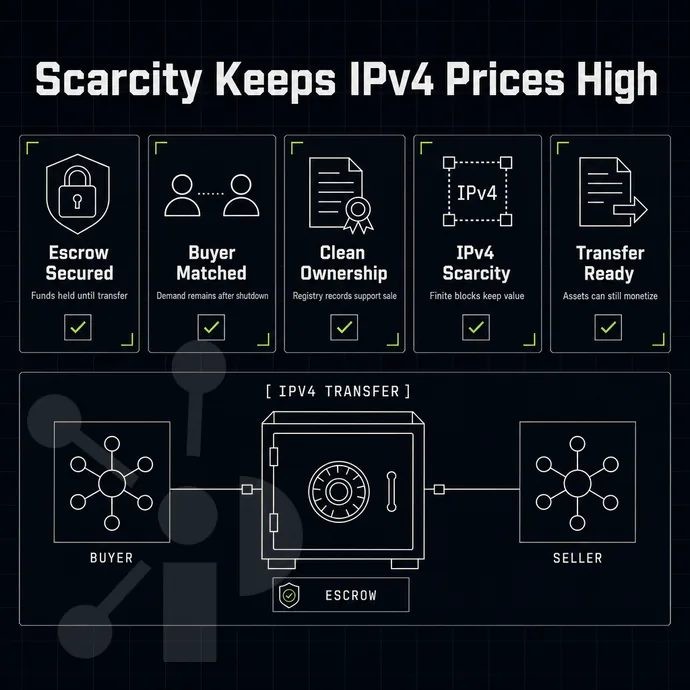
Closed networks still hold value to you even if they shut down. All of the IPv4 addresses from a closed network are available for sale in a fixed supply market where demand is constantly increasing.
Why supply is permanently capped
There are approximately 4.3 billion unique addresses in existence today.
Note that this scarcity is not cyclical but rather structural. All ISPs, data centers, cloud providers and large corporations are competing for the same finite pool of scarce IP addresses. When a network closes down, its IP addresses come back on the market at the precise time when most buyers are active. The same scarcity affects google users and every other internet-connected entity that relies on direct IP allocation for their services.
How demand keeps prices elevated
Growth in internet users and the proliferation of mobile devices to connect users to platforms and services globally all require routable public IP space.
What determines your block's value
The two biggest influencers of a number are block size and RIR region. Large blocks get lots of interest from institutional buyers and command strong per IP addresses prices. A /24 under ARIN can trade at very different prices to an identical size block under RIPE NCC in the same month. Due to the variations in regional demand and the rules around inter RIR transfers.
| RIR region | Typical buyer pool | Price relative to ARIN |
|---|---|---|
| ARIN (North America) | US carriers, cloud providers, enterprises | Benchmark rate |
| RIPE NCC (Europe, Middle East, Central Asia) | European ISPs, hosting operators | Noticeably different in the same month |
| APNIC (Asia-Pacific) | Regional carriers, data center operators | Varies by sub-region demand |
If you’re closing out a network, that inventory you hold has real value at them and can be sold. All listings posted by sellers through Prefixx go through Tixx inspection for quality prior to being listed for sale to interested buyers via escrow and for a flat seller-only commission with no commission paid upfront by the seller.
Before moving, it is crucial to verify that you have the legal and physical space to do so.
Establishing ownership rights before you sell
Don’t sell the address space you have recovered from a network that is shutting down before you have verified that you can move/move the space and that it will be yours to sell. It could take a long time to verify this and could kill the sale in the end.
Preparation: confirm registration and eligibility
- Verify the WHOIS information for the block under your organization’s name at the relevant RIR. Potential buyers and their attorneys will verify this information prior to execution of an asset purchase agreement. Incorrect information should be corrected via a correction ticket with the registry prior to advertising for sale.
- Determine whether the resources in question are legacy or non-legacy. Resources in legacy blocks were assigned prior to the creation of the current RIR system structure, and typically are outside of current standard policy. Agreement with the appropriate registry is often required for such resources to be sold, whereas non-legacy resources in that region are transferred according to standard transfer of resources policy for that region.
Verification: check for policy violations and routing hygiene
- Check if there are any outstanding violations. Policy violations that are outstanding will prevent RIR approval. Check account status in registry portal.
- Run a pre-sale quality check. Tixx by Prefixx validates the ownership, blacklists, routing and RIR information of a given block and generates a health report as well as a transfer readiness score. It’s the fastest way to attach a clean block to real market demand.
Once ownership and eligibility for the IPv4 addresses are confirmed, the block should be fully prepared for the market before it is let.
Cleaning up the block before it goes to market
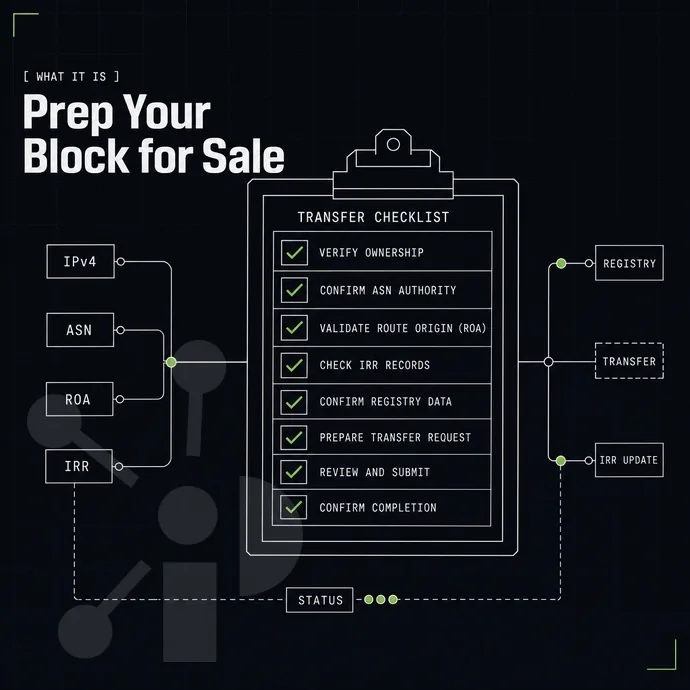
A development that comes to market with a clean reputation, neat registry records, and a verified public IP address will get better prices and complete more quickly. Buyers often inspect registry data to confirm that each public IP address in the block resolves to the seller's organization without conflicts or liens.
Withdraw BGP announcements and update IRR objects
Pull the prefix from your router and verify that the withdrawal has propagated. Next, remove or update the appropriate IRR route objects in the database(s) for the relevant RIR (i.e. RADB, RIPE DB, ARIN IRR). Stale objects can confuse downstream routers and prevent the buyer’s first announcement.
Revoke your RPKI ROAs. A ROA for your old ASN will mark announcements from the new holder of your large blocks as invalid and thus drop their traffic. So clean up that before you hand over the block.
Blacklist and reputation checks for IP addresses
Test the space against major DNSBLs including Spamhaus ZEN, BarracudaConnect, SpamCop, SORBS and CBL. Being listed on the Spamhaus ZEN list can make a space unsellable to businesses that communicate via email. They will want to spend months cleaning the space up before they can sell it at a fair price.
Open removal requests for any existing listings prior to listing.
Geolocation and reverse DNS for IP addresses
Make sure your block's geolocation is accurate, misconfigured records cause server access problems for customers directing traffic to specific regions.
Our pre-sale quality control process for blocks we sell, Tixx, checks for same things we check for our customers in pre-sale for blocks they lease: ownership, blacklists, routing hygiene, RIR standing.
With your block in good working order, you can now choose the best exit: a sale, a lease, or a return to the registry for your IPv4 addresses.
Choosing between a sale, a lease and a return to the RIR
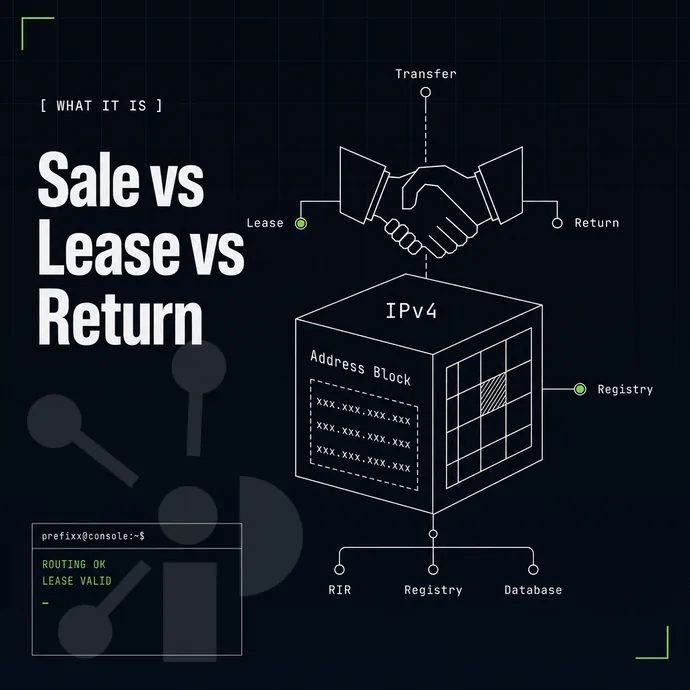
There are three general exit paths when a network using classless inter domain routing shuts down: (1) sell it off in its entirety, (2) lease it out to others on a long-term basis. Alternatively, (3) return it to the relevant RIR (e.g. ARIN). For commercial organizations, the choice between these typically depends upon (a) speed, (b) ownership intent, and (c) what the IPv4 market will pay. Organizations that choose IP leasing retain ownership while generating recurring revenue from their unused resources.
Sale: clean break, one-time proceeds
An outright sale transfers ownership permanently.
We complete the transaction for you. Our seller-only commission for such transactions is 3% to 8% depending on the size of the IPv4 address space offered for sale. (Note that commission for smaller blocks of IPv4 addresses offered for sale is at the upper end of this range.) No commission is charged on the part of the buyer. We only get paid if we win the IPv4 inventory for you.
IP leasing: retain ownership and generate recurring cash flow
Leasing IP block is reasonable if a temporary shutdown occurs or the legal entity continues to exist. The owner holds title to the space and earns ongoing revenue until the space is reclaimed. We prepare the LOA, RPKI ROA, and IRR objects for the lessee so they can begin routing as soon as possible. Organizations that maintain their registry accounts find leasing addresses provides recurring income while preserving the option to reclaim or sell the block later.
Return to the RIR: rarely the right move in today's IPv4 market
Space that is returned yields no value. Registries accept voluntary returns of IPv4 addresses, however the secondary market pays handsomely for the same space that has been commercially registered. Therefore it is only legacy assets with unclear or disputed title that surface from time to time. The same IPv4 resources that registries would reclaim at no cost can instead be monetized through sale to other organizations that need them.
While there are several options available to complete a real estate transaction, working with a registered real estate broker, much like how IPv4 addresses simplify network routing, can make things easier, especially with regards to registry and escrow paperwork. Brokers connect sellers with qualified buyers and manage the technical coordination required across multiple registry systems.
Why work with a registered IPv4 broker for a shutdown sale
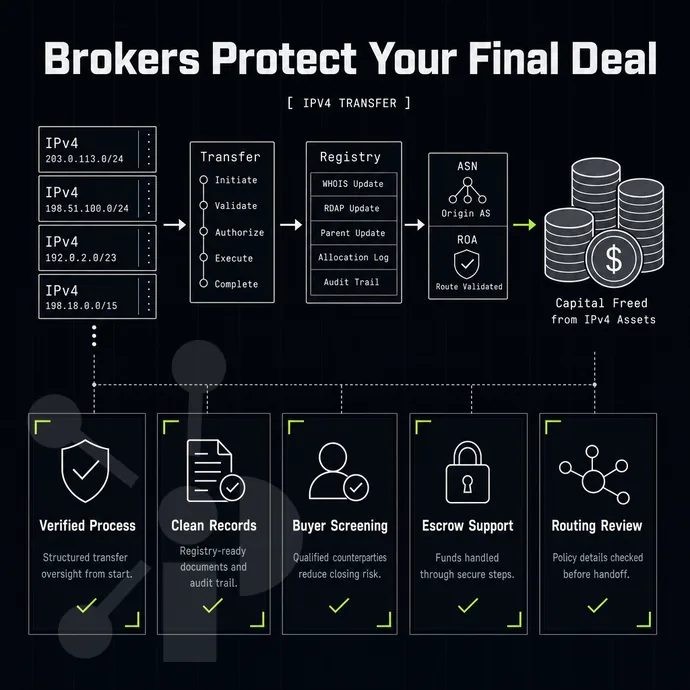
Selling IPv4 addresses during a network shutdown requires the same amount of effort as usual for these types of transactions: regional Internet registries. Contracts, escrow services and routing papers, mostly a once-per-lifetime task for any operator. A registered broker handles all this for you.
All Prefixx listings are registered with ARIN, RIPE NCC and APNIC, and facilitated with LACNIC listings where appropriate. Senior consultants at Prefixx manage the listing, review offers from potential buyers, assist with drafting of an asset purchase agreement, and facilitate the closure of a sale via escrow. Sellers pay a commission of 3-8% on successful sales, no commission is paid by buyers and there is no commission charged if Prefixx fail to secure a sale for a listed resource.
- Tixx QC on every block. Check ownership, transfer eligibility, blacklist status and routing QC before listing those addresses for sale to buyers.
- Payment via escrow held until all parties have transferred and the deal completed.
- White-glove paperwork for you. We create the LOA, RPKI ROA and IRR route objects for you.
- We have a multilingual team spreading over the five RIR regions. We are your single point of contact for all IP blocks, regardless of their registration.
- Boutique, human-in-the-loop deals are staffed by a senior consultant who follows a client through a transaction from initial contact until the matter is transferred to another lawyer.
If you are considering selling IPv4 addresses as part of a shutdown, visit Prefixx.net/sell-IPv4-addresses or contact our team to discuss your IP allocation and get a no-obligation valuation.
Frequently asked questions about IP addresses
Can I sell unused IPv4 addresses after switching to NAT when closing down?
Yes. A company in wind-down can sell its IPv4 holdings, provided it still holds valid registration with the relevant RIR at the time of transfer. The addresses are an asset, and the proceeds can be distributed as part of the liquidation process. A broker such as Prefixx can manage the entire sale on your behalf, from listing and buyer vetting through escrow settlement and RIR transfer paperwork, so your legal or insolvency team does not need to learn the process.
How long does selling IPv4 when a network shuts down via transfer take?
Timeline depends on the RIR and whether the block is clean and transfer-eligible on day one. ARIN transfers typically complete in two to four weeks once documentation is in order. RIPE NCC transfers are often faster, sometimes under two weeks. Blocks with open abuse records, active disputes, or incomplete WHOIS data take longer, which is why pre-sale quality control matters before you list. Each of the five regional internet registries maintains its own approval workflow and documentation requirements for processing transfers.
What happens to IPv4 addresses still announced in BGP at shutdown?
A live BGP announcement does not block a sale, but the prefix must be withdrawn before the transfer completes. The seller is responsible for decommissioning the announcement and revoking any RPKI ROAs tied to their ASN. If those steps are missed, the buyer's routing will conflict with the old origin ASN, creating reachability problems. When buying IP addresses through Prefixx, the white-glove team checks routing hygiene as part of their quality control and flags any live announcements before the deal closes. Proper decommissioning ensures that downstream networks can connect to the new holder's infrastructure without encountering stale origin conflicts or path selection issues.
Do I need to return or sell IP addresses to the RIR?
No. An internet protocol version 4 IP range allocated or assigned under current RIR policy can be transferred to another organization rather than returned. Returning space to the RIR yields nothing; selling it through the secondary market recovers real value. Legacy resources and directly assigned PI space are also transferable under most RIR policies. The only exception is IPv4 addresses held under certain contractual arrangements that explicitly prohibit transfer, which a broker can identify during due diligence.
How is the sale price of an IPv4 block determined?
Price is driven by block size , RIR region, reputation history, and current market demand. A /24 under ARIN and an identically sized block under RIPE NCC can command a noticeably different purchase price in the same month. Buyers seeking smaller blocks often face higher per-IP pricing due to reduced liquidity and the administrative overhead of processing numerous individual transactions.
Blocks with clean reputation records and no blacklist entries command a premium over those with abuse history. Because no official price index exists, working with a registered broker gives you access to real transaction data and a realistic valuation before you commit to a listing.
What documents are needed to transfer IP addresses after a network closure
The core requirements are proof of current registration (WHOIS records matching the seller entity), a signed transfer agreement between buyer and seller, and the RIR's own transfer request forms. If the company is in liquidation, the liquidator or authorized signatory must execute the transfer process paperwork on behalf of the entity. The signed agreement typically coordinates with third-party escrow services that hold funds until both registry approval and documentation requirements are satisfied.
An LOA (Letter of Authorization) is also required to authorize routing changes on the buyer's side. Prefixx prepares all routing documents needed for the transfer process, including the LOA, RPKI ROA updates, and IRR route objects, as part of every deal.
Can I lease out my IP addresses instead of selling if the shutdown is temporary?
Yes, leasing to a private network operator is a viable alternative when the shutdown is temporary or when you want to preserve ownership while generating revenue. A lease keeps the block registered in your name while a lessee in high demand uses it under a contractual non-revocation guarantee.
This works well for companies pausing operations, restructuring, or waiting for market conditions to improve before selling. Prefixx offers guaranteed leases of IPv4 addresses with provisioning within 24 hours and handles the full white-glove setup, including RPKI, LOA, and reverse DNS, on the lessee's behalf.
Shutting down a network does not necessarily mean abandoning its IP IPv4 block. Such addresses have real value on the market only if the respective address block is “clean” as to ownership, free from negative associations with respect to routing, and suitable for some form of exit. First, get a copy of the appropriate RIR records in order. Next, “clean” the block of any heritage items. Finally, decide whether to sell, lease or return the space.
Most organizations in this position benefit from a broker who can verify transfer eligibility, run pre-sale quality checks, and handle the paperwork from LOA through escrow close. That is exactly where Prefixx operates. If you have IPv4 addresses tied to a network that is winding down, reach out to the Prefixx team to get a valuation and understand your options before the block sits idle any longer.
Contact us to discuss your IPv4 needs today
No hidden fees, free consult. A broker replies within one business day.