
By Savvas Bout, Founder of Prefixx. Last updated 23 October 2026.
Organizations with legacy /16 or /20 blocks usually do not need all the addresses in the block. Selling off part of the space in the block enables them to convert idle space into capital without having to give up their entire allocation of IPv4 addresses.
However, selling off part of a block is more complex than a simple full block transfer.
Selling the wrong part of your infrastructure can lead to all sorts of problems, including a split that stalls at the registry, a remnant prefix that isn’t routed.
This guide explains the key elements to consider when deciding whether to sell a portion of your infrastructure, how RIR rules differ between ARIN.
What it means to sell part of an IPv4 block
A partial block sale enables you to generate value from underused address space while you still hold the remainder of your allocation. A /20 holder can sell off a /24 or /23 that he no longer needs to use. The transfer is registered with the Internet registry for only the subset of addresses transferred. For more context, see IP Address block brokers - best way to sell a class B?.
How a partial sale works
Each RIR treats the sub-block that was transferred in the same way as a completely separate resource after the transfer. Space that the seller has left at their original allocation is registered there. The largest market for selling IPv4 is made up of enterprises that years ago had provisioned more IPv4 address space than they needed, and since then have had idle IPv4 addresses listed on their books.
A university with a /19 (8,192 addresses) turns about half of them. Then it splits off a /21 it wants to sell from the other /21 it will continue to use. Two separate RIR objects are recorded post-transfer.
Minimum transfer sizes and policy limits
Not all splits are created equal and can be outside of the normal policy compliance rules of the major internet registries (floor).
- ARIN: /24 minimum (256 addresses).
- RIPE NCC: /24 minimum.
- APNIC: /24 minimum.
If you try to sell a /25 or smaller it will fail at the registry level. The block you carve out needs to be routeable on clean boundaries not some arbitrary slice.
What the seller retains
The seller retains full control of the majority of the original allocation, no changes to the routing or new RIR agreements required. Prefixx consultants will review the parent block prior to listing to ensure the proposed split is clean, meets policy and is ready for transfer.
Why organizations sell only part of their address space
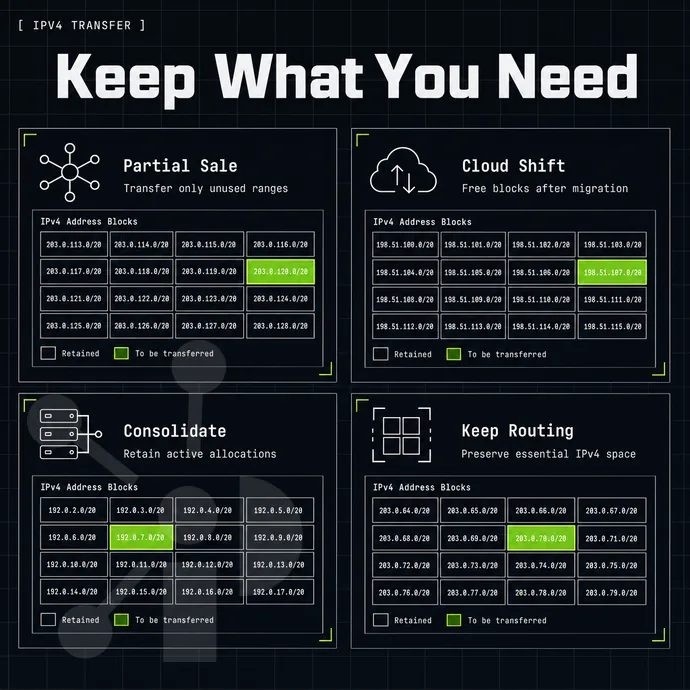
There is usually no need for a company to sell out the whole inventory. A network redesign, a cloud migration or a data center consolidation project often results in large blocks of IP addresses, which in turn contain a number of sub-ranges that will not be required and are not justified to be announced on the internet. Selling part of this unused IP address space is a reasonable compromise.
Right-sizing after a redesign
Old allocations of a /16 or /18 can contain many unannounced /24s. Selling these sub-ranges of old IP addresses can help to recoup capital invested while not touching current operational infrastructure. RIR transfer of IPv4 addresses also supports partial transfers, so the seller can retain portions of the allocation that are currently used.
Freeing capital without full divestiture
IPv4 addresses are traded in the secondary market of IPv4 addresses . Here the trade of single IPv4 addresses as well as of larger IPv4 address blocks is negotiated. The price for an IPv4 address trade depends on several parameters such as the size of the single IPv4 address / IP address block in netbits.
The RIR region in which the respective IP address holder is registered and the good name of the respective IP address holder. Selling off single /24 or /22 blocks from a larger holding allows for immediate liquidity while keeping the remaining space under the control of the original organization and thus keeping all their options for routing open.
Reducing maintenance overhead
All RIR records, RPKI ROAs, and IRR route objects need to be maintained from time to time.
Prefixx can assist with partial sales by conducting a block-level Tixx quality check, handling the RIR transfer paperwork and facilitating the escrow settlement for the seller. They only charge a commission on a successful sale and there are no upfront fees to list a partial holding.
RIR policy: minimum transfer sizes and eligibility rules
Minimum transfer size and Eligibility rules for transfer of IP address space are specified by each internet registry. Verify minimum transfer size floor for sending and receiving registry for a proposed IPv4 address block split, and verify that proposed sub-block is a valid CIDR prefix.
Preparation for cutting large blocks
- First determine the size of your sub-block. Most major registries have a minimum sub-block size of a /24. Any split smaller than this will be refused. Also check that the prefix is on a clean CIDR boundary.
- Check for registry specific rules such as: ARIN needs approval under policy 8.3 (needs-based) or 8.4 (needs-free); RIPE NCC has no such requirement and thus transfer is facilitated more easily. APNIC transfers are conducted under the terms of Prop-050; LACNIC transfers are facilitated and subject to different timetables than other transfer types; AFRINIC allows transfers where policy permits.
Execution
- File transfer request with appropriate registry(s) and attach supporting justification documents as required by section 8.3 or 8.4 of the ARIN Policy. The needs assessment typically required for an ARIN 8.3 request is not required for an ARIN 8.4 request. However approval by the Board of Directors of the transferring organization is required for both types of requests.
- Coordinate the escrow and paperwork steps in parallel. It takes some time to prepare the routing documents (LOA, RPKI ROA, IRR) as well as the registry filing. Any delays here affect the overall processing time.
Note: Never assume a fixed registry processing window. Timelines vary and are not guaranteed. Build buffer into any contract or cutover date.
Verification
- Check if the registration update has been processed by the respective registry. After the transfer has been processed, check the WHOIS information for the updated holder of the IP address / IP range. Also, verify if the RPKI republishing was successful and if the updated information is correctly defined in the respective IRR.
Just as policy compliance for a sub-block makes only half the promise, the other half is to ensure that the carved out sub-block is mathematically sound and can be independently routed.
How to split a block: cidr math and routing practicalities
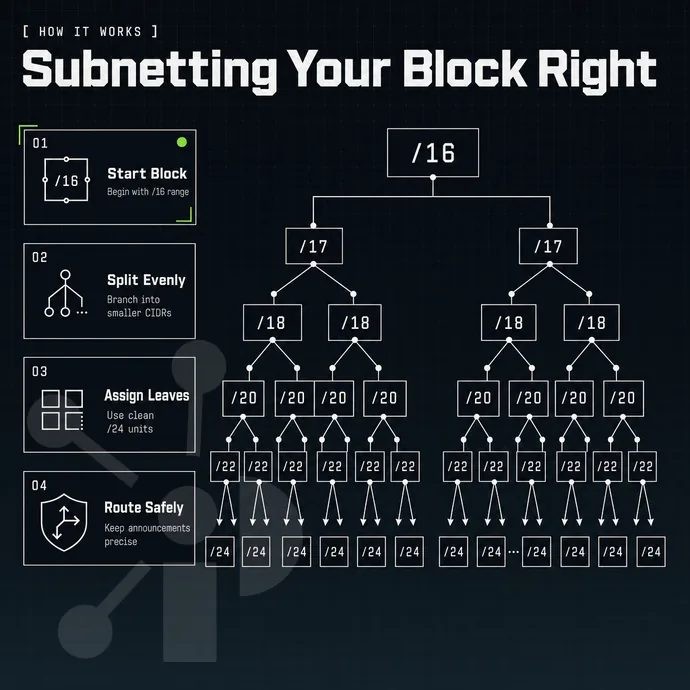
Making sure to split a block for a partial sale correctly is theoretically quite easy but in reality requires a lot of precision.
Cidr math: how a /20 divides
Every time you increase the subnet prefix length by one bit, the available address space is halved. So the 4,096 IPv4 addresses in a /20 can be split into two /21s with 2,048 IPv4 addresses each. These can in turn be split into four /22s with 1,024 IPv4 addresses each. And so on, down to sixteen /24s containing 256 IPv4 addresses each.
For a split to be on a power-of-two boundary, it cannot be a random size carved out of the middle of a block. Host bits of the new boundary must all be zero at the subnet boundary for a prefix to be invalid.
Routeability by prefix length
Maximum prefix length filters on IPv4 of /24 and upwards are common on most transit networks.
For saleable IPv4 address space a floor of /24 can be considered. Announcing /25 or smaller space is not always possible.
Retained block validity
The portion that you retain must also form a valid CIDR prefix.
| Parent block | Sub-block for sale | Retained block |
|---|---|---|
| /20 (4,096 IPs) | /21 (2,048 IPs) | /21 (2,048 IPs) |
| /21 (2,048 IPs) | /22 (1,024 IPs) | /22 (1,024 IPs) |
| /22 (1,024 IPs) | /23 (512 IPs) | /23 (512 IPs) |
| /23 (512 IPs) | /24 (256 IPs) | /24 (256 IPs) |
Mathematically splitting a parcel is only half the battle. The sub-block created must be 'clean' enough to pass due diligence by prospective buyers.
Pre-sale quality checks every seller should run
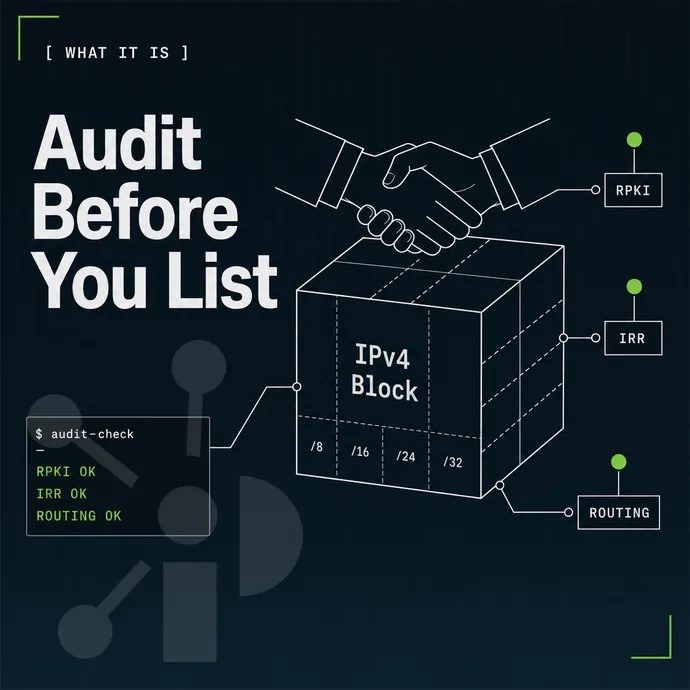
A “dirty” block is usually a “discounted” block. Before you start advertising any of the IPv4 addresses from a given “dirty” block for sale, do some “hygiene” checking first. You can lose a lot of money, and cause a lot of grief with a stalled transfer, if you don’t. The buyer and their broker will check the same information anyway, so you might as well do it first.
RIR registration and transfer eligibility
Verify that the block appears correctly in your RIR’s WHOIS database with correct org contact information.
- Verify the organization name, physical address and reported abuse contact are current.
- Confirm no existing transfer lock or pending dispute.
- Verify that any sub-allocation to a downstream is documented.
Blacklist and routing hygiene
Check all your sub-blocks against the major DNSBLs: Spamhaus ZEN, BarracudaConnect, SpamCop, SORBS and CBL. One /24 within a /22 can affect the price of the entire block. Also check the RPKI ROA state and the IRR route objects. Old or conflicting route objects show very bad stewardship to potential buyers.
Be sure to check for any open abuse complaints with ARIN, RIPE NCC, and/or APNIC before listing an IP address for transfer. Transfer of an IP address can be halted by a registry due to outstanding complaints.
Tixx by Prefixx
For every block that we move through Tixx, our quality control layer.
The transfer process: from listing to completed sale
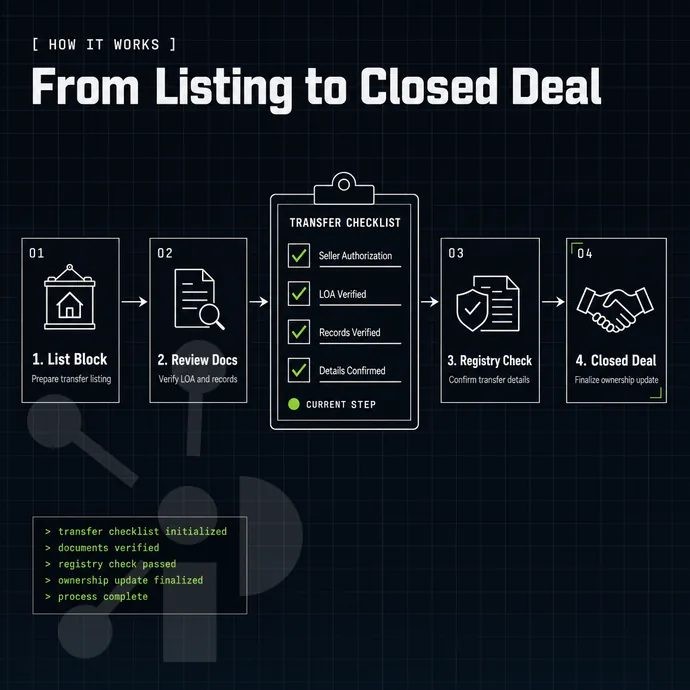
The sale of a part of an IPv4 block is a sequential process. All steps are intended to safeguard both parties involved in the transaction as well as the correct assignment of the released block by the RIR.
Preparing the sub-block
Is the sub-block a valid CIDR?
Engaging a broker and vetting buyers
To list, to check buyers for eligibility, and to start the transfer to the destination after the escrow has opened, a registered broker with credentials at the ARIN, RIPE NCC and APNIC RIRs is required. This step checks if the buyer is eligible to receive an IP address as per RIR’s policies to prevent a failed transfer after the IP has been released from the seller’s custody in the escrow.
Escrow, RIR submission, and routing handover
In Escrow mode, the funds are held until RIR confirms transfer. Upon such confirmation, LOA is issued, RPKI ROA is prepared and IRR route objects are updated to allow new holder to start announcing the whole block right away. Seller gets paid upon RIR’s confirmation.
All stages of the process are managed for you: listing, QC, escrow, RIR submission, LOA, ROA and IRR.
What drives the price of a sub-block
There are four variables which affect the market price for the sale of larger holding(s) of IPv4 address es. Understanding these before listing enables a seller to time their sale and achieve best price for any sub-block they wish to sell.
Block size and liquidity
- Determine your most liquid unit. As the standard trading unit for A /24 blocks of IP space across all RIRs, its demand can be announced independently of larger block sizes. While larger blocks of IP may command a higher per-IP price in regional markets, they typically have fewer buyers than a /24.
- Match the size of your large block to the demand for it. If your large block of space can be cleanly divided into /24s, each /24 will likely sell faster than the whole. Smaller, routable blocks of address space typically sell faster than large aggregates.
RIR region and reputation
- Check which registry is holding this block. A /24 held under ARIN may trade at a vastly different price than an identical /24 held under RIPE NCC in the same trading month. The two rates are not published, and the difference is purely a function of regional supply/demand as well as policy differences.
- Audit routing and reputation history. Prefer to announce clean blocks with no black list entries and a clean history (versus announcing a block with abuse complaints or with RPKI invalids for example). Reputational check should be run before announcement is listed.
Note: Skipping the reputation audit is the most common mistake sellers make. A single active Spamhaus listing can stall a deal or force a price reduction mid-negotiation.
Timing and demand cycles
- Keep an eye on demand signals. The IPv4 address space is traded in cycles based on cloud expansion, regulatory changes as well as changes in the policies of the RIRs. Listing at a peak of demand is most successful for you.
- Act quickly as conditions change rapidly. Well timed listings on quality addresses close faster and at better prices than others on the market.
Demand for geographic regions can vary even more greatly when the buyer is registered under a different internet registry than the seller. For community perspectives, see IP Address block brokers - best way to sell a class B?.
Inter-rir considerations when the buyer is in a different region
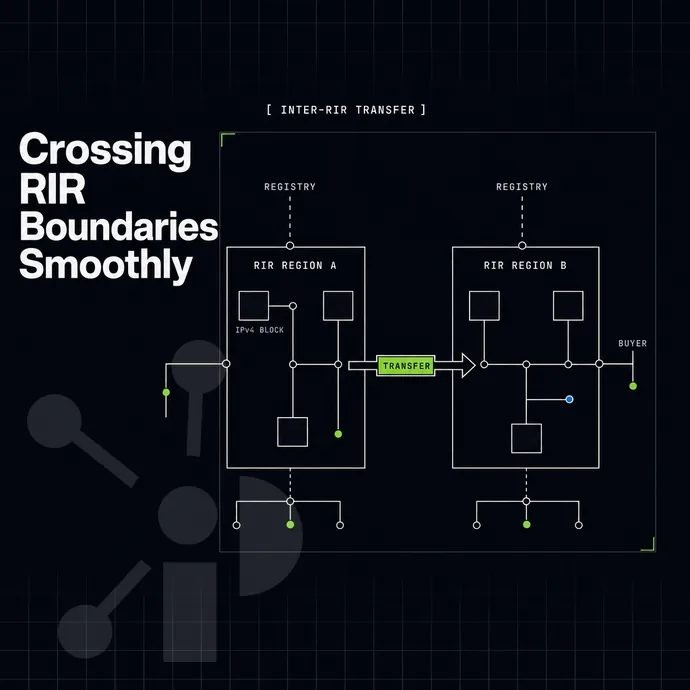
Selling part of an IPv4 block to a customer who is not under the same Internet Registry as you (iRIR transfer) has different mechanics, timelines and required documentation than an iRIR transfer. The different registry pairs have different requirements.
Which registry pairs support direct transfers
ARIN, RIPE NCC and APNIC each have established bilateral inter-RIR transfer agreements. Therefore, an ARIN seller can transfer directly to a RIPE NCC or APNIC buyer, and likewise the reverse. The needs justification or policy requirements of the seller’s and buyer’s respective registries must, however, be satisfied prior to initiating the transfer process.
LACNIC does not have a bilateral agreement with other registries. So, for example, for the transfer of IPv4 addresses held under a LACNIC registry, these need to be processed by the facilitation team rather than a direct registry to registry process. This affects how one scopes out time frames.
Documentation differences from intra-rir transfers
All transfers of IP numbers require a lot of paperwork with each registry involved. The sending registry checks if the seller is allowed to sell those IP numbers and then releases the relevant address blocks. The receiving registry in the meantime checks if the buyer has sufficient justification for requesting those IP numbers.
RPKI ROAs and IRR route objects must be updated at both registries after the transfer has taken place. Routing hygiene does not transfer automatically.
Where Prefixx fits
Prefixx is a registered broker with ARIN, RIPE NCC and APNIC (LACNIC facilitated). This allows us to efficiently manage both the seller’s and buyer’s end of any submission. We will prepare the LOA, ROA updates and IRR objects required to allow the buyer to make a clean announcement of the block(s) of IP address space.
Of course, an outright sale may not be the optimal solution and leasing the unused portion of your space is something we recommend you consider before you settle on a sale.
Selling vs. Leasing the unused portion: choosing the right path
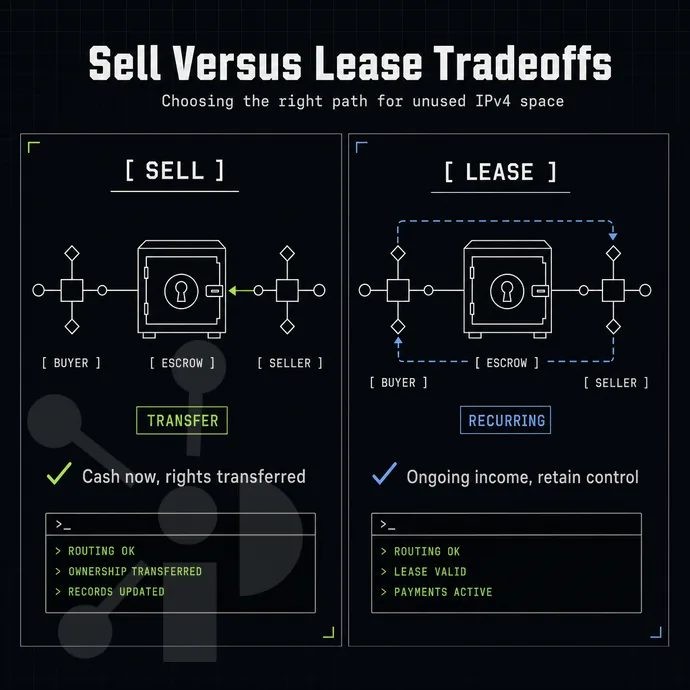
Do you need cash quickly for the unused IPv4 addresses you have in surplus, or would the income from continued use of that space on an annual basis be more valuable to you? Both the sale of surplus address space and leasing of that same space can be very appropriate in certain scenarios.
When selling makes sense
Selling your IPv4 addresses as an outright sale turns them into a one-time capital event. Once the transfer has completed and updated at the relevant RIR, there is no further management of those addresses required. This is often the best option where the surplus is permanent, you need cash now. Alternatively, The ongoing management required to be a lessor is not worth the returns that you receive on an ongoing basis.
A typical scenario: a network team consolidates from a /19 to a /21 after a migration.
When leasing makes sense
Leasing makes sense when your surplus is temporary or when you have no idea how your growth will evolve. You retain the ownership of your IP space and generate cash flow on a regular basis.
- Surplus created by multi-year long running migration process still ongoing.
- IPv4 inventory reserved strategically for future expansion needs.
- Blocks you may need back within a defined window.
Leasing through Prefixx
Our lease offering includes a non-revocation guarantee, RPKI ROA, LOA, and reverse DNS. White-glove service is included. We provision within 24 hours and handle reputation monitoring throughout the lease term.
There is a tradeoff between ownership of a property and ongoing expense as opposed to a “clean sale” of a property.
Why work with a registered IPv4 broker for a partial sale
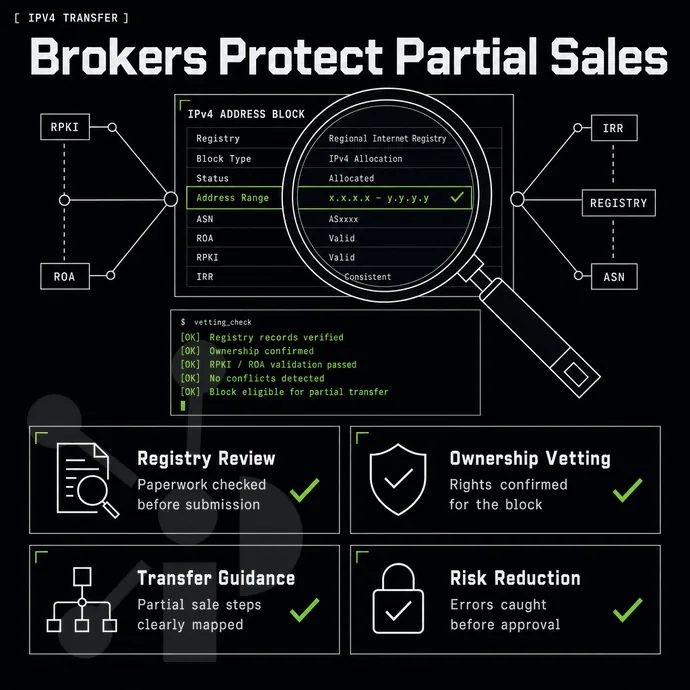
Selling part of a large block of IP addresses is not a straight forward transaction. The internet registry requires formal paperwork to be completed, the buyer needs to be verified and the IP addresses to be sold cleared of any blacklisting and checked for routing health prior to completion. Attempting to sell IP addresses without a registered broker adds significant risk to each stage of the transaction.
Prefixx is a boutique IPv4 broker age with registrations at the three primary IPv4 registries ARIN, RIPE NCC and APNIC. We have executed transfers of IP space in all five RIR regions. Below we lay out what a partial IP sale looks like.
- Tixx QC on every block. Ownership, blacklists, routing, and RIR verified before listing goes live to buyers.
- White-glove paperwork: our consultants draft the LOA, prepare the RPKI ROA and create the IRR route objects for you.
- The funds are held in escrow until the relevant regional registry has processed the transfer.
- We charge a seller-only commission on a no win no fee basis. This is 3% to 8% of the sale price of the property. The buyer pays nothing.
- We have Senior consultants involved on every deal. There are no self-serve queues, deals are managed by a human from start to finish.
If you are ready to sell IPv4 addresses from a larger block, see how we list and close partial sales or review our process to compare it against a direct transfer. The questions below cover what sellers most commonly ask before getting started.
Common questions about partial IPv4 block sales
Selling part of an IPv4 block raises several different practical considerations not present in a sale of a full block. This section outlines the key issues to consider including eligibility, process and the role of a broker.
Can you split and sell a portion of your block?
Yes, but usually the minimum transferable unit is a /24 (256 IP addresses). If you hold more IP addresses than that, you can list out single /24’s (or more) that you wish to sell. Each must be a complete CIDR block and not some random collection of IP addresses.
The IP registry for the space that your resource record is currently in needs to Approve the transfer of the space to you.
What happens to the remaining address space?
The part you are keeping will still be registered under your organization name. You can continue to announce routing for that portion. The portion you sold will be registered to the buyer of that portion through a formal transfer of that portion’s IP address block at one of the RIRs. Updating the corresponding WHOIS entries for that space and removing your organization name from responsibility for that space.
Note: Splitting a block can affect its reputation score. Prefixx scans against 12 DNSBLs before any transfer, so both parties know the health of each prefix upfront.
How do you sell IPv4 addresses through a broker?
Selling IPv4 addresses involves a broker who validates the seller’s IPv4 block offering, finds a suitable buyer and completes the sale via escrow. When selling IPv4 addresses with Prefixx, there are no buyer fees charged. A seller-only based commission is charged at 3% to 8% and smaller IPv4 address blocks tend to be at the upper end of this commission band.
We manage the LOA, RPKI ROA and IRR route objects for you. You sign, we deal with the paperwork and co-ordinate the RIR end of the transfer.
Key takeaways when selling part of your IPv4 blocks
Selling part of an IPv4 block is viable, but only when the math works. The subnet you carve out must align with CIDR boundaries, meet the minimum transfer size your address registry enforces, and pass pre-sale quality checks before it reaches any buyer. Skipping those steps erodes value and stalls the transfer process.
For large blocks, an inter-RIR transfer adds complexity but opens a wider buyer pool. Leasing unused IP allocation is worth considering if a full sale feels premature. Either way, escrow and a registered broker protect both sides. Prefixx handles the full transfer process end to end. Start the conversation at Prefixx.net/sell-IPv4-addresses.
Frequently asked questions
Can I sell just a /24 out of a larger block I own?
Yes. A /24 is the standard minimum transfer unit across ARIN, RIPE NCC and APNIC, so carving one out of a /22 or /21 and selling it independently is a routine transaction. You retain the rest of your allocation and continue announcing it under your own ASN. The key requirement is that the sub-block you intend to sell must be cleanly aligned on a CIDR boundary before the transfer request is submitted to the registry.
What is the minimum size sub-block I can sell under ARIN, RIPE NCC or APNIC?
Under ARIN, the minimum transferable block is a /24 (256 addresses). RIPE NCC also enforces a /24 floor for transfers between members. APNIC follows the same /24 minimum for inter-RIR and intra-RIR transfers. Anything smaller than a /24 cannot be transferred as a standalone block through the registry system, regardless of how it is currently announced in BGP.
Do I need to notify my RIR before splitting and selling part of my allocation?
You do not need pre-approval to split a block internally, but the transfer itself must go through your RIR's formal transfer process. ARIN requires both parties to submit a transfer request through ARIN Online. RIPE NCC handles the re-assignment through its ticketing system, and APNIC requires a transfer request via MyAPNIC. The registry updates the WHOIS record only after the transfer is approved, so the split is not officially recognised until that step completes.
Will selling a sub-block affect the routing of my retained addresses?
It should not, provided you announce your retained prefixes correctly before the transfer completes. If you were announcing the parent aggregate, you need to start announcing the retained sub-blocks as separate, more-specific routes before withdrawing the aggregate.
Failing to do this in the right order can cause a brief routing gap for your own traffic.
How long does a partial IPv4 block transfer typically take?
An intra-RIR transfer (both parties under the same registry) typically completes in one to three weeks once all documentation is in order.
Does a blacklisted sub-block reduce the price of the rest of my space?
A blacklisted sub-block does not automatically drag down the market value of your clean space, because buyers evaluate each prefix independently.
Tixx by Prefixx runs a full reputation scan on every block before listing, so you know exactly which prefixes have issues and can decide whether to remediate, price accordingly, or hold the affected space.
Should I sell or lease the unused portion of my IPv4 block?
Selling converts the asset to cash immediately and removes ongoing management overhead, but you permanently give up the addresses.
The right answer depends on your growth forecast and capital position. Prefixx handles both routes, with escrow-secured sales and guaranteed non-revocation leases that include white-glove routing support, so you can compare real offers for both structures before committing.
It is possible to split off a part of your IPv4 block and sell it. But details matter. The minimum transfer sizes for IPv4 blocks as published by the RIRs have to be respected. CIDR mathematics has to be correct, otherwise the respective registry will not accept the transfer.
Besides paperwork, reputation and routing stability play a large role in this business.
Don’t treat pre-sale quality checks as mere ‘housekeeping’ to complete prior to listing.
If you have IP block you are ready to monetize, Prefixx runs Tixx quality control on every block and handles the full transfer process across ARIN, RIPE NCC and APNIC. Start with a listing inquiry at Prefixx.net to find out what your block is worth and what it takes to get it to market.
Contact us to discuss your IPv4 needs today
No hidden fees, free consult. A broker replies within one business day.