
By Savvas Bout, Founder of Prefixx. Last updated 14 October 2026.
You can buy an IP address block. Whether buying IP addresses or renting them by leasing makes sense for you depends on various factors. Which IP address space would you like to buy? Who governs the IP address space you are interested in? What does the transfer process look like for buying IP addresses? Understanding your current and future routing requirements will help determine whether ownership or leasing better suits your present infrastructure needs.
The IPv4 address space has been a finite resource since the free IP address pools of the five regional Internet registries (RIR) for North America, Europe, Asia, Latin America and Africa have been exhausted. IANA originally coordinated the global allocation of address space to these five RIRs before their respective free pools were depleted.
Buying IP addresses therefore involves checking the seller, checking the routing history of the IP addresses, filing the paperwork with the appropriate RIR and checking whether the addresses have been delivered clean and routable.
One single error when buying IP addresses can have severe consequences for you: your upstream may not announce the IP addresses and by default most spam databases will flag the IP addresses as spam on day one. Many brokers recommend securing pre approval from your upstream provider before finalizing the purchase to confirm they will announce your newly acquired ranges.
This article will explain the differences between owning IP addresses and using IP addresses. It explains how IP addresses are being transferred for purchase at the ARIN, RIPE NCC and APNIC databases and what you should check before you buy the IP addresses. Finally, this article explains how you can use an escrow service when buying IP addresses. Organizations looking to purchase IP addresses must navigate registry-specific transfer policies and ensure proper due diligence on the blocks they intend to acquire.
Yes, you can buy IP addresses and here is how it works
Buying IP address space is a legal transaction and it is done through the regional internet registries (RIRs) where the space is sold on the secondary market. A few years ago the RIRs stopped allocating free IPv4 address space, so for most organizations today buying IP address space on the secondary market is the only option. Organizations should work with experienced brokers who understand the regional registry requirements and can guide them through the transfer process.
Address exhaustion and why it matters
The five RIRs used up their free IPv4 address pools between 2011 and 2020. All 4.3 billion IPv4 addresses have been allocated and no more can be assigned from a registry. Organizations today needing a block have to buy it from current holders. For community perspectives, see Acquiring Public IPv4 Address : r/networking.
What you actually buy when you buy IP addresses in blocks
Single IP addresses cannot be purchased. The minimum transferable unit of IP addresses is a /24 (256 addresses). The block is registered with an RIR (RIPE NCC, ARIN) and this registration process allows the holder to control the IP address's routing and reputation. The registration process through the RIR provides ongoing administrative support to ensure the holder maintains proper documentation and contact records.
- A /24 suits most small to mid-size deployments.
- Larger blocks (/20 to /16) suit carriers and cloud operators.
- All blocks span ARIN, RIPE NCC, APNIC, LACNIC, and AFRINIC registries.
How Prefixx brokers IPv4 addresses deals
All the tedious paperwork required by RIRs to assign and move IP addresses is handled by our support staff. They check availability of desired IP block through Tixx, prepare LOA and RPKI ROA documents and settle funds with clients through escrow service. The client receives ready-to-use IP addresses, and here is how the free pool of IP addresses disappeared.
Why the free pool is gone and what that means for buyers
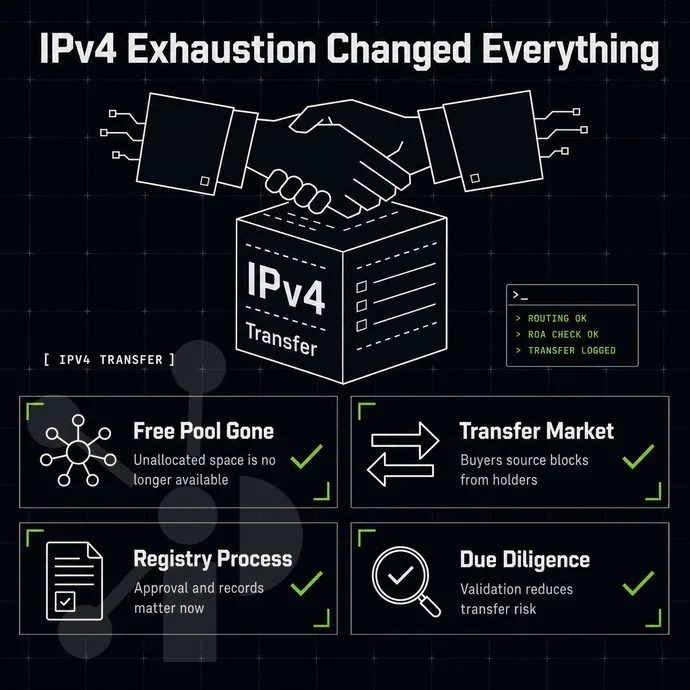
The free pool of IPv4 addresses is gone.
IPv4 address blocks and what replaced free allocation
No registry currently issues new IP addresses from the free pool. Instead, they manage waiting lists for returned legacy IPv4 address blocks, which tend to be small and irregular. For example, ARIN manages a waiting list for returned legacy space while RIPE NCC offers one /24 per member from returned space. However, in neither case can they meet commercial demand.
The waiting list problem for buyers
Secondary marketplace for current holders of IP address space to sell or lease space that they currently hold. Prefixx sources IPv4 address blocks ranging from /24 to /16 from current holders of IP address space across all five RIRs. All space listed on the Prefixx Tixx secondary marketplace goes through pre approval quality control and is sold with escrow-secured settlement. The platform's inventory includes both smaller allocations and large blocks to accommodate organizations with varying capacity requirements.
What this means for your procurement strategy
Prefixx handles the full transfer process for you, from the RIR paperwork for the transfer to the actual routing of the IP addresses. But first, you need to know what you are buying, and how the size of the block and the RIR region in which it resides affects your choices. The team can assist with routing validation, RPKI configuration, and ensuring clean announcement across your upstream providers.
Buy vs lease: choosing the right path for your organization
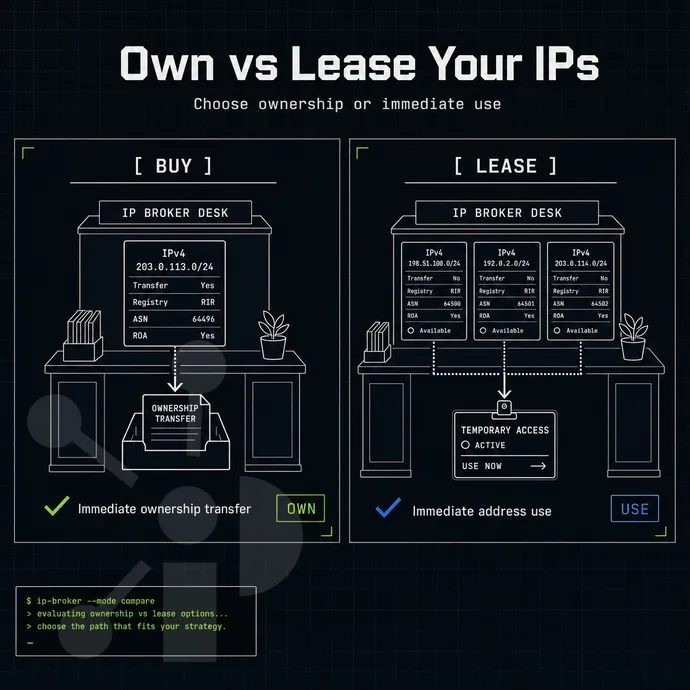
Buying IPv4 IP block allows for immediate transfer of ownership of bought IP space. Leasing IPv4 address range grants immediate use of an IP allocation for your network without an RIR transfer, while ownership is only transferred upon expiration of the lease contract based on the agreed time horizon and budget. Both models treat the IP block as a transferable digital asset that can be deployed immediately for production use.
Buying: permanent ownership and the transfer process
In an outright purchase, the allocation is registered in your name at the RIR and you own the IP assets for ever. You can sell them later on. Community data puts a price of around $50 per IP for a /24, so this is a capital expenditure. We at Prefixx also support organizations by managing the full purchase on their behalf, including the escrow, the quality check by Tixx, and all the paperwork required for the transfer to your account.
- Best for long-term infrastructure or organizations looking for high resale value.
- You maintain full routing control and RIR standing.
- You must submit a formal transfer request. Submit the transfer request to the relevant RIR.
Leasing transfer process and operational expenditure
A lease agreement allows you to pay on a recurring basis for allocated IP allocation without having to change the registration at the RIRs. Provisions for a lease are typically put into place much faster than a full transfer and you are not responsible for managing the transfer process.
Leases are well suited for companies needing short periods of time to meet growing capacity needs or to test out a new system or application. Organizations that lease typically pay monthly or annually based on the size of the allocation and the lease term length.
- No RIR transfer required.
- White-glove setup included with every Prefixx lease.
- Non-revocation guarantee protects your routing stability.
Which path fits your organization
While short-term or variable demand for IPv4 address blocks is best covered by leasing as part of a flexible process, multi-year strategic infrastructure is best bought. Prefixx has outlined a detailed comparison between Leasing and Buying at /lease-vs-buy. Below is an overview of what it's like to work with Prefixx to buy IPv4 address blocks and infrastructure.
Internet assigned number authority frequently asked questions
Where can I buy IPv4 addresses for my network?
You buy IPv4 addresses through a registered broker or directly on the secondary transfer market, since the RIRs exhausted their free pools between 2011 and 2020. The process involves selecting a vetted allocation sized to expand your address block, signing a purchase agreement, settling funds through escrow, and completing an RIR transfer to move the registration into your name. Organizations that buy IP addresses must verify the block's routing history and ensure no spam or abuse flags exist before finalizing the transaction.
Specialist brokers like Prefixx handle the entire process end to end, from sourcing and Tixx quality checks through to the LOA, RPKI ROA, and IRR paperwork that makes the prefix routable. These brokers also protect buyers by verifying ownership and ensuring the block has no history of abuse or blacklisting.
Can I buy public IPv4 addresses for personal use?
Yes. Any organization can purchase a publicly routable IPv4 pool on the transfer market and have it transferred into their name at the relevant RIR. The minimum practical size is a /24 (256 addresses), which is the smallest segment most ISPs will accept a BGP announcement for. Once the RIR transfer completes, you hold the registration and can announce the chunk from your own ASN or deploy it via a BYOIP program on a cloud or bare-metal provider.
How can I buy IPv4 addresses and own my own block?
Owning an IP batch means holding the registration record at an RIR such as ARIN, RIPE NCC, or APNIC under your org id and organization's name. You acquire that registration by purchasing a group of IPv4 addresses of the appropriate space size on the resale market and completing a formal RIR migration, or by receiving an allocation directly from an RIR if you qualify. Each RIR maintains its own policies for ownership transfers, and ARIN in particular requires pre-approval of the receiving organization before any block can be reassigned.
After reassignment, you control routing, reverse DNS, and RPKI for the network, and you can sell or lease it in the future. The prefix remains assigned to your organization record at the RIR, ensuring that you retain administrative and technical authority over the resource.
Who can you purchase IPv4 addresses from?
IPv4 addresses are sold by organizations that hold surplus registered space, including enterprises, ISPs, universities, and government bodies. Those sellers typically transact through a registered IPv4 broker who vets the IP resources, markets them, and manages the escrow and RIR conveyance paperwork. Buyers typically search for available blocks through broker platforms that maintain current inventory listings and pricing data.
Prefixx is a registered broker with the American Registry for Internet Numbers (ARIN), RIPE NCC, and APNIC, sourcing vetted blocks from /24 to /16 across all RIR regions and running every address range through Tixx quality control before it reaches a buyer. This vetting process ensures that each block has a clean routing history and poses no reputational or operational security concerns for the acquiring organization.
All such transactions, regardless of block size, go through the formal handover process of the RIR where the IP space was registered prior.
The quality of IP addresses you get to purchase depends on the due diligence done by your side prior to closing the deal. Thus, without expert advice and proper vetting of the seller, you may well end up with IP space, whether full blocks or smaller blocks, that is blacklisted, hijacked, or not transferable.
Whether to buy or lease assets depends on whether organizations need to manage assets on their balance sheet as permanent, fixed holdings, or simply to have access to assets on a monthly basis (with no capital outlay). Both leasing and buying are common practices and will not be appropriate for every organization.
If you are ready to explore specific blocks, Prefixx, one of the few brokers running Tixx quality control on every listing, handles the full portability paperwork across ARIN, RIPE NCC and APNIC.
Contact us to discuss your IPv4 needs today
No hidden fees, free consult. A broker replies within one business day.