
By Savvas Bout, Founder of Prefixx. Last updated 23 November 2026.
Before you can start announcing newly acquired or leased IPv4 address space, one simple question has to be answered: Is this IPv4 address space announceable? If not, all your newly announced prefixes might disappear from the global routing table or might trigger route filtering by your upstreams with severe impacts even before traffic starts to flow through your new infrastructure.
Just because you own the space does not necessarily mean the answer is yes. The block will also need to check for RPKI validity , IRR coverage of the route objects , RIR registration status, prefix length, and upstream filter policies.
A space that looks good on paper may be unroutable because a ROA is missing, a route object has expired, or the originating ASN does not match the information in the registry for that space.
This article goes through all the technical and administrative checks to determine routability.
What does it mean for an IPv4 block to be announceable
A block is announceable when a router can originate its prefix into the global BGP routing table and have upstream peers accept and propagate it.
The four conditions that must all be true
BGP stands for Border Gateway Protocol and is used to exchange reachability information between autonomous systems. Each autonomous system has its own unique Autonomous System Number (ASN). A prefix is the network part of an IP address which is announced using so-called CIDR notation, e.g. 203.0.113.0/24.
- RIR registration: the block must exist in the registry database (ARIN, RIPE NCC, APNIC, LACNIC or AFRINIC) with a current, valid record.
- ASN authorisation: the originating ASN must be permitted to announce that prefix, either through an IRR route object or an RPKI ROA.
- Prefix length: the block must be a /24 or shorter (numerically larger masks such as /25 are widely filtered and will not propagate globally).
- No upstream filter: the transit provider or IXP must not drop the announcement at its edge.
Why RPKI matters here
RPKI validation of announced prefixes by authorized origin ASNs is performed by means of Route Origin Authorization (ROA), signed with a cryptographic key. Lack of proper ROA for announced prefix by authorized origin ASN causes such announcements to be rejected by many networks. ROA is created by our team for every lease and transfer.
A practical example
A /24 bought on the secondary market may look clean at the RIR level, but may not propagate because the ROA of the previous holder refers to a different ASN. This creates an RPKI-invalid state: the announced block is valid, the announced prefix length is valid.
However, (2) the announcement does not match up to condition 2, so the announcing AS will announce the block, but it will be rejected by peers.
The four conditions that determine announceability
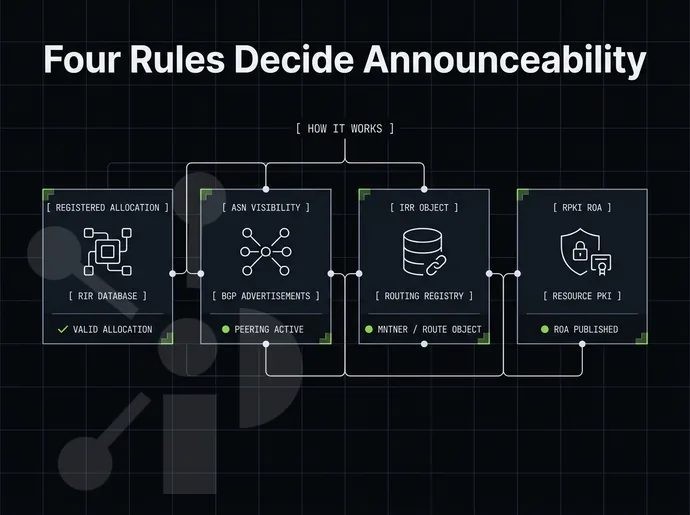
There are four key technical conditions that must be met for a prefix to propagate across the Internet.
Registration and prefix length
The block must be allocated to an active, non-revoked resource holder at one of the 5 RIRs: ARIN, RIPE NCC, APNIC, LACNIC or AFRINIC. Space that is unregistered or revoked has no value to the upstreams.
The prefix length is used as a hard filter. The global default route filter is set to “Reject” for IPv4 prefixes longer than /24. This means that even if you are the true owner of a /25 or /28 prefix, most peers will reject to announce it to you. The smallest announceable prefix length is /24.
RPKI and IRR validity
The validity of an RPKI announcement depends on the existence of a Route Origin Authorization for the origin ASN of the announcement. An RPKI-invalid announcement is discarded by any origin validation enabled network. Most networks today still accept RPKI-unknown announcements, but such tolerance is decreasing as more networks start to enforce strict origin validation.
IRR consistency: The upstreams build prefix lists from the route objects stored in RIPE DB, ARIN IRR, RADB, and other similar databases. If the origin ASN announced by you does not match the registered route object, the prefix lists will silently discard your announcements.
Quick-reference checklist
| Condition | Pass | Fail result |
|---|---|---|
| RIR registration | Active, non-revoked holder | No routing standing |
| Prefix length | /24 or shorter (aggregated) | Filtered by most peers |
| RPKI | ROA present, ASN matches | Dropped by validating networks |
| IRR | Route object matches origin ASN | Silently excluded from prefix-lists |
While all four conditions need to be satisfied, Prefixx can check them for you one by one using Tixx before you even purchase a block of IP addresses. For each IP address deal we prepare LOA, RPKI ROA and IRR route objects. After you have read about the conditions above, you can verify them for any particular IP address block.
How to check whether a specific block is currently routed
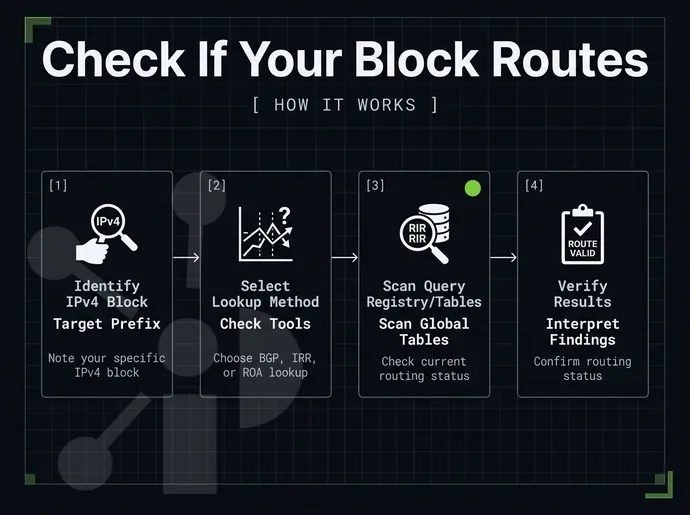
Before committing to a block purchase or lease, run these checks manually. They take under ten minutes and tell you whether the prefix is currently visible in the global routing table, whether its RPKI and IRR records are clean, and whether any origin conflicts exist.
Routing visibility
- You can also check your prefix with RIPEstat. On stat.ripe.net/lookup enter your prefix and select the Routing tab. There you can see if the prefix is actually in the global BGP table and who is announcing it with which origin ASN. If a prefix is not shown in the table it either is unrouted or has been withdrawn.
- Using a public looking glass for spot-checking propagation with BGP.tools. You can add multiple vantage points to test for same origin ASN. If you see different origins for same announcement across vantage points it either means there is a hijack in progress or announcement is stale.
Note: A block that is currently routed by someone else is not automatically clean. Verify that the announcing ASN matches the registered holder before drawing any conclusions.
RPKI and IRR verification
- ROA status check. ROA status can be verified through the Cloudflare RPKI Portal as well as the RIPE NCC RPKI Validator. A valid ROA confirms that the origin ASN is authorized. Invalid or missing ROA(s) will typically cause origin announcements to be dropped or de-prioritized by most networks.
- Check the route objects in the IRR. You can query IRR Explorer or the RIPE DB WHOIS interface. Verify if a route object for the current origin ASN exists. Stale or wrong route objects get filtered by major transit providers.
After you acquire the block
After you have acquired a block of IP addresses, these checks will continue to be performed for you on an ongoing basis. The Prefixx client portal provides a simple way for your team to check for BGP visibility, origin ASN, RPKI validity and IRR consistency for all leased or purchased blocks of IP.
Knowing that a block of IP is currently routable is only half the story however, as a block of IP that passes all live checks can become unroutable after it has changed hands.
Why a block can be owned but still not announceable
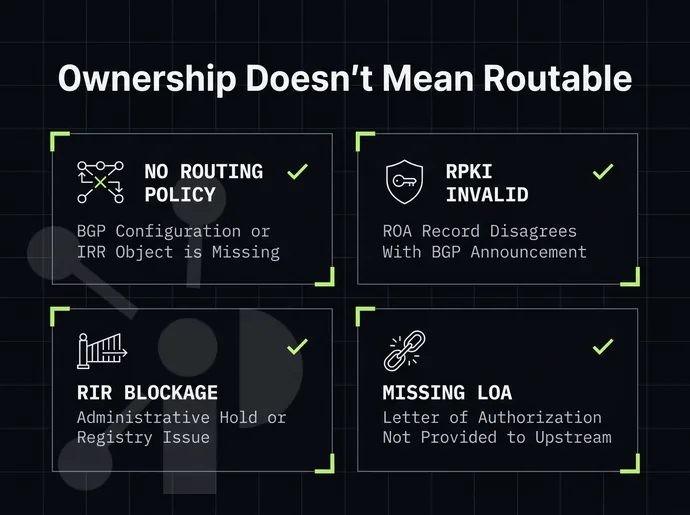
RIR registration proves ownership of a block of IP addresses.
Never-routed blocks with no routing objects
There are several blocks of IP space that have been allocated years ago but never announced.
As a result, their upstream providers who are running strict origin validation in their routing tables have no way to authorize the announced prefix.
Legacy registrations predating modern infrastructure
Legacy space was assigned before IRR and RPKI became operational requirements.
Post-transfer routing gaps
Even after a transfer has closed.
This Will all have been signed by the previous holder’s ASN.
Until three items line up (RIR registration, at least one IRR route object that is up-to-date, RPKI ROA for origin ASN), the block cannot be announced, i.e. any single item not up-to-date breaks the chain.
Why pre-purchase due diligence matters
To spot these issues prior to the close of a deal, a comprehensive routing-hygiene check is necessary.
While there are other ways to perform such a check, this will outline what you need to check prior to selling in a pre-sale review. Subsequently, we outline what RPKI and IRR can bring to your review of routing hygiene issues and thereby how these can be more easily detected.
RPKI, ROAs and IRR route objects: what each one does for announceability
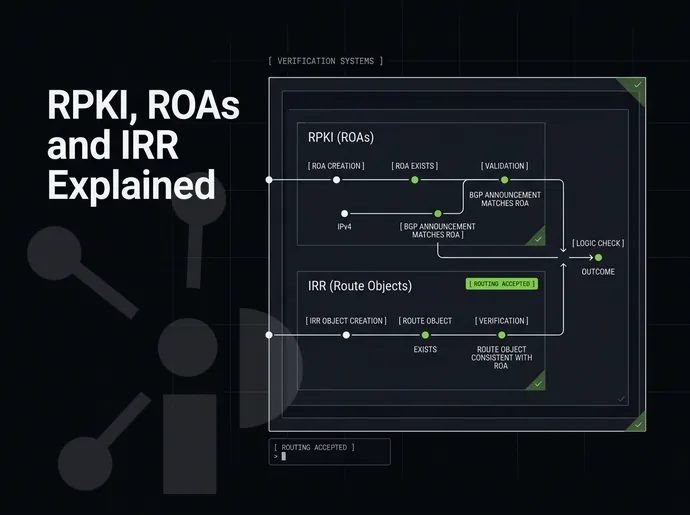
Two independent systems are used to decide whether or not a BGP announcement is accepted on the global internet: RPKI and the IRR. A single gap (in RPKI or in IRR) in a block of IP addresses is enough for a peer to silently discard a route announced from that block of IP addresses.
What RPKI and ROAs do
RPKI is a cryptographic framework. The RIR issues a certificate for the address space of a resource holder. The holder of a resource then creates a Route Origin Authorisation (ROA) for example stating that only a certain ASN is allowed to originate a certain prefix and that this prefix must not be longer than a certain length.
ROV announces found to be in conflict with the advertised ROA will be marked as ‘Invalid’ and discarded.
What IRR route objects do
The IRR is a distributed set of plain-text databases (RIPE DB, ARIN IRR, RADB, NTTCOM and others).
Why both matter together
RPKI and IRR are two completely independent systems. Even a valid ROA does not create a corresponding IRR route object. An IRR route object, even if it is valid, does not carry any cryptographic weight for peers enforcing ROV. Both of these are real-world failure cases.
- Valid ROA, no IRR object: transit providers filter on IRR and thus drop the route.
- When there is an IRR object but no ROA, a ROV-enforcing peer would mark the route as NotFound or Invalid.
As part of our white-glove service and BYOIP support, our team creates LOA, RPKI ROAs and IRR route objects for you. All of these objects are thoroughly reviewed by a consultant before submission. The size of the prefix you want to announce is as important as the routing records themselves.
Prefix length limits and why a /25 or longer will be dropped
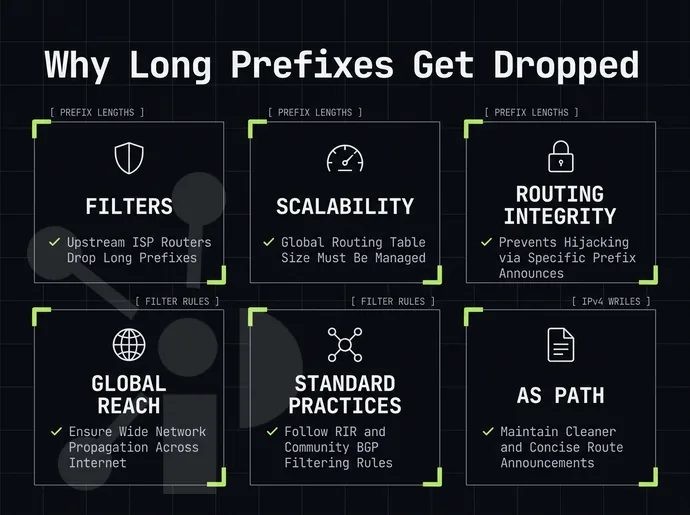
That a block is valid technically is different from it being propagated on the public Internet. As a rule of thumb the global maximum prefix length for IPv4 is /24. Most routers will start dropping packets for longer prefixes before they even escape the local network.
Why /24 is the hard floor
Even with hundreds of thousands of prefixes in the global routing table, major transit networks and IXPs use a maximum-prefix-length filter of /24 by default. MANRS recommendations therefore simply imply that announcements of smaller lengths (e.g. /25 or /28) are silently discarded by most peers without ever reaching them, as opposed to being rejected with an error message.
Address validity versus routability
A single valid IPv4 address is a 32-bit value which can be represented as four decimal numbers between 0 and 255 i.e. 203.0.113.5.
Prefix length at a glance
| Prefix length | Usable addresses | Globally routable |
|---|---|---|
| /16 | 65,536 | Yes |
| /20 | 4,096 | Yes |
| /24 | 256 | Yes |
| /25 | 128 | No (filtered) |
| /28 | 16 | No (filtered) |
Yes, longer prefixes can be used within private peering arrangements or within MPLS VPNs where both ends agree to accept them.
All blocks of IP address space listed by Prefixx are checked for routing health by Tixx prior to a deal being closed. The constraints imposed by the prefix length become very apparent when a block of IP address space is transferred between registries. The transfer sequence creates its own routing gaps.
What happens during and after an inter-rir transfer that affects announceability
Inter-RIR moves do not flip a switch.
Registration changes
- Deregistration at the source RIR: The source registry WHOIS database is deleted from the records of the originating organization for that resource and the corresponding source RIR organization record is closed off. The block has no authoritative registration until the destination RIR completes their side of the transfer.
- Registration at the destination RIR: The resource record for the block is created by the receiving registry as a new resource record under the account of the new holder of the block. The block now has a valid home which can be queried again.
Routing object cleanup
- Stale route objects and ROAs. Route objects and ROAs (RPKI ROA and IRR route object) referenced from old source RIR’s repository are no longer referencing correct organization that holds the resources. RPKI enforcing routers will announce route in state of Invalid or NotFound and peers may then announce route no longer.
- New route objects and corresponding ROAs need to be published by the new holder at the destination RIR. A new ROA and corresponding IRR route object must be published by the new holder before the block can be announced. If this step is not taken then the prefix will either fail to validate under RPKI or will have no IRR coverage and thus be filtered by downstream routers.
Note: This gap can last days to weeks, depending on RIR processing queues and how quickly the new holder submits paperwork. Do not schedule a live cutover until both the ROA and IRR objects are confirmed active.
Geolocation lag
The geolocation databases (like MaxMind, IP2Location, DB-IP, ipinfo.io) have their own update cycles. They are not synced in real time with the RIR WHOIS data. So the block will display wrong country / organization for days / weeks after the transfer completed.
Prefixx handles the full routing paperwork sequence, including LOA, RPKI ROA, and IRR route objects, across ARIN, RIPE NCC, APNIC, and LACNIC (facilitated) as part of its inter-RIR transfer service. The same routing-object discipline applies when you bring an existing block to a cloud or bare-metal provider through BYOIP.
BYOIP: announcing a block you already own on cloud or bare metal
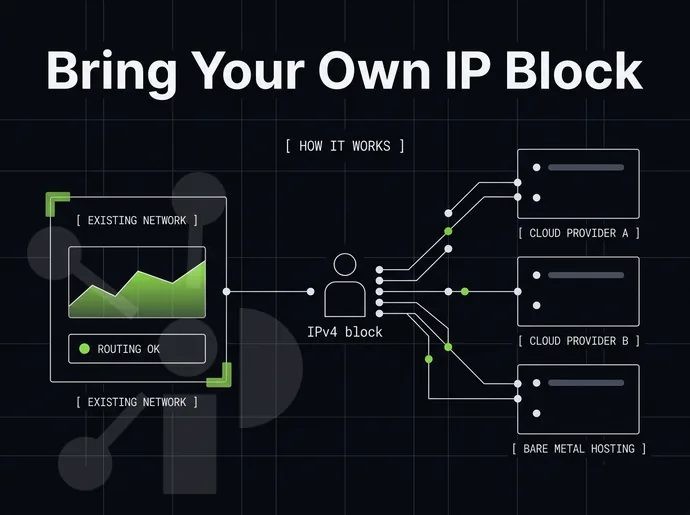
BYOIP allows you to announce an IP block you already own. This can be announced into a cloud or hosting provider’s network, allowing traffic to flow through their network, whilst you retain full ownership of the IP range. As a precursor to having a provider announce a prefix for you, the prefix must first of all be announceable, i.e. it must have clean WHOIS data, a valid RPKI ROA, consistent IRR route objects and not be currently any blocked lists.
Cloud BYOIP programs
BYOIP on AWS, GCP, Azure, OCI and Cloudflare are all separately managed programs, with differing requirements. Essentially all require a signed Letter of Authorization (LOA), RIR database proof of ownership for the given prefix. Additionally, A Route Origin Authorization (ROA) that states the provider’s ASN is an acceptable origin for the announced prefix(es). Minimum advertised prefix lengths vary by provider but typically start with a /24-sized prefix. The provider then announces the customer-provided prefix from their network edge.
RPKI is non-negotiable here. A ROA mismatch causes route-origin validation failures and most cloud BYOIP pipelines will reject/drop the invalid prefix at the intake to the cloud.
Bare-metal BYOIP
For bare metal servers, the provider will either peer your ASN with them over BGP or announce the prefix for you from their ASN.
BYOIP and BYOASN are native on our bare metal servers. There are no per-IP charges for bringing your own IP block(s) to our platform.
How Prefixx supports BYOIP deployment
We will prepare all of the required routing documents such as LOA, RPKI ROA and IRR route objects and work with the RIR(s) and where necessary with the cloud provider’s onboarding team. This is a fully managed service by a team of experts as opposed to an automated service that you would complete yourself online.
We run Tixx quality control on every block we send. We flag up any prefix that we detect to have a reputation issue or a routing inconsistency, which could cause a subsequent request to fail.
For a full breakdown of what BYOIP deployment involves, see our BYOIP service page. When something does go wrong with an announcement, the failure usually traces back to one of a small set of root causes.
Common reasons a block fails announceability checks (and how to fix them)
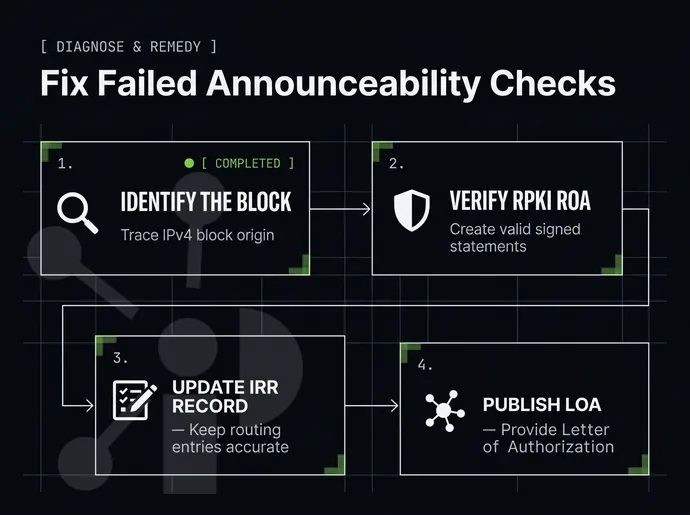
The vast majority of announceability failures can be attributed to a small set of root causes. Once you determine the cause, correcting it is typically straightforward.
RPKI and IRR mismatches
The most common blocker for announcing a particular prefix is a missing ROA for that prefix.
A separate class of errors can be caused by missing or wrong origin-AS Number in IRR route objects.
Fix: Create a ROA with the length of announced prefix(es) exactly. Make sure IRR’s route object mentions the origin ASN correctly.
Prefix length, bogons, and stale RIR records
This rule filters prefixes longer than /24 by default.
- Bogon or IANA-reserved range: the block was never allocated for public routing. Verify the prefix against current IANA and RIR allocation data before purchase.
- Stale RIR registration: a record tied to a defunct organisation can trigger transfer holds or upstream skepticism. The registration must be updated to a live, verified entity before the block is usable.
Reputation blacklists
Upstreams and mail providers use DNSBL information to lower the priority of emails coming from listed IP addresses.
The client portal includes 12 DNSBLs and BGP monitoring for new listings post-acquisition.
Why Prefixx runs announceability checks before every block changes hands
A block that clears escrow but fails to announce is a wasted investment. Prefixx builds announceability checks into every deal through Tixx by Prefixx, our pre-sale quality control layer. Before any block reaches a buyer, Tixx verifies ownership, transfer eligibility, routing hygiene, and blacklist standing, then produces a health report and transfer readiness score.
- The routing hygiene has been checked upfront: RPKI, IRR (route object) check, origin ASN, and prefix length verification against bogon filters as well as maximum prefix length policies.
- All the White-glove paperwork is done by us. We will prepare the LOA, the RPKI ROA and the IRR route objects for you, so that your newly bought block will become globally routable the moment the RIR transfer has completed.
- Escrow-secured settlement, money doesn't move until transfer has completed. Zero commission charged to buyer.
- Registered across all major RIRs. We broker transfers under ARIN, RIPE NCC, and APNIC, with LACNIC facilitated, and support BYOIP deployment and inter-RIR transfers.
If announceability is a concern, speak with our consultants before you commit to a block. Visit our white-glove service page or contact sales to discuss your requirements. The checklist below pulls every condition covered in this article into a single pre-announcement reference.
Quick announceability checklist
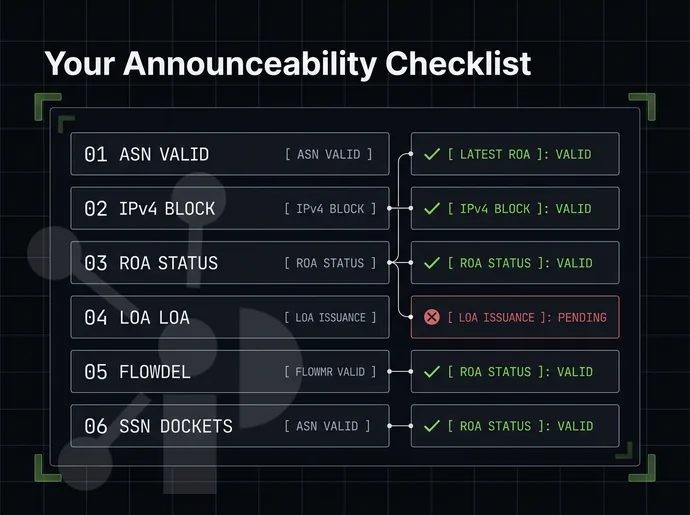
These are the six checks one has to perform before announcing a block of IP addresses. A single one of them being wrong causes a prefix to fail global routing table acceptance.
Make sure that your RIR registration is up to date and that it is listed under the correct Origin ASN for the new block of IP addresses. For IPv4 addresses, make sure that the prefix length is /24 or shorter. Make sure that a valid ROA (Route Origin Authorisation) has been created for the exact prefix in question and for the maximum prefix length for that prefix. An IRR route object must also match independently.
Check that the block in question clears bogon filters and does not contain any reserved-range conflicts. Also check that the block is not listed on any major blacklists. RPKI validity and IRR route object consistency are for me the fastest way to verify routing hygiene.
If you acquired the new block of IP addresses through an inter-RIR transfer or BYOIP deployment, you will need to request a fresh LOA to verify the new RIR registration before you start sending BGP updates for the new IP addresses.
Frequently asked questions
What is the maximum prefix length that is globally routable for IPv4?
The de facto maximum prefix length accepted by most transit providers and Internet exchanges is /24. Anything longer, meaning a /25, /26, or smaller, is filtered by the majority of networks following RIPE NCC's recommendations and common operator policy. This is not an RIR rule but an operational norm enforced at the routing level. A /24 is the smallest block you can reliably announce to the global table.
Can I announce a /25 or /28 on the public internet?
Not reliably. Most networks apply a maximum prefix length filter of /24 for IPv4, so a /25 or /28 will be dropped by the majority of upstream providers before it reaches the global routing table. Some private or regional networks may accept longer prefixes internally, but you cannot count on global reachability. If you own a /23 or larger, you can announce the aggregate /23 while using the sub-prefixes internally.
What is the difference between a block being rir-registered and being announceable?
RIR registration means the registry has a record of who holds the resource. Announceability means the internet's routing infrastructure will actually forward traffic for that prefix. A block can be fully registered with ARIN or RIPE NCC and still be unroutable if no one has created the matching IRR route object, RPKI ROA, or if the prefix length exceeds /24. Registration is a legal and administrative status; announceability is a technical one that requires separate routing configuration.
Do I need both an RPKI ROA and an IRR route object to announce a block?
In practice, yes. RPKI ROAs are increasingly required by transit providers that enforce Route Origin Validation, and a missing or invalid ROA will cause your announcement to be dropped by those networks.
IRR route objects remain necessary for providers that filter based on IRR data rather than RPKI, and many large networks use both.
How do I check whether an IPv4 block is currently being announced?
RIPEstat's BGP looking glass and routing information service show live and historical announcement data for any prefix, including origin ASN, upstream peers, and RPKI validity. Tools like BGPView and Hurricane Electric's BGP Toolkit provide similar visibility. You can also query route collectors directly via the RIPE NCC Routing Information Service. Prefixx's client portal includes BGP monitoring backed by RIPEstat and RIS data, covering visibility, origin ASN, RPKI validity, and IRR consistency.
What happens to announceability when a block is transferred between RIRs?
During an inter-RIR transfer, the block moves from one registry's database to another, and the existing IRR route objects and RPKI ROAs tied to the source registry become invalid or orphaned. You must create new routing objects under the destination registry before or immediately after the transfer completes.
There is a window where the block can appear unroutable if the new objects are not in place. Planning the routing paperwork alongside the transfer timeline is essential to avoid a reachability gap.
What paperwork do I need before I can use BYOIP on a cloud platform?
Every major cloud BYOIP program, including those from AWS, GCP, Azure, and OCI, requires a Letter of Authorization confirming you hold the right to use the address space. Most also require a valid RPKI ROA authorizing the cloud provider's ASN to originate the prefix, and some require an IRR route object as well.
The exact requirements vary by provider, but LOA plus ROA is the minimum in every case. Prefixx prepares the LOA, RPKI ROA, and IRR route objects as part of its BYOIP service, so the paperwork is handled before the block reaches the cloud platform.
Announceability is not just a checkbox. A block needs clean RPKI, consistent IRR objects, a valid RIR registration, and a prefix length that is actually acceptable to the global routing table. Any one of these can keep a perfectly legitimate block dark, regardless of who owns it.
While transfer of a block through escrow is easy (in terms of ownership), creation of an ROA, IRR updates to the route objects, and sometimes even a reputation sweep to get the upstreams to carry the traffic after all this, can take time and be stalled by the wrong sequence of actions to complete the necessary paperwork.
As you consider purchasing or leasing a block of space, the Prefixx team runs Tixx quality control on all blocks prior to listing them with buyers.
Contact us to discuss your IPv4 needs today
No hidden fees, free consult. A broker replies within one business day.