
By Savvas Bout, Founder of Prefixx. Last updated 23 November 2026.
Closing a deal for a new set of IP addresses. Transferring them and updating the registrant information with SWIP and WHOIS after delivery is not enough to get your network up and running on the Internet. Until all abuse complaints are correctly answered by your team and your network is correctly located by geolocation databases your network is not operating properly.
Even simple BGP peers may pull outdated contact information from old registrations of parts of your network that you have long since fully operated in house.
For your space to be correctly identified and for you to receive abuse notifications, to allow others to change the authorizations for your IP space, etc., all of this information needs to be correct in the repertory databases managed by the IP address registries: ARIN, RIPE NCC, APNIC and the others.
The steps to be taken by a buyer after a purchase are not always clearly indicated by the seller or by the broker. In this article, we explain what changes with an SWIP update and a WHOIS update, what steps must be taken with which registry, what are the typical timeframes for these updates, and above all, how one can verify that all information has been updated correctly before connecting to these IP addresses.
What swip and WHOIS actually mean in IPv4 networking
Once a block of IP address space has changed hands, two acronyms seem to be always present: SWIP and WHOIS. They are related but distinct. Additionally, It is important to understand both of them if you are a company that has just acquired a block of IP address space and you need to prove your ownership of that block of IP address space.
What WHOIS does
WHOIS is the query protocol to query the Whois databases of the five RIRs to retrieve the registration information of an IP address, an ASN or a contact.
Each RIR operates its own WHOIS service.
What swip does
Shared WHOIS Project or SWIP is an acronym that stands for Shared WHOIS Project. It is ARIN-specific and allows a downstream network to be listed as the operating organization in the ARIN WHOIS database for a particular block of IP addresses that has been reassigned or reallocated. Typically the upstream resource holder is listed in WHOIS for such addresses.
For example, an ISP that holds a /20 block could use SWIP to create a reassignment record for a /24 block assigned to a particular business. In the reassignment record, you would list the business’s name, address, and the contact information for their abuse desk. Later, when someone reports abuse on that /24 block, their report will immediately go to the correct party.
Why both matter after delivery
After a block of IP addresses has been ported, the correct registration of IP addresses in the WhoIs database is no longer a choice but rather a necessity for your network as a variety of people (abuse desks, blacklists, peers on the Internet) check WhoIs to verify the legitimacy of an IP address.
For every transaction we review the accuracy of the WHOIS information. If a reassignment needs to be updated or even a new RIPE NCC inetnum object needs to be created for the block that is about to be put into service, our consultants will process the necessary paperwork. In the following section you will read what needs to be watched out for when the information stays outdated.
Why WHOIS records matter after a block changes hands
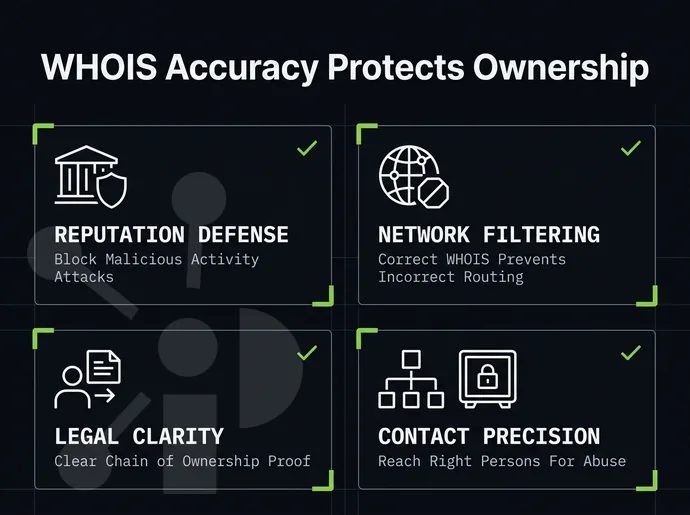
Hours after a block is fully routed and connected to reach its destination. The previous owner of IP space will show up in WHOIS and RDAP registries, causing hours of potential harm until the proper registered owner information has been updated.
Abuse complaints and noc routing
Complaints with reports of abuse at ISPs and anti-spam networks are forwarded to the abuse contact in the registration information. If the WHOIS information for a domain still lists the seller, that person will not receive the complaints. In the meantime, NOC notifications are escalated to a team of people who no longer manage the space.
Geolocation and RDAP accuracy
MaxMind, IP2Location, DB-IP and ipinfo.io services rely on the WHOIS and RDAP data in order to geolocate IP address blocks. When a registration record is stale it is easy to see how a newly transferred block could be mislocated for weeks and thus adversely affect geo-targeted content, payment fraud rules and even CDN routing.
Prefixx publishes an RFC 8805 geofeed on a daily basis and has full monitoring of all 4 services via the Prefixx client portal to quickly detect any ‘drift’ and correct as necessary.
Email deliverability and BGP validation
Anti-spam systems also use WHOIS information for assessing a sender’s reputation. If the announced origin ASN does not match the holder of a registered resource, this can lead to reduced delivery rates. BGP origin validation tools also check for such inconsistencies between announced route origin and registered resource holder. RPKI ROAs as well as IRR route objects need to be updated by the new holder in order to get cleaned validation results from those tools.
| Risk area | Cause | Consequence of stale WHOIS |
|---|---|---|
| Abuse routing | Old abuse contact in RDAP | Complaints reach previous holder; violations go unresolved |
| Geolocation | WHOIS org and address unchanged | Block placed in wrong country by MaxMind and peers |
| Email deliverability | WHOIS owner mismatches sending ASN | Spam filters flag the mismatch; delivery rates fall |
| BGP validation | ROA and IRR not updated to new holder | Origin validation tools flag the announcement as inconsistent |
Update all of the following objects simultaneously (i.e. do not update them one at a time), in order to eliminate the risk of an update to one of them getting "out of sync" with the others.
Prefixx's white-glove service can update all four objects (WHOIS, RDAP, RPKI ROA s, IRR route objects) as part of a single task, to ensure that the registration information for a network is always accurate and up-to-date. For ARIN-held blocks, this process is done via SWIP.
How the swip process works at ARIN
The Shared WHOIS Project (SWIP) is how ARIN tracks the downstream use of address space. A direct allocation or assignment holder (upstream ISP, etc. or new block holder after a transfer of that block) is required to enter SWIP records for all /29s and larger that they reassign to their customers.
Preparation
- First confirm that you are eligible to submit a SWIP (e.g. is your organization the parent of the allocated space listed in the ARIN database?). If a block of space was transferred to you then you must confirm that the transfer has completed and that the space appears in your ARIN Online account.
- We need you to gather a number of fields from the downstream organization. All of the following fields must be completed or the record will be rejected: downstream organization name, street address, abuse contact email, NOC contact, and the exact subnet to be reassigned.
Submission
- There are two methods of reassignment, reassignment using the ARIN Online forms for reassignment or reallocation, or reassignment using the legacy SWIP email template and sent to [email protected]. The ARIN Online method is the fastest way to receive a reassignment confirmation.
- Select the correct record type for this reassignment. A simple reassignment of space for end-customer use does not involve any further delegation of space reassignment. A reallocation of space allows the downstream organization to further assign space to others, i.e. ISP's themselves.
Note: Submitting a reallocation when a reassignment is appropriate gives the downstream org unintended delegation authority. When in doubt, use reassignment.
Verification
- Verify propagation of WHOIS updates. Check the status of a newly-submitted subnet at search.ARIN.net within a few hours of submission. Updates may take a few days to fully propagate throughout the WHOIS mirrors.
- Verify that the contact for reported abuse is able to receive notification. ARIN, as well as third party reputation systems, use the listed contact for the abuse report from your SWIP record. Notification sent to an unreachably addressed contact will not be resolvable and may negatively affect the reputation of the associated block of IP numbers.
SWIP is an ARIN-only mechanism. The other 4 RIRs use different objects to accomplish similar functions, and the steps after transfer are different for each of the 4 RIRs.
WHOIS updates at RIPE NCC, APNIC, LACNIC and AFRINIC
SWIP is an ARIN construct, the other four RIRs have object-based WHOIS databases. Upon transfer of a lease or its activation, corresponding objects have to be created/respectively updated in these databases as well to consider delivery complete.
RIPE NCC: inetnum objects and the RIPE database
Each IPv4 block assigned by RIPE NCC is registered in the RIPE Database as an inetnum object. The inetnum object has a mnt-by attribute which contains the maintainer of the inetnum object that is allowed to change it.
After a transfer the new LIR of the receiving party creates a new inetnum object for the transferred IPv4 block. He links all involved persons or roles and sets the mnt-by attribute to his maintainer credential. The corresponding inetnum object of the sending party is removed or marked as transferred.
Updates can be submitted via the RIPE Database update mechanisms: by email with signed PGP message, via the Syncupdates interface, or via the RIPE NCC portal.
APNIC: whois.apnic.net and myapnic
The inetnum object model for APNIC records is identical to that used by the sending registry. A transfer is completed by the receiving member creating the necessary inetnum and associated person or role objects after logging in to the MyAPNIC portal. Such records are made queryable within hours at WHOIS.APNIC.net and the corresponding records are deleted from the APNIC database upon completion of the transfer from the sending registry.
LACNIC and AFRINIC
Both registries use a very similar object model which can be updated through the member portals of each respective RIR. After an inter-RIR transfer the resource is created as a new, independent object in the receiving RIR’s database. In the originating RIR the resource is marked as transferred, or deleted.
After delivery of a transferred resource or activation of a new lease it is recommended to check receiving RIR’s WHOIS database for the delivered RIR resources (after completion of transfer or lease activation). Resources included in an inetnum object of a receiving RIR should be assigned to correct organization and mnt-by should be correct for the organization as well. Block should not be routed till the resources’ record is corrected.
We verify WHOIS accuracy for all relevant RIR databases as part of our white-glove delivery of services to complete a deal, such as verifying the inetnum object, all person or role references. Additionally, Mnt-by attributes for example. The WHOIS verification is part of a complete delivery sequence that goes beyond the simple registry records.
What delivery actually means in an IPv4 transaction
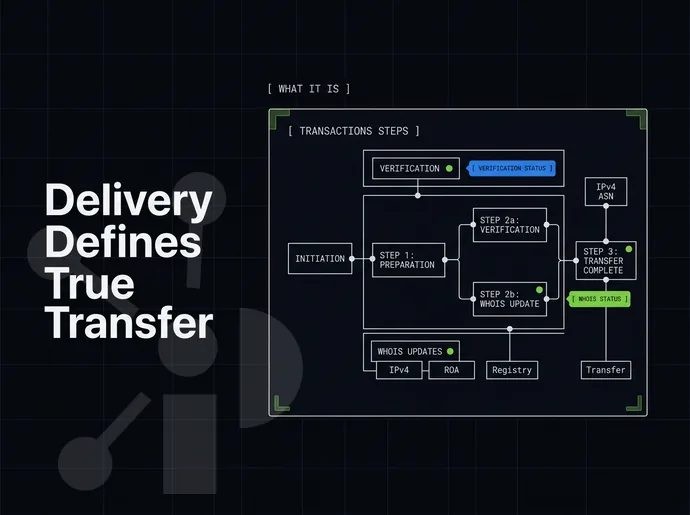
Delivery of an IPv4 address transfer is not a single action but a number of steps. Verification of the change in the new holder via WHOIS or SWIP is the final point of verification that all steps have been completed correctly.
The delivery sequence, step by step
We trigger off the escrow release process. Once funds have cleared we submit the RIR transfer request to the relevant registry. The registry validates the request for eligibility on both parties part and updates their database. We then announce the new BGP aggregate for the block.
Supporting documentation for the transfer is prepared by the team in parallel to the transfer (LOA authorizing the transfer. RPKI ROA announcing the new origin ASN, IRR route objects used by upstreams to announce routes and the announced routes to be validated by upstreams). None of this will magically appear after an escrow release.
What WHOIS and swip confirm
The WHOIS query after a transfer delivers a chain-of-custody verification. It verifies whether the WHOIS database of the registry has been updated to a new holder, whether the contact information has been published correctly and whether the IP address is no longer assigned to the previous holder of the IP address range. For the ARIN registry, SWIP in addition verifies the reassignment records of the downstream organization for accuracy.
If after the transfer window has closed, WHOIS still shows the seller of the domain then this is an active problem and not a delay in updating.
Geolocation is a separate, slower layer
RIR records and geolocation databases are not up to date simultaneously.
How to query WHOIS and verify your record is correct
Once SWIP or the assignment update has completed, use a variety of WHOIS queries to verify all of the object’s fields still refer to the correct holder. A single method may return stale or partial information, so use at least two methods to verify this information.
Query methods
The fastest way to get started with the command-line tool is to run WHOIS 192.0.2.0 (substitute in your own address) from a Linux or macOS terminal. To get structured, machine-readable output instead, use RDAP. All five of the RIRs listed above support RDAP, and return output in JSON with consistent field names, rather than as free-text.
| Registry | Web interface | Protocol |
|---|---|---|
| ARIN | search.ARIN.net | WHOIS + RDAP |
| RIPE NCC | apps.db.ripe.net | WHOIS + RDAP |
| APNIC | WHOIS.APNIC.net | WHOIS + RDAP |
Fields to verify
Check these 5 fields on every query result.
- OrgName / org: Must show the new holder's organization, not the previous one.
- inetnum / CIDR range: Confirm the range matches the exact block transferred, not a supernet.
- netname: Should reflect the new assignment; old netnames from the upstream often linger.
- abuse-c / abuse contact: Must route to the new holder's abuse mailbox, not the previous ISP's.
- admin-c / tech-c: Both contacts should belong to the new organization.
Common discrepancies
The most common problem with this type of record is that it still references the previous upstream of the holder of this record. This can happen when the SWIP was submitted, but the upstream ISP for the previous holder has not yet removed their own reassignment record for that range. The other common problem is with an outdated abuse-c contact. The complaints for abuse will go to the wrong person and cause a blacklisting of that IP address.
More and more tools and registries are using RDAP as the default output format because it is structured as JSON and therefore easy to validate on a field level. Discrepancies can be fixed by Prefixx’s white-glove service including updates of the abuse contact and checks on the routing-hygiene of the updated lease. However, WHOIS is only one of three layers of records that need to be up to date before a block of IP addresses can route correctly.
RPKI, IRR and WHOIS: how the three records relate
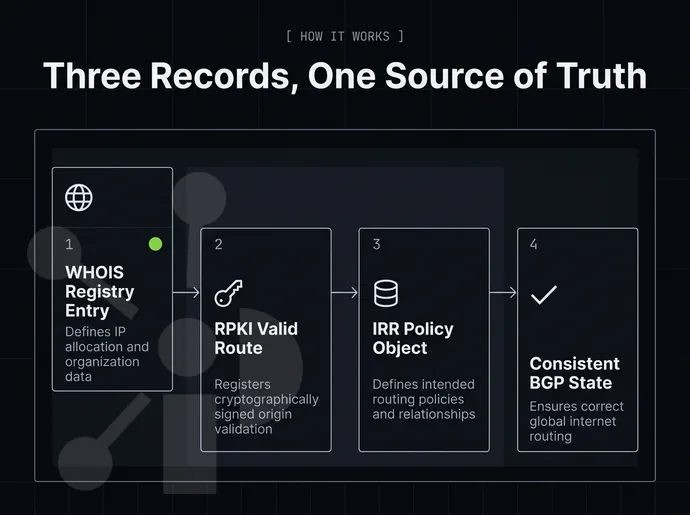
Each of the WHOIS, IRR and RPKI systems serves a distinct purpose and problems occur when these are mixed up and there are routing failures even when all administrative records seem to be correct.
The three layers
- The WHOIS / SWIP database keeps administrative information on who holds a block of IP addresses. It answers the question “who is responsible for this block of IP addresses?”. Note that this is different from a question of routing. You should update this information first, either through your RIR or by sending a SWIP to your upstream.
- An IRR route object specifies which ASN is allowed to originate a prefix. Route filters at many carriers are fed from databases such as RADB and the ARIN IRR feed. A missing or stale route object means that prefix filtering downstream will fail.
- RPKI ROA is a cryptographic assertion of a specific prefix and its origin ASN and max length. An RPKI enforcing upstream will drop invalid RPKI configured routes even when WHOIS/IRR looks good.
Updating all three after delivery
- Verify the WHOIS for the new holder. Check the public WHOIS at the RIR before updating any routing records. An outdated WHOIS entry can cause problems with creating ROAs at some registries.
- Create the IRR route object for the announced IP range. The origin ASN for this route object should match exactly the ASN that you will announce via BGP. Mis-stated IRR for announced routes is a common cause of peer filtering.
- Publish the RPKI ROA for the announced AS and set the MaxLen to the length of the announced prefix. A ROA announcing a /20 prefix but the /24 being announced creates an RPKI-invalid state.
Note: A block can have a valid WHOIS record and a published ROA while the IRR route object still names the previous holder's ASN. All three layers must agree, or some upstreams will filter the route.
How Prefixx handles this
Part of Prefixx’s white-glove service is to prepare LOA, RPKI ROA and IRR route objects for customers. Even with all three layers correct, however, a host of other problems can occur after delivery. They follow a number of well-established patterns.
Common problems that appear in WHOIS after delivery
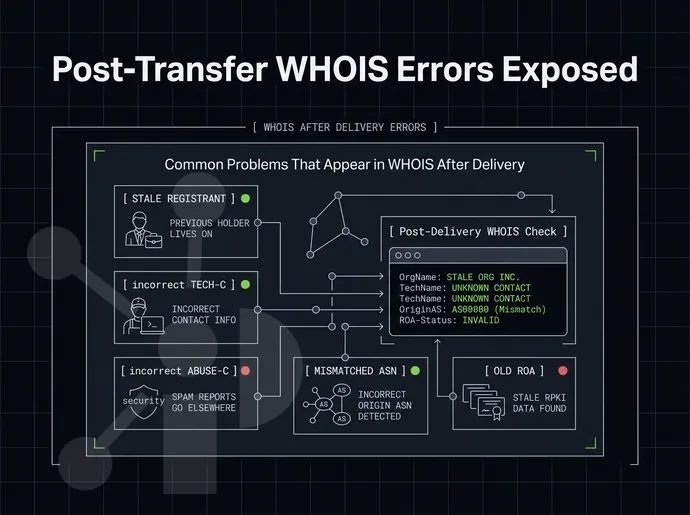
After delivery of a completed RIR transfer, there are 5 distinct sets of downstream records that may or may not get cleaned up automatically, each with their own set of root causes and fixes.
Attribution and contact failures
Swip not submitted by the upstream
The ISP is still listed as the network owner for this block in WHOIS. Complaints regarding potential abuse will need to be forwarded to the appropriate person. Submit a SWIP reassignment or reallocation through ARIN (or equivalent inet(6)num update through RIPE NCC) and list the end user as the contact for this new allocation/block.
Abuse contact pointing to the previous holder
Unanswered spam reports and abuse notifications typically get interpreted by blocklist operators as negligence and get the entire range listed.
Routing record failures
RPKI ROA missing or wrong-origin
These routes will be declared RPKI-invalid by announcements from the new ASN by the peers which implement origin validation.
IRR route object not updated
Route policy mismatches occur when peers filter on RPSL route objects, not advertising a prefix because the recorded origin ASN does not match the announced origin ASN. The route object must be updated or deleted in the appropriate IRR database (e.g. ARIN, RIPE, RADB).
Geolocation lag
Geolocation databases consuming WHOIS and RDAP information update on their own refresh cycles. Until that updated information is ingested by the database, it’s possible that a block will resolve to the wrong country or even city.
So, publishing an RFC 8805 geofeed and notifying database providers of the updated information can help to resolve this situation more quickly. Geolocation information is treated differently than the other record types and at Prefixx this information is corrected as part of the normal white-glove service provided to clients. However, that geolocation information lag deserves a closer look.
Geolocation lag after a WHOIS update
Updates to WHOIS information will typically propagate to the relevant RIR database within a few hours of a domain name transfer or a SWIP update. In contrast, geolocation databases are maintained by commercial organizations using their own scheduled crawls and heuristic inferencing, so typically there will be a few days to weeks delay between a change and it appearing in a delivered dataset for a particular block and reported country, region, city, etc.
Why commercial databases don't follow WHOIS in real time
MaxMind GeoIP2, IP2Location, DB-IP, and ipinfo.io each maintain their own independent datasets.
The update frequency for geo data varies by provider.
Rfc 8805 geofeed: the fastest correction path
A geofeed file, according to RFC 8805, is a plain CSV file published on a publicly available HTTPS URL. Each row maps an IP prefix to a country code, region, city and postal code. Here is a minimal example for such a file.
- Prefix: 192.0.2.0/24.
- Country: US.
- Region: US-FL.
- City: Miami.
- Postal code: 33131.
The file URL is declared in the WHOIS or RDAP record via a geofeed: remarks field. All four providers named above support RFC 8805 and consume the file on their next crawl cycle.
What to expect after publishing a geofeed
Note that while some geospatial data providers are able to pick up on geofeed corrections within 24-48 hours of their next data crawl, others may take longer to implement. Our team operates a daily RFC 8805 compliant geofeed for all of the blocks we manage, regenerating the feed every 24 hours at 06:00 UTC.
We also issue correction requests to the individual data providers, but note that each of them will operate on their own schedule.
A post-delivery WHOIS and swip checklist
Transferring a block to Azure does not automatically make it routing ready. Run through this checklist before advertising the block to the rest of the world.
Registry and WHOIS verification
- Check the status of your transfer. Log in to your RIR portal account to see if the transfer has completed or if it is still in the pending status.
- Verify WHOIS and RDAP data for OrgName, abuse-c and admin-c contacts. Old holder’s contacts often attract incorrect abuse reports.
- Submit SWIP or update the inetnum object as appropriate. Downstream reassignments require a SWIP under ARIN, whereas they can be updated against the inetnum object under RIPE NCC, APNIC, LACNIC or AFRINIC. Unregistered reassignments prevent effective abuse tracing.
Routing hygiene
- Verify RPKI ROA. Check if ROA was published correctly and check for route-origin validation query. A RPKI-invalid state will get your prefixes silently dropped by your upstreams.
- Inspect the IRR route object for this announcement. The IRR entry for the ROA needs to have the same prefix and origin ASN as the ROA entry. Missmatches here can break filter policies at transit providers running IRR filtering strictly.
Geolocation, reputation and reverse DNS
- Publish your updated RFC 8805 geofeed file. Include the URL of your geofeed in your WHOIS records. The geofeed for Prefixx is regenerated daily at 06:00 UTC and then submitted to the databases of MaxMind, IP2Location, DB-IP and ipinfo.io.
- Perform a DNSBL check against major reputational lists such as Spamhaus ZEN, Barracuda, SpamCop, SORBS and CBL. Existing inherited blacklists from previous owners can cause immediate problems with email delivery or firewalling.
- Set up PTR records. Delegate the reverse DNS zone for your IP range and create PTR records for all active IP addresses. Without PTR records, mails get rejected by mail servers and get marked as suspicious by spam filters.
It is very important to complete all 8 steps of the plan before the block is put into production. If the block was purchased through Prefixx, the white-glove service includes creation of RPKI ROA’s, IRR route objects, LOA’s and geofeed declaration. Please contact sales to confirm the scope of work for white-glove prior to close. The end-to-end nature of this service is what Prefixx brings to every transaction.
Why choose Prefixx for IPv4 transfers and post-delivery setup
The paperwork that follows an IPv4 transfer, updating WHOIS records, RDAP data, inetnum objects, RPKI ROAs, IRR route objects, abuse contacts and reverse DNS, is where most buyers hit unexpected friction. Prefixx is built to absorb that complexity on your behalf.
- Tixx quality control before delivery. Every block is checked for ownership, RIR standing, DNSBL reputation and routing hygiene before it reaches a buyer. Problems are caught pre-delivery, not after your WHOIS record goes live.
- White-glove post-delivery setup. Our team prepares the LOA, RPKI ROA and IRR route object as part of every transaction. Leases include geolocation correction, reverse DNS, reputation monitoring and abuse complaint processing as standard.
- Client portal for ongoing visibility. After delivery, you get BGP monitoring, reputation scanning across 12 DNSBLs, geolocation tools, rDNS management and RFC 8805 geofeed propagation, all in one place.
- Registered across all major RIRs. We broker transfers under ARIN, RIPE NCC and APNIC, with LACNIC facilitated, so your origin ASN and SWIP updates follow the correct registry process regardless of region.
- Zero buyer fees. Seller-only commission of 3 to 8 percent. No surprises on the buyer side at closing.
If you are working through a transfer or setting up a block post-delivery and want a team that handles the routing paperwork end to end, see how we approach BYOIP deployment or contact sales to discuss your specific block and registry.
Key takeaways: swip, WHOIS and a clean delivery
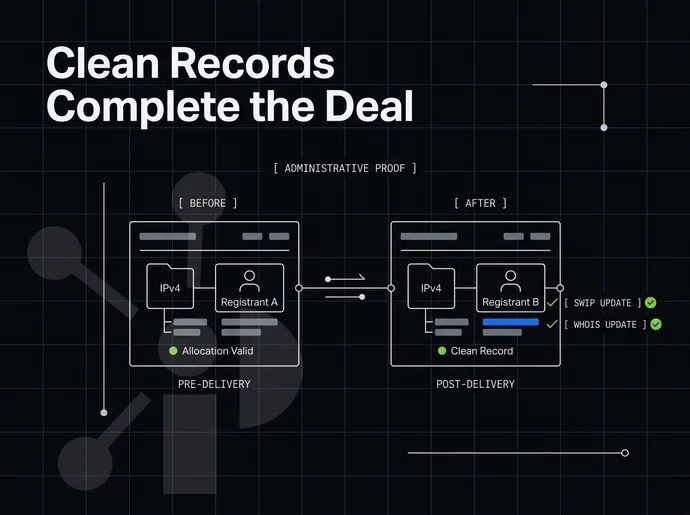
SWIP and WHOIS updates after IPv4 delivery are not optional housekeeping. They are the administrative proof that a block belongs to its new operator. A complete delivery means the RIR transfer record, inetnum object, RPKI ROA, IRR route object, abuse contact, and RFC 8805 geofeed all reflect the new holder consistently. Post-transfer WHOIS verification is the only way to confirm that proof is in place.
Stale records have real consequences. An outdated WHOIS record after transfer breaks abuse routing, triggers DNSBL listings, causes geolocation propagation errors, and exposes the origin ASN to RPKI filtering. A SWIP update after IPv4 delivery closes those gaps. Reverse DNS, RDAP accuracy, and geofeed publication finish the job. Every item on the post-delivery checklist exists for the same reason: consistency between what you announce and what the registries show.
Frequently asked questions
What is swip and why does it matter after an IPv4 block is delivered?
SWIP (Shared WHOIS Project) is ARIN's mechanism for registering downstream reassignments and reallocations in the public WHOIS database. When you receive a block and reassign any portion of it to a customer or downstream network, SWIP creates a public record linking that sub-allocation to the correct organization and abuse contact.
Without a correct abuse contact, abuse reports land at the upstream holder, not the actual operator, and that misdirection slows incident response.
How long does it take for WHOIS to update after an ARIN transfer?
ARIN typically reflects a completed transfer in WHOIS within one to two business days of approving the transaction.
Is swip required for every IPv4 reassignment under ARIN?
ARIN requires SWIP registration for any reassignment of a /29 or larger to a single end-user or downstream network. Assignments smaller than a /29 are exempt from the SWIP requirement, though you may still submit them voluntarily. ISPs and hosting providers that allocate blocks to customers must comply or risk violating their ARIN registration services agreement. Failing to SWIP eligible reassignments can trigger compliance reviews and jeopardize your standing as an ARIN resource holder.
What is the difference between WHOIS and RDAP?
WHOIS is the legacy plain-text protocol that has served IP and domain registration lookups since the 1980s. RDAP (Registration Data Access Protocol) is its structured successor, returning JSON responses with standardized fields, authentication support, and internationalization. All five RIRs now publish RDAP endpoints alongside traditional WHOIS, and ARIN has been actively encouraging the migration. For automated tooling, RDAP is the better choice because the response format is consistent and machine-readable without custom parsing.
Why does my IP block still show the wrong country after a WHOIS update?
WHOIS records the administrative registration country of the resource holder, not the physical location where the block is announced or used.
Publishing an RFC 8805 geofeed file and submitting it to those providers is the fastest way to correct the discrepancy. At Prefixx, geofeed publication and geolocation correction are included as part of the white-glove service on every lease, and the geofeed at Prefixx.net is regenerated daily.
Do I need to update WHOIS separately from the RPKI ROA after delivery?
Yes. WHOIS and RPKI are independent systems that serve different purposes and are updated through separate processes. WHOIS reflects registration ownership and contact data inside the RIR database. An RPKI ROA (Route Origin Authorization) cryptographically authorizes a specific ASN to originate a specific prefix, and it lives in the RIR's RPKI repository, not in the WHOIS record.
Completing the transfer updates WHOIS, but you must separately create or transfer the ROA to your ASN before route-origin validation will pass for your announcements.
What happens if the abuse contact in WHOIS still points to the previous owner?
Abuse reports generated by activity on your block will be delivered to the previous owner's NOC or abuse desk, who have no authority or obligation to act on them.
It can also expose the previous owner to legal or contractual liability for activity they no longer control, which creates friction with your counterparty.
The accuracy of WHOIS information after a transfer has taken place is not a mere formality.
Although the update of the WHOIS information after a transfer is handled differently by every RIR, the basic principle is the same: only after the contact information of the new holder has been added to the registry, the transfer is finally completed.
There are two common pitfalls for new buyers. First, many mistakenly believe that delivery of their new asset(s) occurs upon payment and receipt of LOA. This is actually the starting gun for the real finish line: a clean WHOIS record at the relevant RIR(s).
Second, few buyers allow enough time for registry processing of newly transferred objects.
We help buyers and sellers of blocks with all the transfer paperwork needed.
Contact us to discuss your IPv4 needs today
No hidden fees, free consult. A broker replies within one business day.