
By Savvas Bout, Founder of Prefixx. Last updated 26 November 2026.
Announcing a leased or purchased /24 via BGP is quite straight forward. However, announcing Reverse DNS delegations under RFC 2317 is a complete different story. A lot of engineers are stuck with classless fragments smaller than /24, which are announced from within the announced /24 block and the parent zone is delegated to someone else’s nameservers.
It’s very important to get the PTR records correct for several reasons: mail servers, abuse contact and security tools all use reverse DNS lookups. Quietly breaking things that are hard to track down after the fact is not very smart either.
This article describes the CNAME delegation of a /25, /26 or other sub-/24 that can hold its own PTR records for its addresses without the upstream space holder giving up control of the whole zone.
Along the way, it describes how this delegation relates to other paperwork required for your space such as your LOA, RPKI ROA and IRR route objects. Additionally, What you need to check before announcing your new space, whether that space was transferred to you or is leased as a new prefix for your use.
What reverse DNS delegation actually does
Reverse DNS lookup for an IP address returns the corresponding hostname. The reverse of the forward DNS lookup (e.g. hostname to IP address) of “who owns this IP address?” enables mail delivery, permits investigation of abuse, and allows for checks on routing hygiene worldwide.
How the in-addr.arpa hierarchy works
The reverse lookups for addresses in DNS are stored in the in-addr.arpa namespace. The octets of the IP address are reversed and written in reverse order in the DNS tree, which mirrors the reverse delegation of the DNS namespace from least specific to most specific.
For the address 203.0.113.45, the lookup for the reverse IP address is 45.113.0.203.in-addr.arpa. The answer is a PTR record (point to a name) like mail.example-ISP.net. This single record is what receiving mail servers and possible abuse desks read.
What is the difference between forward DNS and reverse DNS?
Forward DNS looks up a hostname to an IP address. Reverse DNS looks up an IP address to a hostname. Reverse DNS uses different record types than forward DNS and lives in different zones, but otherwise is part of the same DNS infrastructure as forward DNS.
- Forward: A or AAAA record, queried by name, returns an address.
- Reverse: PTR records, queried by address under in-addr.arpa, return a hostname.
- Delegation: Forward zones are delegated by registrar; reverse zones are delegated by the IP address holder's RIR or upstream provider.
Why reverse DNS matters in practice
Messages from unknown hostnames at IP addresses are rejected with very low scores by mail servers. Abuse teams follow the source of an incident by looking up the source address. Network operators test the routing information and verify whether announced prefixes have correct reverse DNS information for the used subnet.
We can prepare reverse DNS for your IP addresses as part of our white-glove service for Prefixx leases. In order to have clean IP addresses to operate with from the very beginning, we need to start with preparing reverse DNS for a /24, and then deal with the delegation of the sub-/24’s later.
How standard reverse zone delegation works for full classful blocks
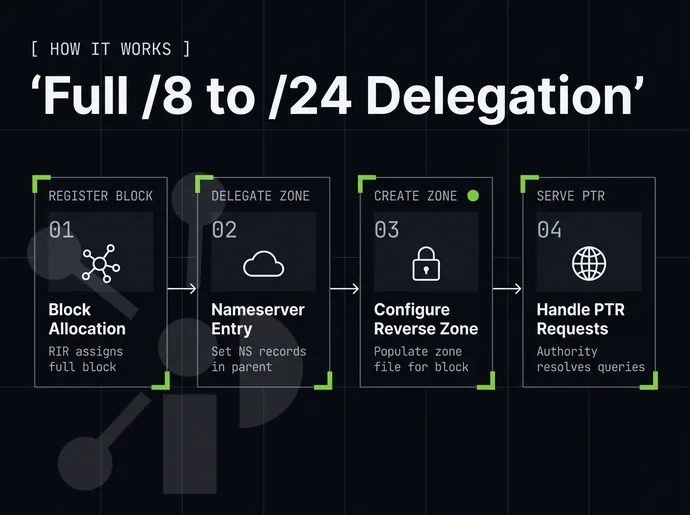
The standard reverse DNS delegation is to make your complete block as small as possible and as regular as possible, i.e. a full /24/16/8 octet size zone in the in-addr.arpa reverse space tree. In this case the upstream provider only has to set up NS records for that single zone that resolve to your DNS servers, no classless delegation in between required.
How delegation flows from the RIR to your name servers
When you receive a /24 like 192.0.2.0/24, the RIR or upstream ISP adds NS records under 2.0.192.in-addr.arpa pointing to your authoritative servers. Those records tell resolvers to query ns1 (and ns2) for all PTR lookups within that range. Ownership of the zone transfers to you at that point.
Zone file structure for a /24 with ns ns1
Your zone data file for 2.0.192.in-addr.arpa needs three things: an SOA record, NS records, and individual PTR entries. The SOA names your primary server and sets refresh and retry timers. NS records list your authoritative servers. Each host gets one PTR record mapping its last octet back to a fully qualified hostname.
A minimal example looks like this: 1 IN PTR mail.prefixx.net. maps 192.0.2.1 to a hostname. Repeat for every active IP address in the block. Unused addresses need no entry.
Why do I need ptr records for my IP addresses?
Mail servers are probably the most clear-cut case. Most receiving MTAs will reject or severely down-rate messages from IP addresses without a valid reverse DNS. A missing PTR record from a host typically indicates that the host is unconfigured or compromised and thus will get tagged as such by most spam filters.
In addition to validating email, PTR records appear in system logs, traceroutes and in abuse reports. They greatly aid in incident response and lend to a more professional appearance of your block. All 12 DNSBLs of the reputation monitoring tools are scanned by Prefixx in the client portal for reverse DNS configurations.
A /24 properly delegated with full PTR coverage for all hosts begins with a clean reputation. This can deteriorate rapidly however when your allocated space is less than a /24 and is a sub-zone of a zone not under your control.
The problem rfc 2317 solves: delegating smaller-than-/24 blocks
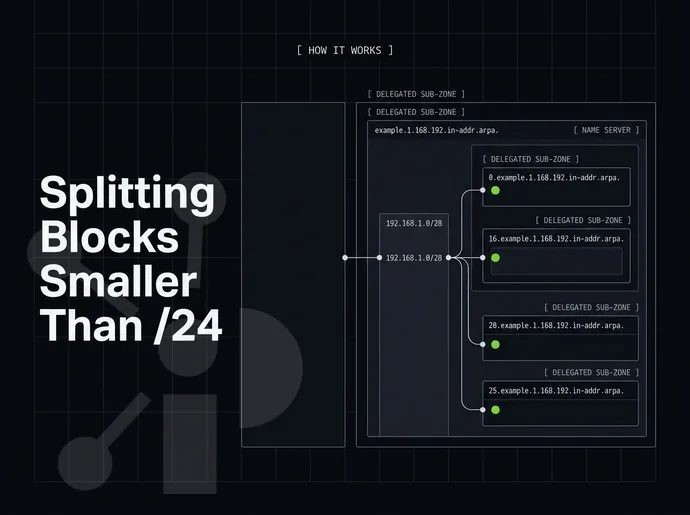
The in-addr.arpa namespace mirrors the class boundaries of IPv4: zones exist naturally at /8, /16, and /24 edges. That works fine when an ISP hands a customer an entire /24. It breaks the moment the assignment is smaller.
What is a reverse zone in DNS?
A reverse zone maps IP addresses back to hostnames using PTR records. The zone for 192.0.2.0/24 is 2.0.192.in-addr.arpa. Every address in that /24 gets one PTR record inside that single zone. Delegation works cleanly because the zone boundary matches the address boundary exactly.
The ns ns1 problem with sub-/24 blocks
The slices of /25, /26, /27, /28, /29 and /30 receive no special treatment in terms of native DNS mechanisms to slice out just that piece. The parent /24 zone for a customer’s IP address is owned and managed by the ISP for the entire zone, including all the PTR records for that zone. Thus stripping customer of ability to manage and creating an operational hurdle for the ISP.
Note: Without a delegation mechanism, a customer cannot update their own PTR records. Every reverse DNS change requires a ticket to the ISP.
How rfc 2317 closes the gap
- Create a classless delegation zone. The ISP creates a new zone named by convention, such as
0-127.2.0.192.in-addr.arpa, covering the customer's /25. This zone lives on the customer's nameservers. - Create CNAME records in the parent /24 zone for all addresses in the range you delegate to it. Each CNAME will refer from the standard reverse DNS name to the corresponding name in your zone. The resolver will then follow the CNAME and lookup the PTR record for you.
- Customer Managed PTR. The target zone is authoritative on customer nameservers. Therefore customer can add/modify/remove PTR records for their IP addresses without ISP intervention.
RFC 2317, Reverse Path to Internet 1998, March by Eidnes, de Groot and Vixie. This is currently the main method of reverse delegation for space below /24. In the next section we describe the reverse delegation in detail.
How rfc 2317 classless delegation works step by step
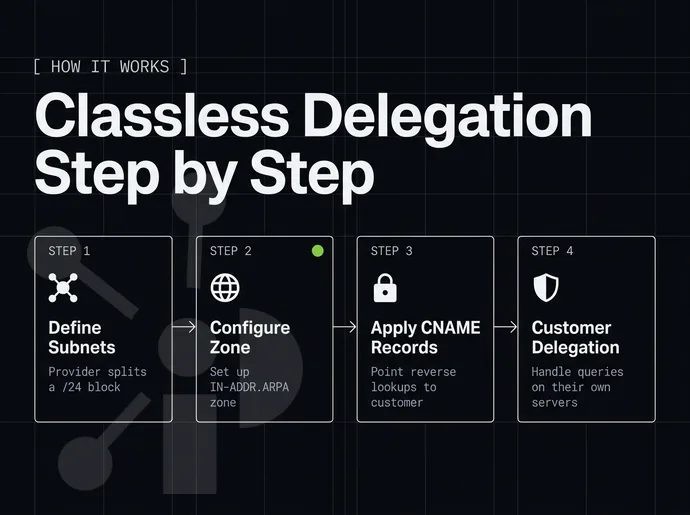
RFC 2317 describes a real problem: A provider might own a /24 net but split it into smaller subnets for his customers. With the described delegation method, one would not depend on the owner of the /24 net for creating reverse PTR records. The described CNAME trick allows to work around this problem.
How the parent zone is wired
This reverse /24 zone includes all 256 IP addresses in the range of IP addresses delegated to you. For each of your IP addresses, your provider will add a CNAME to a synthetic child zone. The name of this zone will be given in slash notation.
For a /26 covering.64 to.127 carved from 192.0.2.0/24, the parent DNS data file entries would look something like this:
64.2.0.192.in-addr.arpa. CNAME 64.64/26.2.0.192.in-addr.arpa.
65.2.0.192.in-addr.arpa. CNAME 65.64/26.2.0.192.in-addr.arpa.
127.2.0.192.in-addr.arpa. CNAME 127.64/26.2.0.192.in-addr.arpa.
The provider adds an NS delegation for the synthetic zone to the customer’s name servers.
64/26.2.0.192.in-addr.arpa. NS ns1.customer-ns.example
64/26.2.0.192.in-addr.arpa. NS ns2.customer-ns.example
What the customer manages
The customer controls the child zone 64/26.2.0.192.in-addr.arpa entirely. They write PTR records for each IP address in their own zone database. A resolver follows the CNAME from the parent zone and lands on the customer's PTR. The provider never needs to touch those records again.
Some name servers reject slashes in zone names. In that case, operators use a dash convention instead: 64-127.2.0.192.in-addr.arpa. The CNAME targets and NS delegation record must match whichever convention is chosen. Both forms are widely deployed.
Can I delegate reverse DNS for a block smaller than a /24?
Yes. RFC 2317 describes how to delegate a sub-/24 network, including /25, /26, /27 and even a single IP address. This works as long as the parent /24 zone is owned by the same provider as the sub-network and that provider is willing to set up a CNAME for inverse DNS lookup and an NS-delegation for the reverse zone.
Your provider will refuse delegation of a /24 for technical reasons if he is unwilling to set up the necessary records for reverse DNS lookup. Prefixx will set up the delegation for you in white-glove style and you will be able to manage your reverse zone from day one. The following two sections will explain the details for both parties to set up inverse DNS in detail.
Setting up the parent zone: what the upstream provider must configure
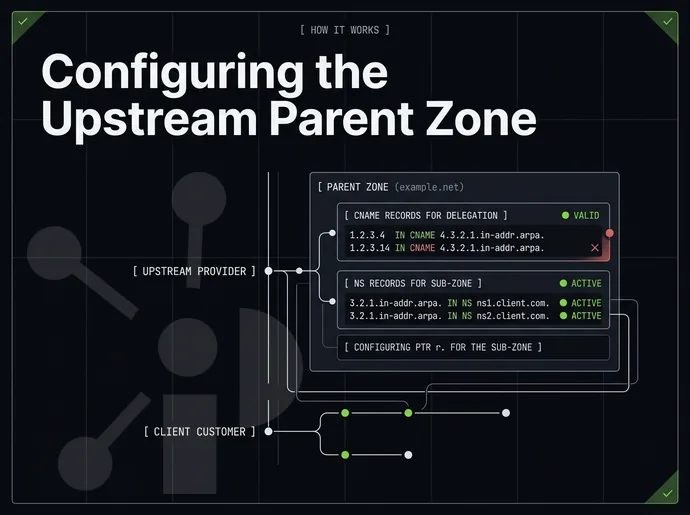
When it comes to the configuration of your upstream provider the RFC 2317 delegation either works or it doesn’t. To make sure that all PTR records in your child zone can resolve two types of records have to exist in the parent /24 reverse zone.
What records does the upstream provider need to create for rfc 2317 delegation?
For each of the sub-ranges of a delegated range the provider adds one NS record for the customer's authoritative name server. This NS record will look something like this:
- NS record:
64-95.168.192.in-addr.arpa. IN NS ns1.customer-dns.example(delegates the range.64 to.95). - CNAME per IP:
65.168.192.in-addr.arpa. IN CNAME 65.64-95.168.192.in-addr.arpa.
For each IP address in the delegated range of IP addresses there must exist a single CNAME. This CNAME then redirects a resolver’s inquiry to the child zone where the CNAME’s owner can add and manage PTR records for that customer.
What the provider keeps and what it hands off
The Provider retains complete control of the IP addresses outside of the assigned /delegate IP range. Provisioning of CNAME and NS for the assigned /sub-range is completed, while the remainder of the /24 is under the complete control of the Provider.
The boundary between.64 to.95 and PTR lookups for.1 to.63 or.96 to.255 is enforced automatically by the parent zone. Therefore, this boundary does matter to a customer.
Common mistakes that cause ptr lookup failures
Missing CNAMEs are by far the most common reason for failed PTR lookups. A provider can create NS records for a customer but forget a single CNAME for one of that customer’s IP addresses. As a result, an IP address will return NXDOMAIN, even though the customer’s name servers are perfectly fine.
In addition to NS targets for delegated zones being incorrectly set, NS targets for the wrong servers is the second biggest failure mode for us. Our process for creating a routing record attempts to catch these types of provider failures before they affect real traffic. That said, once you get the NS for the parent zone correct, the NS for the child zone of that parent must be equally correct.
Setting up the child zone: what the customer or operator configures
This child zone needs to be hosted by your customers’ name servers. After you have delegated the authority to the child zone by means of NS records for the parent zone, this child zone needs to be configured correctly. If not, then PTR lookups will fail silently.
What the child zone file must contain
The zone name should match the delegation exactly. So for a /26 network with IP address 192.0.2.64/26 the zone for reverse DNS would be named 64/26.2.0.192.in-addr.arpa. Three record types are required.
| Record type | What it must contain | Common error |
|---|---|---|
| SOA | Primary NS, admin email, serial, refresh, retry, expire, TTL | Serial not incrementing after edits |
| NS | Must match exactly what the parent delegated to | NS records differ from the parent delegation |
| PTR | Owner name is the last octet; RDATA is the FQDN with trailing dot | Missing trailing dot causes the zone name to be appended |
Ptr record syntax
For 192.0.2.67, the owner name in the zone is simply 67 (the last octet). RDATA for an A record must contain a fully qualified domain name (e.g. host.your domain). Note that a trailing dot is required. Without the trailing dot, the resolver will append the name of the zone and perform a lookup for a hostname that was not intended to be looked up that way.
For synthetic delegation names such as ns1.your domain, NS records for the child zone must be entered exactly as the name was entered for the parent zone. Mis-spelling the name will break delegation.
How do I verify that my reverse DNS delegation is working correctly?
Verify that dig -x 192.0.2.67 from an external resolver returns a correct PTR for your intended hostname, plus an ANSWER section with the NS for the child zone. If the answer is empty then check the parent NS records for the correct name servers. In addition, make sure the child zone’s SOA serial has been incremented since the last edit to that zone.
Try querying the child zone's NS server directly: dig @ns1.your domain 67.64/26.2.0.192.in-addr.arpa PTR. If this dig returns the correct PTR but the recursive query above it doesn't, the problem is with the parent delegation, not with the zone files themselves.
For Prefixx leased blocks, reverse DNS (DNS reverse) delegations and reverse DNS records are a service that we manage as part of our white-glove service for you. We create and manage the delegated zone, work with the upstream to get the new delegation created and then update rDNS records on a per-record basis via the Prefixx client-portal. After both zones are created for you, we then go through a structured test to verify that everything is resolving as it should end-to-end.
Verifying and troubleshooting reverse DNS after delegation
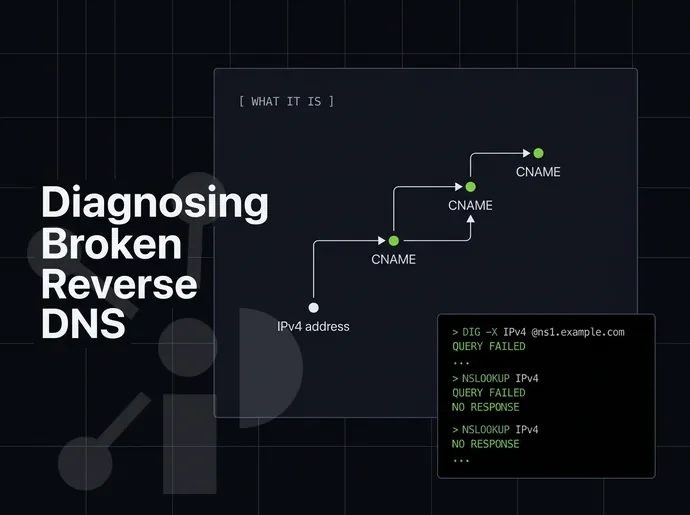
Verify delegation after you have set it up. A broken CNAME chain or an unloaded DNS zone database silently fails to send any traffic at all. In the meantime, TTLs will continue to generate incorrect results for hours.
Run the basic lookup commands
- Test with dig, nslookup, and host. Run
dig -x,nslookup, andhostagainst your resolver. All three should return the same PTR record. Disagreement between them usually points to a caching issue on one resolver. - Trace the delegation chain manually. Query in-addr.arpa from the root:
dig @a.root-servers.net -t NS in-addr.arpa, then follow each referral down to your /24 zone. This confirms whether the parent zone is actually delegating to your name server, not just whether your name server answers.
Diagnose common failure modes
- This is a difference between NXDOMAIN and SERVFAIL. NXDOMAIN is reported for a zone that did load, but for which the PTR record for a given IP address was not found. SERVFAIL is reported for a name server that does not answer authoritatively for a given domain name. This usually means that the name server's zone record file for that domain name did not load. Fix the DNS zone data first, then debug the record.
- A Broken CNAME chain. A CNAME in the parent zone for an RFC 2317 delegated domain-name points to the domain-name in the child zone. A single missing or wrong CNAME or PTR in that zone breaks reverse DNS lookups for that domain-name. Check both the CNAME in the parent zone and the PTR in the child zone separately.
- TTL caching delays. Reverse DNS propagation follows normal DNS TTL rules, not the timelines for transfer of RIRs information. Negative TTL cached by a resolver will continue to return NXDOMAIN after you fix the record. This can only be solved by waiting for the TTL to expire or testing on an uncached resolver.
Does rfc 2317 apply to IPv6 addresses?
No. This RFC solves a very specific problem with sub-delegation of IPv4 /24s. The reverse DNS for IPv6 is done using ip6.arpa with nibble-boundary notation. And as IPv6 allocations are very large, sub-/24 fragmentation does not really happen. So simply delegate on a nibble boundary and manage the PTRs for that delegated part directly.
No CNAME workaround needed for this. And as the verification of reverse DNS for a given IP address is covered in the above sections. It might be good to place this in the context of the leasing and BYOIP related routing paperwork.
Rfc 2317 in the context of IPv4 leasing and BYOIP
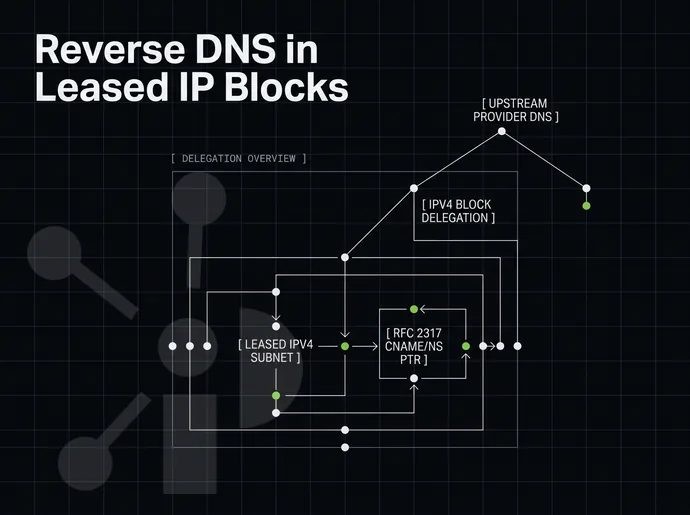
If you’re leasing IPv4 space or bringing your own block to run on bare metal or in cloud, reverse DNS is something to be aware of during the operational handover. A missing PTR or one that doesn’t match the A record causes problems quickly: mail gets rejected. Abuse desks get notified and IP blocks get added to blacklists of anti-spam systems before the first packet has even left the first router.
Prefixx treats reverse DNS as a first-class deliverable, not a footnote. Our white-glove service covers per-record PTR management and zone delegation for /24 and larger blocks, all accessible through the client portal. For BYOIP deployments, our team prepares the LOA, RPKI ROA, and IRR route objects as part of the same handoff, so routing hygiene and reverse DNS land together.
- Per-record PTR management (and reverse zone delegation for /24 and larger) is included in the standard lease terms.
- BYOIP support includes LOA, RPKI ROA, and IRR route objects and is administered by the NodeKick team.
- Tixx Quality Control checks every block for blacklisting and routing errors before it is delivered to you.
- Reputation monitoring on 12 DNSBLs + geolocation correction is included in our white-glove service.
- We are a registered broker with ARIN, RIPE NCC and APNIC. LACNIC transfers are also facilitated.
Correct reverse DNS entries and a clean reverse DNS delegation are important for some customers. Please let us know if this matters for you and we can discuss your block requirements. Note where RFC 2317 is weak and how later documents have addressed these issues.
Rfc 2317 limitations and what came after
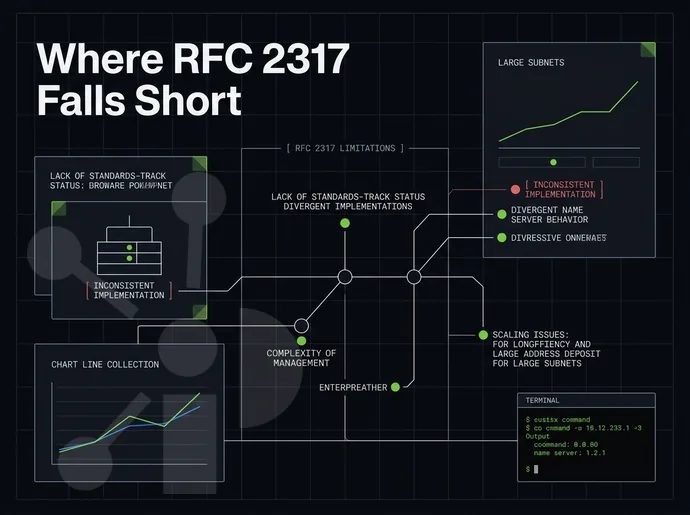
RFC 2317 is an Informational RFC, not a Standards Track document. Thus, name server implementations may differ from one implementation (e.g., software package) to another. No one needs to implement it precisely, yet for operators of sub-/24 reverse zones it already causes sufficient discomfort with current inconsistencies.
Where rfc 2317 breaks down
The slash character in zone names can cause problems for old or strict name servers, that don’t understand the slash at all and therefore have to be told to use a dash instead. Thus a zone named 0/26.2.0.192.in-addr.arpa could also be called 0-26.2.0.192.in-addr.arpa and this is even commonly used.
A second DNS lookup is performed by each of the DNS lookups for the PTR entries through a CNAME. For most current systems this additional step is too small to notice, but it can affect certain resolvers, or systems that for other reasons are not able to follow long CNAME chains.
Note that reverse DNS for IPv6 addresses uses nibble-boundary delegation under the domain ip6.arpa. Here, each hexadecimal digit in the address is used as a label. Classless delegation of reverse address space as described in RFC 4183 for inverse IPv4 lookups is not equivalent to and not covered by RFC 2317.
What later guidance changed
RFC 8501 and subsequent guidance for operational practice refines reverse DNS delegation practice, particularly for ISPs delegating sub-/24 space to their customers. The basic practice described in RFC 2317 is still relevant, with practice now better guided as to issues such as CNAME chain length and zone name character sets.
When to skip rfc 2317 entirely
For allocations larger than a /24, standard NS delegation is easier to implement and is supported by everyone. RFC 2317 was written for the sub-/24 case. As a result, The normal work that we do to prepare reverse lookup records, reverse zone delegation and LOA documentation for a lease is all that most people need to know about this. The rest of this document outlines the key points that everyone should take away from reading it.
Key takeaways on classless reverse DNS delegation
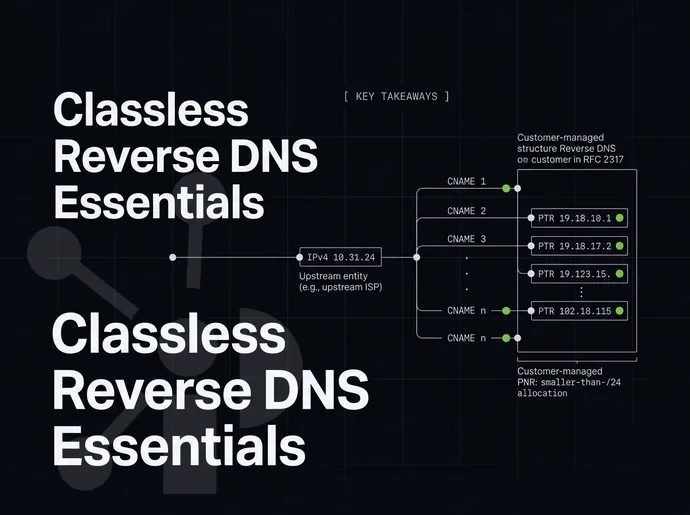
RFC 2317 solves a specific problem: how to hand PTR record control to a block holder who owns less than a full /24. The answer is a CNAME in the parent reverse zone pointing to a delegated child zone. There, The block holder manages their own in-addr.arpa records through their own NS records, such as ns1 of their domain name. Both sides must configure their respective zones correctly, or reverse DNS resolution breaks entirely.
For leased or BYOIP IP addresses, rDNS delegation is routing paperwork, not an afterthought. It sits alongside the LOA and ROA in the handoff checklist. Prefixx handles that paperwork as part of white-glove service. Run dig -x against a sample address to confirm the reverse zone resolves before you call the setup complete.
RFC 2317 classless delegation solves a real operational problem: it lets the holder of a sub-/24 block manage their own reverse DNS mappings without depending on the upstream provider for every change.
The mechanics are straightforward once you see them, a CNAME chain in the parent zone pointing into a delegated child zone that the block holder controls. Getting it right requires coordination at both ends. The parent zone must publish the CNAME records and the NS delegation; the child zone must accept the forwarded queries.
If you are acquiring a sub-/24 block and need PTR management handed to you cleanly, that coordination is part of what Prefixx handles. Every lease includes white-glove routing paperwork, reverse DNS delegation, and ongoing rDNS management through the client portal. Contact the Prefixx team to discuss your block requirements.
Contact us to discuss your IPv4 needs today
No hidden fees, free consult. A broker replies within one business day.