
By Savvas Bout, Founder of Prefixx. Last updated 23 October 2026.
Each broker contract scope looks good on paper until reality sets in, six months later. A block of IP addresses gets withdrawn from circulation. A routing table entry isn’t included in time. Unexpected charges surface from corners of the contract that were never discussed.
Network engineers and IP address managers read the fine print because the contract is the product that’s being purchased, what it does include. What it doesn’t, and how liability is apportioned to ensure that an IP address acquisition or lease includes everything your business needs.
This difference is most pronounced in several specific areas: (1) documentation of transfer of ownership documents; (2) preparation of RPKI/IRR objects. (3) reputation remediation; and (4) what happens to the block if it fails to meet quality criteria after the sale has closed.
This article will go through all of these points in more detail.
What IPv4 brokers actually cover in a contract
An IPv4 broker contract clearly outlines the broker’s responsibilities from the time the client engages the broker until the allocated address space is announced on the relevant IP databases and is connecting as expected. What is not included in the contract with the registrar (i.e. the registry) will not be done for you.
What the broker takes on
A full-service IP broker is someone who sources or lists IP for you, does due diligence on it. Coordinates an escrow with you to purchase it and files all of the paperwork required with your local RIR to transfer registration of the IP to you. At Prefixx we use Tixx quality control on every block of IP that we sell to you. This includes verification of ownership, blacklist checks, full routing checks and IP transfer checks.
The LOA, RPKI ROA and IRR route objects are also prepared by our team. These documents enable routing on the receiving side of a network. A clean transfer does not necessarily mean a block can be routed yet.
What falls outside broker scope
A broker is not a registry. Although a broker fills out forms on behalf of a customer and contacts ARIN, the RIPE NCC, APNIC, or LACNIC as needed, the actual decision to transfer IP addresses and set a time frame for the transfer is made by the registry itself and cannot be changed by the broker.
- The registry approval timelines are not under our control.
- Upstream BGP announcement is your buyer’s or your ISP’s responsibility.
- Ongoing abuse complaint resolution is the responsibility of the address space holder.
The three transaction types this shapes
We distinguish three types of deals, and accordingly the scope of services a broker can offer you. When you’re buying IPv4 addresses, the broker will find, evaluate and close the deal for you. When selling IPv4, the broker creates a listing, qualifies offers from potential buyers and manages the escrow for the sale.
For IP lease transactions, the broker will in addition to the above guarantees non-revocation of the lease and provides white-glove routing support during the lease term. We detail below each of these three types of transactions starting with the buy side.
Buy-side scope: what happens when you buy IPv4 addresses
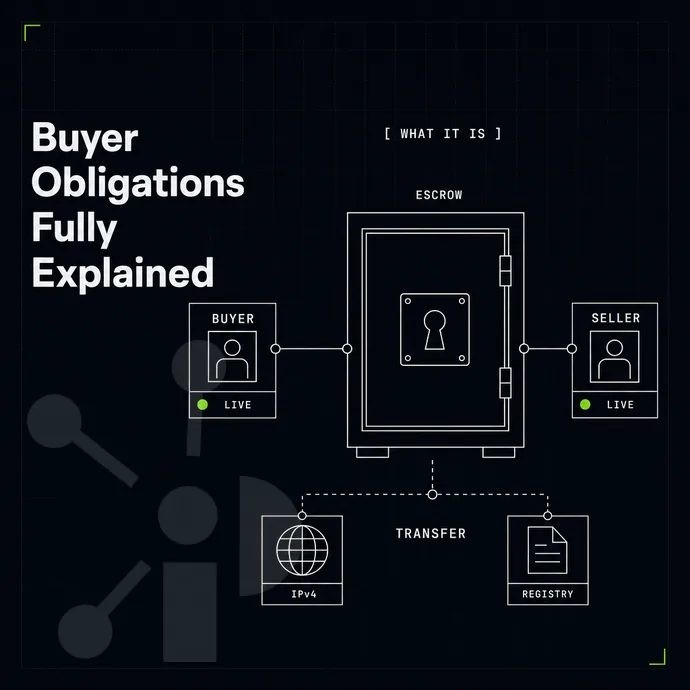
The broker’s buy-side scope extends beyond just finding a seller for IPv4 addresses. A broker undertaking a purchase will also complete sourcing, carry out due diligence on potential suppliers, set up an escrow and assist with post-transfer IP addressing. It is worth establishing what brokerage effort is being applied to complete each of these steps.
Block sourcing and pre-sale quality control
We source our IP blocks from all valid RIR regions (ARIN, RIPE NCC, APNIC, LACNIC, AFRINIC) in sizes ranging from a /24 up to a /16.
We also check blacklists and perform a general routing health check. We use Tixx to generate a health report and transfer readiness score for all our IP blocks, Prefixx.
Escrow and the transfer process
Once a block has gone through quality control, the broker of your choice then sets up an escrow account for both parties' funds.
A good broker does not charge any buyer-related fees.
Post-transfer routing and geolocation work
Completing the transfer of a block to a broker is not the end of the job. The broker needs to complete LOA, RPKI ROA, and IRR route objects for announcements to start working from day one.
Geolocation correction can then be done, e.g. by MaxMind or IP2Location to correctly assign a region to the block of IP addresses. Until this step is done, all kinds of tools for traffic routing and fraud scoring will continue to misread the block for months to come.
| Buy-side task | Handled by Prefixx | Typical self-serve approach |
|---|---|---|
| Blacklist and routing hygiene check | Tixx QC on every block | Manual, buyer's responsibility |
| Escrow setup | Included | Varies; often absent |
| LOA, ROA, IRR preparation | White-glove, included | Buyer arranges independently |
| Geolocation correction | Included post-transfer | Rarely offered |
| Buyer fees | None | Varies by platform |
A buyer of IPv4 addresses looking for the full Tixx style quality control, escrow, routing paperwork etc. all under one engagement, should look for a broker that offers a similar bundle on the sell side with different requirements and obligations.
Sell-side scope: what the broker does when you monetise your address space
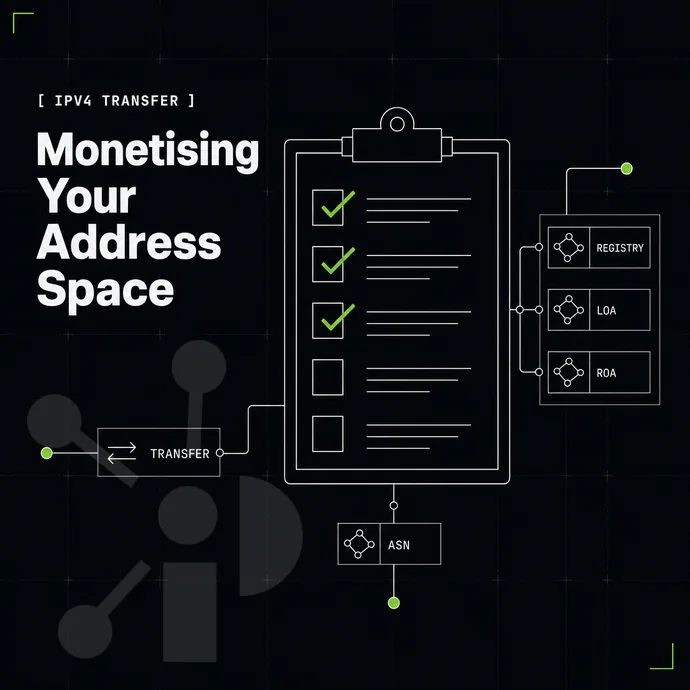
Engaging IPv4 brokers to sell your IP addresses can relieve you from most of the related work. Below is a step by step overview of the selling process, from the moment you sign the engagement letter until the IP addresses have been transferred to the buyer.
Preparation
- Block assessment and listing preparation. We review the address block for ownership information, RIR information, blacklisted IP addresses and other routing information using Tixx. A healthy report and transfer readiness score is generated before any listings are activated. This ensures that a deal does not collapse in the middle of a transfer due to a unknown reputation issue that was discovered too late.
- Market positioning. We set an asking price based on current secondary-market conditions for your RIR region and block size. You approve the price; we handle all buyer-facing communication. Note: sellers who list without a broker often underprice because per-IP rates vary significantly by registry and block size.
Execution
- Buyer vetting: We check every potential buyer for RIR eligibility and real need before handing out IP address details. This is a contractual obligation for us.
- We negotiate the transfer on your behalf and set up the transfer to go through escrow. The funds are held in escrow until the RIR confirms the transfer of IP numbers to the new customer. You never have to deal with the payment details.
- RIR transfer filing. We will prepare and file all necessary paperwork with the respective registry for the transfer. The seller will be asked to confirm transfer in the RIR portal when required.
Commission and seller obligations
Brokers that are reliable enough to sell IP addresses on behalf of their owners operate on a no-win-no-fee basis. Our commission for selling IPv4 address space is between 3% and 8% of the seller’s side only. Smaller blocks of IP addresses are charged at the upper end of this range. There are no commission charges for the buyer.
Once engaged, you are not responsible for sourcing a buyer, determining a price, managing an escrow, or completing RIR paperwork. We handle all of this for you. Your IP address will transfer to the new owner only after the funds have cleared escrow and the appropriate registry or registrar has notified us of the change.
If your goal is not to own IP Address, but rather to utilize IP Address for routing, then you have another option, leasing the IP Address which has its own distinct contract.
Lease-side scope: rights, guarantees and ongoing obligations
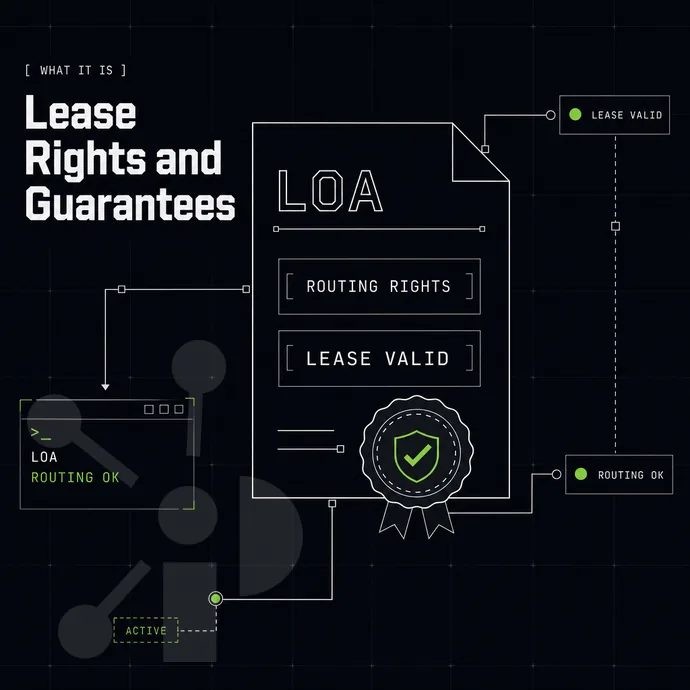
Lease agreements transfer the right to use IP address space (i.e. routing) not ownership of the IP address space. The lessee receives an LOA, RPKI ROA and IRR route objects to enable announcement of the block of IP address space via BGP. The lessor retains registration of the IP address space for the entire term of the lease agreement.
Routing rights and the non-revocation guarantee
An LOA enables the lessee’s ASN to originate a prefix.
The IRR route objects for this announcement (ROUTE and ROUTE6 in the appropriate registry database) provide additional context.
Ongoing broker obligations
Leasing IPv4 addresses is not a one time transaction. The broker will continue to service the lease until it expires. Prefixx will monitor the reputation of IPv4 space leasing brokers on 12 DNSBLs including Spamhaus ZEN and Barracuda. Prefixx also manages reverse DNS and processes abuse complaints. Daily Geolocation corrections are published to a geofeed according to RFC 8805.
Blacklist scanning matters because a newly leased IP address may carry legacy reputation issues. Catching a listing early prevents deliverability or access problems for the lessee.
Short-term versus long term lease structures
Short-term leases suit traffic spikes or project-based capacity needs. Long term structures, typically annual or multi-year, offer rate stability and reduce re-provisioning overhead. Prefixx targets provisioning within 24 hours for both structures.
Regardless of whether the lessee holds the project under a Master Lease or Sublease, the lessee never becomes transfer eligible. Transfer eligibility only arises when the Lessee becomes the full owner of a project via a full RIR transfer of that project.
That distinction is the core of IPv4 leasing versus buying. Leasing delivers routing utility; purchasing delivers the asset. The right choice depends on whether the organization needs the block permanently or only for a defined operational window. When the block does need to move across registry regions, the contract scope expands further still.
Inter-rir transfers: how registry region changes the contract
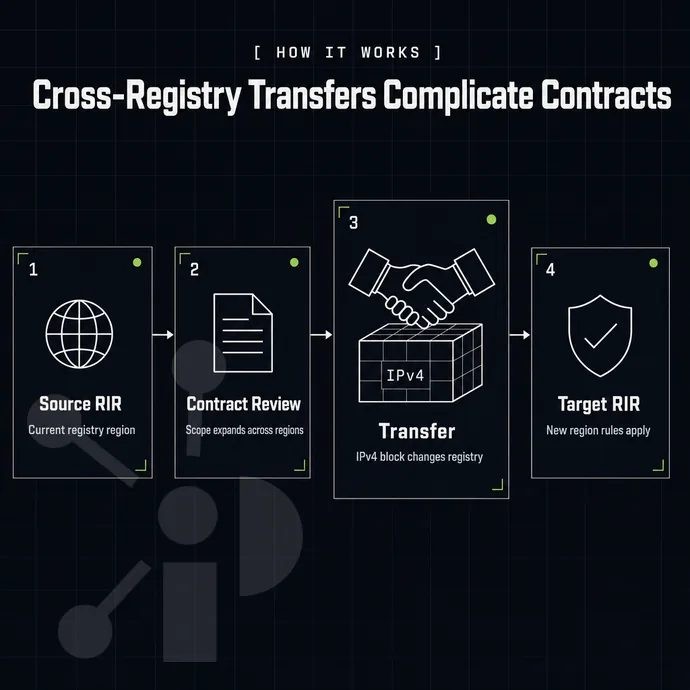
Inter-RIR transfers are where the contract scope of the IPv4 broker expands most. Transferring IP space across registry regions requires compliance with two separate sets of policy and the broker must maintain synchronization with both sides of the transfer.
Each RIR sets its own rules
The five RIRs (ARIN, RIPE NCC, APNIC, LACNIC, and AFRINIC) have independent eligibility criteria, documentation requirements, and approval times. A block of IPv4 address space that moves from ARIN to RIPE NCC will require a needs justification to be approved by ARIN and a membership check to be approved by RIPE NCC before the address space can change hands.
LACNIC is a bit of a special case here, as transfers into and out of LACNIC are facilitated by the inter-RIR mechanism already implemented by LACNIC itself. Thus the broker has to handle an extra layer of coordination.
How regional pricing reshapes deal structure
A /24 unit of IP address space might trade for a certain price under the control of ARIN, while an identical /24 block would trade for more under the control of RIPE NCC. The difference represents a multiplier that our consultants would model for you before you ever sign a contract to buy and cross regionate such space.
When the price difference is large enough, customers even target certain regions for price reasons. Subsequent routing, updates of RPKI ROAs as well as changes of IRR objects have to be done in both registries.
What our team handles end to end
- Verify transfer eligibility between source and destination RIR.
- Creation of LOA, RPKI ROA and IRR route objects for destination region.
- LACNIC facilitation coordination for destinations in Latin America.
- Tracking approval queues at both registries in parallel.
We complete inter-RIR IP address transfers for our customers for ARIN, RIPE NCC, APNIC customers. We can also assist with LACNIC transfers. As with the purchase of an IP address, every block of IP address space that we transfer is reviewed by Tixx for quality and for potential reputational or routing issues prior to commencement of transfer.
The process of making IP address space that has been transferred to the correct RIR for a customer’s location “routable” involves BYOIP and associated routing documents.
BYOIP and routing paperwork: where broker scope meets technical deployment
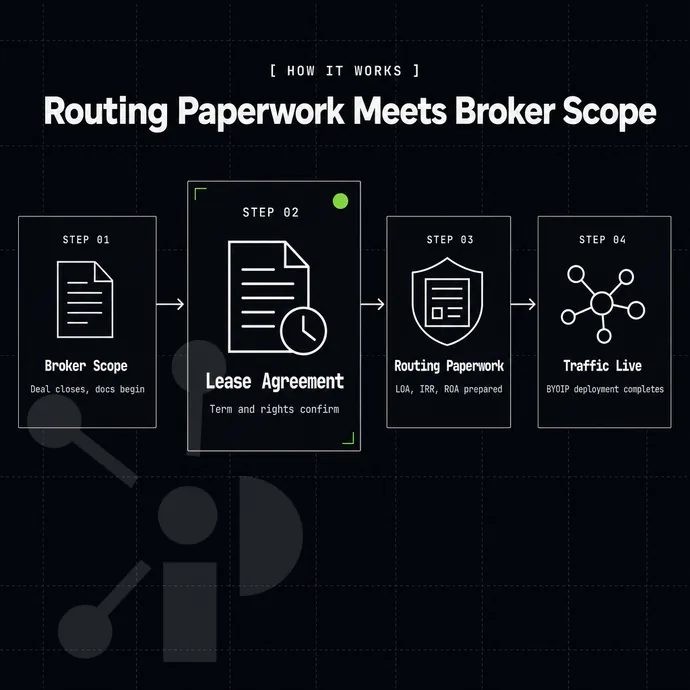
When closing an IPv4 address space deal, it only marks the beginning for the buyer. Before actual traffic starts flowing, three documents need to be created and put into place: a Letter of Authorization (LOA), an RPKI Route Origin Authorization (ROA) and an IRR route object. Most potential buyers have never even started creating these documents, a field in which IP broker scope meets technical deployment.
What each document does
A Letter of Authorization (LOA) enables a carrier to originate a prefix for a customer.
BYOIP deployment across environments
BYOIP programs for cloud environments such as AWS, GCP, Azure, OCI and Cloudflare require a signed LOA and valid RPKI ROA prior to onboarding. Bare metal environments typically require the same documents plus IRR consistency for onboarding. At Prefixx we can prepare the LOA, ROA and IRR route objects for you to onboarding your BYOIP. BYOIP on Netrouting bare metal servers is included in the price with no per-IP surcharge.
Human-in-the-loop process: A specialist reviews the proposed block of address space. Verifies the RIR for which the customer is a registered user and then contacts the upstream registry to effect any necessary change(s) to enable the proposed routing of the customer’s address space for related paperwork purposes. No automated process or ‘one-click’ process exists for address space routing related paperwork.
Broker scope versus diy
| Dimension | Self-managed | Prefixx white-glove |
|---|---|---|
| LOA preparation | Buyer drafts and coordinates | Prepared by our team |
| RPKI ROA | Buyer creates via RIR portal | Created and validated by Prefixx |
| IRR route object | Buyer registers manually | Registered and checked for consistency |
| Cloud BYOIP onboarding | Buyer coordinates with cloud provider | Supported for AWS, GCP, Azure, OCI, Cloudflare |
Treat these documents with the same amount of respect that you would give a buyer-only problem if your team doesn’t have any experience with routing operations.
Ensure that any IP broker you choose to engage will take ownership of these documents from start to finish prior to you signing them to a contract for the address space in question. Knowing what a broker can do for you is only half the story; it is also important to know what a broker cannot do for you.
What falls outside the broker's contract scope
A broker's contract typically deals with finding, evaluating, documentation and closing of a deal.
Registry and approval boundaries
- Recognize that the broker is not the RIR. IPv4 brokers submit transfer requests and prepare documentation on your behalf. The RIR reviews and approves those requests on its own schedule. We cannot guarantee approval timelines, and no broker can. Note: Any service promising a fixed RIR turnaround is overstating its authority.
- Transfer eligibility is RIR’s decision. Tixx by Prefixx checks for ownership, routing and blacklist issues before passing a block to you. But it is the registry that finally approves transfer.
What the broker does not supply
- Domain registration and web hosting are out of scope for us. We treat IPv4 addresses as routing resources. We don’t register domains, host websites or provide email services. That’s all to be arranged with your chosen provider.
- After we transfer or lease IP addresses to you, the operation of the network (such as the internal routing, BGP announcements and the upstream peering) is your responsibility. We can prepare the LOA, RPKI ROA and the IRR route objects for you, but we do not operate your network.
- Downstream abuse policy is yours to enforce. We can help you monitor for reputation attacks, but the policies around acceptable use on any space you acquire are your responsibility. We offer white-glove service for reputation monitoring but the address holder makes the policy decisions.
Brokerage versus a public marketplace
- We don’t have a public price list like other self-serve marketplaces do. Instead, we give you a fixed price for your transfer for 72 hours, calculated based on the size of the block, the RIR you’re sending from/ receiving to, and current market prices. This stops you from getting quoted at old prices.
- Before assuming a block is unavailable, reach out and inquire. We’d be happy to answer any questions regarding scope and clarify what is covered in a deal. All engagements at Prefixx.net are handled by senior consultants only, not by an automated queue.
Once you understand what is in scope and what is not, you need to understand how to evaluate a contract with a specific broker before committing to it.
How to evaluate an IPv4 broker's contract before you sign
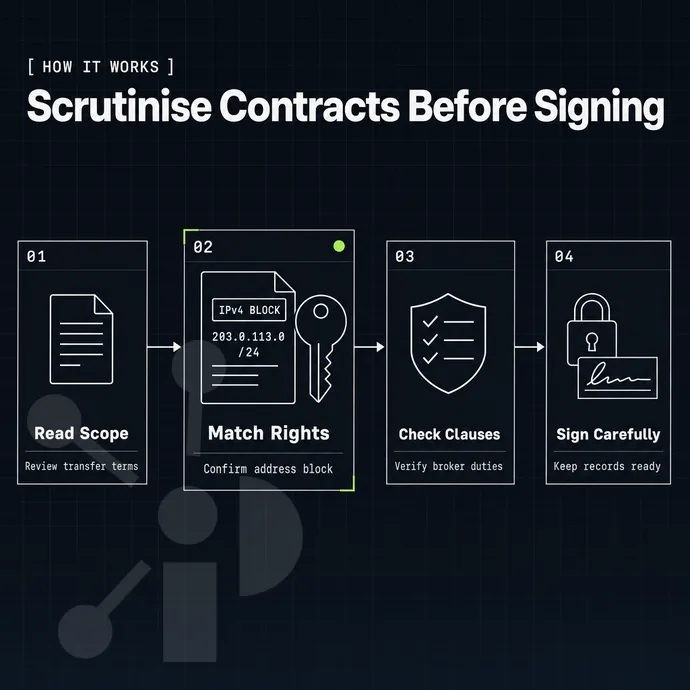
A IPv4 broker contract is a case where your due diligence either pays off or costs you a lot of money. Before you sign anything you have to verify three things: the financial setup of the broker, the quality of the blocks he has and the post-transfer obligations of the broker.
Fee structure and escrow mechanics
A clean IP broker charges only the seller for the broker’s services. Fees charged to the buyer are a warning sign. Make very sure that the broker’s commission is fixed as a percent and clearly written down before you agree to do business with the broker.
The money must move through a third party licensed escrow service, not the broker’s checking account. The escrow service will protect both parties in the event of a dispute whilst the money is in transit.
Block quality and RIR standing
The biggest problem with buying IPv4 space post sale is that there was no quality control process in place pre sale. Ensure the contract refers to a specific pre sale inspection process which includes ownership verification, IP blacklist verification, routing verification and the IPv4 block in question can be transferred via the relevant RIR.
Broker registration is a big one too, make sure they have active registration with the RIR in question. They are bound by the registry’s policies so you have some form of recourse should things go wrong.
Lease non-revocation and long-term support scope
For leases of IP addresses the most important clause is non-revocation. A lease without this clause can be pulled at any time and cause big disruptions to your routing. In addition to non-revocation, a contract for a long term lease of IP addresses for use in a fixed deployment should spell out post-transfer support. This includes re-issue of LOA, updates to RPKI ROA, updates to IRR for route-objects and handling of abuse complaints. These are not extras, they are essential.
This broker contract fails to negotiate for post-transfer routing support. The LOA, RPKI and IRR objects need to be maintained for the life of the assignment, not just at the close of sale.
At Prefixx, we back every lease with a non-revocation guarantee and provide white-glove routing paperwork.
Why choose Prefixx for IPv4 brokerage
Choosing the right IPv4 broker shapes every term in your contract, from how cleanly the address block transfers to whether routing paperwork lands on your desk or sits unfinished. Prefixx is a boutique brokerage built around a human-in-the-loop model: senior consultants manage every deal, and no IPv4 address space reaches a buyer without passing Tixx quality control first.
- Zero buyer fees. When you buy IPv4, you pay nothing to us. Sellers pay a 3 to 8% commission only on a successful close.
- Tixx QC on every block. Ownership verification, blacklist scanning, routing hygiene and RIR standing are checked before any IPv4 addresses change hands.
- Escrow-secured transactions. Funds are held in escrow throughout the transfer process, protecting both sides.
- White-glove routing support. Our team prepares the LOA, RPKI ROA and IRR route objects for every lease. Geo-location correction, rDNS, reputation monitoring and abuse complaint handling are included.
- Inter-RIR transfers across all five regions. We are a registered IP broker with ARIN, RIPE NCC and APNIC, with LACNIC facilitated, covering every major IP address region.
- BYOIP deployment support. Bringing your own IP resources to bare metal or a cloud platform? Our consultants handle the paperwork end to end.
Whether you are buying IPv4, leasing IPv4 for a fixed term, or planning a long term acquisition strategy, contact us to discuss your requirements and receive a personalized offer.
Key points: IPv4 broker contract scope at a glance
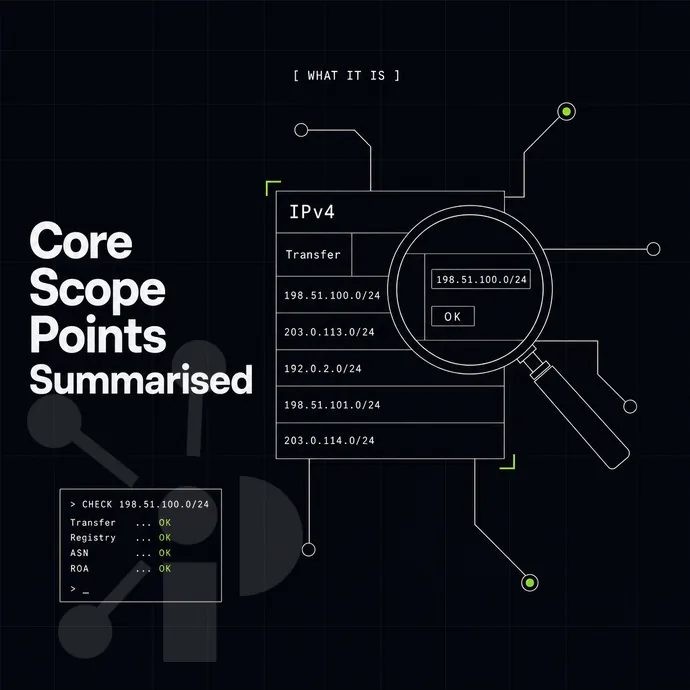
A broker contract for IPv4 laying out what the broker is responsible for and what the seller is responsible for.
For a lease of IPv4 this would include setting up the IPv4, writing up the routing information for the buyer and being a general white-glove type of person to help with any issues that may come up. Quality control is performed on every block of IP addresses before they are sold to a buyer. Also, all transfers are done through escrow to protect both the buyer and the seller.
In addition to items outside of the broker’s scope of services (i.e. network engineering, abuse remediation, RIR time lines etc), make sure when you are reviewing a contract for leasing IPv4 IP block that IP resources are checked for black list history, RPKI and IRR objects are prepared for you and leasing of IPv4 IP block includes a non-revocation clause. We’d be happy to review these items with you in the contract. Contact us at Prefixx.net.
Frequently asked questions
What does a broker contract for IPv4 IP resources typically include?
A broker contract covers the scope of the block being transacted (size, RIR, and intended use), the commission structure, escrow terms, and the routing paperwork the broker will prepare on your behalf.
Reputable contracts spell out what happens if a block fails those checks before closing. The agreement should also state the timeline for RIR transfer submission and what support the broker provides after the deal settles.
Does an IPv4 broker charge the buyer or the seller?
Most established brokers charge the seller only, not the buyer.
What is the difference between buying and leasing IPv4 addresses through a broker?
Buying transfers full ownership of the IP block to you via an RIR-recorded transfer, giving you permanent control and the ability to resell later.
Leases are faster to provision and carry a lower upfront cost, but you do not build equity in the addresses. A broker handling leases should provide a non-revocation guarantee, RPKI, LOA, and reverse DNS as part of the arrangement.
How does escrow work in an IPv4 broker transaction?
The buyer deposits funds into a neutral escrow account before the RIR transfer is initiated.
Only then are the funds released to the seller. This structure protects both parties: the seller knows payment is secured before relinquishing the block, and the buyer knows the block is verified before money moves.
What RIR paperwork does a broker handle on your behalf?
A full-service broker prepares the Letter of Authorization (LOA), RPKI Route Origin Authorizations (ROAs), and IRR route objects needed to announce the block cleanly after transfer.
For leased space, the broker maintains those routing records for the duration of the lease. Prefixx handles all of this as part of its white-glove service, included with every lease and available on purchases.
Can a broker manage an inter-rir transfer across different registries?
Yes, but the broker must hold registration with each registry involved.
Prefixx is a registered broker with ARIN, RIPE NCC, and APNIC, and facilitates LACNIC transactions. The broker coordinates eligibility checks, policy compliance, and paperwork on both sides of the registry boundary so the deal does not stall mid-process.
What should I check before signing an IPv4 broker agreement?
Confirm the broker is registered with the RIR relevant to your transaction, not just self-described as a broker. Verify that the contract specifies a pre-sale quality check covering ownership verification, blacklist status, and routing hygiene, not just a verbal assurance.
Check whether escrow is mandatory or optional, and who the escrow agent is.
A broker contract is only as strong as its scope.
When leasing, the non-revocation guarantee and the ongoing white-glove service promises are worth as much as the rate. A non-revocation guarantee is not enough for a lease, unless it comes with a defined way to monitor reputation, deal with abuse and manage rDNS.
If you are ready to map those requirements against a specific block or portfolio, Prefixx reviews the scope with you before any paperwork is signed.
Contact us to discuss your IPv4 needs today
No hidden fees, free consult. A broker replies within one business day.