

By Savvas Bout, Founder of Prefixx. Last updated 2 October 2026.
The challenge that every network team faces when expanding into the Asia-Pacific region is the same: APNIC IP address space is in short supply, transfer rules are strict and IP prices move fast. Knowing how to handle resource registration and acquire IP addresses from APNIC in detail, covering registry policy and routing hygiene, is the difference between closing a deal within weeks and it falling through at the last minute.
Note that APNIC exhausted its free pool of IP addresses in 2011, so all of the IP address space that is currently available for purchase is now being sold on the secondary transfer market.
In this article we describe how transfers of IP space between members of APNIC, the regional internet registry serving the Asia-Pacific, work, the checks that APNIC performs on a proposed transfer, and the key differences between leasing and purchasing an IP address block, all important considerations when managing internet resources for a deployment centered on that region.
We also go through the various pieces of routing paperwork that form part of your internet infrastructure, LOA, RPKI ROA, and similar documents that go well beyond ordinary domain name registration, and how these must be configured as IRR objects in order to announce the newly acquired space. By the conclusion APNIC's transfer evaluation is complete, the buyer will have a clear picture of whether the block meets technical and policy requirements for their deployment.
What is APNIC and what does it do?
The Asia Pacific Network Information Centre (APNIC) is the regional internet registry for the Asia-Pacific region. It assigns IP addresses and Autonomous System Numbers to the companies that build and run the Internet in 56 countries across the region, including Japan, New Zealand and Pakistan.
How asia pacific network information centre delegates IP addresses
The Asia Pacific region’s IP address allocation body, APNIC, allocates IP addresses in large blocks to Internet service providers, companies, research organizations and other organizations within the region. IP address allocations are made on an application basis and approved for use by the required organization to meet their IP address needs.
APNIC does not sell IP addresses but allocates IP address usage under a registry-type of IP address distribution. This registry-type distribution model ensures that resource allocation follows documented need and community-developed policies rather than commercial sale.
In Southeast Asia, an ISP receives an IPv4 allocation from APNIC and further allocates smaller blocks of IP addresses to its customers.
Five regional registries and how APNIC manages internet number resources
The five Regional Internet Registries (RIRs) divide the world geographically: APNIC (Asia-Pacific), ARIN (North America), RIPE NCC (Europe & Middle East), LACNIC (Latin America), and AFRINIC (Africa). ARIN primarily serves organizations and network operators located in the United States, Canada, and certain Caribbean territories.
Policy for the regional internet community is developed through open, bottom-up community processes.
The asia pacific network information centre foundation for network operators
The APNIC Foundation is dedicated to supporting development of the Internet in the Asia Pacific through training programs, research grants and other forms of capacity building. The APNIC Foundation is separate to the APNIC database operation but draws on the APNIC community. While APNIC operates the technical registry infrastructure for the region, the Foundation focuses on educational and community development initiatives.
In the following section we explain how APNIC fits into the global IP address space registry and the geographical implications for any IP address space transfer.
How five regional internet registries divide internet number resources
The system for allocation of Internet address space is organized in a two-tier structure.
Asia pacific region and the global RIR map
The APNIC territory includes dozens of economies across the Asia Pacific, from Japan to Australia. The remaining regions of the globe are served by three other regional internet registries: ARIN (for North America). The RIPE NCC (for Europe, the Middle East and parts of Asia), LACNIC (for Latin America) and AFRINIC (for Africa).
These regional Internet registries are each independent, but collaborate regarding policy within respective regional Internet communities. Just as RIPE NCC serves Europe and surrounding territories, APNIC fulfills the same registry function for the Asia Pacific economies.
| RIR | Service region | Headquarters |
|---|---|---|
| ARIN | North America | Chantilly, Virginia, USA |
| RIPE NCC | Europe, Middle East, Central Asia | Amsterdam, Netherlands |
| APNIC | Asia Pacific | Brisbane, Australia |
| LACNIC | Latin America & Caribbean | Montevideo, Uruguay |
| AFRINIC | Africa | Ebene, Mauritius |
What each RIR actually manages
In addition to allocating IP addresses, RIRs operate public WHOIS databases, reverse DNS for delegated IP address ranges, and enforce transfer policy within their regions.
Why the RIR boundary matters for buyers
Purchasing a block of IP addresses in error under the wrong RIR for your network can cause all sorts of problems with your routing as well as causing problems with RPKI. At Prefixx we are a registered broker with ARIN, RIPE NCC and APNIC. We also can facilitate transfers into LACNIC registries. With the above said, understanding what an APNIC IP address is, and verifying such prior to purchasing it, is of extreme importance to you.
What is an APNIC IP prefix and address?

An APNIC IP address is any IPv4 or IPv6 address which is allocated from a prefix that is in turn allocated from APNIC, the Asia Pacific National Internet Registry for the Asia Pacific region. Knowing what an APNIC IP address means in reality can be important to confirm ownership, plan your IP addressing and to complete transfers successfully. Each IP prefix carries routing metadata that determines how traffic is directed across networks in the region.
Regional internet registries and how APNIC allocates number resources
The APNIC database contains a record of the internet number resources assigned by APNIC to its member organisations (such as Internet Service Providers and companies). A member organisation may in turn assign part of the allocated address space to its customers, with each of those assignments recorded in the database as well. The top-level allocation and all downstream assignments are recorded with a reference to the APNIC database.
The term APNIC IP address refers to a block of IP addresses. This can be a block directly allocated to an APNIC member, or a block of IP addresses that an APNIC member allocates to his/her end-users.
APNIC WHOIS database and RDAP
APNIC maintains registration information in a publicly searchable database at WHOIS.APNIC.net. Information about currently allocated Internet number resources includes holder information, allocation size and contact details. Registration Data Access Protocol (RDAP) provides same information in structured JSON format for easier computerized processing than raw WHOIS output.
Note: A WHOIS record shows the registered holder, not necessarily the current network operator.
Confirming an APNIC IP address in practice
- Perform a WHOIS query on the prefix in question. Verify the Internet protocol version, allocation size, and member ASN. This will tell you which RIR holds the record for that prefix.
- Verify the allocation chain. Follow the “inetnum” or “inet6num” object down the chain until it reaches the originating APNIC resource block. A valid APNIC allocated IP will resolve up to an appropriate APNIC issued parent range.
- Verify RPKI status for a given IP address/ prefix. Check if a valid Route Origin Authorization (ROA) for the announced prefix exists or not. An unrouted / RPKI-invalid block can indicate a routing/ registration gap which needs to be resolved before it can be used.
However, the rest of the document describes how regional internet registries like APNIC actually allocate address space these days, and how the secondary market has become the principal means by which meaningful holdings of IPv4 addresses are acquired and traded across the Asia Pacific region.
How APNIC allocates IPv4 addresses today
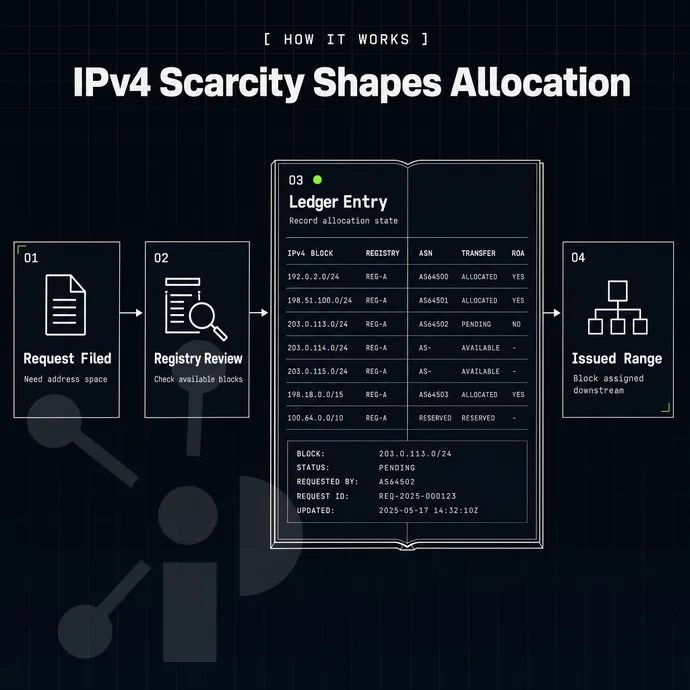
The Asia-Pacific's Regional Internet Registry, APNIC, manages IP addresses (including IPv4) and AS Numbers for 56 countries in the region. Understanding how APNIC today distributes blocks of IP addresses to organizations, requires understanding the fundamental change that took place in 2011. This shift has shaped how organizations in the region approach their network planning and infrastructure development strategies.
The pacific network information centre last /8 policy
APNIC’s general IPv4 pool was exhausted around 2011 and is now in the final /8 of IPv4 address space. According to the APNIC IPv4 policy for new member organisations, the only allocation from the reserved /8 pool available is a very small one-off allocation. The ceiling for new member organisations is this one small allocation, there are no exceptions for larger initial allocations of IPv4 space.
Existing members with a demonstrated need for additional IP addresses, such as those operating an autonomous system, can request further allocations under internet governance policy, which are assessed against their current holdings on a utilized basis.
Membership tiers and regional internet registries RIRs eligible resources
Members holding more resources will need to pay more for membership, but will gain access to the same amount of eligible Internet number resources as they would under existing policy. Membership does not grant additional IPv4 addresses above what is allowed by policy for each tier of membership.
Internet governance obligations, correct contact information and abuse case handling, apply to all members regardless of tier.
The secondary market as the real path forward
The free pool of IPv4 address space has been depleted and transfer of internet number resources, including IPv4 addresses and AS numbers (including legacy numbers), between organizations in the Asia-Pacific IP zone and other RIRs is now the primary way to obtain meaningful amounts of IPv4 address space in the region.
Prefixx manages the entire process of APNIC IP number transfers for you, including Tixx quality check on every block of IP numbers.
While the huge address block under APNIC management for IPv6 is freely allocated, for IPv4 the transfer market for new holdings in the Asia-Pacific region is the only realistic option.
After you have managed to get hold of a block of IP addresses through the transfer market, three different technical systems are responsible for the clean routing of the IP addresses across your service region and a good reputation of the IP addresses online. These systems are WHOIS, RPKI and reverse DNS and will be explained in more detail below. Autonomous systems use these technical frameworks to exchange routing information and maintain connectivity across the internet.
APNIC WHOIS, routing security, and reverse DNS
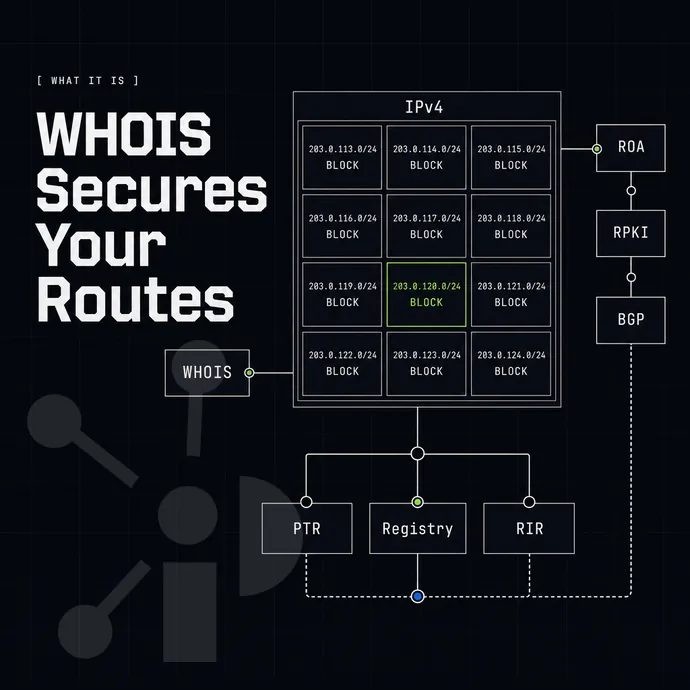
There are three main systems used to manage APNIC-held resources such as IP addresses and AS numbers: database services including a public WHOIS database, a routing security infrastructure, and reverse DNS delegations. These systems collectively ensure that internet number resources remain properly documented and accessible to network operators throughout the region.
The WHOIS database as an internet resource
APNIC holds the registration information for all the IP blocks and autonomous system numbers allocated in the Asia Pacific region. This information is contained in a public WHOIS directory where anyone can search for an Internet resource to find out who the registered holder is.
What their contact details are and whether or not the space has been allocated.
RPKI and route origin validation
A Resource public key infrastructure (RPKI) for each address block is tied to a Route Origin Authorization (ROA) that is signed cryptographically. A ROA for a prefix specifies the autonomous system (AS) that is allowed to originate that prefix. An upstream then can drop/flag announcements of a prefix that do not match the signed ROA for that prefix, thus protecting the overall internet infrastructure from route hijacking and leaks.
IRR route objects help to fill another hole.
Reverse DNS delegation
The reverse DNS zones for the APNIC address range are delegated. This means that the holder of a block can set up reverse DNS for his respective IP range by publishing a PTR record. Accurate reverse DNS is important for correct mail delivery, for abuse research and for reputation scoring with the rest of the internet community.
We prepare LOA, RPKI ROA, and IRR route objects for every deal we work. When you buy an APNIC Internet resource via Prefixx, the routing documents are handled end-to-end to ensure your new block announces cleanly on the very first day. We go through this all in the next section. Proper routing configuration is essential for network security and operational stability once the transfer completes.
Why Prefixx for asia pacific region IPv4 transfers
Prefixx is a registered broker with APNIC, ARIN and RIPE NCC. We broker inter-RIR transfers into and out of the Asia Pacific region. We handle all the registry steps for you, so you don’t have to worry about following APNIC’s policies and deadlines or about filling in paperwork.
- As part of our Tixx quality control, we verify the ownership, transfer eligibility, blacklisted status, and IP routing for every block before a deal is closed. APNIC IP address blocks arrive clean.
- All of our real estate transactions are Escrow-secured and we charge NO buyer fees. Sellers only pay a 3 to 8% commission on close of a transaction.
- White-glove routing paperwork included. Our team prepares LOA, RPKI ROA and IRR route objects for you to use with your address pool.
- BYOIP deployment support. We will deploy your acquired internet number resources on your preferred Netrouting bare metal host through our partner network.
- Senior consultants are engaged on every transaction with Senior Transaction Managers. This is not a self-serve online marketplace where clients can conduct all transactions online with automated approvals. Instead, a human conducts all transactions from sourcing to RIR approval.
To compare options or get a quote on APNIC IPv4 addresses, explore our transfer service or contact our team directly.
Frequently asked questions
How does APNIC manage each autonomous system and internet resource for networking?
APNIC, the Asia-Pacific Network Information Centre, is the Regional Internet Registry responsible for distributing and managing IP pool and border gateway protocol routing resources across the Asia-Pacific region. It allocates IPv4 and IPv6 addresses, ASNs, and related resources to network operators, ISPs, and enterprises in its territory. Like the other four RIRs, APNIC also maintains routing policy data, supports RPKI, and publishes Whois records for the resources it administers.
What are APNIC internet number resources and address pools?
The APNIC IP pool refers to the total inventory of IPv4 and IPv6 addresses that APNIC holds and distributes to members in its region. APNIC exhausted its free IPv4 pool in 2011, meaning no new IPv4 addresses are available through direct allocation from the registry.
Where is the APNIC foundation located?
It serves a large and diverse territory where APNIC manages IP addresses, autonomous system numbers, and other resources across the Asia Pacific region, covering economies from Japan and South Korea in the north to Australia and New Zealand in the south, and across Southeast Asia and the Pacific Islands. The registry APNIC serves member organizations by maintaining accurate records of resource allocations and facilitating policy-compliant transfers within its designated service area.
Can I transfer IPv4 addresses into the APNIC region from another RIR?
The process requires both source and destination network operators to meet their respective registry's transfer eligibility criteria, and the particular IP prefix block must pass routing and ownership checks before the transfer is approved. Operators must also ensure that routing authorization records are properly configured to prevent hijacking and maintain the block's reputation after transfer.
Working with a registered broker simplifies the process considerably.
While APNIC is responsible for the IP address policy and allocation in the Asia-Pacific region, the free pool of IP addresses ran out years ago. Secondary transfer of announced and used IP addresses on the market is the only option for current address needs.
To transfer one or more IP address prefixes to an organization, the relevant rules of APNIC, the body that registers internet number resources, the accurate representation of assigned addresses in the WHOIS database, the setup of RPKI reverse cohorts of issued addresses as well as general routing hygiene have to be fulfilled first.
Getting the small things right is important.
If you are buying, selling, or leasing APNIC address allocation, Prefixx handles the transfer paperwork, Tixx quality control, and white-glove routing setup end to end. Contact the team at Prefixx.net to get a vetted block matched to your requirements.
Contact us to discuss your IPv4 needs today
No hidden fees, free consult. A broker replies within one business day.