
By Savvas Bout, Founder of Prefixx. Last updated 10 November 2026.
One of the biggest decisions an IP address manager can make is the inter RIR move of large blocks of address space between different registries. With the open inter-RIR transfer corridors that exist today, such a move is operationally possible today that it wasn’t even a decade ago.
How do the different transfer policies of ARIN, RIPE NCC, APNIC and LACNIC translate to a matrix that is as permissive as possible for any given pair of registries? This article maps out all of the open corridors between the RIRs and lists out the policies of each.
The documentation required for any given inter RIR transfers process, and where the facilitated transfer can be of value to help facilitate a transfer that does not have a direct path currently. Preparing the required documents in advance can streamline the approval timeline at both the source and destination registries.
What open inter-rir transfer corridors mean for IPv4 addresses
An open inter-RIR transfer corridor is a formal channel agreed by a set of RIRs that enables the transfer of a /net block between two RIRs. The absence of such a corridor for intra RIR transfers would in most cases prevent the deal from happening regardless of the agreement between buyer and seller.
What is an inter-rir transfer corridor and why does it need to be open?
There are several ways to govern transfer of Internet number resources in a region. Each RIR typically governs a set of countries and employs a set of policies to manage Internet number resources within that geography. For a transfer of Internet number resources to be governed by more than one RIR, the policies of both RIRs must allow for such a transfer. When resources move from one region to another, the buyer's RIR must explicitly permit inbound transfers under its own policy framework.
Which corridors use one regional internet registry today
The American Registry for Internet Numbers (ARIN) has open corridors with RIPE NCC and APNIC. The RIPE NCC and APNIC also have direct transfer paths between each other.
The LACNIC and AFRINIC registries have not yet established reciprocal corridors with other RIRs, thus it is not currently possible to transfer IPv4 addresses held under the LACNIC or AFRINIC regimens to another RIR. Organizations holding space in ARIN, RIPE NCC, or APNIC can move resources among those three registries but cannot yet move to or from the other RIR regions.
- ARIN to RIPE NCC: open, bilaterally active.
- ARIN to APNIC: open, bilaterally active.
- RIPE NCC to APNIC: open, bilaterally active.
- LACNIC and AFRINIC: no open cross-registry corridors.
What this means for buyers and sellers of IPv4 addresses
Corridor status determines whether a deal is feasible even before you talk about price. Our consultants verify the corridor status at the onset of an inter-RIR consultation. Before you commit any block to a deal, it’s also good to get a feel for how inter-RIR transfer differs from intra-RIR transfer and get quote for the simpler of the two. Understanding the full scope of each transaction helps avoid surprises during the approval phase.
Intra-rir transfers vs inter-rir transfers: core differences
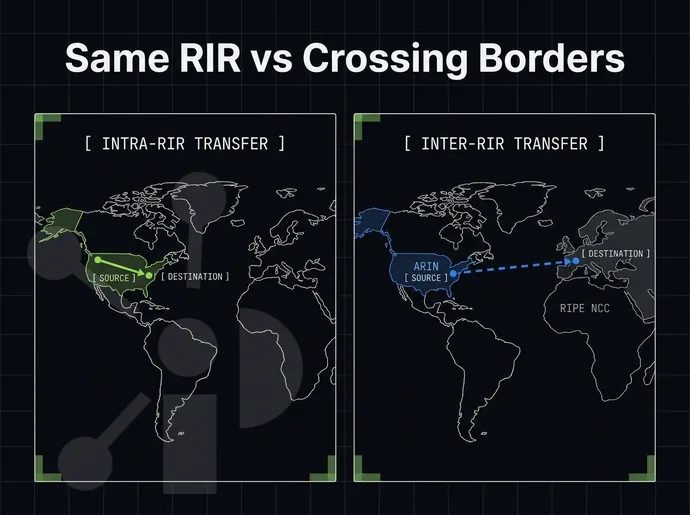
Note: All IPv4 address transfers are not created equal. Whether an organization is transferring IP space to another organization that is in the same registry as the transferring organization or in a different registry can impact the number of policy sets that apply, time to complete the transfer and required documentation.
The documentation burden also varies depending on whether the transferring organization must demonstrate utilization to one set of policies or prove need to both the source and destination registries, including verification that specified recipients meet eligibility criteria.
Intra-regional internet registry transfers: one registry, one rulebook
Intra-RIR transfers are between a buyer and a seller who are both within the same RIR. Such a transfer is processed by only one registry (the one of the seller) and thus subject to the one pricing structure, one eligibility check and one transfer policy of that registry.
Normally such a transfer is processed faster than a cross-registry transfer because there is no need for coordination between the two registries involved in a cross-registry transfer. A single RIR handles the entire process from eligibility verification through final approval, streamlining the administrative workflow.
Most internet number resource transactions take place as intra-RIR transfer s within ARIN, RIPE NCC or APNIC. The legacy status of a resource as well as its block history typically does not lead to disputes about the interpretation of policies as both parties are under the control of the same RIR.
Inter-rir transfers: navigating open corridors
If buyer and seller are in different registries, both seller's and buyer's RIRs need to agree on the move. Each applies its own rules on what is eligible for intra RIR transfers and thus the same block of IP numbers needs to comply with both of them. The buyer's RIR will evaluate whether the recipient meets its eligibility criteria and whether the block satisfies its transfer policy requirements.
Block size and address space history can make for a complicated set of requirements for resources that are legacy in nature. Even for cross-registry moves, additional agreements may be required in not all corridors. Resources that fall under legacy space classifications often require careful evaluation of their historical registration status and compliance with current transfer eligibility criteria.
Which rir-to-rir corridors are currently open for IPv4 transfers?
Open inter-RIR transfer corridors as of 2026 are: ARIN-to-RIPE NCC, RIPE NCC-to-ARIN, ARIN-to-APNIC, APNIC-to-ARIN, RIPE NCC-to-APNIC, and APNIC-to-RIPE NCC. LACNIC transfer facilitated but not registered. AFRINIC is not a participant in inter-RIR transfers. Prefixx handles IP address space moves for all open transfer corridors and does LACNIC deals for you.
| Dimension | Intra-RIR | Inter-RIR |
|---|---|---|
| Registries involved | One | Two |
| Policy sets | Single registry rules | Both registries must approve |
| Typical timeline | Days to a few weeks | Weeks to several months |
| Documentation burden | Standard eligibility forms | Dual eligibility, legacy agreements |
| Fee schedule exposure | One registry's fees | Fees from both registries |
Same RIR, follow the intra-RIR process. Different RIRs, verify the relevant corridor is open prior to setting a timeline to complete. Prefixx handles the dual-registry coordination in full and facilitates the relevant paperwork for both parties. Organizations should initiate the verification process early in their planning cycle to avoid delays once purchase agreements are signed.
Which inter-rir corridors are open today
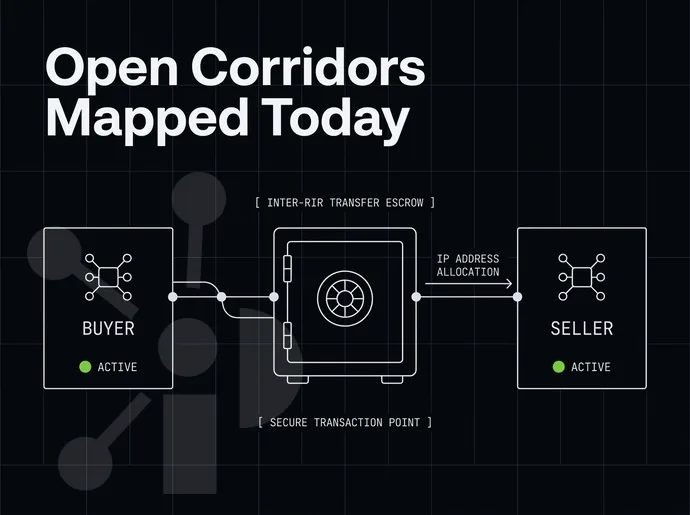
Note that not all registry pairs have open transfer corridors between them. This map illustrates the current intra RIR transfers and transfer corridors between all pairs of registries, outlines the relevant policy and restrictions applying to each corridor. Additionally, the recipient organization needs to be consulted prior to purchasing a block in order to verify the availability of the relevant transfer corridors.
Open inter-rir corridors at a glance
- ARIN to RIPE NCC (bidirectional). This inter-RIR transfer is governed by ARIN policy 8.4 and corresponding RIPE NCC policy. Either RIR can be the ‘sending’ and ‘receiving’ RIR for this inter-RIR transfer. There is no needs-basis for the RIPE NCC in these cases, but recipient must meet the requirements of ARIN’s RSA or LRSA policies.
- ARIN to APNIC (bidirectional). This policy has been accepted by both ARIN and APNIC and has corresponding policy in place. Needs-basis for specified transfers into the ARIN region.
- RIPE NCC to APNIC (bidirectional). Fully open with no needs-basis on either side of the corridor. This is typically the fastest route for Asia-Pacific buyers purchasing from European markets across the RIRs.
- LACNIC (facilitated only): There is no ratified outbound transfer policy in place for LACNIC. Moves to Latin America are facilitated on a case-by-case basis, and recipients must meet internal criteria for the moves. This process typically takes longer and is less certain than other regions.
- AFRINIC (restricted): Most outbound transfers from AFRINIC have been suspended by the organization while they work through some internal governance matters. Blocks coming from AFRINIC should for now be treated as transfer-ineligible until the registry indicates otherwise.
Note: RIR transfers always require both registries to agree. If either side has not ratified a compatible policy, the corridor is closed regardless of what the seller tells you. Once both registries confirm policy alignment, the transfer can proceed through the standard approval workflow at each RIR.
How long do inter-rir transfers typically take?
It will take 4 to 8 weeks to open the three fully open corridors.
Registry review queues, document completeness and whether a block is marked as legacy influence the clock. We manage all the paperwork end to end to avoid any form of delay due to missing documents.
Where Prefixx fits in inter-rir transfers
The IP space is registered with ARIN, RIPE NCC, APNIC, and LACNIC. We facilitate LACNIC transfers. Prior to listing IP space on Tixx, all space listed goes through Tixx QC to verify transfer eligibility. After a corridor has been confirmed for transfer, each registry must satisfy the pre-approval requirements for that registry.
The proposed transfer process step by step inter-rir
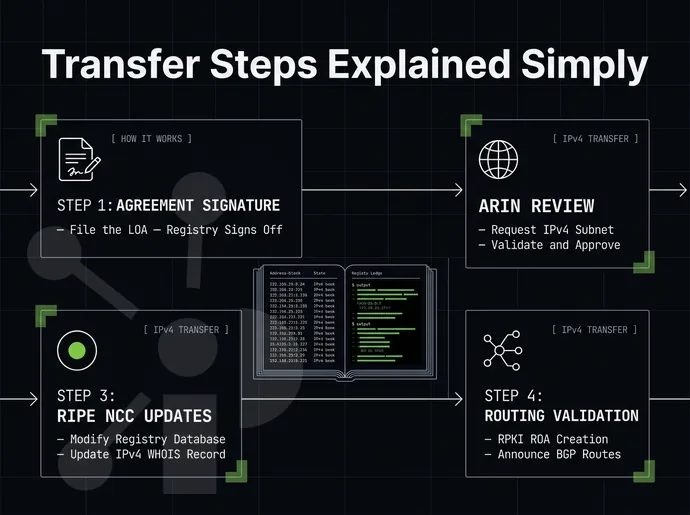
Inter-RIR space transfers are between registries for the customer’s space. These can take several weeks from agreement signature to full routing propagation, as opposed to days within a single registry. Routing propagation depends on how quickly the receiving organization updates its network configuration to advertise the transferred space.
Asset purchase agreement and deal initiation
The agreement for an asset purchase is a contract between the seller and buyer for the purchase and sale of assets. The source organization then submits a transfer request to the home RIR of the organization, including a copy of the agreement as well as any required justification for the transfer. The justification documentation must demonstrate the recipient's operational need for the addresses being acquired under the transfer.
What pre approval steps does the receiving RIR require?
A needs assessment of the destination organization must be met prior to transfer. For the ARIN-approved transfer, the receiving organization must have an approved resource request on file with ARIN. For the RIPE NCC approved transfer (covering Europe and the Middle East), a buyer must either have an active LIR membership or be sponsored by a currently active LIR.
Both parties then coordinate within their respective registries. A block is removed from a seller’s registry only after both parties have approved. The new holder must satisfy all eligibility requirements of the destination RIR before the source RIR will release the block.
Routing paperwork for the recipient organization
As the transferred resources appear in the buyer’s RIR record, all their routing objects must be updated. We’ll prepare LOA, RPKI ROA and the IRR route objects for the buyer as part of our white-glove service. With intra RIR transfers, the resource holder can then immediately and correctly announce the entire block of resources, without any breaks in the resources' routing hygiene. Next, the buyer must familiarize himself with the obligatory fees for each of the registries.
RIR fees, annual fees and the fee schedule across corridors
Each RIR charges for independent services and corresponding cost structures at the receiving registry may differ significantly from those left behind. Cross-registry moves should be modeled for both the one-time charge for transfer and the subsequent annual charge at the receiving registry.
What each regional internet registry charges for internet number resources
regional registry fees are typically charged in three different layers: a membership/registration fee at the receiving RIR, a transfer processing fee for the transfer itself. Additionally, The annual fee for a block of IP addresses at the receiving RIR. Each RIR charges fees for these layers at different rates.
| Registry | Membership model | Transfer processing charge | Ongoing cost basis |
|---|---|---|---|
| ARIN | Registration services plan; tiered by resource size | Specified transfer fee per request | Annual registration service plan renewal |
| RIPE NCC | LIR membership or PI sponsorship | No separate transfer processing charge | Annual LIR membership or per-object sponsorship |
| APNIC | Member category based on holdings | Included in membership | Annual membership scaled to resource size |
| LACNIC | Member category by resource size | LACNIC requires a formal membership before it will process an inbound transfer | Annual membership renewal |
| AFRINIC | Member category by resource size | Varies; inbound transfers subject to policy review | Annual membership renewal |
Do I pay fees to both registries in an inter-rir transfer?
Most registrars charge a nominal release or block fee for inter RIR transfers (an administrative/processing charge), and the acquiring registrar will typically charge for enrollment/membership in their own registry. For inter RIR transfers, the charges of both registrars need to be determined by the current policy of both parties and should be communicated in advance of any purchase agreement being executed. The seller's RIR may impose its own release requirements or documentation standards that must be satisfied before the transfer can proceed.
How to model the total cost before committing
Add a one-time transfer charge to the first year membership for the destination registry. Then multiply the annual membership fee for the new registry by your projected holding period. A large block of names transferred to a more expensive registry of records will have the recurring fee exceed the one-time transfer charge within the first year.
We charge zero buyer charges on address space and our commission on sellers of domain name space is a seller-only commission of 3 to 8% of the sale price for such space.
Our commission structure and the cost to the buyer to source and close an inter RIR block of domain name space through us is zero. In addition to the fees charged by Prefixx the cost of domain name space varies by registry.
How block size and ARIN region move IPv4 address pricing across corridors
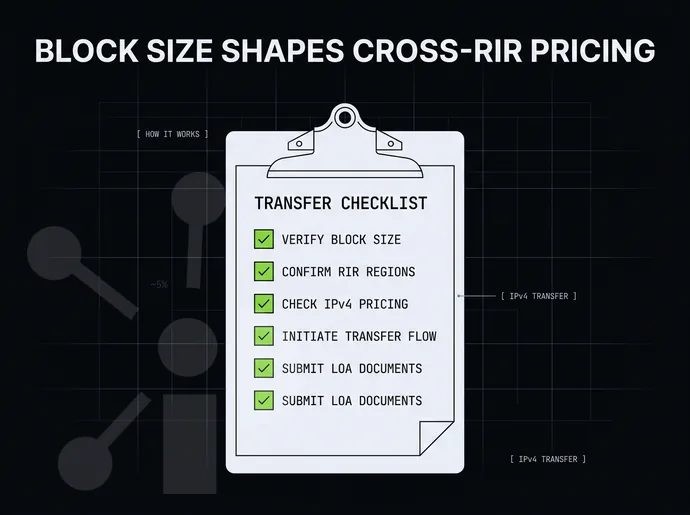
Pricing for IPv4 space across inter RIR transfers and the different regional Internet registries (RIRs) is not equally priced for equally sized blocks of space.
While a /24 of IPv4 space may sell for the same price whether purchased directly from ARIN space or from RIPE NCC held space, the latter will often sell for higher effective prices in the inter-RIR transfer market than the former. (Neither ARIN nor RIPE publishes a current effective price for IPv4 space it sells.) Understanding what drives those gaps helps buyers decide whether an inter-RIR transfer is worth pursuing.
Mapping regional internet registry demand and block size
- There are no free pools of IPv4 addresses left in the 5 RIRs. All free pools were depleted between 2011 and 2020. All IPv4 addresses are now sold as secondary market products. The supply of IPv4 addresses is limited. Regional scarcity is the lowest price.
- Review rates for the various routes. Historically addresses in the ARIN space have commanded a premium over RIPE NCC addresses with the APNIC space sitting in its own demand curve. If one plans to launch in a space where there is simply cheaper supply (e.g. in their region) they can look to complete an inter-RIR transfer to take advantage of said cheaper rates.
- Larger prefixes have a lower per address rate than smaller ones, so if you need to scale up then purchasing a single large block as opposed to several smaller ones can work out cheaper per IP address.
Address space and routing hygiene for recipient organization
- First audit the block in question. Value can be affected by a number of factors including the reputation of the sender, the sender’s status on the Tixx blacklist, and the block’s routing history. Tixx by Prefixx performs a full audit of the block to confirm the block’s ownership. The block’s transferability and also completes a full audit of the block’s routing history to verify full routing hygiene before approving the block for the deal.
- Check if both RIRs involved accept the transfer type. Each of the RIRs (ARIN, RIPE NCC, APNIC) has its own policies for inter-RIR transfers, not all corridors are open in both directions. Check if you are eligible for a transfer as early as possible.
What happens to my RPKI ROA and IRR records after an inter-rir transfer?
The receiving RIR becomes the RIR of record for the new block of IP numbers. All existing RPKI ROAs originally issued by the source RIR must be withdrawn and reissued as new ROAs under the receiving RIR’s RPKI repository. In addition, all corresponding IRR route objects originally registered with the source RIR must also be withdrawn and registered with the receiving RIR’s IRR.
As part of the data transfer process, Prefixx creates LOA, RPKI ROA and IRR route objects to continue routing in the meantime. Route objects are published to the ripe database or other appropriate routing registries to ensure global reachability during the transition period.
Note: Leaving a stale ROA in place after transfer creates an RPKI-invalid state. Downstream networks that enforce ROV will drop your prefixes until the old inter RIR record is removed and the new one is published. The routing hygiene work doesn't stop there, geolocation databases need realignment too.
Geolocation, RPKI and routing hygiene after an inter-rir transfer request
After the transfer of the registry is complete, three operational layers need to be aligned: RPKI, IRR route objects and geolocation databases. Each recipient entity has its own update cycle, and differences in those update cycles create potential problems with routing and deliverability.
RPKI ROA reissuance under the new trust anchor
Each RIR operates its own set of RPKI trust anchors. Therefore when a block of IP numbers is transferred from one RIR to another (e.g. from ARIN to RIPE NCC), the existing ROA(s) signed with the trust anchor of ARIN will become invalid. The seller's RIR will revoke the original ROA as part of the transfer process, ensuring the cryptographic material no longer validates under the old trust anchor.
Until the holder of the newly transferred block of numbers, whether through standard or inter RIR transfers, has created new ROA(s) and they have propagated through the RPKI infrastructure and have become invalid (i.e. before they have been revoked), it is safer for the recipient organization to allow the old ROA(s) to be invalid for some time rather than have a gap without any invalid ROA(s).
IRR route objects must receive the same treatment as the authoritative object in the RIPE database. Stale information in the source registry can cause IRR-filtered peers to silently reject the prefix.
Geolocation lag and the rfc 8805 geofeed path
The geolocation databases such as MaxMind, IP2Location, DB-IP and ipinfo.io extract location information from detailed records, including data on inter RIR transfers, that are updated on their own ingestion schedules. So a block that has been transferred several weeks ago can still show a wrong country.
Using RFC 8805 geofeeds is the fastest way to make corrections.
Legacy status and what it means for routing hygiene
Resources with legacy blocks need special treatment. Legacy resources were assigned before the modern RIR system was put into place. Their internet number records might not contain all the contact and maintainer objects that automated validation tools for new RIR resources expect.
Verify that all objects for a transfer have been made complete before the transfer is closed to avoid routing failures after the transfer. Ensuring that all required objects and contact information are present in the resource records prevents validation failures when the transfer documents are processed by the receiving RIR.
Prefixx covers all layers for any transaction, LOA, RPKI ROA, IRR route objects, geolocation fix-up, reverse DNS etc. All work post-transfer is clearly described in the inter RIR process and thus business cases are clearly defined whether or not to spend time on a transfer.
Common reasons organizations pursue inter-rir transfers
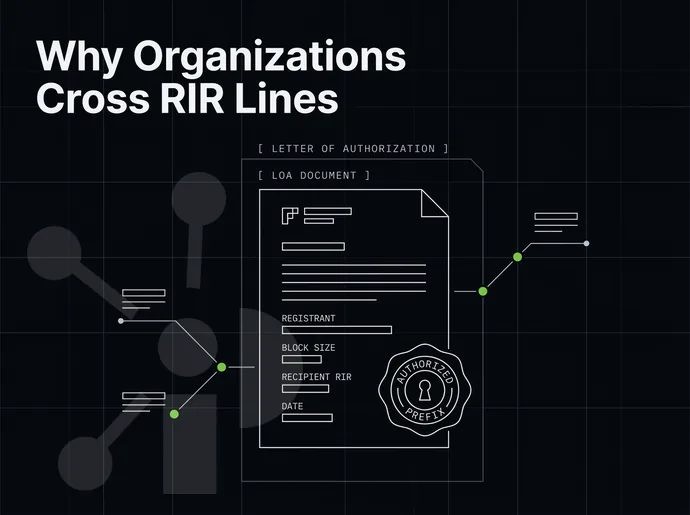
Most inter-RIR transfers are not made voluntarily by organizations, but rather as a consequence of their business having moved, changed supply options. Alternatively, Their administration having moved and the addresses for their organization being registered in a location that is no longer relevant. Organizations may find that their operational footprint no longer aligns with the service region of their current RIR, prompting a reassessment of where their address space should be registered.
Geographic expansion and routing preference
A North American headquartered company opened an office in Europe and found that its ARIN allocated IP space caused inter RIR routing problems. IP space registered with the RIPE NCC with local ISPs and cloud providers is generally routed more predictably within a given service region. In this case it made sense to transfer the block to register the space with the correct registration authority.
The same reasoning would apply to Asia-Pacific expansion. IP space registered with APNIC, complete documentation and all, would have better routing credibility in the region than IP space registered with ARIN. Organizations expanding operations into a new service region often find that locally registered address space simplifies peering arrangements and reduces latency for end users.
Supply and demand across registries
In most cases available IP inventory will be hosted with a different RIR than that of the buyer. Thus a Latin America operator looking to buy a /20 may find better priced stock with RIPE NCC or APNIC. Each registry has its own policy for IP number transfers, and these are determined by the seller’s RIR.
Our consultants map the corridors prior to a deal being advanced in order to avoid a buyer purchasing a block that cannot legally transfer through registries. This pre-qualification step ensures the intended recipient can satisfy all policy requirements before resources are committed.
Pre approval steps for consolidation after acquisitions
An acquirer that is already registered under a different RIR than the target company can inherit all the addresses of the target company under the current RIR of the acquired entity. The acquiring entity may later elect to consolidate holdings by moving inherited blocks to align with its primary registration, though such moves require evaluating whether the other RIR's policies and transfer corridors permit the consolidation.
Consolidating all IP addresses under one registry simplifies several tasks, including the renewal of IP address space, handling of abuse cases and changes to the routing policy. While such a transfer is only worth the effort for administrative reasons, there are several scenarios in which a transfer of IP addresses takes place. Organizations managing address space across multiple registries often find that aligning all holdings under a single authority reduces the complexity of coordinating policy updates when each other RIR maintains distinct procedural requirements.
Why Prefixx excels at inter RIR transfers
Prefixx has been brokering inter-RIR transfers since 2018, registered with ARIN, RIPE NCC and APNIC, with LACNIC facilitated. Every deal we handle crosses the full inter-RIR transfer corridor, from source organization to recipient organization, with our team managing the paperwork at both registries.
- We run quality control on every block before any transfer request is processed. This includes checking for valid ownership and transfer eligibility, as well as checking blacklists, routing for validity and the RIR for status. We don’t want any surprises after the APA has been signed.
- Escrow-secured transactions. We keep the funds in escrow until the transferred resources have arrived at the destination RIR. The buyer and seller are never exposed to each other.
- No buyer fees, our fees are for sellers only. A commission of 3% to 8% for sellers is all. The buyers pay nothing.
- We handle all the white-glove routing paperwork for you, preparing the LOA, RPKI ROA and IRR route objects for the seller’s and buyer’s RIRs.
- Senior consultants, multilingual, human-in-the-loop for all transfer related matters across the five RIR regions. No ticket queues, no self-serve portals.
If you are ready to initiate an inter-RIR transfer or want to understand what the process involves for your specific region, contact our team for a no-obligation assessment.
Key takeaways: inter-rir and intra-rir transfers at a glance
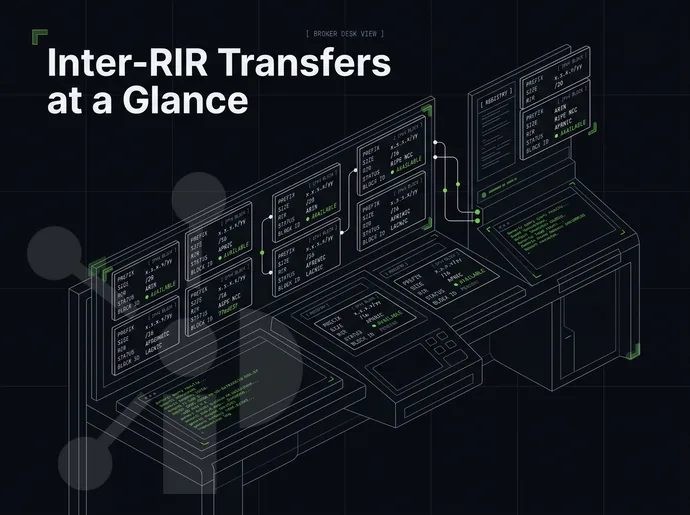
Inter-RIR transfers move IP addresses between two separate registries, each enforcing its own policies. Intra-RIR transfers stay within the same RIR, which simplifies coordination but still demands a complete transfer request, verified documentation, and pre-approval from the source organization's registry. Open inter-RIR transfer corridors exist only where both RIRs have signed bilateral agreements, so confirming corridor status before any asset purchase agreement is signed is essential.
Realistic timelines run several weeks once the RIRs involved begin processing. After the transfer completes, the recipient organization must update routing objects, request RPKI ROAs, and correct geolocation records. Prefixx handles every one of those post-transfer steps as part of its white-glove service, so the transferred resources are operationally ready from day one.
Inter-RIR transfers open up the entire secondary market, not just the registry where your organization is already registered. The corridor you can use, the pre-approval your RIR requires, and the transfer timeline all vary enough that planning ahead is not optional. A block that clears ARIN policy may still need RIPE NCC membership paperwork, a needs justification, or an APNIC resource review before the transfer can proceed.
The practical takeaway for inter RIR transfers is straightforward: match the block to the corridor first, then work backward through each registry's requirements. Skipping that step is the most common reason deals stall mid-transfer.
If you are sourcing a block across registries or moving space to a new region, Prefixx handles inter-RIR transfers across ARIN, RIPE NCC, APNIC and facilitated LACNIC deals end to end.
Contact us to discuss your IPv4 needs today
No hidden fees, free consult. A broker replies within one business day.