
By Savvas Bout, Founder of Prefixx. Last updated 21 October 2026.
You don’t want to inherit a spammy reputation, blocked prefixes and BGP rejected announcements when buying or leasing a /24. A simple IPv4 block quality check is not optional, it will make a huge difference between a clean routing from day one and a few weeks of delisting hell with a bad block.
There is no central entity publishing condition reports in the secondary market. Thus, there is no requirement for sellers to report items such as blacklist violations, RPKI failures, or disputes over ownership.
This guide goes through what a comprehensive quality check actually looks at (i.e. ownership/RIRs, routing, RPKI/IRR, blacklisted etc. with a focus on what the results actually mean), what the results of a quality check mean (i.e. are the problems with a resource recoverable or not?), and how you can perform a structured pre-transfer quality check on resources.
What an IPv4 block quality check actually covers
A quality check for a IPv4 address block is typically done before it is sold on the secondary market. As every IP address has a history, this history is also transferred with the block of IP addresses in the secondary market.
RIR registration and transfer eligibility
The check verifies if the IPv4 address in question is properly registered with the right organization and if there are no liens, disputes or policy holds that would prevent a transfer of an IPv4 address. An unresolvable WHOIS record kills a deal.
Blacklist and reputation status
Spam, abuse and phishy IP addresses accumulate with every previous operator of a IP address. In a thorough check the block is checked against major DNSBLs like Spamhaus ZEN and CBL and all active listings are flagged for the buyer’s convenience before they become his problem.
Routing hygiene and geolocation accuracy
RPKI ROAs and IRR route objects must origin from the announced origin ASN, otherwise they will be route filtered by your upstreams.
Step 1: verify RIR registration and ownership
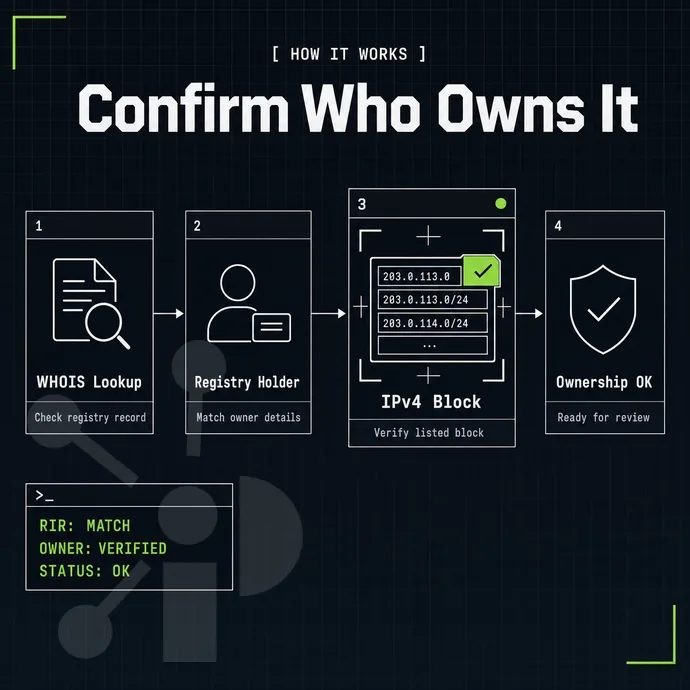
For every block listed in the secondary market, we start with a WHOIS lookup to confirm the registry holder of record. ARIN’s free pool has long since been depleted, and the RIR now only processes transfers for number blocks, so this is the first quality check for any potential buyer.
What a clean record looks like
A healthy registration should have a current org record, a matching network record, and up-to-date contact information for the past few years. The RIR (e.g. ARIN for North America, RIPE NCC for Europe and the Middle East, APNIC for Asia-Pacific) can also confirm jurisdiction.
Red flags to catch early
Stale or missing org contacts for a customer, disputed legacy IP spaces with no RSA or LRSA on file for a customer. Additionally, Network objects that don’t match announced IP prefixes for a customer are all considered hard stops. A discrepancy between a WHOIS record and a router’s origin information indicates a problem.
Why registry identity affects valuation
A /24 registered under ARIN can trade at very different prices than an identically sized block of IP registered under RIPE NCC in the same month. So verifying which registry holds the IP address record is crucial to ensure both that transfer is compliant and that you get the best price before you buy.
As part of our pre-sale quality control process Tixx verifies the current ownership of a IP block as well as the transfer eligibility for a given IP block.
Step 3: audit routing hygiene (RPKI, IRR and BGP)
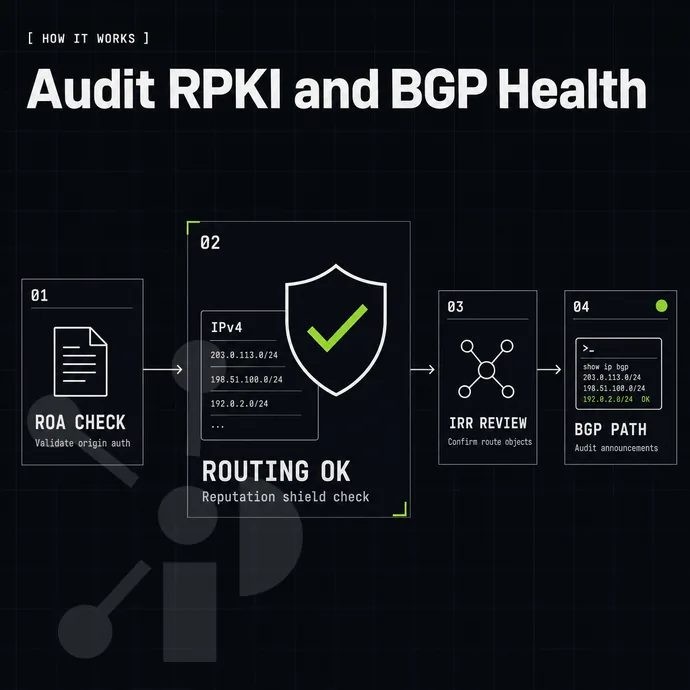
After a block of IP space has been transferred, routing hygiene is often more important than a poor reputation score and the records at a RIR. Three important signals are RPKI ROA validity, IRR route objects and BGP announcements.
RPKI ROA validity
Route Origin Authorizations (ROA) are cryptographically signed statements that assert a prefix is originated by a given origin ASN and that the maximum number of prefixes signed by that ASN is greater than or equal to the number of prefixes in a block.
A NOT_FOUND error means that there is no ROA for the announced prefix. While most networks today will announce NOT_FOUNDs (in most cases without incident), RPKI-enforcing upstreams will silently drop traffic from announceer running with a RPKI-invalid drop policy if they find an Invalid ROA for an announced origin ASN or prefix length.
IRR route objects
Most countries have Internet Routing Registries (IRRs) like ARIN, RIPE, RADB, etc. that hold route objects that list the ASNs that are allowed to originate a particular prefix. Large transit providers typically build their prefix-filter lists from IRR data.
Thus, a route object for a particular prefix that is missing or outdated will cause announced prefixes of that given to be filtered by upstreams, regardless of the RPKI status.
BGP visibility
Even a clean ROA and a valid IRR entry do not necessarily mean a prefix is actually routed. RIPEstat provides a plethora of information about a prefix, such as whether it is announced in the global routing table. This ASN is announcing it and whether this ASN matches the IRR/RPKI information of the registry where the prefix is registered.
A prefix that has never been announced before or that has been withdrawn years ago often contains outdated or even conflicting information in the registry.
Why choose Prefixx for IPv4 block quality checks
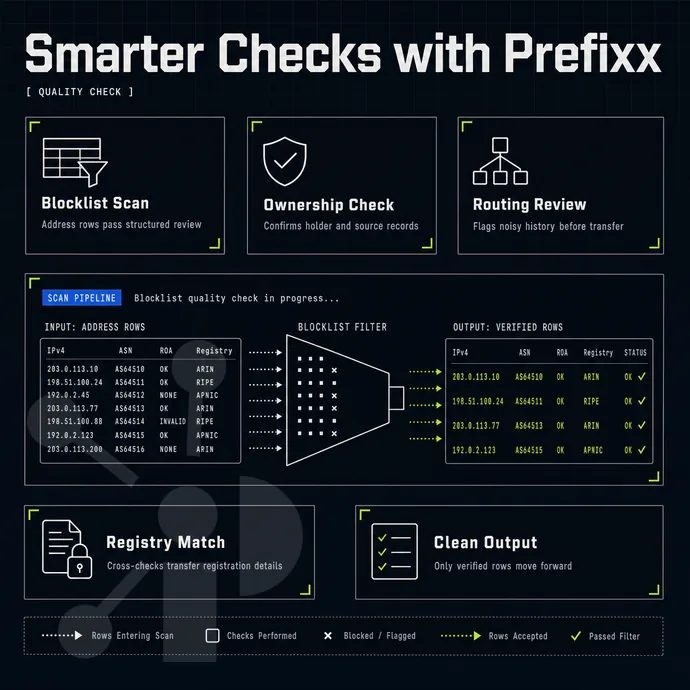
Every IP address block we handle goes through Tixx by Prefixx, our structured pre-sale quality check. Tixx verifies ownership, confirms transfer eligibility, scans blacklists, and reviews routing hygiene, producing a health report and transfer-readiness score before any block reaches a buyer.
- Zero buyer fees. Seller-only commission of 3 to 8%, no win no fee.
- Registered broker with ARIN, RIPE NCC and APNIC; LACNIC facilitated.
- Every lease includes white-glove service: geolocation correction, reverse DNS, reputation monitoring and abuse complaint handling.
- Client portal covers BGP monitoring, 12-DNSBL reputation scanning, geolocation tools and rDNS management after transfer.
If IPv4 address quality matters to your deployment, speak with our team. We broker vetted blocks across all RIR regions and manage every IP address through transfer and beyond.
A quality check on any IPv4 block comes down to four things: clean RIR registration.
Prefixx runs every block through Tixx before it reaches a buyer. Tixx covers ownership, blacklist status across 12 DNSBLs, RPKI validity, IRR consistency, and RIR transfer readiness, producing a health report and a transfer readiness score.
The white-glove team then handles the LOA, RPKI ROAs, and IRR route objects on your behalf. If you have a block in mind or want to see the Tixx report before committing, reach out to Prefixx and get a full quality assessment before you sign anything.
Contact us to discuss your IPv4 needs today
No hidden fees, free consult. A broker replies within one business day.