
By Savvas Bout, Founder of Prefixx. Last updated 14 October 2026.
Even when all other aspects of a transfer are binding, a lien on an IPv4 address block can tank the deal entirely.
Since the RIRs maintain no lien registry, all such risk falls on the buyer.
This article will detail how IPv4 liens occur, how different registry regions treat IPv4 liens. What a complete pre-transfer due diligence search looks for, and how in addition to searching for liens and network blocks, quality control for owner and transfer eligibility can be done before a purchase, lease.
What is a special purpose address registry lien on an IPv4 block?
In common property law, a lien is a claim by a creditor against real or personal property, including allocated blocks of land or assets, which will prevent the transfer of that property until the lien is satisfied. Note that this does not apply to IPv4 address space, but analogous encumbrances do exist.
What the IETF and the regional internet registries can and cannot grant
A regional internet registry does not confer any legal ownership of a number range. All a registry does with a number range is record a particular party’s right to use that range and to cause that range to be routed.
A range can be seized by a court as the assets of a defunct company, but IANA considerations and a given registry's policies determine whether a given range can be moved to a new registrant. The internet engineering task force publishes standards that define how routing announcements work, but those technical protocols do not determine who may announce a given prefix.
Address space of a company in insolvency is gray. The question shows considerable research on part of the buyer's counsel: Is the block free to transfer or does a trustee hold it out for transfer? Insolvency proceedings affecting companies holding address space introduce uncertainty that can delay or prevent transfers entirely.
How encumbrances attach to IPv4 IP address blocks
Several situations create functional holds on a block:
- A bankruptcy trustee can freeze all of a company’s assets including the space at a registered address.
- The secured lender’s agreement lists the IP addresses as collateral and has traffic routed through multiple networks to maximize returns for the lender.
- RIR approval for a transfer is blocked by a destination address dispute until resolved.
There is no UDRP-style fast-track process for addressing disputes over address space. Holds on address space can take months. Registries typically do not show activity logs or dispute timelines publicly, leaving buyers unable to assess how long a hold has been in effect.
What this document describes for buyers
This document outlines the ‘due-diligence gap’ that surprises property buyers.
Understanding the anomalies that appear in this graph requires a brief discussion of how address space is allocated in the first place. The allocation timeline became particularly significant after regional exhaustion date milestones were reached, fundamentally altering how blocks could be obtained.
Normative references: RIR policies that govern block transfers
RIR transfer policies for IPv4 address space are the closest thing to a formal lien framework.
Normative references for regional internet registries
- Check the Governing Policy Document. The Transfer Policy is published by each registry for their respective domain name space. These are the normative documents against which all transactions will be measured. Contracts and LOAs etc. will be secondary to the governing transfer policy of the relevant registry.
- Check for needs-basis requirements. For ARIN and APNIC transfers, the recipient must provide a justification for the space requested. The space cannot be transferred if the receiving organization does not have a valid operational need for the space. For RIPE NCC members, the space can be transferred without needs assessment.
- Cooling-off periods: The 12-month hold imposed by ARIN after a transfer of IP address space before that space can be moved again by the new holder. Intended to prevent speculative flips of IP address space, this creates a hard barrier on future use of that space for resale after a period of time.
Network working group IANA considerations
- This post discusses the global policy layer. IANA delegated address space to the 5 RIRs under a single global policy. Each RIR then delegated downward. The date of exhaustion of IANA’s free pool has already passed. All subsequent transfers will thus take place on the secondary market.
- Inter-RIR transfers between map related groups and cross-registry rules. For Inter-RIR transfers between related groups of registries (e.g. ARIN-to-RIPE NCC transfers), each registry must confirm eligibility prior to a block being transferred.
Note: A registry can freeze a transfer if the block carries an active dispute, an unpaid membership fee, or a policy violation. Tixx checks for these conditions on every block Prefixx handles before a deal proceeds.
Freezes on IP address space are not caused solely by registry policy. Additionally, holds on IP address space by Courts and bankruptcy trustees can occur without warning from the registry.
Informative references: court orders, bankruptcy, and creditor claims on address space
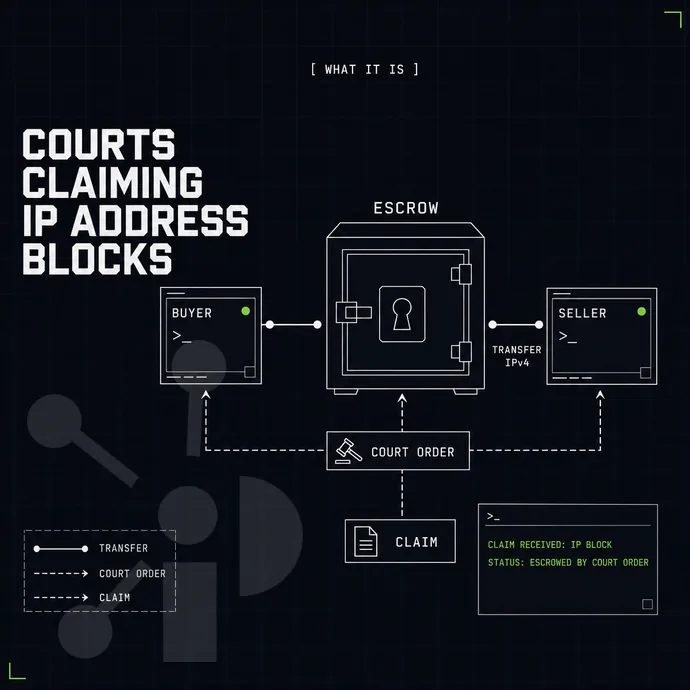
The growing number of court decisions treating internet number resources as tangible property significantly affects the transfer of IP address space.
Court treatment of IPv4 address space blocks and informative references
The most frequently cited case in the area of auctions of Internet number resources is Microsoft Corporation v. Here a bankruptcy trustee of Nortel’s estate conducted an auction of all of Nortel’s allocated and unallocated blocks of Internet number resources as assets of the Nortel estate. The trustee treated the allocated blocks as tangible assets of the estate, much like any other internet numbers held by the corporation at the time of insolvency.
While ARIN filed an amicus brief in the case asserting that Internet number resources were not property but rather a contractual license, the court proceeded with the sale, thereby leaving the critical issue of whether Internet number resources are property or not for another day.
How a lien freezes a block at the RIR
When a judgment is entered against a person, that person can be served by the judgment creditor with a notice to address a registry for an administrative hold. While such a hold is in place, the RIR will not process transfer requests for future use or any other purpose across the entire range of the block in question (not just individual addresses). The hold applies uniformly to the whole range, preventing any subset from being carved out or transferred independently.
As this document describes, large legacy allocations held by a single organization (that have no modern RSA and thus sit outside of normal self identification checks) are particularly affected by this circumstance. The absence of a Registration Services Agreement means these legacy blocks held by single organizations lack the contractual framework that would otherwise require regular attestation and contact verification.
Internet engineering task force impact on number transactions
Tixx, Prefixx's pre-sale quality control layer, checks the RIR standing of a Block and flags any transfer restrictions or future use limitations prior to the Block being sold to a Buyer.
A Tixx report that indicates a Block is clear of any known holds does not necessarily mean that there will never be a claim made against the Block in the future. Buyers who engage Tixx early in the acquisition process can better manage the timeline and avoid surprises that might otherwise delay or derail the transaction.
However, it does provide assurance that there are no known holds against the Block at the time of sale. A title search should also be conducted to determine if a Block is covered by a UCC financing statement as collateral.
In addition, settlement via escrow ensures that all funds are released by the Buyer only when the relevant registry or registries have confirmed, in line with internet standards, that the transfer is clear. Buyers should treat security considerations as part of the same operational review that examines registry holds and financing encumbrances.
These restrictions include legal and policy holds, but also other, even protocol-based restrictions on blocks that cannot be removed by any transfer, regardless of any court order or internet registry decision. Protocol-based restrictions often stem from the technical characteristics of certain address blocks, such as those reserved for documentation or private use under established RFCs.
Clearing a lien before you buy IPv4 addresses
We show you the history of every IPv4 address block. Liens on IPv4 address blocks, unresolved RPKI ROAs, dirty IRR route objects, or even a seller in bankruptcy, Prefixx uncovers who the current owner of a block is before you buy it.
- For every block of IPs we perform WHOIS audits on the appropriate internet registry, verify RPKI ROAs, inspect IRR route objects and perform scans against the major DNSBLs. For each block of IPs we provide a health report and transfer readiness score.
- Escrow-secured transactions: All payments are held in escrow until the RIR confirms the transfer of the IP. No clean block, no release.
- No buyer fees, we are a seller-only commission broker, and Prefixx charges nothing to buyers.
- Our consultants complete the white-glove routing paperwork. This includes completing a Letter of Authorization (LOA), preparing an RPKI ROA and fully populating the IRR route objects. Your space routes perfectly on the global internet from day one.
- IP Address Space is registered with ARIN, RIPE NCC, and APNIC. We can perform inter-RIR transfers as well as assist with LACNIC facilitated IP address transfers from end to end.
If you are ready to acquire vetted IPv4 address block s with full due diligence handled for you, visit our buy IPv4 addresses page or reach out to our team to discuss your requirements.
Network working group frequently asked questions
Can creditors lien IPv4 blocks, including limited broadcast ranges, managed by RIRs?
In theory, yes, but enforcement is complicated. Courts in several jurisdictions have treated IPv4 allocations as property interests capable of being encumbered, and the question shows research effort when examining cases where a company has pledged its network assets as collateral. The practical problem is that RIRs, unlike domain name registrars, do not link local lien records to their WHOIS databases, so a lien exists in a legal document but leaves no visible mark on the registry record. A buyer or lender relying on WHOIS alone will not see it. The same enforcement gap exists for domain names, where registrars maintain transfer locks but do not systematically cross-reference UCC filings or court judgments.
Do regional internet registries treat public IPv4 internet access space as encumberable property?
No RIR recognizes IPv4 allocations as property in the traditional legal sense. ARIN, RIPE NCC, APNIC, LACNIC, and AFRINIC each publish policies stating that address space is a registry resource, not an asset owned by the holder. That internet registry policy position does not stop courts from treating allocations as property for lien or bankruptcy purposes, which creates a direct conflict between registry policy and commercial law that has played out in real insolvency cases. Each of the five regional internet registries maintains this position consistently in their published documentation, yet the gap between registry policy and judicial practice continues to widen as more insolvency cases reach the courts.
What the internet assigned numbers authority does with IPv4 blocks after bankruptcy
A bankruptcy trustee will typically inventory all network resources, including IPv4 allocations, and may seek to sell them to satisfy creditors. ARIN has been involved in court proceedings where address blocks were treated as estate assets and transferred under court order, overriding normal registry transfer procedures.
RIPE NCC has taken a stricter stance, arguing that IP space reverts to the registry for future use rather than passing to a trustee, and that position has created legal disputes. This position reflects RIPE NCC's interpretation of its service terms, which treat number assignments as revocable licenses rather than transferable property.
How do I check whether an IPv4 block has a transfer hold or freeze?
Start with the relevant RIR's WHOIS database and look for status flags such as "ALLOCATED-BY-RIR", "LEGACY", or explicit transfer-lock remarks. RIPE NCC uses status fields and, in some cases, remarks added by the LIR or the registry itself. Each internet registry publishes its own WHOIS schema, so the exact field names and status codes vary by region.
Neither database surfaces third-party liens or court orders, so a clean WHOIS record does not guarantee the block is unencumbered. A structured pre-sale check aligned with internet standards, like the one Tixx by Prefixx runs, cross-references registry standing, routing hygiene, and blacklist status before any block reaches a buyer. Compliance with internet standards ensures that routing announcements and registry metadata align, reducing the risk of operational conflicts after transfer.
Liens on IPv4 address blocks vs encumbered blocks: what is the difference
A reserved block is one that IANA or an RIR has set aside for a specific technical purpose, such as private use, documentation, or future allocation, and it is never available on the transfer market. Each reserved block is typically defined by a specific subnet range documented in the relevant technical standards and registry publications.
An encumbered block is a legitimately allocated, routable range that carries a legal claim against it, such as a lien, a court freeze, or a disputed ownership interest. Reserved blocks are identifiable immediately from IANA's registry and RIR records.
Can IANA reclaim address space that has been allocated to an RIR?
IANA has no operational mechanism to reclaim space it has already delegated to an RIR under normal circumstances. The allocations are governed by agreements between IANA and each RIR that reserve blocks for future use, and revocation would require a policy process or a fundamental breakdown of that relationship. Each RIR maintains its own registry of assigned names and allocation records, which IANA references but does not directly control once delegation has occurred.
In practice, IANA reclamation of RIR-delegated space has never happened and is not a realistic risk for buyers in the secondary market. The more relevant reclamation risk is at the RIR level, much like domain names can be revoked, where an RIR can revoke a member's allocation for policy violations, non-payment of fees, or fraudulent registration. Just as registrars maintain authority over assigned names under their respective policies, RIRs retain the right to reclaim space that violates their membership or usage terms.
How does tixx quality control protect buyers from encumbered blocks?
Tixx by Prefixx runs a structured pre-sale check on every block before it is listed or transferred.
Blocks that carry a transfer hold, show a disputed registration, or fail any part of the check do not proceed to a buyer. The result is a health report covering security considerations and a transfer readiness score, so buyers see the block's status before committing to a deal rather than discovering problems after the transfer has closed.
Operational risk of liens on IPv4 IP block is real, not just hypothetical. A court order, a bankruptcy, a claim by a creditor can instantly freeze a block of IP numbers while in transit.
Thus, before any agreement is final, a block of IP numbers used on public data networks needs to have a clean chain of title: the IP numbers need to be registered at the RIR, there need to be no outstanding legal holds on the numbers, and the numbers need to be eligible for transfer under the registry's policy for transfer.
This document describes Tixx, Prefixx's pre-sale quality control process, which checks ownership, transfer eligibility, routing hygiene, and blacklist status on every block before it reaches a buyer. If a block carries an encumbrance that would derail the transfer, you find out before money moves, not after. If you are buying, selling, or leasing IPv4 space and want that verification done for you, contact the Prefixx team before you commit to a block.
Contact us to discuss your IPv4 needs today
No hidden fees, free consult. A broker replies within one business day.