
By Savvas Bout, Founder of Prefixx. Last updated 12 November 2026.
There is a special class of legacy IPv4 address space that does not fall into the membership of the usual RIRs (i.e. they were not allocated from within the standard allocated IPv4 address space).
These IPv4 addresses represent real, routable space and are hence highly valuable, but the associated paperwork from days of old can be incomplete.
The policies of ARIN, RIPE NCC and APNIC with respect to legacy IP address space transfers have evolved over time.
This can include a Letter of Authorization (LOA) , a Positive Routing Policy for IP Addresses (RPKI) Route Origin Authorisation (ROA) , as well as IRR route objects. Failure to document any of these can result in significant delay, or even render purchased space unable to be routed properly by a buyer. Proper documentation ensures that the transferred address space maintains full reachability and connectivity across the global routing infrastructure.
This article will explore what legacy space is and go through the various major domain registries and the various problems that each of them causes, before finally outlining what a good domain name transfer looks like in detail. Each registry maintains its own documentation and procedural requirements on its official site, so reviewing the relevant policy document or resource page is an essential first step.
What is legacy space in the IPv4 address space
Most legacy IPv4 address space was distributed before the Regional Internet Registries started formal address allocation. Much of this space was assigned by IANA or by legacy organizations that predated the RIRs, including organizations from the ARPANET era. Knowing what these spaces are is a good first step in trying to transfer them. Understanding the historical context of these early assignments helps clarify the administrative relationships between the organizations involved and the address blocks they originally distributed.
What makes an IPv4 block a legacy addresses resource?
A legacy block is allocated before an RIR introduces the need for a formal agreement with the holder of the block of IP addresses.
This is different from allocated space. Allocated space was issued by an RIR with a contract and immediately placed within the space of the registry’s policy.
Legacy IP space versus provider-independent address space
Provider-independent (PI) space is portable and not assigned by your ISP, but was assigned by an RIR according to modern policy. Legacy IP space was assigned before the time of the RIRs according to entirely different administrative rules.
Why internet protocol exchange points matter for legacy address allocation
Legacy holders announced their IPv4 addresses blocks at peering points many years ago, often with no RIR involvement whatsoever. To transfer these /19s and larger for example, an organization first must establish standing with the appropriate RIR(s). Our consultants work with holders to achieve this end prior to negotiating the actual transfer. Once standing is established, the transfer procedures implemented by each RIR must be followed to complete the transaction.
- Confirm a block is reserved in the correct RIR's WHOIS database.
- Establish or update the holder’s RSA or LRSA where required.
- Verify that the IP address is clean and can be transferred.
Understand the administrative work that needs to be done to identify who currently holds the legacy space and why all that space is unused.
Why end user organizations hold legacy IPv4 address space
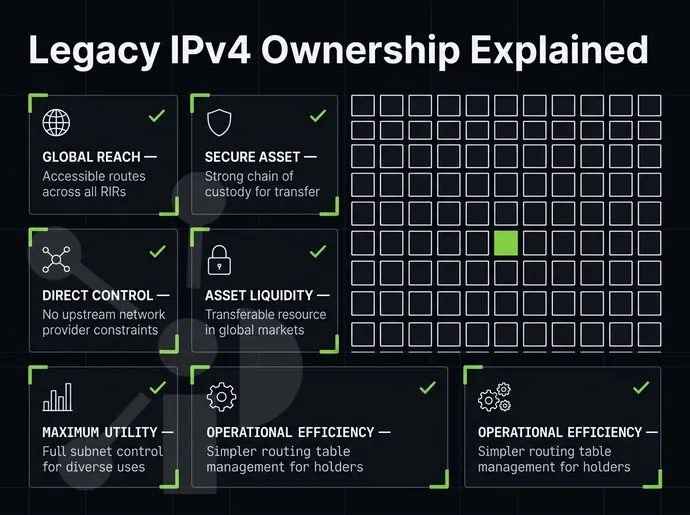
Long before scarcity entered the lexicon of Internet policy, IP address space was doled out in generous blocks of /8s and /16s to universities, government agencies.
Why end user organizations hold surplus IPv4 address space
A /16 allocated to a University in 1991 may now be using a handful of /24s out of the space, with the rest of the allocation sitting quietly on a shelf. Not being unrouted in the global tables. The space is taken up by private networks, NATs and the natural consolidation of space holding that large public allocations used to require. The secondary transfer market exists to fill this space between what a organization holds and what it actually uses.
After the five RIRs used up their free pool between 2011 and 2020, all subsequent address blocks are provided by holders of IP address space who are willing to sell, lease or transfer them. These are mainly legacy holders holding surplus IP address space.
Legacy addresses and RIR standing
These legacy resources were allocated prior to the full formation of the RIR system and prior to many of these holders signing a Registry Services Agreement.
Do legacy IPv4 holders need to sign an RSA before transferring?
Yes, generally.
After the RSA question has been resolved, the transfer process for the domain name between the registries involved will follow a specific order. Completing the registry approval process represents the final step before ownership is formally recorded in the appropriate database.
How the transfer process works for legacy IPv4 addresses
Legacy IPv4 space previously assigned to end-users or a network operator is transferred according to each RIR's procedures.
Preparation with a detailed description of each step
- Check if a record is legacy and which RIR it is registered at. Get the current WHOIS for the record and check the registration data for the resource holder, the RIR in which the record is registered, and for any RSA or LRSA.
- Execute or update an RSA/LRSA if required. Some receiving RIRs require the transferring party to sign a registration services agreement before the request can proceed. Note: Skipping this step is one of the following reasons transfers stall at review.
Execution via internet exchange points
- Submit the transfer request. The transfer request should be filed with the RIR of record for the IP space in question. Additionally, Should include supporting documentation such as proof of entitlement, organization details for all affected organizations, etc., and any relevant escrow confirmation information. A broker can handle all of this for you and keep everything on track.
- This process includes a RIR review and approval by the respective Registry staff to verify eligibility and check for compliance with applicable policies. The processing time frame may vary between the two RIRs with ARIN typically processing faster than the RIPE NCC for cross-registry transfer requests; however, no specific time frame is guaranteed.
RIPE NCC verification
- WHOIS and routing table updates: After approval from the RIR, the WHOIS for the new resource holder is updated. Verify the new space can be announced from BGP routing tables after updates complete.
- Update ROA and IRR route objects. Create RPKI ROAs and IRR route objects for the newly added holder. Without these objects, the announced space will fail route-origin validation and can even get filtered by your upstreams.
How long does an inter-rir transfer of legacy IPv4 space take?
Registration offices have different time frames for completion for the end user, mostly depending on the dealing office and the complexity of the transaction. Each registry treats the completion timeline as dependent on the specific circumstances of the transaction rather than as a predictable event.
Transactions crossing RIRs, such as those involving the RIPE NCC or APNIC databases, require additional checks and take longer.
The timing of domain availability is determined by the individual domain name policies of legacy resources and can vary significantly from buyer’s initial expectations. Some legacy resource transfers may complete within weeks, while others can extend beyond one year depending on documentation completeness and registry workload.
RIR policies that govern legacy IPv4 address space transfers
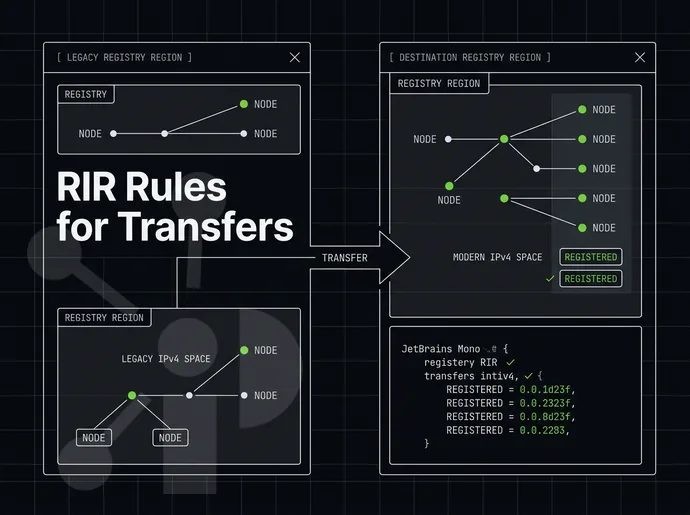
The legacy IPv4 address space predates the RIRs, but all registries today have policies to bring such space under the control of the modern registry system. Note that the policies vary greatly by region, and should be studied carefully before any transfer is initiated. Understanding these regional variations helps organizations plan for future acquisitions and avoid costly delays in the transfer process.
Assignment policies across the five registries
North America address space is governed by ARIN in two ways.
RIPE NCC removed the needs-basis requirement in 2012 (policy 2012-02), so address space is now allocated to any RIPE NCC member without requiring demonstrated utilization, and the minimum allocation size changed to a /24.
LACNIC is responsible for the Latin America region.
Can legacy IPv4 address space be transferred across all five RIRs?
Inter-RIR transfers are approved individually by the source and destination registry. A block of IP numbers to be moved from ARIN to RIPE NCC therefore has to fulfill the ARIN policies for outbound IP numbers and the RIPE NCC policies for inbound IP numbers simultaneously.
Space and Autonomous System Numbers, like other provider independent space, are transferred between registries, with the additional complexity of routing registries involved in ASN transfers. A block with unresolved blacklist or abuse history can easily stall the transfer at either registry.
How Prefixx handles the cross-registry process
Prefixx is a registered broker for ARIN, RIPE NCC, and APNIC offerings, with assistance on LACNIC transactions as well. Tixx quality control checks every single IP block that we process before a sale is actually closed, for ownership, transfer eligibility, and proper IP routing. Our team works closely with registry officials to provide information required for smooth approval of each transaction.
A transfer to another party is subject to the terms and conditions of the registry’s transfer policy.
Routing, RPKI, and IRR steps after transferring legacy IPv4 space
Transferring legacy IPv4 space closes the ownership question, but routing, reputation, and geolocation all need separate attention. Legacy blocks were allocated before modern routing hygiene standards existed, so RPKI ROAs, IRR route objects, and geolocation records are often missing or stale.
What is the minimum block size eligible for transfer at each RIR?
| RIR | Minimum transfer size | Notes |
|---|---|---|
| ARIN | /24 | Legacy resources eligible; LRSA or RSA required |
| RIPE NCC | /24 | Receiving org must hold LIR membership |
| APNIC | /24 | Both parties must be APNIC members |
| LACNIC | /22 | Facilitated transfers only; stricter eligibility |
| AFRINIC | /24 | Transfer policy still maturing |
RPKI and IRR after the transfer
Legacy space typically has no ROA for announced prefixes which means that such prefixes are RPKI invalid or not-found. Upstream providers that enforce route origin validation (e.g. K root servers) will thus drop announced prefixes. A ROA needs to be created for the new holder of a prefix under his/her registry account. In addition, all IRR route objects for announced IPv4 addresses and prefixes must be updated in order to enable routing tables to correctly identify the origin ASN of announced prefixes.
A white-glove broker such as Prefixx fills this gap by preparing LOA, RPKI ROA and IRR route objects for the buyer, making sure the assigned block is globally unique and correctly attributed before it’s announced. The services provided encompass comprehensive technical preparation to ensure seamless routing and attribution of transferred address blocks.
Geolocation and reverse DNS
Stale geolocation data tied to IPv4 addresses can cause users to be misdirected and even cause services that rely on geolocation information to fail. Publishing an RFC 8805 geofeed helps to keep MaxMind, IP2Location, DB-IP, and ipinfo.io up to date. We at Prefixx publish a daily geofeed and take care of rDNS delegation for your IPv4 addresses and address blocks, thus updating both layers as part of one smooth handoff.
To facilitate future transfers, we require that buyers and sellers initiate the process with a single broker who can manage the RPKI, IRR, geofeed, and rDNS workflow for a given sale or lease of space. A responsible broker ensures that all technical records are verified and updated before the transfer completes.
That even with the broker of your choice and proper routing instructions, such as clean banking routing information, payments can still go wrong for the end user. The key to closing deals smoothly and quickly, rather than waiting months, is to anticipate where payments will go wrong before IPv4 addresses and address blocks slow everything down. Experienced brokers work closely with their customers to structure payment flows that minimize friction and avoid common pitfalls in the settlement process.
Common pitfalls when transferring legacy IPv4 addresses
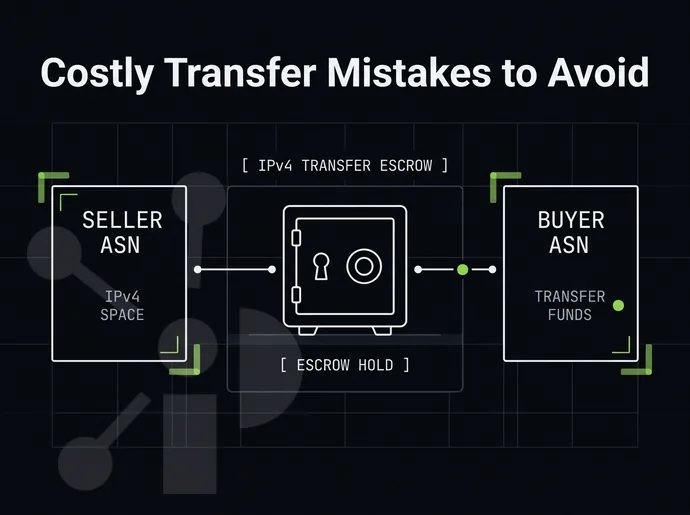
Most problems migrating legacy IPv4 space occur at the paperwork stage and can be foreseen. It is very costly in terms of time to discover these problems late in the process. Proactive verification of holder documentation and early contact with the relevant registry can prevent delays that might otherwise extend the timeline by weeks or months.
Preparation: documentation and ownership
- Confirm an RSA or LRSA is on file. Many legacy addresses were assigned before modern registry agreements existed. Without a signed RSA, the RIR will reject the transfer outright. Contact your RIR and execute the agreement before listing the block. Note: this single step blocks more deals than any other.
- Clarify WHOIS registration gaps. A buyer should verify whether the organization listed in a WHOIS search corresponds with the organization identified in current documents of the buyer. Stingily out-of-date contact information, organization information, and registration information can be the source of a host of disputes over ownership.
- Scan blacklist ed addresses. Spammers and abusers often sell their blocks of wasted range to unsuspecting buyers who get blacklisted too. Check addresses against blacklists before you close the deal. Tixx quality control includes verification of full ownership, check for sufficient transfer capacity, blacklists, and other forms of routing abuse on all blocks that we trade.
Execution: routing and registry timelines
- Fix IRR inconsistencies before you announce. Stale or conflicting route objects are dropped by BGP peers. Update the IRR records to reflect the origin ASN of the resources that you are transferring.
- Also, budget time for RIR processing time. Legacy IPv4 numbers go through a review with the respective registry that typically takes longer than the typical transfer time. This time needs to be factored into your project plan.
How are legacy IPv4 addresses valued on the secondary market?
The value of IPv4 addresses depends on several factors, including the size of the address block. The RIR region in which the IP addresses are registered, the quality of the IP address holder’s routing, and its online reputation. While larger IP address blocks are sold at lower per-IP prices, smaller allocation such as a /24 is typically traded at higher per-IP prices.
IPv4 addresses held by ARIN and RIPE NCC for example typically have different market prices in the same month due to different local demand. IP addresses that are blacklisted or poorly documented can sell at a low price, even significantly below the going market rate.
There is also a geolocation lag after a transfer as geolocation databases often take several weeks to update a new location of a transfer. However, by means of a daily geofeed for IPv4 addresses according to RFC 8805, corrections can be implemented fast and across all providers. Clean routing and current registration data of a block can trigger stronger offers and faster closure of the blocks.
Brokers handling domain transfers and IPv4 addresses have the best chance of avoiding problems with a broker if they have their own direct relationships with the domains' registries and implement quality control measures before any block is transferred. Working with experienced brokers helps customers navigate the complexities of registry requirements and documentation standards across different RIR jurisdictions.
Why work with a registered broker for legacy IPv4 addresses transfers
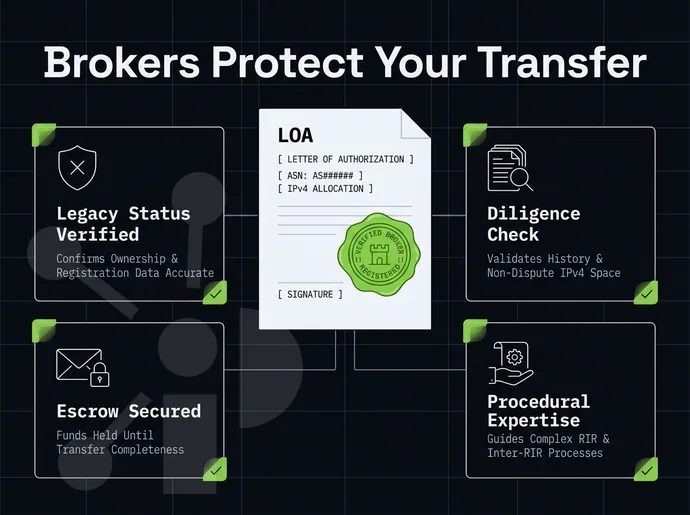
Information regarding legacy IPv4 addresses (such as registration data) is often incomplete. Legacy address pool allocation information is from decades past, and how legacy address region versus newly assigned segment is treated by regional internet registries (the RIRs) varies. So it is essential to find a good, registered broker who understands the rules as they apply at ARIN, RIPE NCC, APNIC, and the other RIRs.
We have been working in the networking industry since 2007 and are a neutral broker for IPv4 addresses and subnet allocations across all 5 registries. We charge no buyer fees and work on a commission-only basis for sellers of 3% to 8%. Clients can contact us directly to discuss their specific requirements and receive guidance on the transfer process.
- RIR registration: We are registered broker s with ARIN, RIPE NCC, and APNIC, with LACNIC transfers facilitated.
- Tixx QC on every block: Ownership, blacklists, and routing hygiene checked before any addresses change hands.
- White-glove paperwork: Our team prepares the LOA, RPKI ROA, and IRR route objects for you.
- Escrow-secured transactions: Funds are held in escrow throughout the transfer process, protecting both sides.
- Human-in-the-loop: Senior consultants manage every deal from sourcing through final registration.
Contact us at Prefixx.net if you need to transfer legacy IPv4 prefix, to discuss the details, associated costs and more.
Key facts about transferring legacy IPv4 addresses
The assignment of Legacy IPv4 addresses occurred prior to the creation of regional internet registries (RIRs). Therefore, incomplete or even no records of IPv4 address assignments exist and verification of transfer eligibility must occur prior to commencement of transfer process. Transfer of Legacy IPv4 inventory requires documented justification, approval by relevant RIR and clean routing (valid RPKI ROAs and accurate IRR entries) prior to announcement of assigned address resource by receiving organization.
Additional complexity is introduced by Inter-RIR transfers, as each RIR applies different assignment policies and documentation requirements to legacy IP addresses. We mitigate risks throughout the process of an inter-RIR transfer with a registered broker such as Prefixx. Prefixx takes care of registry records, creates LOA and routing objects, and runs Tixx quality checks on every block before close of transfer.
Transferring legacy IPv4 addresses from one party to another is possible but remains bound by the policies of the RIRs. What registry governs your block of IP numbers, whether you hold a legacy RSA number, and what region the holdings is moving to determines the time it takes and the associated costs. Getting these details right early in the process avoids delays, failed transfers and realizes full value.
Valuation is not trivial and depends on block size, RIR region, routing history and peer reputation. Secondary markets for IPv4 addresses have no public price feed, which means that sellers usually end up underpricing themselves or spending a lot of time on paperwork to get a higher price.
If you hold legacy territory and want to know what your block is worth, whether it qualifies for transfer, and what the routing hygiene looks like before you list it, Prefixx runs that analysis as part of every engagement. Start with a free block assessment.
Contact us to discuss your IPv4 needs today
No hidden fees, free consult. A broker replies within one business day.