
By Savvas Bout, Founder of Prefixx. Last updated 14 October 2026.
It seems straightforward enough: sell your remaining IPv4 address space. But the steps to selling IPv4 in the secondary market are surprising to many. A block of IP addresses that took years to amass to build out early web applications can take months to sell when key documentation is missing, seller eligibility to transfer a block unknown. Gathering historical allocation records and verifying registry standing can be time consuming when organizations lack centralized documentation systems.
Alternatively, Worse, listed with the wrong group of buyers. IPv4 transfer market sellers often find that huge value is left on the table, only to discover mid transaction that their IP addresses are on a black list and of virtually no value. Organizations that fail to verify their block's reputation before entering negotiations risk discovering too late that their asset cannot support legitimate business use.
In the process of pre-sale due diligence, RIR transfer approval and settlement, each stage has its own paperwork, timing and failure points. For example, if a quality check is not carried out before a listing is put online, problems will surface during the vetting of potential buyers instead of before, thus putting a stop to deals that otherwise would have been fine.
One common mistake is failing to run comprehensive blacklist and reputation checks before engaging with buyers, which can derail negotiations at the worst possible moment.
In the following sections, all the stages are explained in the correct order. What constitutes a smooth transfer of shares and what not, will also be explained. A complete understanding of each stage ensures that both buyer and seller can anticipate requirements and avoid delays.
A complete guide to selling IPv4 addresses step by step
Whether you are a company with a large pool of unused IPv4 addresses or a holding organization looking to free up capital from your excess IPv4, the process of transferring IPv4 is more structured than an ordinary asset sale. Each step must be understood clearly before commencing work on the transfer of your IPv4. Sellers who attempt to navigate this structured workflow without professional guidance often fail to complete the transfer within expected timelines.
Address exhaustion and why IPv4 addresses still have value
The five RIRs have depleted their free pools of IPv4 addresses between 2011 and 2020. That means all 4.3 billion addresses in existence are in use. Today the only market for buying and selling used IPv4 address space is the aftermarket. That makes the sellers a powerful lot.
Who should sell IP addresses through IP brokers
Selling unused or underutilized IPv4 addresses can be done by companies such as enterprises who downsized, by Internet Service Providers who reorganized, and by companies that acquired large IPv4 address space blocks as a result of mergers and acquisitions. The space just sits there idle and thus has value for someone else.
What this guide covers when you sell IP addresses
Here's an overview of the full selling process to sell IPv4 address space, as described in detail for the market context first. Our consultants at Prefixx manage all steps of the process for you if you choose to sell your IPv4 address space via us. Understanding the full process ensures sellers can anticipate each requirement and avoid delays that commonly arise from incomplete documentation or eligibility questions.
Understanding IPv4 exhaustion and why IP brokers have market value
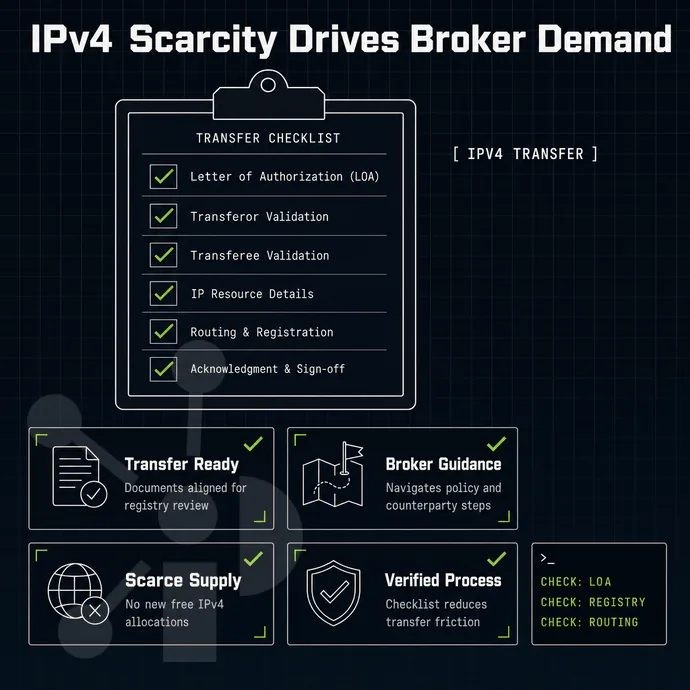
All available IPv4 addresses have been allocated. Five RIRs used up all their free IPv4 address space between 2011 and 2020. Today, all additional IPv4 address space is traded on the secondary market. This limited supply of IP addresses against high demand is what the market value of IP addresses is based on.
Why IP brokers carry real monetary weight for IP resources
All organizations requiring IP address space today have to buy it from current holders. As there are only a limited number of IP address blocks available, this leads to increased prices due to the large number of interested buyers. In addition, the complex transfer process takes a long time and thus, in itself, is a further factor for the valuation. Buyers evaluating an IPv4 block must also account for the administrative overhead and registry fees that accompany the acquisition.
How block size and RIR region move the price
The region within the registry where a block is registered can influence market prices.
The price for an identical block size registered under ARIN and an identical block size registered under RIPE NCC can vary appreciably between the two RIR regions in the same month. This is due to a variety of factors including regional demand, registry policy, as well as concentration of potential buyers within a region. Organizations evaluating these price differences must consider how registry location aligns with their business operations and routing requirements.
| RIR | Region | Transfer policy | Price tendency |
|---|---|---|---|
| ARIN | North America | Needs-based review | Historically premium |
| RIPE NCC | Europe, Middle East, Central Asia | No needs assessment | Active, liquid market |
| APNIC | Asia-Pacific | Needs-based review | Strong regional demand |
| LACNIC | Latin America | Facilitated transfers | Emerging liquidity |
| AFRINIC | Africa | Policy in flux | Lower volume |
Getting funds released from idle address space via IP address brokers
Selling IPv4 addresses held by an organization that no longer routes them can convert dormant assets into cash. Tixx quality control is applied to all IPv4 address space listed by Prefixx, enabling buyers to know what they are purchasing and ensuring that transactions complete as agreed. To that end, Step 1 involves verifying what IPv4 address space an organization owns and whether such can be transferred. Verification confirms that the seller is a legitimate organization with proper registry standing before any marketing or negotiation begins.
Step 1 -- audit your IP block and review IP brokers registry records
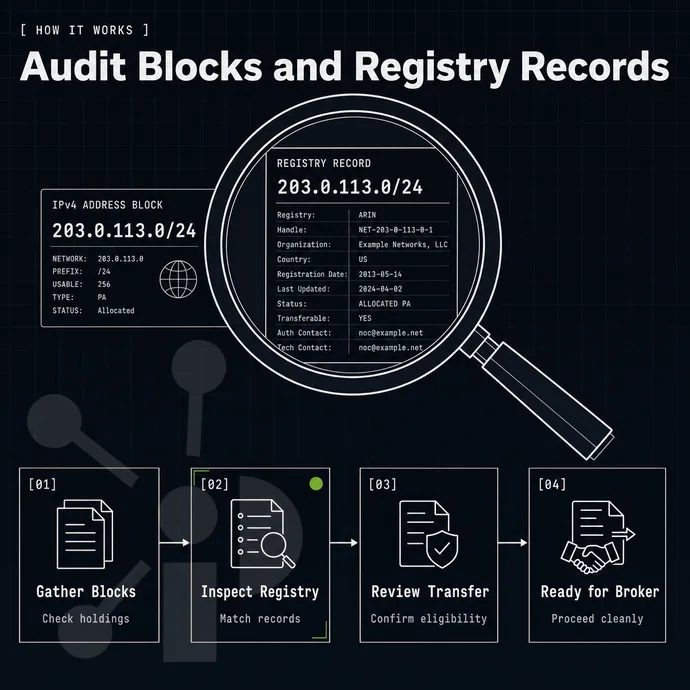
It's also important to verify what you actually own and whether it can be transferred prior to approaching buyers or discussing payment. Issues that are unresolved at this early stage can prevent a sale occurring in current market. Organizations that skip this verification step often struggle to find buyers willing to proceed once transfer complications surface during due diligence.
Ownership and internet registry records
- First, log into the RIR’s portal for the region where your IP block is registered. Pull up the current registry information for your block and verify that all of the information (Organization, Contact information, etc.) for the block is correct as well as the correct prefix size. The information needs to match exactly in order to complete the transfer.
- Verify eligibility for a transfer under the policies for the RIR where your IP addresses are held. Each registry (ARIN, RIPE NCC, APNIC, LACNIC, AFRINIC) has its own holding-period and RSA requirements, so be sure to verify these prior to listing.
Note: ARIN requires an RSA or LRSA to be in place before any transfer can proceed. Missing this is the most common reason a sale stalls. The RSA or LRSA agreement serves as the legal foundation that governs how ARIN transfers are processed and approved by the registry.
Due diligence on reputation history
- Check if your IP address is listed on major blacklists. A clean history can be a strong selling point, whereas listings on Spamhaus or other similar DNSBLs can negatively affect the listing price and decrease interest from potential buyers.
- Review routing hygiene (BGP origin, RPKI validity, IRR records), inconsistent data here indicates poor stewardship to potential buyers.
What a broker does for you
At Prefixx we run all blocks through Tixx before we can sell them to customers. Tixx checks for ownership, transfer eligibility, blacklisting, and other IPv4 addresses routing issues and generates a health report and a transfer readiness score.
Only after you have this insight into potential problems can you begin the sales process of negotiating a price to fix these issues. This price needs to be defensible. Prefixx provides ongoing support throughout the remediation phase to help sellers address flagged issues and improve their block's marketability.
Step 2 -- establish market value and set realistic price expectations
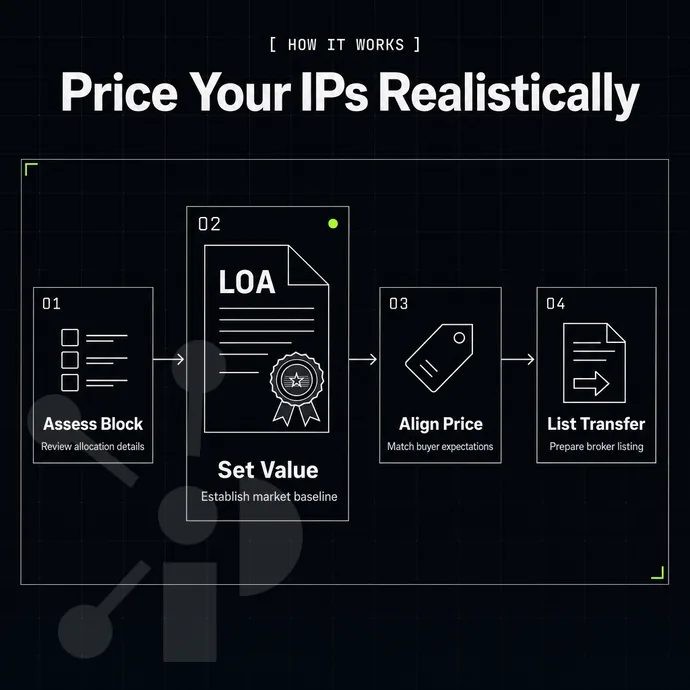
A realistic number prior to listing on the broker’s platform is necessary to establish a correct market value for IPv4 IP allocations. Many independent variables influence the market value and must be correctly assessed in order to sell IPv4 space for the right money or to buy IPv4 space quickly. Sellers who understand these variables can position their assets to attract serious buyers and close transactions that align with their business objectives.
Block size and IP count from IP brokers
The number of aggregated IP prefixes and their corresponding amount of potential buyers decreases with larger prefix aggregations. While a /16 block of IPv4 addresses is suitable for big carriers and cloud providers, a /24 is step by step more attractive to a larger group of customers. Conversely, large blocks require buyers with substantial infrastructure needs and capital, narrowing the pool of qualified purchasers.
The price per IP address increases with the number of addresses in a smaller IP block because there are much more potential buyers that can use such a number of IP addresses. A /24 is the smallest aggregatable IP prefix and has always a lot of interested buyers. Buyers seeking their first IPv4 block often prefer smaller allocations because they align with immediate infrastructure needs and require less capital outlay.
Registry region and reputation history
The region where a block is registered affects market pricing for that block. Historically, market demand in the North American market has meant that ARIN space commands a premium over similar sized blocks of RIPE NCC space and APNIC space.
Thus, in a single month, a /24 of ARIN registered space and the identical size block of RIPE NCC registered space could command very different prices in the market. Organizations evaluating acquisition options must weigh these regional price differentials against their operational requirements and the geographic footprint of their business.
The routing hygiene of a block of IP addresses matters as much as its “blacklist cleanliness”, RPKI validity and absence of past abuse. A block with a clean history will convert faster than one with a poor reputation, experiencing lower prices and a greater number of potential buyers.
Why current market prices are not published
There is no price index for the official registries published. Current market prices are agreed in closed negotiations between parties and fluctuate greatly from week to week as the supply of domains decreases. A broker would typically track current live deals across all the RIRs and use this to calculate a fair market value for a specific number of domains that you own. Experienced brokers provide ongoing support throughout the negotiation phase to help clients understand how these fluctuations affect their specific block.
The broker’s company (e.g. Prefixx) runs Tixx quality control on all domains listed, including any associated IPv4 addresses, to check for transfer eligibility and repistor (reputation) to ensure the valuation reflects more than just the number of domains. The broker provides ongoing support throughout the verification process to address any issues that arise during quality control checks.
Step 3 -- choose between a one-time sale and recurring income through leasing
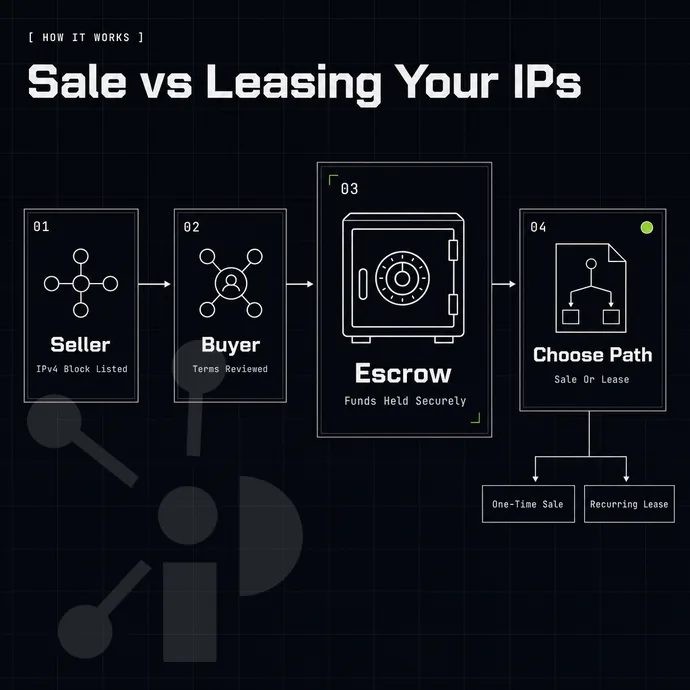
You now face a fundamental choice in the IPv4 selling process: convert your IPv4 blocks into a lump sum through a one time sale, or generate recurring income by leasing while keeping ownership of the block.
Selling outright to find buyers
An outright sale is a straight transfer of ownership of the whole to the buyer in return for a single payment, and after the RIR records have been updated, that is the end of it. The IPv4 transfer completes when both parties sign the registry's transfer agreement and the receiving organization demonstrates its need for the resources.
A clean exit from an IP block no longer required by the seller and not intended to be managed in the long term by them. The seller relinquishes all administrative responsibility for the IPv4 addresses once the registry completes the transfer and updates its records accordingly.
Avoiding the common mistake when leasing for ongoing returns
Our leasing model walks you step by step through retaining full ownership of your space while having tenants pay to use it. We handle LOA, RPKI ROA and IRR objects for your leased IPv4 addresses and provide white-glove monitoring to maintain a healthy IP reputation throughout the lease term. This approach ensures that organizations retain control over their IPv4 addresses while generating revenue from underutilized allocations.
You are still responsible for that specific block of space. The registry maintains your organization as the holder of that IPv4 block until you complete a formal transfer or return the allocation.
Splitting a larger holding
Many sellers do both. A holder sitting on a /16 might step by step sell several /24s outright for immediate capital and lease the remainder. Prefixx brokers both sides of that arrangement. See our lease vs. buy guide if you are still weighing the options.
Once you have settled on a path to sell IPv4 addresses, the next step is finding the right buyer and getting the deal in front of them. This hybrid approach allows organizations to retain ownership of a portion of their allocation while still generating revenue from it through lease agreements.
Why choose Prefixx to manage your IPv4 sale
Selling IPv4 addresses means navigating transfer policies, registry records, and buyer due diligence at the same time. Prefixx handles the entire process so you can focus on the outcome. Each stage of the transaction requires coordination with registry officials, legal review, and documentation verification to ensure compliance throughout the sales process.
- Registered broker with ARIN, RIPE NCC and APNIC. We know each relevant RIR's transfer rules and keep your block compliant from listing to close.
- Seller-only commission, no win no fee. Our 3 to 8% fee applies only on a completed sale. No hidden fees, no buyer charges.
- Tixx QC on every IPv4 block. We check ownership, IP reputation, blacklists and routing hygiene before your IP ranges reaches potential buyers.
- Escrow-secured payments. Funds are held in escrow and released only when the transfer completes, protecting both sides.
- White-glove LOA, ROA and IRR preparation. Our team handles the technical aspects of every IPv4 transfer, including all routing paperwork.
- Senior consultants, every deal. Our team has been in the industry since 2007. You get a human in the loop, not a self-serve queue.
If you are ready to sell IPv4 addresses or want a current market valuation of your IPv4 address blocks, visit our sell page to start a conversation with our team.
Frequently asked questions
Can I own IP resources like an IPv4 block outright and sell addresses from it?
Yes. IPv4 address blocks are registered to an organization through a Regional Internet Registry, and that registration confers transferable rights that function like ownership in practice. You can buy, sell, or lease those rights on the resale market. The RIR holds the authoritative record, so any transfer must be processed through the relevant registry to be recognized by the global routing system. Organizations treat these rights as assets on their balance sheet, and the transaction process mirrors standard commercial asset transfers used in business acquisitions.
IPv4 selling process steps from start to finish
A straightforward sale through a broker typically closes in four to eight weeks from the moment a buyer clears registry eligibility, is matched, and escrow is opened. The variable is the RIR transfer window: ARIN and RIPE NCC process most transfers within two to three weeks once paperwork is submitted, while APNIC timelines are similar. Blocks with clean routing history and no policy holds move faster. Complications such as legacy resource disputes or missing WHOIS contacts add time.
What is the difference between selling and leasing IPv4 addresses?
Selling transfers the RIR registration permanently to a new organization. Leasing keeps the registration in your name while granting a third party the right to route and use the space for a defined term. Selling generates a one-time payment and ends your obligations. Leasing your IPv4 addresses produces recurring revenue but keeps you responsible for the block's reputation and any policy compliance issues that arise during the lease term.
Do I need to be registered with an RIR to sell my IPv4 addresses?
The block must be registered with an RIR, and the seller must be the organization of record in that registry's WHOIS database. You do not need to maintain an active LIR membership in every case, but the transfer process requires you to interact with the registry directly or through a registered broker. Prefixx is a registered broker with ARIN, RIPE NCC, and APNIC for IPv4 addresses, and facilitates LACNIC transfers, so every internet registry coordination step is handled on your behalf. Prefixx provides dedicated support throughout the entire transfer workflow to ensure compliance with each registry's requirements.
How is the price of an IPv4 addresses block determined?
Price is driven by allocation size, the RIR region the space is registered under, current supply and demand, and the reputation history of the addresses. A /24 registered under ARIN and an identically sized block under RIPE NCC can see noticeably different buyer demand and trade at different rates in the same month. Organizations evaluating blocks for acquisition should consider how regional pricing differences align with their business requirements and budget constraints.
Blacklisted or heavily abused space trades at a discount or may require a step by step remediation process before a sale is viable. No official price list exists anywhere, so current market rates come from closed transaction data that experienced brokers track continuously. Brokers typically structure the transaction so that payment is held in escrow until the registry confirms the transfer and the buyer verifies routing capability.
What do IP brokers do with your IPv4 addresses reputation history when you sell a block?
The reputation history attached to those addresses does not disappear at the point of transfer. A buyer conducting proper due diligence will check this before committing. Tixx, Prefixx's pre-sale quality control process, scans every block for blacklist entries, routing hygiene issues, and RIR standing before a listing goes live, so both parties know exactly what they are dealing with. Prefixx provides ongoing support throughout the verification and transfer process to address any issues that emerge during diligence or registry coordination.
Are there seller fees when using a broker to sell IPv4 addresses?
Prefixx charges sellers a commission of 3 to 8 percent of the sale price, with smaller blocks at the higher end of that range. The commission is success-based: if the block does not sell, no fee is charged. That structure means the broker's incentive is fully aligned with getting the deal closed at the best available price through secure payments. The buyer typically covers registry transfer fees directly, while the seller's only cost is the commission deducted from the final payment.
Selling IPv4 is not a passive process. The blocks that trade well and get good prices for their IPv4 addresses are well-prepared for the market: clean registry records, realistic market price. Additionally, Decision whether a one-time transfer of IP blocks is more valuable than payment for ongoing lease of IP space.
The three key steps below, from attracting qualified buyers to escrow protection and beyond, will walk you through whether your deal closes within weeks or languishes for months.
If your block is ready, or you are not sure whether it is, Prefixx handles the valuation, vetting through Tixx quality control, and the full transfer paperwork across ARIN, RIPE NCC, APNIC and LACNIC. Seller commission is the only fee, and there is no charge if the block does not sell. Submit your block details at Prefixx.net to get a no-obligation assessment.
Contact us to discuss your IPv4 needs today
No hidden fees, free consult. A broker replies within one business day.