
By Savvas Bout, Founder of Prefixx. Last updated 14 October 2026.
Most networks treat the transfer of IP address space in the form of paperwork at the end of a sale of an IPv4 block as the end of their operational responsibilities with that space. However, the space of transferred addresses is no longer routed by the seller of the IP address space.
Additionally, the IPv4 addresses must be configured in all layers (routing tables, IRR objects, RPKI ROAs, reverse DNS for the reverse mapped addresses, geographic location information for the addresses, etc. of the transferred space) by the buyer of the IPv4 address space. Buyers often underestimate the technical complexity involved in the transfer process, particularly when coordinating updates across multiple registry systems simultaneously.
If one of these layers of configuration is not properly completed for the transferred space of IP addresses, the seller of the IP space can start to receive abuse reports for the transferred space of IP addresses that they no longer operate. Alternatively, your upstream may continue to announce a /aro of IPv6 IP resources originated by you that you have no right to originate. The same configuration challenges apply regardless of which internet protocol version the transferred resources belong to.
After a sale has completed, there are a number of steps to bring down from service and from advertising, to clean up your routing registry and RPKI configuration, to deal with your reputation and any blacklists that you may have been on, and to get each relevant regional internet registry to update their databases. A complete post-transfer checklist ensures that no configuration layer is overlooked and that your network remains operationally sound.
These steps are the same whether you have sold a single /24 or large blocks that span multiple RIRs. It’s a simple checklist to follow to protect your ASN and to keep your remaining space clean. This article begins with what happens immediately after the transfer has completed. The routing and registry cleanup procedures remain identical regardless of whether the transferred allocation was a small subnet or comprised large blocks.
What internet registries do after you sell an IPv4 block
Following the completion of the RIR transfer, the following three events occur in rapid succession: the escrow releases payment to you, the registry updates the registration records to reflect the new ownership. Additionally, Your routing rights are ended. Here is the sequence of events. For more context, see Buying / Leasing IPv4 in APNIC : r/networking.
Sell IPv4 addresses: the post-transfer sequence
Our Escrow holds funds until the transfer is complete. Once the RIR has confirmed that the domain block has been transferred to the buyer, we pay the seller. The escrow mechanism ensures that sellers receive their payment promptly and that buyers can deploy additional funds only when the registry confirms successful completion.
Your LOA will expire after this announcement, ending the entire process and leaving you unable to advertise this prefix.
Selling IP addresses: what changes in the regional internet registry
RIRs list the buyer as the holder of the resources, then impose a lock period of around two years to prevent resale of the same IPv4 addresses.
Sell IP addresses with no hidden fees
When you sell IPv4 addresses via Prefixx, our commission is seller-only, i.e. we get no commission from the buyer. We find suitable buyers for you, draw up purchase agreements, and bring the deal to a close via escrow. Throughout the sales process, the seller only pays commission, with no hidden charges or deductions by the buyer when the deal is settled. Our team provides white glove service throughout negotiations and documentation to ensure a smooth transaction for sellers.
Re-transfer lock-up Windows and the transfer process for sellers
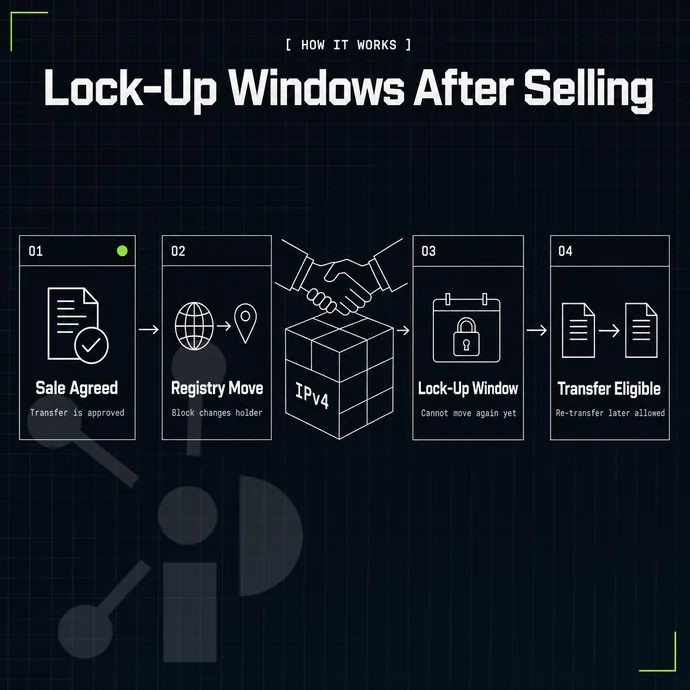
All registries require a waiting period before a transferred domain name can be moved again. Sellers later may regret a sale and will find themselves prohibited from reversing their decision. Organizations considering selling IP addresses should carefully evaluate their long-term needs before initiating a transfer, as registry lock-in periods prevent immediate reacquisition of the same resources.
RIPE NCC transfer process: the 24-month lock-up
The recipient of an IP address block under RIPE NCC policy is prohibited from selling or transferring the block for 24 months after allocation. As a result, organizations that sell IP space into this registry region give up flexibility for two full years. This policy reflects a broader trend among internet registries to stabilize address allocations and discourage speculative trading in the transfer market.
Arin's approach to managing IP resources
Note that ARIN does not set a specific time period for re-transfer of withdrawn address space as does NRO/AFRINIC/APNIC/RIPE NCC. ARIN does require a demonstration of need for any new allocation of address space, including through a purchase on the secondary market.
The real cost of regret over IP addresses
The sale of a one-off unit of space is a permanent one. But leasing space allows you to retain ownership of the unit whilst generating a constant stream of income from the space, and retaining the option to re-take it when required. This distinction makes leasing particularly attractive for organizations uncertain about their long-term needs, as opposed to committing to a one time sale.
Income from leasing IPv4 addresses can often equal or even exceed the annual amount that a broker could sell the space for. At Prefixx, our experienced consultants can model both a sale and a lease of a space to help you make a decision that is right for you. The lease income calculation depends on current demand and the prevailing market price for comparable address ranges.
If you have decided that a sale is the best course of action, then the broker you choose to sell through can have a very material impact on the outcome for you. The right broker understands your network's operational constraints and can structure the transaction to minimize disruption to your business.
Why work with Prefixx when you sell IP addresses
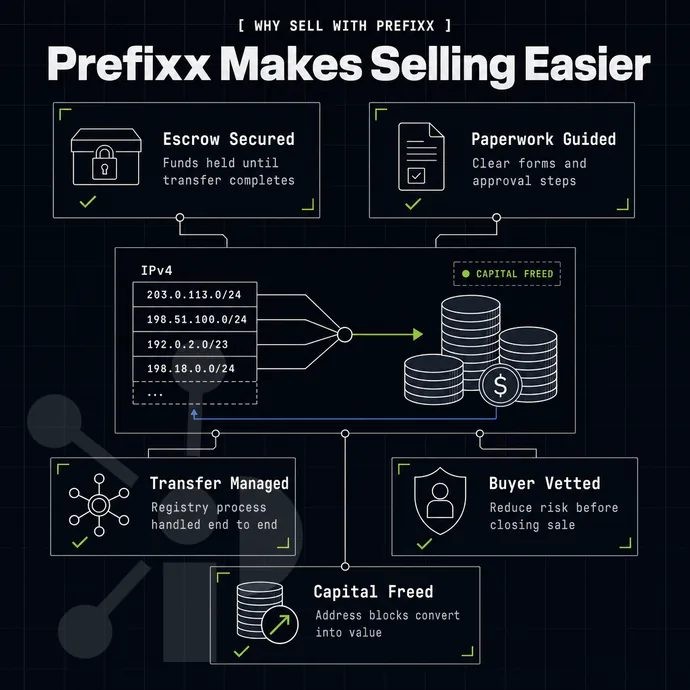
Selling IPv4 addresses is more than finding a buyer to sell to. The process of transfer, the setup of an escrow, and the required paperwork for the new routing after the sale all can be a nightmare for sellers trying to do everything on their own.
Prefixx takes care of everything, from finding a qualified buyer to filling out the LOA, the RPKI ROA, and the IRR objects after the sale has closed. The team provides dedicated support throughout every stage, ensuring sellers never navigate the complexities alone.
- No buyer fees and no upfront cost to sell. We charge a seller-only commission of 3-8% (smaller blocks at the higher end) and only get paid when your block sells.
- We verify quality of every single block going into a buy offer for Tixx: ownership, blacklist status, routing quality etc.
- Escrow-secured transactions. Funds are held in escrow until the transaction is completed and all parties have confirmed the transfer.
- We register IP addresses with the three regional Internet registries ARIN, RIPE NCC and APNIC. We take care of the necessary documentation and verification.
- White-glove service included. Our Senior consultants manage the entire transfer process so you can focus on your business.
Whether this is a one-off sale or you are looking at Leasing to generate ongoing income whilst retaining ownership of the block, we’d be delighted to discuss further and provide you with an exact figure for your block.
Frequently asked questions about IP addresses
What's the typical IPv4 addresses block price on the secondary market?
Prices vary by RIR region, block size, and routing history. A /24 under ARIN and an identically sized block under RIPE NCC can trade at noticeably different rates in the same month, and neither number is published anywhere official. Reputation, transfer eligibility, and current demand all move the final figure. Contact a broker for a current market valuation before listing. Regions experiencing high demand for scarce resources typically command premium pricing compared to those with more available inventory.
Who owns IP addresses, and what's the transfer process for selling them?
When you sell IPv4 addresses, the RIR that issued the block holds the authoritative registration record, and the listed resource holder is the recognized owner. Ownership of IPv4 addresses transfers when both parties submit the required paperwork to the relevant RIR, which then updates the WHOIS record to reflect the new holder. All five RIRs support transfers of IPv4 space, including legacy resources. The process of transferring IPv4 addresses is governed by each RIR's conveyance policy, and a registered broker can handle the paperwork end to end. The RIR registration system treats each resource holder as a distinct legal entity for purposes of transfer approval and policy compliance.
How can I sell IPv4 address blocks effectively?
Start by confirming the block is reassignment-eligible at your RIR and free of encumbrances. A broker like Prefixx will vet the block through Tixx quality control, build the listing, find qualified buyers, and close the transaction through escrow. Prefixx charges a seller-only commission of 3 to 8% of the sale price, with smaller blocks at the higher end, and no fee if the block does not sell. The RIR reallocation is handled end to end by the Prefixx team. The broker will facilitate all registry communications and coordinate the technical handoff between parties.
How long do IP addresses stay restricted after a transfer?
Each RIR imposes a post-migration holding period before the new owner can handover the block again. ARIN and RIPE NCC both enforce a 12-month restriction after an approved portability. APNIC follows a similar policy. These restrictions apply to onward transfers of IPv4 addresses, not to routing or operational use, so the buyer can announce and use the space immediately after the RIR updates the record.
What happens to geolocation records after I sell my IPv4 block?
Geolocation databases are maintained independently by providers such as MaxMind, IP2Location, DB-IP, and ipinfo.io, and they do not update automatically when a block changes hands at the RIR. Under tailored contracts, the buyer needs to submit correction requests to each provider and publish an RFC 8805 geofeed so those databases can reflect the new location. Each provider maintains its own proprietary data set, so corrections must be submitted individually to ensure consistent geolocation accuracy across all platforms.
Prefixx publishes a daily geofeed for IPv4 addresses leased to clients and includes geolocation correction as part of its white-glove service on leases. Sellers should inform buyers that this step requires active follow-up after the relocation closes.
Can I lease my IPv4 blocks instead of selling them?
Yes. Leasing lets you retain ownership and generate recurring revenue while the lessee gets routable address space without a capital purchase. Prefixx structures guaranteed IPv4 addresses with leases under non-revocation terms, RPKI, LOA, and reverse DNS, with provisioning within 24 hours. This is a practical option if you expect to need the space again or want to test market demand before committing to a permanent sale. Leasing also preserves the option to expand your own infrastructure back into that space when business needs change.
What documents do I need to retain after an IPv4 sale?
Keep the signed purchase and sale agreement, the escrow settlement confirmation, and any LOA or authorization letters issued during the transaction. If RPKI ROAs or IRR route objects were withdrawn as part of the sales process handover, keep a record of those changes. These documents establish a clean chain of title if the block's history is ever questioned.
The actual work of selling an IPv4 subnet ends with the signature of the buyer. The delegation at the registry, the release of the escrow for the payment in question once the seller has confirmed that the transition has been completed in full. Additionally, the proper cleanup of LOAs, RPKI ROAs, and IRR route objects that list your company as the originator is recurring income for network engineers, for example.
All of this must be completed by the seller in order to prevent your company’s good name from being tied to the traffic of your buyer for years to come.
If you want those steps handled without chasing registries or deciphering handoff forms, Prefixx manages the full post-sale process for sellers, from escrow coordination through routing record retirement. Start a conversation with the Prefixx team to get a valuation on your IP range and a clear picture of what the redistribution will involve.
Contact us to discuss your IPv4 needs today
No hidden fees, free consult. A broker replies within one business day.