
By Savvas Bout, Founder of Prefixx. Last updated 25 November 2026.
Your routes are announced, your prefix is announced live on the Internet, but no traffic ever reaches you. It is often the upstream prefix filters which are responsible for this phenomenon.
If the announced prefix of your newly acquired / leased IP addresses does not match any of the criteria of the filters of your upstream’s policy, all traffic to these addresses will be dropped in the black hole where your announcements were expected to arrive.
Clearing an upstream prefix filter to start announcing new space, whether that be space you have purchased, space you have leased, or even space you are bringing to a new provider via BYOIP, requires more than correct BGP configuration.
It also requires correct paperwork, i.e. a valid LOA, an accurate IRR route object and an RPKI ROA that your upstream can validate. This article explains the upstream prefix filters that you encounter, why an announcement is refused and what documentation and routing hygiene you need in order to be able to clear the filters reliably.
What are upstream prefix filters
An upstream prefix filter is a collection of rules applied by your upstreams, or peers at an IXP, on the BGP session with your router.
How it works at the router level
BGP UPDATE messages are sent from your customer-edge router to the upstream router’s peering router. The upstream router applies an inbound prefix-list or route-map on the interface in which the prefix will reside in the upstream router’s routing table.
A typical Cisco IOS example looks like this:
ip prefix-list CUSTOMER-IN permit 203.0.113.0/24.neighbor 198.51.100.1 prefix-list CUSTOMER-IN in.
203.0.113.0/24 is announced.
What is the maximum prefix length most upstreams will accept for IPv4?
The de facto industry limit for announcements is /24.
This is not a protocol rule. This is an operational policy that is typically documented in a provider’s routing policy and implemented with prefix-length filters in addition to the standard prefix-list.
Why the direction matters
"Upstream" means the provider side of the session. The filter is applied inbound on the provider's interface, which is outbound from your perspective. Confusing the two directions is the most common misconfiguration when troubleshooting a missing announcement. With that foundation in place, it helps to trace exactly what happens inside the BGP exchange when a filter runs.
How upstream prefix filters work in BGP
BGP UPDATE messages include NLRI, lists of prefixes that a neighbor is advertising.
The four-step flow
- Your router sends a BGP UPDATE for the announced prefix.
- The upstream applies an inbound prefix-list or route-map.
- Each prefix is accepted or silently discarded.
- Once a prefix has been accepted it propagates onwards throughout the rest of the internet.
A rejected prefix is simply not installed.
Common match criteria
| Criterion | How it works | Typical threshold |
|---|---|---|
| Exact prefix length | Matches only the stated mask | /24 exactly |
| Length range (ge/le) | Accepts a band of prefix lengths | ge 8 le 24 |
| Origin AS | Checks the AS_PATH origin ASN | Must match RPKI or IRR |
| Community tag | Matches a BGP community value | Upstream-defined values |
Filters can go in both directions but the majority of policy enforcement for incoming prefixes from customers is done in the inbound direction.
Why is my BGP announcement being silently dropped by my upstream?
Most silent drops are due to one of these three causes: Your prefix length is longer than what your upstream can handle (for IPv4 this is usually /24 or less). The AS number of the origin of the announcement does not match what the upstream’s IRR or RPKI data says it should be.
First, check your RPKI ROA actually covers the announce prefix length and exactly the prefix(es) you are announcing. Check that your IRR route object correctly lists the origin AS for the route(s). Then check that the prefix length announced is within the ge/le range specified in your upstream documentation for the specific announce. Once you understand why silent drops are being enforced by your upstreams for these specific reasons, the steps to fix above will make sense.
Why upstreams apply prefix filters
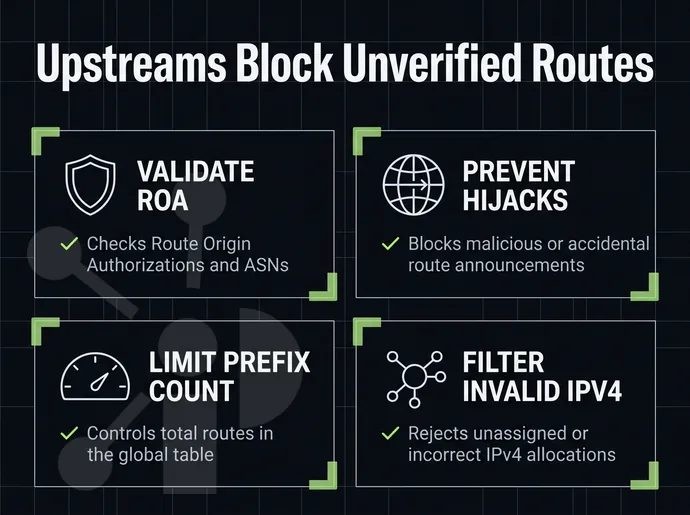
Prefix filters are applied by upstreams to protect the global routing table from announcements that are invalid, malicious or accidental.
Routing security and compliance
- Enforce prefix-length limits. Most IPv4 prefixes are announced with a length to advertise less than a /24. Announcing overly specific prefixes will cause your announcements to be rejected and often the cause of such announcements is misconfiguration as opposed to malicious intent.
- Validate against IRR route objects or LOA. A customer can only announce the space they actually hold. Announced prefix and origin-ASN of upstream traffic is checked against registered route objects. All traffic not in this scope is blocked.
- Run RPKI Route Origin Validation (ROV). This complements the IRR filtering work done by the upstream by using cryptography to verify whether the originating ASN of a route is allowed to originate a given prefix by checking for a signed ROA and dropping or de-preяfеring announcements for which no such ROA exists.
Note: IRR and RPKI are not interchangeable. IRR route objects are registry database entries, editable by anyone with the right credentials. A ROA is a cryptographically signed certificate anchored to the RIR's trust anchor. Without both layers, a hijack can slip through.
What is the difference between an IRR route object and an RPKI ROA?
An IRR route object is typically a plain text file within a Routing registry database (e.g. RIPE DB, ARIN IRR, RADB). This object contains information about which ASN(s) are allowed to originate a particular prefix or prefixes. In contrast, an RPKI ROA is a signed object issued by a RIR for a specific resource.
The object contains information about a prefix and its maximum length and it binds this information to an authorized origin ASN. IRR objects can typically be updated very quickly, whereas RPKI ROAs are difficult to forge.
Network hygiene
- Block bogon and unallocated space. This is accomplished by filters which prevent announcements of reserved or unallocated ranges to reach the global table so that unwanted traffic destined for no where is not attracted.
- Catch fat-finger errors. Mistyped prefixes in router configuration can cause legitimate traffic to be black-holed. Upstream filters are a last line of defense to catch such errors before they cause problems.
If we did not have these mechanisms in place, the global routing table would soon grow to include an excessive number of in valid or too specific prefixes, impairing the reachability of all.
The LOA , RPKI ROA, and IRR route objects that Prefixx creates for leases and for transfers are exactly what an upstream needs to create a correct prefix filter for your block of IP addresses.
Common filter rules and length limits
Upstream prefix filters, which are applied by every transit provider and every internet exchange, are the gatekeepers of the global routing table.
Length boundaries in the dfz
The Default-Free Zone (DFZ) has two boundaries which by convention will never be crossed.
Some upstreams even impose stricter rules. A transit provider for example might require announcements from his customers to have a /20 minimum and then only announce more specific IP addresses from within this aggregate.
A prefix-length range can be expressed by filter syntax using two bounds: the lowest length that a prefix accepted by the rule has.
Such a rule can then read: “accept this prefix family.
Irr-based filter generation
Most upstreams generate prefix-lists automatically from the RPSL route objects entered in the ARIN, RIPE NCC, APNIC, LACNIC and AFRINIC databases. If a route object is missing or outdated, the generated filter will not list that prefix.
An unregistered route object is treated as a filter deny. Upstream does not see a misconfiguration but rather sees a prefix that was not unlisted and discards it.
Do I need both an IRR route object and an RPKI ROA to pass upstream filters?
Yes. This serves two different purposes: building an IRR route object to feed IRR-based filter generation, and building an RPKI ROA to satisfy origin-validation checks. A growing number of upstreams now build prefix-lists using the IRR data and then apply RPKI Invalid drop policies on top of that.
Although a prefix with a valid ROA may be filtered by the IRR, a prefix with a route object but an invalid ROA will be discarded by any upstream that is enforcing RPKI. Thus both the route object and the ROA must be complete for reliable propagation in today's DFZ. Prefixx generates both the route object and the ROA for all leases and transfers. The following section explains how each of these documents is used by the filter.
IRR route objects, RPKI ROAs and how they feed filters
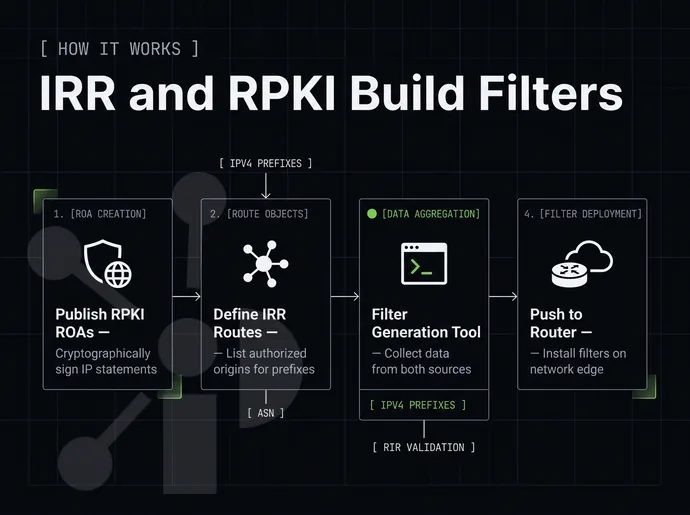
Prefix filters for upstreams are usually built from two data sources: IRR route objects and RPKI ROAs.
IRR route objects and how upstreams use them
Your RPSL route objects in the Internet Routing Registry for the AS that originated a prefix are used by your upstreams to generate prefix-lists using tools such as bgpq4 or IRRd (part of IRR ToolKit). If the route object is missing, out of date or listed in the wrong IRR database then the generated prefix-list will not include your announcements. They will thus never pass the filter.
RPKI ROAs and route origin validation
A ROA is a signed object that binds a prefix to an origin AS and a maximum prefix length.
What is a /24 and why is it the minimum routable prefix on the internet?
A /24 has 256 IP addresses in it. The minimum prefix-length filter for most upstreams and transit providers is /24. Therefore, whilst it is possible to announce /25s and /26s, they will be silently dropped by the majority of the global routing table. So the smallest block of IP addresses that it is worth announcing independently is a /24.
Why both must be in place before you announce
Even a valid ROA is not enough to pass filtering for IRR on upstreams. A route object for IRR with no corresponding ROA will fail ROV enforcement on upstreams.
As new space is brought into production, routing paperwork can become a key aspect of getting Internet blocks put into production. We treat LOA, RPKI ROA and IRR route objects for Internet blocks we broker as part of our brokerage work. For BYOIP space, the same paperwork is required to get announced upstream, and announced through their filters.
Upstream prefix filters and BYOIP deployments
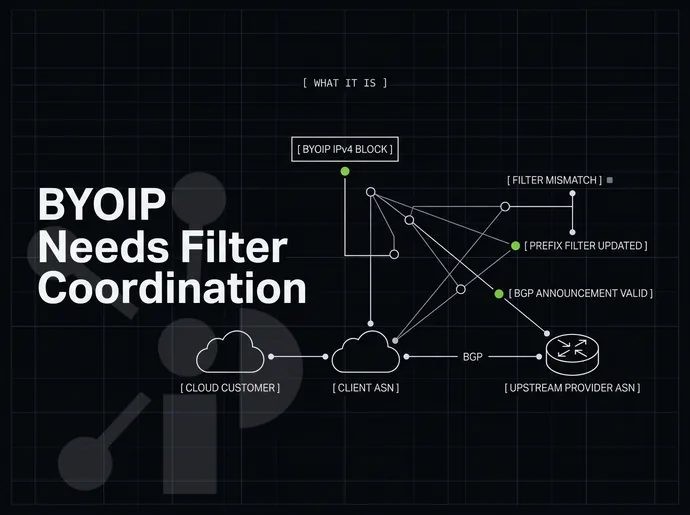
One of the key constraints of bringing your own IP space to a cloud or bare metal platform is that the upstream provider’s prefix filters must announce to include your announced prefix before you start sending IP packets that would end up on the Internet.
How do upstream prefix filters affect BYOIP deployments on cloud or bare-metal platforms?
Upstream routers verify announced prefixes against a check list. Missing or wrong entries will cause the announcement to be silently discarded instead of being rejected with an error message. Verifying the following three items is required: An IRR route object in the correct RIR database, a valid RPKI ROA with correct origin ASN and max-length. Additionally, An LOA by the address holder allowing the announcing AS.
The three-document checklist
| Document | What it proves | Common failure mode |
|---|---|---|
| IRR route object | Authorized origin ASN in the routing registry | Object in wrong registry or stale AS path |
| RPKI ROA | Cryptographic binding of prefix to origin ASN and max-length | Max-length too broad, or ROA covers wrong prefix length |
| LOA | Address holder's written authorization to announce | Absent entirely, or signed by wrong entity |
Where Prefixx fits
Prefixx creates LOA, RPKI ROA and IRR route objects for you. BYOIP is managed and is natively included on the Netrouting bare-metal partner network. There are no per-IP charges for BYOIP. A manual process that we can do for you as opposed to an automated / self-service process.
If any document is missing or mismatched, the upstream drops the announcement without notice. See Prefixx BYOIP support for details on how we handle the paperwork end to end.
Diagnosing a prefix blocked by an upstream filter
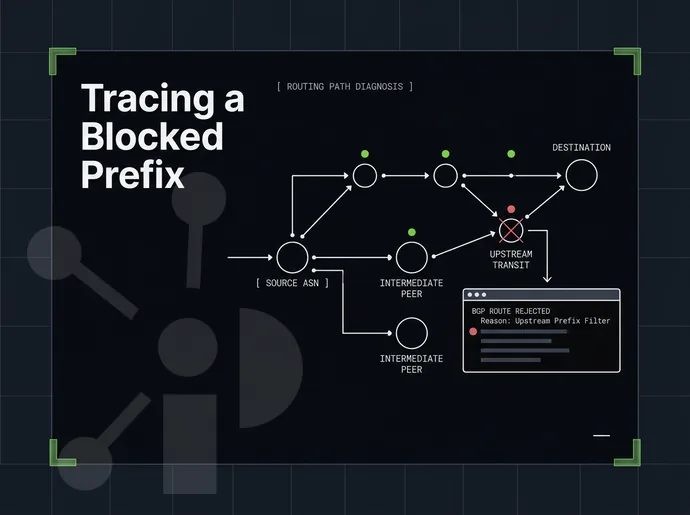
A prefix not seen in the global routing table (i.e. it never shows up) will typically be filtered out by an upstream filter.
Visibility and RPKI
- Verify global visibility for your prefix by checking RIPEstat or BGP.tools. Identify which of the vantage points listed do see your announcements and which do not. Non-visible announcements are typically specific to an upstream or peer and are not systemic in nature.
- Check your ROA. It should exist. AS of origin announced should match AS number of ROA. Announced prefix length must not exceed max-length of ROA. A length mismatch will put you into the Invalid state. Many upstreams will then promptly drop you due to config policy.
IRR and upstream contact
- Check your IRR route object for the missing route object for your origin AS in the registry. Many upstreams filter prefixes for your origin AS which are not covered by a route object, even if RPKI verifies correctly for the filtered prefix.
- Get upstream NOC to look at the matter. Supply them with LOA, prefix in question and ASN of origin. Specifically ask which filter is blocking the announcement. In some cases BGP communities will signal route scope to upstream help in pinpointing problem.
Note: Sending a NOC request without the LOA is the most common delay. Have it ready before you call.
What documentation do I need before my upstream will accept my prefix announcement?
Minimally, a valid LOA from the address holder(s), a matching RPKI ROA, and a corresponding IRR route object with the correct origin AS for the announced prefix must exist. Most upstreams require all of these to be in place before they’ll add a particular prefix to their “whitelist”.
The client portal for Prefixx includes BGP monitoring via RIPEstat/RIS to display information about the visibility of a prefix, the origin ASN, the RPKI validity, the IRR consistency and the upstream view. Additionally, a reputation scan of 12 DNSBLs is included. It is recommended to run both checks after a transfer or a BYOIP has been deployed. The same checks apply to acquisitions or leased blocks and are therefore part of the brokerage process that is part of the filter.
Why upstream prefix filters matter when you buy or lease IPv4 space
Getting a block is only half the job. A stale IRR route object, an RPKI ROA pointing to the wrong origin AS. Alternatively, An LOA still listing the previous holder of the IP address / range in question will cause your upstream to drop the corresponding BGP UPDATE. Prefixx prevents this before the space even reaches the default-free zone.
- Tixx quality control on every block. We verify ownership, transfer eligibility, Tixx blacklist status and many other criteria before any transaction is completed.
- We have prepared the LOA, RPKI ROA and IRR route objects for you. We have also prepared the documentation your upstream needs to pass its prefix-list checks. This can be handed over to your upstream as necessary.
- We include white-glove service with every lease. Our consultants correct geo-location for you, reverse DNS, monitor reputation, scan blacklists and deal with all abuse complaints.
- BYOIP deployment support. We prepare the routing paperwork for BYOIP onto bare metal or major cloud platforms, with no per-IP surcharge.
- We are registered with the 3 main IP address registries: ARIN, RIPE NCC and APNIC. Inter-RIR transfers as well as moves facilitated by LACNIC are handled from end to end and the route announcement for your IP addresses will reflect the correct registry status from the first day on.
If upstream prefix filters are a problem for you, contact us to discuss a vetted block or lease.
Key takeaways on upstream prefix filters
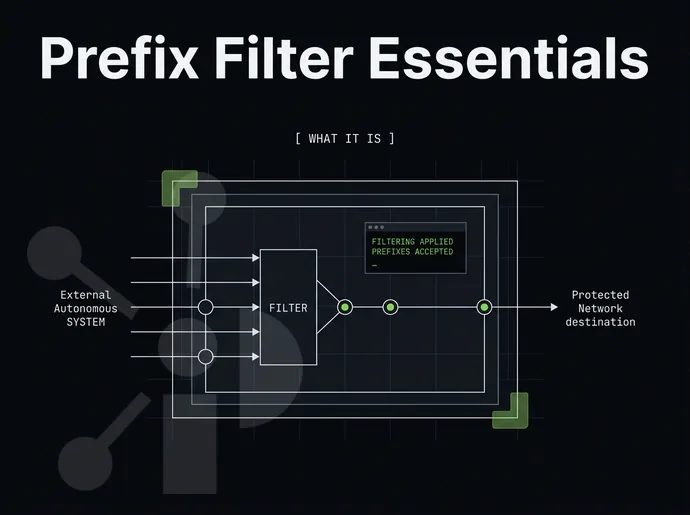
Upstream prefix filters are the default-free zone's first line of defense against route leaks and prefix hijacks. Every BGP UPDATE carrying an NLRI gets checked against the upstream's prefix-list before it enters global routing. Blocks longer than /24 are dropped unconditionally, regardless of origin AS or RPKI ROA validity.
Passing that filter requires three things to align: a registered IRR route object matching the announced prefix length, a valid ROA authorizing the origin AS, and an LOA on file. For BYOIP deployments, Prefixx prepares all three before any route announcement goes out, so the prefix clears upstream filters cleanly from day one.
Upstream prefix filters are not optional bureaucracy. They are the mechanism your upstream uses to decide whether your routes reach the global table. A missing or stale IRR route object, an RPKI ROA that mismatches your announced prefix length, or an announcement outside the max-length your upstream permits will get your prefixes dropped silently. Fixing that after the fact costs time you rarely have.
The practical takeaway is simple: keep your IRR objects and RPKI ROAs current, announce only what your upstream expects to see, and verify filter compliance before you need the route to work under pressure.
If you are acquiring address space and want the routing paperwork handled correctly from day one, Prefixx prepares the LOA, RPKI ROA and IRR route objects as part of every deal. Contact sales at Prefixx.net to get started.
Contact us to discuss your IPv4 needs today
No hidden fees, free consult. A broker replies within one business day.