
By Savvas Bout, Founder of Prefixx. Last updated 16 October 2026.
Renumbering IPv4 before a sale is a reasonable thing to do.
However, by reassigning addresses to internal infrastructure, moving subnets around or deleting route objects for the block in question before transfer, sellers in fact create exactly the kind of problems they try to avoid. Such problems then surface during due diligence by buyers or their brokers, inspecting the history of transfers of IPv4 address space.
The secondary market for blocks of IP addresses has matured and tools like Tixx now check amongst other things the full ownership history, the routing history, blacklists and the RIRs the block is registered with. These verification mechanisms have become standard practice as IPv4 transactions now occur across registries around the world.
A quietly renumbered block with inconsistent registry data will get a bad score, lead to low bids or even stall in the RIR transfer process. This article helps you to understand what really affects the value of a block of IP addresses and what you need to do to transfer a block of IP addresses.
Renumbering before selling IPv4 addresses: what it actually means
Renumbering all the services running on a block of IPv4 addresses before selling them allows those IPv4 addresses to be operationally vacant and therefore easily sold. Renumbering is not a matter for the registry to administer as part of a transfer of resources at a RIR. The seller must present unencumbered resources (i.e. not with any active traffic on them).
Operational dependencies: what must move first
Most networks operate critical services such as DNS resolvers, mail servers, VPN endpoints and CDN origins off of the very same block(s) they are trying to sell. Each of these services is a critical component to the operation of said network and until each and every one of them has been relocated to a new IP address, said block(s) cannot be listed for sale without risk of a failed transfer or some other form of dispute re: handover. Organizations that need to expand their service offerings face the same challenge of disentangling dependencies before any addresses can be freed.
Take the example of a /22 block with active BGP announcements and a PTR for a running mail server. This block cannot be moved before the sellers reip the mail servers, change the PTR and the MX records and withdraw the prefix from routing. Only then does the block give an accurate view of what the buyer is actually buying. The seller must ensure that continued use of these resources has fully ceased before initiating the transfer to avoid complications during registry validation.
Renumbering-to-vacate versus consolidation
Renumbering-to-vacate is a specialized procedure, used when selling a block, to leave an empty block that can be easily transferred. Internal renumbering for the purpose of consolidation reorganizes the previously utilized addresses for efficiency reasons, but does not aim to sell them. Mixing up these two procedures only results in wasting time and confuses the timeline of your deal.
Purchase agreements and what sellers must confirm
Typically, seller warrants in tailored contracts for IPv4 sales are to be free of all encumbrances by closing time. The consultants at Prefixx review the most relevant information, i.e. the respective registry records as well as current routing and blacklists, for all listed IPv4 addresses prior to publishing the respective listings.
All contracts for the sale and purchase of IPv4 addresses that we conclude are thus checked for validity in due course. The consultants provide ongoing support throughout the verification and closing phases to ensure compliance with registry requirements.
Knowing what a contract requires for a block is only half the equation. Understanding contractual obligations helps organizations prepare documentation and registry updates needed to sell IPv4 holdings efficiently.
Why buyers and regional internet registries both care about clean blocks
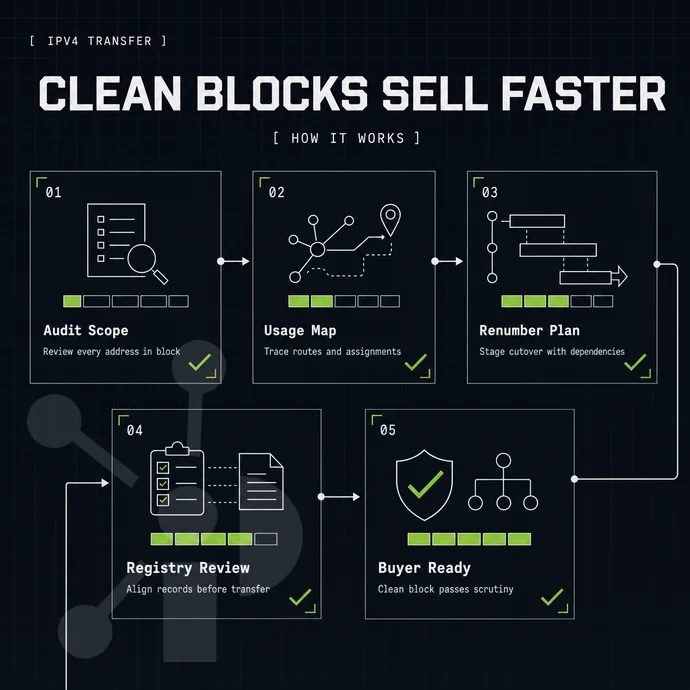
When buying IP addresses, two very different sets of people will scrutinize every single IP address in every block before any money changes hands. These two sets of people are the prospective buyer who is doing their due diligence on the IP addresses, and the Regional Internet Registry (RIR) that validates the transfer of the IP addresses. Both parties often engage technical advisors or brokers to validate routing status and registry compliance before finalizing the transaction.
What buyers check during the sales process
First a potential buyer wants to know the reputation of an IP address. Performing a blacklist check against the major DNSBLs will tell you if an IP has been used for spamming or any form of abuse. In addition to blacklists a check of the routing hygiene of an IP is also very important. This check will tell you if an IP is announced stable and if the announced origin ASN corresponds to the RPKI and IRR records.
Reverse DNS for production traffic requires a vendor to provide coherent and correctly delegated PTR records for the acquired address space. If a block of IP address space is still actively routing with the seller’s ASN then it is likely that full separation of resources has not yet occurred and thus a timely transition to full ownership is in question.
Regional internet registries
A company transferring resources must have legitimate control of those resources and up-to-date registration information for those resources. Each of the registries ARIN, RIPE NCC, APNIC, LACNIC and AFRINIC has its own set of eligibility criteria for the transfer of resources. Old WHOIS information, wrong contact information for registered resources, and a network with old ASN information can cause delays or even be denied.
How Tixx bridges both sides
The Tixx by Prefixx service carries out Quality Control checks before any block is published on the marketplace. A health report is then produced which details a transfer readiness score. Funds are only released after all conditions have been met by the relevant escrow service. Issues that surface during listing are far better than them surface part way through a transfer. Buyers typically engage brokers to verify registry compliance and routing history as part of their technical review.
You need to create a complete inventory of all systems and services that are affected by the block before you can start to cater to either of those audiences.
Mapping operational dependencies before you start
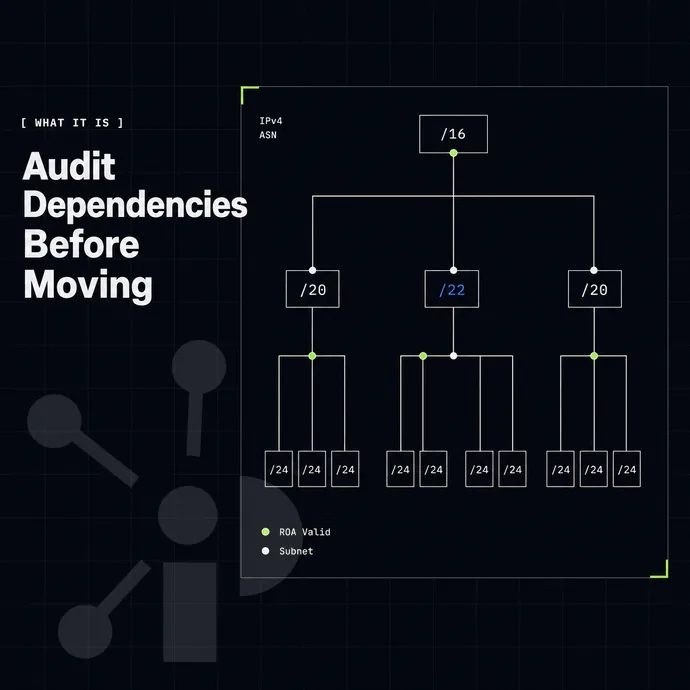
The most common cause for renumbering delays and failed sale timelines is skipping this audit. In order to complete a clean transfer of systems, customers and services, you need a complete audit of all systems, customers and services running on the block in question. The audit must identify every dependency that relies on continued use of the addresses, from customer-facing services to internal monitoring tools.
Internal infrastructure and internet protocol
- Enumerate the hard-coded IP addresses in the range. Collect the configs for all firewalls, load balancers and servers with static IP addresses in the range. Document these prior to continuing with the rest of the planning in the next phase.
- Verify routing of the prefix and BGP announcements. A announced prefix that is still active vs. idle prefixes with operational differences.
Customer-facing services
- Audit your DNS records for the block. List out all the PTR records, all the SPF records, and all the DKIM alignment for the block. They can all break silently when an address changes and are easily overlooked.
- Map API whitelists. These can be used to list customers and partners who have been given access to use your services via source IP. Examples include payment gateways and your CDN’s origin servers.
Note: A single missed API whitelist can block a customer's purchase flow on cutover day. Document every allowlist entry.
Third-party dependencies
- Contact monitoring and lease providers for external system IPs that poll them. Advance notice needs to be given to such external systems for clean closure of Escrow once all dependencies have been resolved and the block is free of continued use obligations.
Update your dependency list as you complete each layer of infrastructure to audit and ensure you have accurately accounted for all features in the correct order to meet the desired timeline and realize the full sale price. Then, turn that inventory into a formal migration plan. Teams often require technical support from registry staff or transfer brokers to validate that dependencies have been properly documented and sequenced.
Building a renumbering plan that protects the sale timeline

Renumbering your IPv4 address space before you sell it is a complex and time consuming process. A structured transfer plan can ensure that your sales process is not derailed by your migration process. Organizations that sell IPv4 resources must balance the technical demands of renumbering against the commercial pressures to close transactions quickly.
Set a freeze date first
Select a completion date after which no new services will be provisioned to the block. This ensures the scope of renumbering is clearly bounded and the team can complete the migration and close out dependencies rather than continually add new ones.
Phase migration by risk tier
Internal tools and monitoring first. Customer facing services and revenue generating infrastructure last. Prioritizing internal systems protects recurring income by ensuring customer-facing services remain stable throughout the migration.
Continue to use original block until all services are verified to be operating off new space. Announce in parallel to old BGP announcement and then withdraw original BGP announced prefix.
Document every change for due diligence
The block’s routing history will be scrutinized by buyers and their brokers. Record each cutover event (i.e. what was moved, and when) in order to have the required information to prove out which IP range was used in place of another for a certain period of time in order to facilitate quicker approval from the RIRs for the transfer of IP space. This documented history reassures parties during the buying evaluation that the renumbering was methodical and that the prefix has been properly vacated.
Maturity in broker experience allows for provisioning realistic timeframes against the window provided for RIR transfers. With all changes fully logged and migrated, focus shifts to ensuring that registry and routing records are updated and reflect the new reality prior to transfer. Experienced brokers coordinate closely with registry staff to verify that all documentation aligns with the updated routing configuration.
Cleaning up RIR records, routing objects and reverse DNS
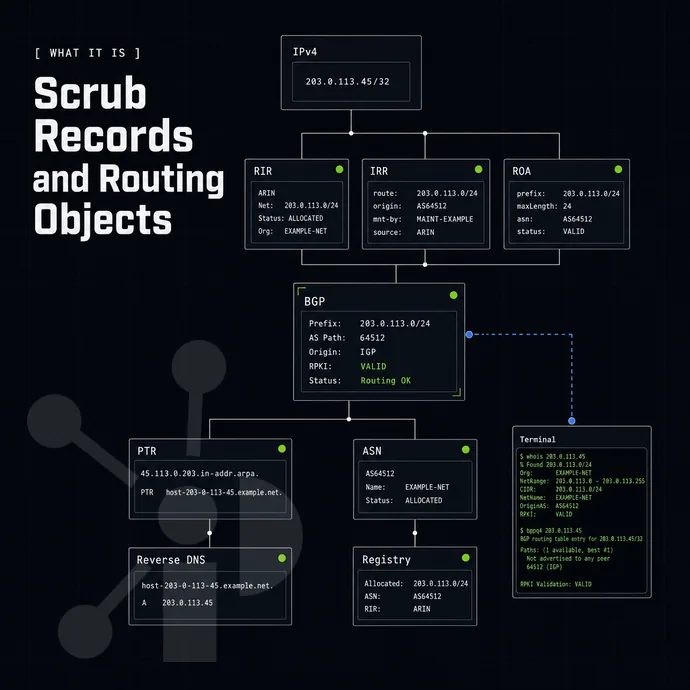
After the operational migration is completed, the relevant information for the block has to be up-to-date in the registry and in the routing tables in order for the RIR approval of the transfer and the takeover by the buyer not to be delayed and to avoid liability of the buyer.
WHOIS, RDAP and IRR cleanup
Begin with the verification of the RIR database for the organization handle, the assigned contact for abuse reports and the technical contact for the block in question. Often, outdated contact information will cause a transfer request to be put on hold by the RIR staff. RIR staff can provide support in updating these records if the organization encounters technical difficulties during the verification step.
Remove the IRR route objects. If a prefix originated from your business ASN, remove the BGP announce and delete the corresponding route object from the routing registries for that prefix. A stale route object gives others on the internet the wrong impression that the block is still yours.
RPKI ROA validity
Check the ROA for the given prefix. An expired or different ROA will cause the buyer to announce the block in RPKI-invalid status.
Reverse DNS delegation
Remove the reverse DNS zones from the block to be cleared or re-delegate them before closing. If the PTR records for the block point to your servers, you will need to remove them or hand them off to the buyer. Operations will get very confused if there are reverse DNS for resources that you no longer own.
The LOA, RPKI ROA and IRR route objects are prepared by our team as part of our white-glove support. All necessary documentation is prepared before the RIR transfer window opens and the customer can start announcing from the new location. After that it is a matter of how your block looks like on the open market.
Blacklist and reputation checks: what to fix before listing
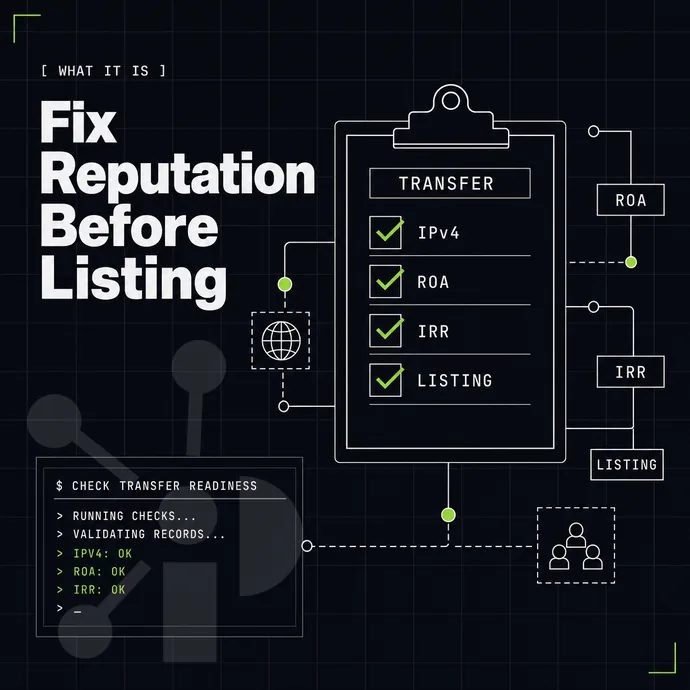
In general a block with active blacklist entries either kills a deal or suppresses the price at which a clean prefix would trade.
Which lists matter most
The five lists that have the widest reach in the industry are Spamhaus ZEN, Barracuda, SpamCop, SORBS and CBL. Spamhaus ZEN has the greatest impact as many mail servers and security firewalls around the world block traffic from IP addresses listed on this list.
As a result, a listing on any of these five lists will negatively impact demand and consequently reduce the number of potential buyers willing to pay full price for your IP address. Organizations considering buying listed addresses should verify current reputation status rather than relying solely on historical data.
Current abuse versus historical listings
For transaction value, it makes a huge difference whether a block is listed because of active abuse, or if it is listed for historical spam that has long since ceased.
Delisting a range once the evidence of abuse has disappeared from a block usually takes only a few days to a few weeks with most business list operators.
What to do before listing
| Step | Action | Why it matters |
|---|---|---|
| 1. Scan all five lists | Check Spamhaus ZEN, Barracuda, SpamCop, SORBS, CBL | Identifies listings before a buyer does |
| 2. Confirm abuse is inactive | Verify no current traffic is triggering the listing | Delisting requests fail if abuse is ongoing |
| 3. Submit delisting requests | Follow each operator's process individually | Each list has its own timeline and criteria |
| 4. Re-scan before listing | Confirm removals are live | Protects the block's high demand positioning |
Tixx by Prefixx scans every block across 12 DNSBLs before it reaches a buyer, so you can clearly see the reputation of your prefix before you sell your IPv4 addresses. After a good reputation has been verified, block size and the relevant registry for the buyer’s location are the only variables that will influence how much you receive. Organizations considering buying should similarly evaluate reputation metrics to ensure they acquire clean ranges that will not impair their operations.
How block size and registry region affect what you receive
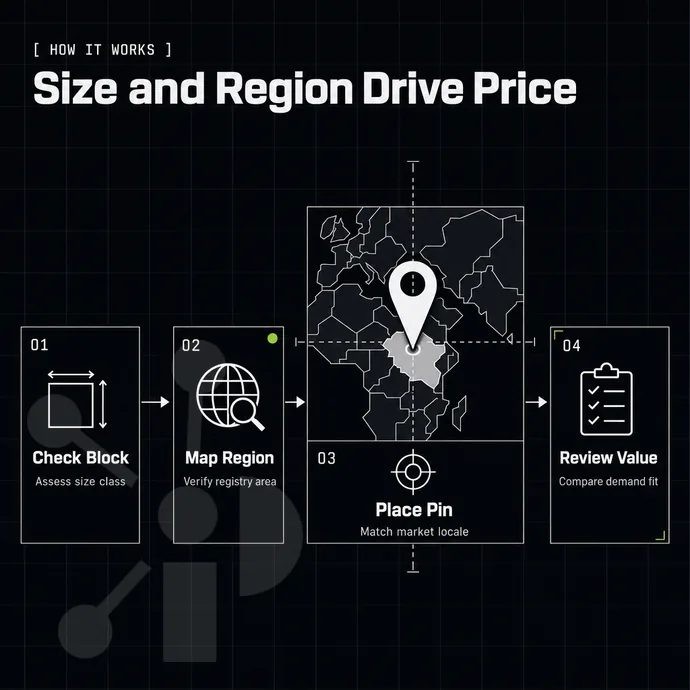
The return one can receive from selling IPv4 addresses will depend on two variables: the location where the IPv4 address space was registered and the actual size of the block. If one gets these two right before embarking on a renumbering exercise, a straightforward sale can be accomplished quickly and additional funds not eroded. Understanding these factors helps sellers position their holdings appropriately in the market.
Understand registry and size dynamics
- Know your RIR region! Secondary market pricing for remaining space does not scale equally across all registries. For example, a /24 block of remaining space held under ARIN may trade at very different secondary market prices than an identical sized block of remaining space held under the RIPE NCC in the same trading month. The buyer will have factored in the RIR holding this space.
- Block size is key. Large blocks (/20 and up) get the institutional buyers: carriers, cloud companies and big enterprises with real operations. Smaller IP prefixes get a broader but less wealthy pool of buyers. The transaction value per IP can vary greatly between these two segments of buyers.
Verify records before listing
- Verify the legal owner of a property by checking the Registry records against the entity selling the property. Any discrepancies can prevent transfer of the property and will generate concern amongst potential buyers.
- Verify the routing history. By verifying whether a prefix has been used to route traffic before, the buyer can assess the value of the IP address for which he is willing to pay the asking price. Missing entries or irregularities will be questioned.
- Scan for blacklist entries as they can directly suppress the market price. Make sure any negative listings are sorted prior to listing on the market rather than after an offer has fallen through.
Time the decision correctly
The time it takes to renumber a block should be factored into a seller’s plan to migrate traffic off a block that they plan to sell. Most sellers don’t have time to properly renumber a block and therefore list the partially active prefix, which can make for a very complicated transfer and hurt negotiations. Experienced brokers can help sellers evaluate whether immediate listing or delayed listing after full migration will yield better net proceeds.
Note: Prefixx runs Tixx quality checks on every block before it reaches a buyer. Resolving issues beforehand means fewer delays at the point of sale. For operators who cannot afford to lose access to the space after selling, there is another option worth considering.
Lease-back as an alternative to a full sale
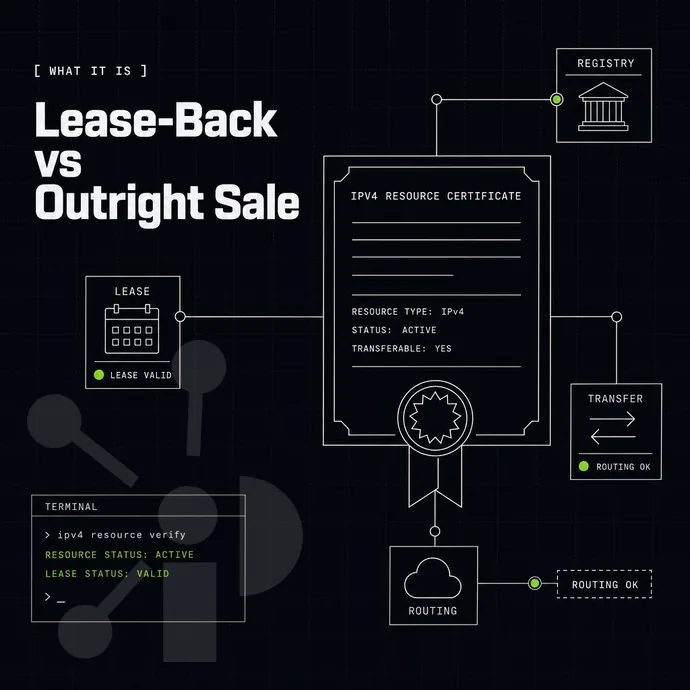
There are operators who for business reasons need to sell their IPv4 address space but who cannot afford to give up the use of this space on a permanent basis. A lease-back arrangement can be made with the buyer of the space in question. This arrangement allows sellers to monetize their holdings while maintaining continuity of service during a phased migration to alternative addressing.
How the structure works
The seller gets immediate capital in the form of a lump sum paid at closing. The seller then continues to pay a recurring fee to the new owner(s) of the addresses to continue using those addresses and keeping the mail moving. Sellers get cash now and routing continuity.
This is very different from simply leasing out idle space and collecting rent over and over. In those situations the original owner keeps the property and collects a stream of cash without ever selling the property. In a true lease-back the title to the property is transferred for the up-front payment and the seller gives up long-term ownership of the property.
Sell IP addresses and stay routed
Lease terms must be solid to make a lease-back hold operationally. The Prefixx lease is structured with a non-revocation guarantee, 24 hour provisioning and white-glove service including LOA, RPKI ROA, IRR route objects and reputation monitoring. This will protect the leaseback tenant from losing routing at an inopportune time. The lease structure includes dedicated technical support to ensure routing stability and address any connectivity issues that may arise during the term.
When to consider it
The lease-back structure is particularly suited to organizations with large blocks of space and capital constraints. It is also a useful vehicle when short time scales for renumbering are not feasible. A simple lease of unused space will often be more appropriate than a lease-back if space is truly surplus.
However, if the upfront payment received for a lease-back exceeds the cost of entering into and being trapped by the obligations of a longer-term lease, then a lease-back may be the most suitable tool.
Why work with a registered IPv4 broker to sell IPv4 addresses
If you’re a seller, selling IP addresses without a registered broker to handle the sales means you’ll have to deal with RIR paperwork for each transaction, investigate potential buyers to get the best possible sales price, and draw up agreements for each transaction which can be time consuming and full of risks of losing value.
Prefixx is registered with ARIN, RIPE NCC and APNIC, with LACNIC facilitated.
- We charge seller-only commission on a no win no fee basis. We don’t charge buyers for our services and therefore do not mark up the market price for a buyer. We charge sellers between 3% and 8% commission only. If the block does not sell then we charge nothing.
- Tixx quality check on every block of IP addresses. We check for ownership, blacklists, routing stability and RIR entries before you can buy the corresponding IP addresses.
- Escrow-secured transactions. All payments are held in escrow until all transfer(s) have completed.
- We provide white-glove documentation for you. Our team will prepare the LOA, RPKI ROA and IRR route objects for you. You just focus on your operational goals. We’ll take care of the rest.
- We are a Senior Consultant led company, not a self-serve online marketplace. Each deal is managed from start to close by a named Senior Consultant.
If you are ready to sell IPv4 addresses or want a clear picture of what your unused space is worth on the secondary market, the sell IPv4 addresses page outlines the full process. Reach out to our team for a no-obligation valuation.
Key steps to renumber and sell IP addresses successfully
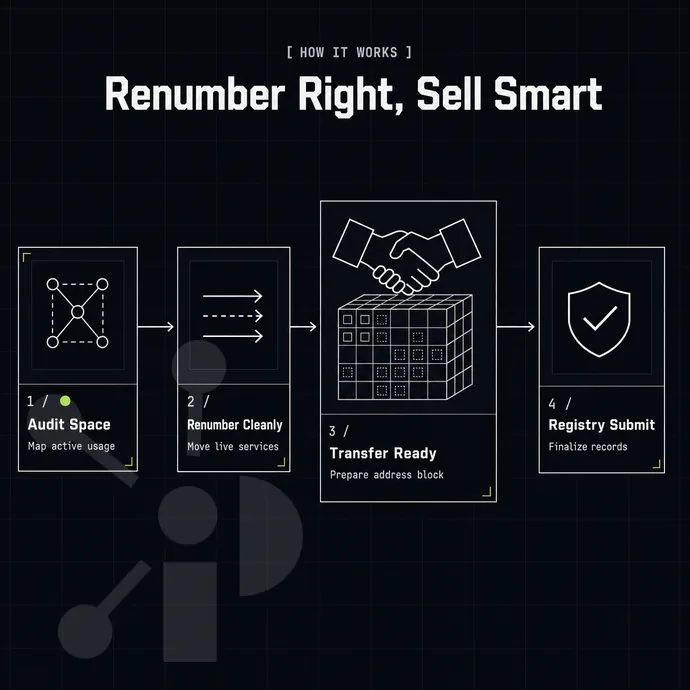
If you are looking to sell IPv4 addresses then the following steps need to be taken in a specific order to ensure a successful sale. First the IPv4 IP block held by the seller must be audited for any operational dependencies.
Then a transfer plan must be built which includes the renumbering of the space to be sold prior to transfer. The seller must confirm that the block to be sold is unencumbered and that reverse DNS is tidy.
We recommend that you use a registered broker to sell your clean IP addresses. He or she will handle all of the paperwork and write up a purchase agreement for you. Using escrow in the transfer process protects both you and the acquirer.
A secondary market broker will get you a fair market price for your block of IP addresses. He or she will also write up contracts that are suitable for the amount of IP addresses you have sold and for the appropriate Internet registry for your region. Clean IP addresses sell quickly for a high sale price.
The value of getting renumbering right before you list
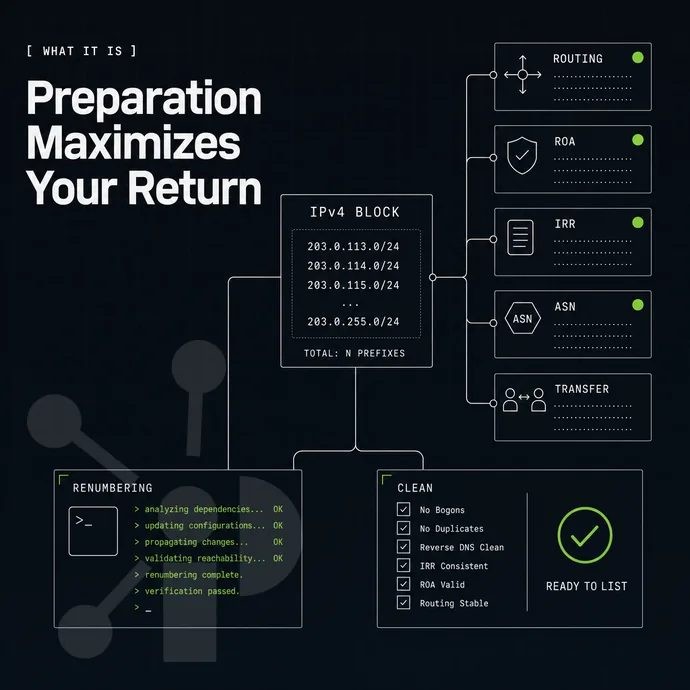
Renumbering before you sell IPv4 addresses is not a formality. It protects your market value. A clean block without any dependencies, correct reverse DNS and proper routing is what you want to signal to potential buyers that the space you are selling is ready to be transferred. This leads to a better price and less hassle during the transfer process.
Messy blocks scare off buyers. It’s in everyone’s best interest to uncover problems with a potential purchase early on in the process, before due diligence has even begun. The value of a conveyance can drop precipitously if problems surface late in the process. Tixx by Prefixx verifies ownership, proper routing, and blacklists for every block before you can even try to sell IPv4 addresses to potential buyers.
Frequently asked questions
Do I have to renumber my network before I sell IPv4 addresses?
Not always, but it is the most common blocker. If your infrastructure is actively using the block you want to sell, you must migrate those services to new address range before the RIR transfer can complete. If the block is already idle or was never put into production, you can move straight to the transfer process. Either way, the block must be free of active routing obligations at the point of settlement.
How long does renumbering take when you sell IPv4 addresses before closing?
Renumbering timelines vary widely depending on the size of your network and the complexity of your dependencies. A small team with a single /24 in a cloud environment can often renumber in days. A large enterprise with BGP-announced space, hardcoded IP references, and third-party integrations can take weeks or months. Plan the renumbering phase before you list, not after you find a purchaser, so the deal does not stall at escrow.
What RIR records need updating before you sell IPv4 addresses via transfer?
The block must be registered to your organization in the relevant RIR database with no pending disputes, liens, or policy holds. WHOIS records, route objects, and any RPKI ROAs tied to the block should accurately reflect current state before you initiate a transfer request.
ARIN, RIPE NCC, and APNIC each have their own transfer forms, eligibility checks, and payment processes, and LACNIC transfers are facilitated rather than direct. Tixx, Prefixx's pre-disposition quality control process, audits all of these before a block reaches an acquiring party.
Can blacklist entries lower the price when I sell IPv4 addresses from my block?
Yes, active blacklist listings are a material defect and buyers will either discount their offer or walk away entirely.
When you sell IPv4 space, you can pursue delisting before the assignment, but no broker can guarantee removal timelines since that decision rests with the list operators. Prefixx scans blocks across many networks, checking 12 DNSBLs as part of the Tixx quality control process, so reputation issues surface before they become a negotiation problem.
Can I sell part of a block and keep the rest?
Yes, provided the portion you sell is a valid CIDR prefix that meets the minimum transfer size for the relevant RIR. You retain the remainder of your allocation, and since there's real money involved, both the sold prefix and the retained prefix must have clean, updated RIR records after the split as a standard business practice.
Selling vs leasing unused IPv4 addresses: what is the difference?
Selling transfers ownership of the block permanently through an RIR-recorded transaction. Leasing lets you retain ownership while a tenant uses the space under contract, generating recurring revenue without giving up the asset. Selling is the right choice if you have no future need for the addresses and want a clean exit.
Leasing makes sense if you expect to need the space again, want ongoing income, or are not ready to commit to a permanent transfer.
How does escrow work when selling IPv4 address capacity?
The prospective owner deposits funds with a licensed escrow agent before any transfer paperwork is submitted to the RIR. Once the RIR confirms the transfer is complete and the block is registered to the incoming operator, the escrow agent releases payment to the seller.
Neither party can access the funds unilaterally during the transfer window, which protects both sides. Prefixx has used escrow-secured settlement on every transaction since the company was founded, and it is a non-negotiable part of how every deal closes.
Renumbering a block before you sell IPv4 addresses is not a formality and can make a big difference between a block that a potential transferee wants to buy and a block that potential buyers don't want to touch.
Make sure that your RIR records and your routing objects are in sync so that the registry sees a clean unencumbered asset. Also make sure you have enough time so that missing a single deadline for a migration does not kill the handoff.
If any part of that workflow feels uncertain, that is exactly where a broker earns its place. Prefixx runs Tixx quality control on every block before it reaches a new holder, handles the LOA, RPKI ROA and IRR paperwork end to end and manages the RIR transfer across ARIN, RIPE NCC, APNIC and LACNIC. Start a conversation with the Prefixx team to get a transfer-readiness assessment on your block before you list it.
Contact us to discuss your IPv4 needs today
No hidden fees, free consult. A broker replies within one business day.