
By Savvas Bout, Founder of Prefixx. Last updated 15 October 2026.
Buying an IPv4 block transfer starts with a number and it is very expensive to get this number wrong. A credible appraisal of an IPv4 block enables you to tell if the price you are offered reflects current market conditions. The size of the block, the RIR in which the IP space is registered. Understanding how the internet routing infrastructure treats different block sizes helps clarify why certain allocations command higher valuations than others.
Additionally, The bad reputation history of the IP space in question, or whether you are overpaying for a lot of wasted space. The secondary market for IPv4 numbers has no public exchange, no price ticker and no generally accepted method for the appraisal of IP numbers. Sellers must also consider the transfer mechanics and escrow arrangements that govern payment and title passage in these private transactions. For more context, see No wonder IPv4 isn't enough : r/sysadmin.
This guide explores the various factors that can influence the value of an IPv4 block: registry, IP range, IP prefix length, IP routing, IP blacklisting, and transferability. It outlines how to stress test an appraisal price prior to agreeing to a purchase or sale, and provides an in-depth examination of a clean IPv4 block to assist with proper due diligence. Understanding these factors helps organizations manage their IP asset portfolios more effectively during acquisition and divestiture decisions.
It also covers how appraisal can be used within a broader strategy for the acquisition or disposal of IPv4 address space. Understanding how IPv4 assets fit into your organization's operational needs helps ensure that any acquisition or disposal aligns with the broader goals of the business. Many companies find that aligning IPv4 appraisals with strategic planning cycles helps integrate address-space decisions into capital budgeting and infrastructure roadmaps.
Whether you are looking to buy a /24 for a new project or simply trying to work out the value of a larger block of IP addresses to sell, understanding how an appraisal works will allow you to get the best price from the off. Accurate appraisal helps ensure your business avoids costly mistakes when entering the IPv4 transfer market. Companies entering the transfer market for the first time benefit from understanding appraisal fundamentals before committing capital to address space purchases.
What is an IPv4 addresses block appraisal and why it matters
An IPv4 block appraisal is an attempt to establish a fair market value for a block of IPv4 addresses in advance of a sale, lease or transfer. Given that all five RIR free pools have been depleted between 2011 and 2020, all current trading is taking place on the secondary market, with no official pricing in place and current market values fluctuating with supply and demand.
Why address space hygiene drives value
The appraisal of a IP address is not just a matter of a price tag. The technical condition of an IP address has to be taken into account. Blacklist status, RPKI valid, IRR consistent, RIR standing, all these factors influence the price that a buyer is willing to pay for an IP address. A clean /24 will get a higher price than an identical sized block of IP addresses with abuse history.
How block size and region set the baseline for IPv4 addresses
Block size is one variable: larger allocations have lower per-address charges, while small blocks like /24s carry higher per IP costs.
Aligning an appraisal of IPv4 blocks with business objectives
For buying, selling and leasing IP addresses, a reliable appraisal provides the basis for negotiations. Our consultants at Prefixx for example combine live market offers with the quality-control results from Tixx and the registry holding to determine the most realistic offer price for a given IP block. In the following section you will find an explanation of the relevant factors that affect the appraisal price. A thorough appraisal helps both parties answer questions about fair market pricing before entering into binding agreements.
The four factors that drive IPv4 addresses block value
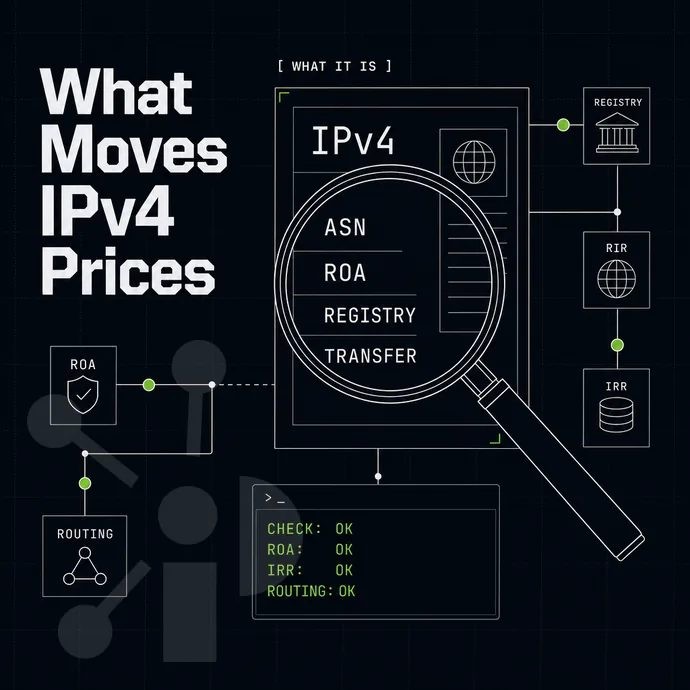
The price of any IPv4 block is influenced by four variables. Understanding these variables will help sellers of IP address space to better advise potential buyers on what they should expect to pay for a specific block of IP addresses. It can also help potential buyers to identify hidden problems with IP address space that may cause them to pay too much for that space.
Sellers who grasp these dynamics can structure their offerings to justify asking prices, while buyers can avoid spending unnecessary money on overvalued space. Both sellers and buyers, whether individuals or companies, benefit from understanding how these four variables interact to shape final transaction terms.
Block size and routing value for IPv4 addresses
As a general rule, bigger contiguous IP blocks are more routing friendly as many network operators are used to deal with aggregated prefixes (e.g. /20, /18) which tend to have higher per-IP rates than /24s. Smaller /24 blocks are more liquid, but the per-IP price can vary significantly from one region to another as there is a limited number of buyers that need exactly that size of IP space.
Buyers should also consider that larger blocks often simplify internal network documentation and registration management across multiple autonomous systems. Network engineers evaluating address blocks must also assess how their existing routing policies will accommodate the new prefix, particularly when integrating multiple allocations into a single autonomous system. The availability of specific prefix sizes in the secondary market also influences buyer decisions, as certain allocations may be scarce or abundant depending on recent transfer activity.
RIR region funds released and IPv4 addresses demand
An ARIN block and a RIPE NCC block of the same size can trade at different prices in the same month. APNIC and LACNIC address space have their own regional demand curves which are influenced by local infrastructure growth and by the fees charged by the registries. Region is often the biggest single price influence.
The pace at which operators deploy new infrastructure in each registry's service area shapes how quickly demand absorbs available supply. The availability of address space within each registry also fluctuates based on how much inventory remains in the free pool and how actively brokers list blocks for transfer.
IPv4 addresses, IP reputation, and routing hygiene
Reputation factors, such as blacklist history in DNSBLs, RPKI validity, IRR records and abuse reports, significantly affect the price buyers are willing to pay for IP space. We scan each block against 12 different reputation lists via Tixx before we put it up for sale. A clean infrastructure history has huge value, whereas a dirty history decreases value. Blocks with a history of clean internet routing and minimal abuse complaints consistently command premium valuations in transfer negotiations.
IPv4 address blocks transfer eligibility and documentation
A long list of missing items like incomplete documentation on your IPv4 addresses, missing RIPE objects, or unresolved legacy status items will get you low prices and will take a long time to close. All of these items need to be fixed prior to listing. Sellers who fix these items first will move through the process of transferring ownership faster and at better prices than their competitors. Prefixx creates LOA, RPKI ROA and IRR objects for every deal.
| Factor | Price impact | Fix before listing? |
|---|---|---|
| Block size | Larger blocks, higher per-IP rate | No (structural) |
| RIR region | Varies by registry and local demand | No (structural) |
| IP reputation | Clean history adds value; blacklists cut it | Yes, remediate first |
| Documentation | Incomplete documentation delays close and depresses price | Yes, resolve before listing |
Of the four factors used in this appraisal, the prefix length of the IP address space under review warrants special treatment. The prefix length directly determines how the block will be handled during registration and routing configuration across networks. Routing policies and registry documentation requirements vary depending on whether address blocks are announced as a single aggregate or subdivided into smaller prefixes.
How block size and prefix length affect the appraisal number
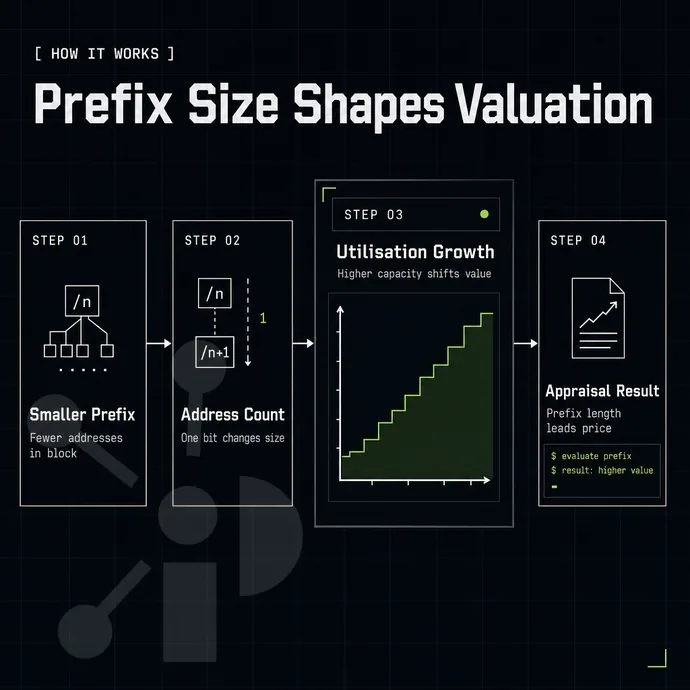
By far the greatest factor in the value of an IPv4 block is the prefix length. One bit in the subnet mask can double or halve the number of addresses in a block, and these numbers increase very rapidly with the size of the prefix. Organizations evaluating address blocks must therefore pay close attention to prefix notation, as a /23 contains twice the usable hosts of a /24 and commands correspondingly different market valuations.
Understanding cidr and IP counts in the RIPE database
- To price out a prefix we can also just count up the number of IP addresses in a block at a given prefix length. A /24 has 256 IP addresses, a /23 has 512, a /22 has 1024, a /20 has 4096, and a /16 has 65,536. So the multiplier to get to the next step of prefix length doubles the block size of IP addresses. So when we price out appraisals for IP address blocks, we can also multiply by the number of IP addresses in the block.
- Flag anything longer than /24. Most ISPs filter prefixes longer than /24 from the global routing table. Sub-/24 IP blocks cannot be announced independently, which eliminates most potential buyers and collapses resale value. Note: a /25 or /26 is nearly unmarketable as a standalone asset.
How size shifts the per-ip price
- Get current market prices for the prefix length you’re interested in. /24s are currently trading in the $5,000 / $13,000 range depending on location and year. Blocks of /20 and greater can attract institutional buyers paying a premium per IP over comparable length prefixes from other regions.
- The liquidity premium needs to be accounted for. An A /24 is the most liquid subnet on the secondary market and therefore trades fastest at this size. Larger blocks trade slower but can eventually close at a higher per-IP price as there are fewer sellers for these sizes.
Technical aspects of applying the size factor to your appraisal
- Comparable sales should be of similar prefix length. Cross-size numbers are usually inaccurate. Use recent sales of similar block size and in same RIR region to establish a number of reasonable proof.
After you have sized the blocks, modeling the registry region(s) where the block is registered can provide significant insight into both the transfer process and the price a buyer is willing to pay. Understanding the registry's escrow and settlement procedures helps ensure that payment flows align with the technical transfer timeline.
Registry region and transfer policy: how RIR affects appraisal
The registry region of a block is one of the most consequential variables in any IPv4 address block valuation. Each RIR runs its own transfer policy, fee schedule and eligibility rules, and those differences directly affect net proceeds and deal timelines. Sellers and buyers alike must understand these regional policy frameworks to properly manage their expectations around transaction complexity and administrative overhead.
IPv4 transfer and address policy compliance by region
ARIN requires the recipient to qualify under one of the sections of Number Resource Policy 8.3 (needs-based) or 8.4 (free-market). Transfer of IP numbers between members of RIPE NCC is governed by the RIPE NCC transfer policy. The recipient must also hold an active ARIN account in good standing to complete the transfer process.
Beyond the transfer terms between two members, both parties must maintain accurate RIPE database records for the numbers in question throughout the transfer period. Maintaining these records ensures that the transfer can proceed smoothly and that both parties fulfill their obligations under the registry's transaction policies. Registry database accuracy is essential because any discrepancy can delay or even block an IPv4 transfer until the records are corrected and validated by the RIR.
The process of LACNIC transfer is facilitated by a broker rather than registered directly. It is the nature of facilitated processes within any network that their timing is less certain, and so are priced by a buyer into their risk. The broker coordinates documentation and registry communication on behalf of both parties throughout the facilitated transfer.
The broker coordinates documentation and registry communication on behalf of both parties throughout the facilitated transfer, though availability of registry staff can introduce additional scheduling uncertainty. The facilitated IPv4 transfer model used by LACNIC differs from the direct registry processes employed by ARIN and RIPE, requiring buyers to account for broker coordination timelines.
Registry fees, limited supply, and net proceeds
For each transfer, there are fees charged by the relevant registries. Any appraisal or valuation that breaks these time consuming costs into smaller blocks must still reduce the seller's net proceeds from sale and include them accordingly. These are not hidden fees which are discovered at closing.
Many brokers recommend using an escrow arrangement to ensure that registry fees and transfer documentation are handled correctly before funds change hands. Sellers should confirm the exact registry fee structure with their RIR before listing their block, as these charges can vary by transfer type and block size.
Inter-rir complexity, timing, and reverse DNS
Transferring a block of IP addresses between registries (e.g. from ARIN to the RIPE NCC) can add significant amounts of co-ordination overhead. This process addresses a timeline of at least two to three weeks, and longer if all necessary documentation is not in place. Liquidity assumption will therefore be affected across the network and the price a buyer is willing to pay today will decrease accordingly.
Prefixx is a registered broker with ARIN, RIPE NCC and APNIC, facilitating LACNIC trades as well. We scope out any IPv4 addresses deal from the very first phone call with regional policy in mind, hence any mentioned fees and time frames are already factored in when we post the asset for sale. The regional policy in place dictates the basic parameters; the history of the IP block’s reputation then will dictate its actual value.
IP reputation checks: what buyers inspect before they bid
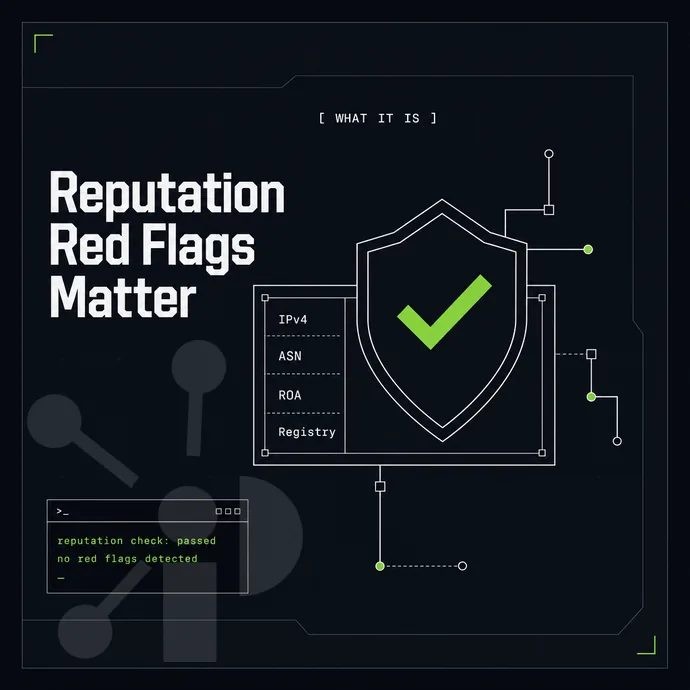
We run a reputation check on buyers and their broker prior to submitting any offer on a property. Sellers who have done their “homework” can list their property at the correct price from the onset, without having to make concessions at a later stage.
IP reputation signals buyers check
Serious buyers usually check a block against multiple DNSBLs before bidding. A list of standard DNSBLs is used for this check, i.e. Spamhaus ZEN, Barracuda, SpamCop, SORBS, CBL etc. If a listing is active within the network then this usually requires some form of remediation by the seller or a price reduction by the buyer.
A clean block can be sold at full market rate. Sellers who proactively remediate listings before marketing their block tend to close deals faster and retain more negotiating leverage with prospective customers.
- RPKI ROA validity: is the origin ASN allowed to announce this prefix?
- Check IRR records against route objects to verify the current holder.
- BGP origin ASN visibility: is the block announced, hijacked, or dark?
- Unresolved abuse complaints indicate that there is a problem with either the leasing or the customers’ misuse.
Reverse DNS, routing hygiene, and market prices
Missing reverse DNS delegation (reverse DNS not resolved or broken), typically a PTR record for IP address should resolve cleanly. Indicates block has likely been abandoned or mismanaged and as such has impacts on a buyer’s offer price from a business perspective. Properly configured reverse DNS ensures that legitimate services and their users can verify the block's authenticity and trustworthiness.
How tixx by Prefixx handles this for sellers
Tixx runs pre-sale quality control on the blocks we sell (ownership check against the relevant registry, DNSBL blacklists check (12 lists), routing quality and RIR checks). The result is a quality report and a transfer readiness score. Sellers who want to sell safely get all the information they need before they even receive an offer.
Why choose Prefixx for your IPv4 block appraisal
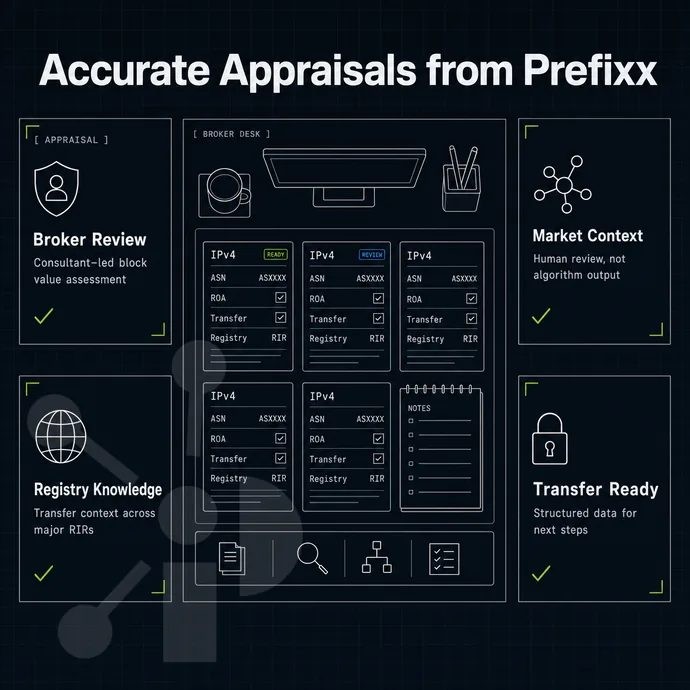
Prefixx is a registered broker with ARIN, RIPE NCC and APNIC, not a marketplace or algorithm. Our consultants have worked in the networking industry since 2007, so when you need an accurate IPv4 prefix valuation, you get a human-in-the-loop read on real market prices, not a formula.
- Tixx quality control runs on every block before it reaches potential buyers, checking ownership, blacklists, routing hygiene and RIR standing.
- Zero buyer fees. Sellers pay a 3 to 8% commission only on a successful close, no win, no fee.
- Escrow-secured transactions protect both sides; funds released only when the transfer completes cleanly.
- White-glove paperwork included: our team prepares the LOA, RPKI ROA and IRR records so incomplete documentation never stalls a deal.
- Multilingual team across all five RIR regions, ready to help sellers and potential buyers navigate any registry.
If you want to sell IP addresses at a defensible price, speak with our team to see what your block is worth today.
Block size, registry region, and reputation history are the three levers that move an IPv4 appraisal number most. A clean /22 under ARIN and a blacklist-scarred /22 under RIPE NCC can sit at very different network valuations even on the same day. Additionally, no official infrastructure valuation list will tell you which way the gap runs. Getting the number right means checking all three infrastructure dimensions together, not in isolation.
Tixx, Prefixx's pre-transaction quality control process, runs exactly those checks on every block before it reaches a buyer or a listing: ownership verification, RIR transfer eligibility, blacklist status across 12 DNSBLs, and routing hygiene. If you want an honest appraisal of a block you own or are considering buying, reach out to the Prefixx team for a no-obligation assessment before you set a rate or place a bid.
Contact us to discuss your IPv4 needs today
No hidden fees, free consult. A broker replies within one business day.